Volkswagen Golf GTI Clubsport v Alpine A290 v Abarth 600e: have electric hot hatches caught up to petrol ones?
In the current issue of evo, we test two of the best electric hot hatches against a pair of ICE benchmarks – these are our favourite shots

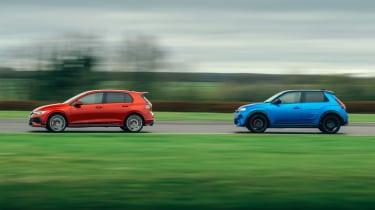
Time for a reality check. In isolation we’ve been impressed by electric hot hatches like the Alpine A290 and Abarth 600e, with their ability to conjure some of the pugnacious character of petrol models gone by. These are cars that don’t chase raw numbers as so many EVs do, but make an effort to involve you in the process of driving despite not having a combustion engine or gearbox to play with. But in the presence of the quintessential petrol hot hatch, the Golf GTI, can EVs really cut it in terms of fun and excitement? Is the gap closing, or are there essential elements of the hot hatch experience that will soon be lost forever? Some laps at Bedford Autodrome should provide the answer.
The Alpine and Abarth are two of the most compelling sub-£40k electric hatches of the moment, and the Golf GTI is considered by many, us included, as the benchmark hot hatch. Not the best, but the base point every contender must at least match. It’s still all the hot hatch most people could ever need – and therefore one that the likes of the A290 and 600e will need to match in terms of ability and fun. The GTI sadly no longer comes with a manual gearbox, but this Clubsport version has a peppy 2-litre turbo engine good for 296bhp, a DSG ’box and a bit of extra spice in its chassis, courtesy of more negative camber at the front and tweaked electronics.
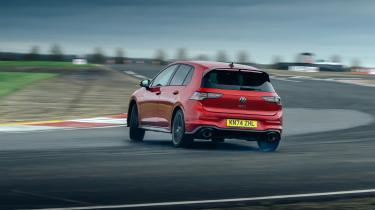
We won’t be feeling the full effect of those upgrades today – temperatures are barely above freezing and the track is extremely slippery – but it’s easy to find a fast groove in the Golf. The conditions mean you need to carefully edge up to the limits, but it’s stable and easy to read, with no major vices in its handling. There’s reassurance in how the GTI’s steering loads up to give you a sense of the grip levels, and how it progressively breaks away at both ends. It’s quick too, even if the turbocharged four isn’t the most sparkling engine. There’s plenty of muscle in the mid-range but it doesn’t come alive at high revs, which is where you are most of the time on track.
There’s no joy to be found in the action of the plastic paddles behind the wheel, but the shifts themselves are at least quick and clean. Stretch the engine harder and you quickly find the limits of traction out of Bedford’s tighter corners, the revs flaring and the nose walking itself wide as the diff locks up. By short-shifting, using the torque and a more precise right foot you can make much neater progress, holding the front tyres on the edge of slip without straying from your chosen line. While the engine and gearbox aren’t central to the experience as they would be in something more specialised, having these extra points of interaction do keep your driving brain engaged, and give you more freedom to influence the behaviour of the car.
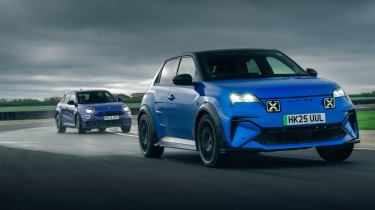
Despite not having these elements, the Alpine makes a good first impression. I’ve driven the A290 on the road before and though it’s a competent and polished everyday hatch, I felt it was missing the locked-in sense of focus and excitement of, say, an old Renault Sport product. Out here, however, the A290 is able to fully express itself and there’s a much more playful side to its character, which I didn’t expect. Powertrain aside (this A290 GTS has a 217bhp electric motor powering the front wheels), traditional hot hatch traits are present and correct. It feels small, connected and really mobile in its handling, in many ways more transparent and communicative than the Golf.
The A290 isn’t light for a supermini – at 1498kg on our scales it weighs 40kg more than the bigger Golf – but it feels darty and on its toes, and gives you more and more feedback the harder you push. The steering sends stronger messages as you put more load into the chassis, and there’s a sense that the A290 is happy to pivot around its nose with weight transfer. Turn in hard on the brakes (which have excellent feel) and the tail readily swings wide, at which point you can blend in the throttle to straighten the car and power away. There’s some torque steer and the fronts do light up if you’re greedy, but these are all familiar – and involving – components of driving a hot hatch.
In today’s conditions the Alpine is more playful than the Golf, but the nature of the electric power delivery does dampen the excitement between the corners. It launches away well, but acceleration starts to taper off well before you’ve reached the next braking zone. The calibration is intuitive, however, in that the front motor doesn’t instantly dump power to the wheels as in, say, a Tesla. There’s helpful progression in the throttle that allows you to gently feed power to the wheels without overwhelming them. Initially there’s enough fun in the A290’s handling to distract you from the fact there’s no engine or gearbox to work with, but once you’ve had time to get a handle on its dynamics, that void starts to become more obvious.
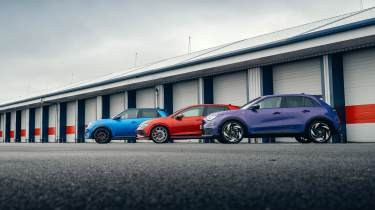
The practical limitations of running an EV on track become obvious too. The battery level drops by five per cent with every lap of Bedford’s 1.87-mile West Circuit, meaning the A290 would barely get through two sessions on a trackday without needing a charge. Shame, as the A290 is at its best here.
At surface level, the Abarth seems more serious than either the Golf or A290. Deep bumpers and a squared-off boot spoiler don’t do much to hide its crossover proportions, but inside you’ll find a pair of sculpted bucket seats and a small, suede-trimmed wheel with an acid-yellow 12 o’clock stripe. Fire it up and there’s what sounds like the throbbing idle of a petrol engine, too. That’ll be the 600e’s sound generator, which uses both the interior sound system and an external speaker to mimic a petrol Abarth 500. ‘Rev’ it and it sounds more like a mooing cow, although it’s less obnoxious than the smaller 500e’s system.
Once moving, the 600e is quicker and more urgent than the Alpine, courtesy of a 276bhp front motor, although the Golf still has a stronger sense of sustained thrust on Bedford’s longer straights. Like the Alpine’s synthesised sci-fi-style whine, the rising and falling tone of the Abarth’s sound generator is useful for gauging your speed into corners, even if it can sound like a petrol car with one (very long) gear ratio. But neither EV is overwhelmingly rapid, so your entry speeds are naturally easy to judge. The relatively modest performance levels help you get into a rhythm, rather than blasting down the straights in bursts and working the brakes to the limit as you would in more powerful EVs.
Dynamically the Abarth feels firm, responsive and keen to change direction. The steering is positive and firmly weighted and it goads you into bullying it around the lap, though when you do it does feel taller and a little less wieldy than the Alpine, with more inertia in its movements (at 1665kg it’s the heaviest car here). There’s less polish in the controls too – specifically in the brake pedal, which has a longer and much less reassuring throw than the Alpine’s.
Pick up the pace and there’s a sense of neutrality to the Abarth, and it does feel purposeful in terms of the control of its suspension and its keen responses. It feels like a performance product, rather than just a faster Fiat 600e. Which makes it all the more frustrating that the stability control holds the car on a tight leash and can’t be permanently switched off (it automatically turns itself back on at speed). Any hint of playfulness or yaw is reined in, the ESC grabbing at the brakes to kill the fun, and your momentum. The best way to make progress in the 600e is by underdriving so that the electronics don’t intrude, which feels wrong in a hot hatch and ultimately makes it less fun and less expressive than either the Golf or the Alpine.
The A290 is thus the more convincing EV hot hatch of the pair, and in dynamic terms can go toe-to-toe with a GTI Clubsport. But what about the best hot hatch of the modern era, the Honda Civic Type R? Find out in a comparison test to follow.