Ferrari Luce – price, specs and release date of Italy’s infamous EV
Ferrari’s first EV is perhaps the most controversial new car of this century, yet after the immediate furore, the signs – and stock price – have moved in a positive direction
The Ferrari Luce, the Modenese marque’s first electric car, is in with a shout of being the most controversial new car reveal of this century so far. It’s surely right up there with the Tesla Cybertruck and reborn Land Rover Defender in terms of generating conversation, and like all great conversation-starting cars, no one’s on the fence.
What is curious though is that in spite of the uproar (and its toppy c£450,000 starting price), the car is reportedly selling well. Ferrari’s conservative-sounding target is 2500 cars sold by 2030 and at least the first year of production is now spoken for. It even now holds the record for most expensive new car sold at auction, with car zero selling for $40million with RM Sotheby’s during Monterey car week. The provisos around the fact this was a charity auction and the tax implications therein taken as read, that’s still a significant headline.
Ferrari’s stock price has also recovered and in fact rallied, from a low of $280 at the initial unveil, to over $360 at the time of writing, which reflects the important fact about the Luce that many conveniently forget: it’s joining and expanding Ferrari’s lineup, not replacing any of the evocative and beloved combustion-powered models it builds already. It’s a new, additional part of Ferrari’s operation.
What we care about most of course is how it drives, and we’ll find out before the sun sets on 2026. For now, here’s everything there is to know about the Ferrari Luce.
Ferrari Luce – in detail
A ‘next-generation sports car’ is what Ferrari calls the Luce, developed in-line with its ambitions not to replace combustion power, but to expand its offerings. It wants to offer all powertrain types from pure internal combustion to plug-in hybrid and all-electric, the latter helping to capture a new set of customers, rather than being designed to convert existing ones. Late last year Ferrari actually scaled back its electrification plans, with a new aim to have just 20 per cent of its sales come from pure electric models by 2030. V12s aren’t going anywhere.
The Luce is strictly electric, though, the first car sold by Ferrari with five seats and follows the Purosangue in being the only the second to be offered with four doors. It’s a complete departure from anything Italy’s most iconic marque has produced in its 79 years as manufacturer of road cars.
Most notably in terms of its exterior design (more on that to come) but also its approach to powertrain, chassis and interior technology too. According to Ferrari this is both the most usable and comfortable model it has produced, only it also happens to have more power than a LaFerrari.
Powertrain, 0-62mph and top speed
The official number is 1036bhp, derived from electrified axles each featuring two fixed-ratio synchronous permanent magnet motors. This not only makes the car all-wheel drive, but also allows for torque vectoring capabilities far beyond those of an EV with a single motor on each axle. The motor tech is derived from that seen on Ferrari’s existing plug-in hybrid cars, utilising trick F1-derived Halbach array rotors to extract the most power from the least weight.
There are over 60 patented pieces of technology in the Luce, with Ferrari having developed everything from the battery to the motor systems completely in-house, even producing many of these components itself too. While the in-house-developed inverter (now just 9kg in weight and integrated within the motor housing itself) is capable of supplying up to 300kW (c400bhp), the front-axle motors combine to produce c280bhp and c200lb ft of torque in running order, which when combined with the c840bhp output of the rear axle makes for that 1036bhp total.
While the SF90 features a ‘front axle disconnect’ unit to disengage the front motors from the wheels when drive is not required, it’s considered an archaic system in comparison to that developed for the Luce. While the SF90’s unit was mounted separately, here it’s completely integrated to dramatically reduce size and weight. Select ‘Highway’ on the eManettino and the front motors will disconnect to make the car completely rear-wheel drive, reducing driveline drag and maximising range as a result. In every other drivetrain mode the front-axle motor will be engaged, making the car all-wheel drive – with some very all-wheel-drive performance…
The 0-62mph sprint is quoted at 2.5sec, just two tenths behind the new plug-in-hybrid 849 Testarossa. Top speed is not quite as impressive at 193mph, putting it 12mph behind the 849 but a match for the pure-combustion Purosangue. Ferrari CEO Benedetto Vigna made it very clear that this is not a car built for YouTube drag races, though: it’s actually included a feature that makes it slower than it might be otherwise.
‘Torque Shift Engagement’ is designed to boost driver involvement and eliminate the ‘unsettling’ feeling of continuous acceleration associated with fast EVs. Using tactile, machined-aluminium paddles, the driver can select five levels of power: 40, 60, 80, 90 and 100 per cent when in ‘Perfo’ mode. The left-hand paddle provides a ‘downshift effect’ under deceleration (a maximum of 0.33G, similar to second gear in a 12 Cilindri) increasing ‘engine’ braking; in automatic mode, it doesn’t free-roll, but instead defaults to 0.05G of deceleration which is equivalent to eighth gear in a Purosangue. This differs to the virtual gearbox seen in Hyundai N products as it doesn’t limit speed by ‘gear’ with a false rev limiter but instead limits torque, segmenting the maximum power available in each given mode into five chunks. You can reach top speed in ‘first gear’ but it would just take you a long time to get there.
The requirement for systems to keep all of this performance in check is more significant than ever, with dedicated and uprated control units employed to process the data from this complex powertrain. Ferrari chief test driver Raffaele de Simone explained to evo that ‘ESC off’ on the Mannetino doesn’t actually disable ESC completely, as doing so would be like putting a ‘horse in a bathroom full of glass’. Understood.
Exterior design
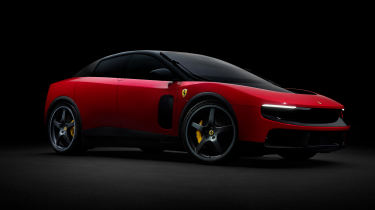
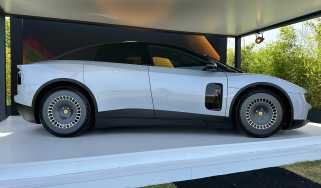
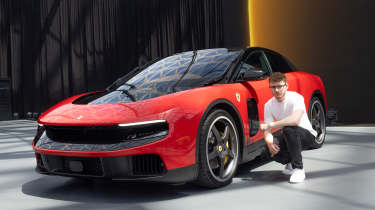
To say the Luce is a departure from Ferrari’s current design language is the understatement of the century, but there's a good reason for that. Ferrari hopes to sell the vast majority to entirely new customers, so a fresh, radical design is what it set out to achieve right from the get-go half a decade ago. The Luce has not been designed in-house in Maranello for that reason, but instead almost solely by LoveFrom, a design studio founded by Jony Ive and Marc Newson, the design minds behind some of the world’s most significant technology products, most notably from Apple.
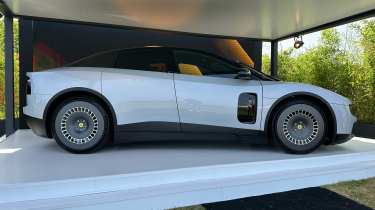
Its ultra cab-forward proportions make it unlike anything else on the road and while the closest Ferrari model to Luce in terms of form factor is the Purosangue, that car is taller, wider and has a longer wheelbase too. Despite this, the Luce achieves interior space similar to that of the Purosangue, with the lack of a central transmission tunnel allowing for the central fifth seat Ferrari has never managed to bring to market until now.
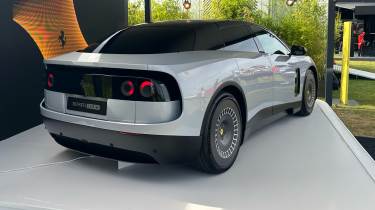
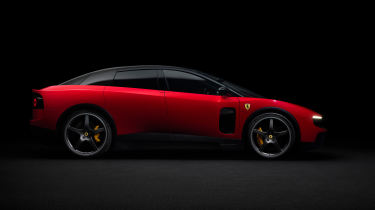
The Luce is defined by its glasshouse, with a continuous, flowing piece of bodywork running from the tip of the nose, over the roof and right to the bootlid. Ensuring this element remained undisrupted was key for both visual continuity and aerodynamics, so it adopts a pair of chunky, windscreen wipers that rest within the A-pillars and are not immediately obvious at first glance, but once you’ve spotted them, they’re hard to ignore.
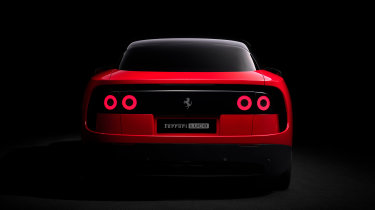
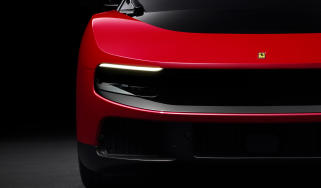
This glasshouse is then clad in painted bodywork that forms its aerodynamic elements, most notably full-width floating aero pass-throughs at the front and rear (the latter featuring an optional embossed Ferrari script). The front grille features an active grille in order to balance thermal and aerodynamic performance, with subtle, fully functional aero elements nestled within the front doors and rear bumper; this element of the project alone took five years and over 250 hours of wind tunnel testing to hone. The result is the lowest drag coefficient of any Ferrari at 0.254Cd (less than a Lotus Eletre), while also maintaining the same peak downforce as the Amalfi at c110kg.
Ferrari took the aerodynamic principles of the Luce so seriously that they embarked on the process two years before full-scale development began. This involved a small team of young aerodynamicists who started from a clean slate to explore every possible avenue, which included looking into a three-wheeled platform.
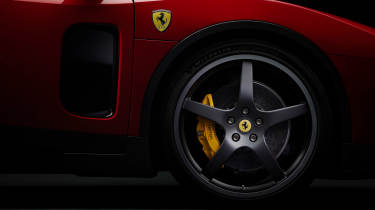
The clean-sheet design makes for little notable reference to Ferrari models of the past, but the flush, circular rear lights are said to hark back to the 360 Modena and 458 Italia. It’s five-spoke forged wheel design is one of the more conventional design elements, but buyers can also option a flush, aero-centric turbine alternative for a five per cent decrease in drag. This wheel is not an ordinary wheel with an aero disc cover, either, but made from billet aluminium. To give some sense of scale, the wheels are a ludicrous 23 and 24 inches front and rear.
Ferrari Luce: interior
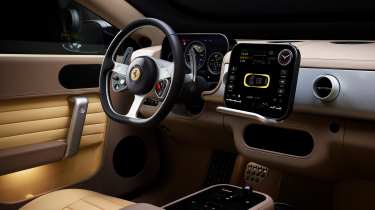
There’s been a huge focus on the ‘extreme integration’ of interior and exterior elements, making the Luce’s divisive design cohesive throughout. Like the exterior, the Luce’s LoveFrom-designed cabin bears almost no resemblance to the rest of the range, adopting an entirely new aesthetic clearly reminiscent of Jony Ive’s most iconic designs. There's a good reason for this, as Manzoni said: '...we shared some thoughts but then we left [LoveFrom] working for about six months in total autonomy, with a curiosity to know what they were conceiving.’ The final product is said to be ‘very close’ to the initial design the firm conceived and took just shy of five years to develop.
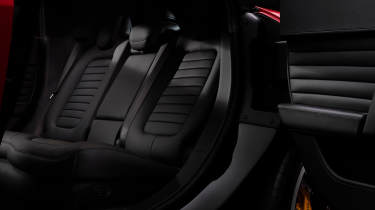
The purpose of the Luce’s unusual proportions become very clear inside. Despite similar dimensions to the Purosangue this feels like a much bigger car, free of a central transmission tunnel to allow for that Ferrari-first fifth central seat. The door cards are minimalistic and clutter-free, with each and every touch point finished with some level of cold-touch milled aluminium or glass. The rear-hinged ‘welcome’ doors enhance the sense of space on entry, and even close with the press of a button like a Rolls-Royce. The boot is huge, too, making it much more usable than a Purosangue.
Jony Ive and Marc Newson are both avid Ferrari collectors, and Ive said he took particular inspiration from elements of his own 250 Europa for the design of this cabin. The bold three-spoke wheel takes clear notes from the Nardi wheel from that car, only with a clean, minimalist touch. The integration of dedicated pods mounted to the wheel for LoveFrom's take on elements like the Manettino brings modern functionality to the table.
This retro-modern design might be divisive, but the concept behind the interface is one we've all been asking for. Jony Ive said: '...this idea that because the power source is electric, that the interface should be digital is nonsense. That makes no sense to me at all. So one thing that we felt very strongly about was we wanted to explore an interface that was physical and that was engaging.' The result is a cabin with more physical toggles, switches and dials than we've seen in decades, and each one has been meticulously engineered to feel unique.
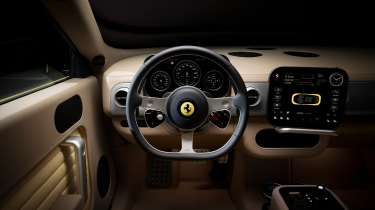
Style is one thing, but the materials and finishing elevate this interior to well beyond just about anything else on the market. High grade anodised aluminium, leather and ultra-durable Corning glass are the primary materials you'll find, chosen for durability, premium feel and the ability to assemble it all with the incredible tolerances you’d only usually associate with an Apple product; the combination of its thin rim, cold-touch aluminium element and tactile machined paddles make the wheel a joy to hold. There are over 100 machined aluminium parts in the Luce's cabin and 40 glass components, compared to perhaps two or three in most cars.

Ive said he hates the way in which modern cars employ swathes of displays that project content right on the surface, and so LoveFrom has combined cutting-edge bespoke OLED digital panels from Samsung with real, physical convex glass lenses and physical needles to bring much-needed depth to the interface. The content displayed on these screens has also been developed from the ground-up by LoveFrom, and is designed to feel 'alive', responding to the tactile physical controls in a way that ensures you feel engaged with the car. The Luce's cabin has been designed with a 'human-centred' approach, and so the dash binnacle articulates with the wheel, and both the driver and passenger can rotate and tilt the central infotainment display with a dedicated aluminium handle.
Every element is said to have been designed as if it were a dedicated product. The rails for the Daytona-inspired seats are entirely bespoke and finished to the same high standard as readily visible elements. The startup 'ceremony' in which an e-ink display within the bespoke glass key appears to transfer its colour to the gear selector took three quarters of a year to perfect. Look to the floating centre console and even the hinges within its cubby have been finished to the same standard.
Having experienced the seamless, fluid way in which the LoveFrom-developed software interacts with the hardware at the Luce’s reveal event, it’s very clear that this will be a strong USP Ferrari hopes will appeal to less traditional buyers. This is an interior designed and assembled to a standard that no other manufacturer can currently match. Navigating the menu systems within the central display is immediately intuitive and impossibly smooth, but because the vast majority of the primary controls are handled by physical dials, switches and toggles, there are far fewer layers to the digital system than you might expect and it’s a wholly refreshing system to interact with as a result, setting a new standard for the industry as a whole.
Battery
Powering the 800V system behind it all is a huge 122kWh liquid-cooled battery pack that Ferrari claims is the most energy-dense of any current electric car, at 195Wh/kg. (To save you doing the maths, that gives the battery pack a total weight of 626kg.) Integrated into the chassis structure for increased rigidity, a total of 14 nickel manganese cobalt pouch cells from South Korean firm ’SK on’ are packed into each of the 15 modules, of which 85 per cent are located below the floor pan. The rest are fitted neatly under the rear seats, resulting in 47:53 weight distribution.
Unlike some manufacturers, Ferrari assembles these battery packs itself. It may receive the cells from elsewhere, but the rest will be done in-house, with the cells laser welded (not screwed, in order to save weight) into each module, and those modules then dropped into the larger packs all at Maranello. It’s this that helps make the system futureproof, with Ferrari in control of every step in the process.
Something that’s proven to be especially key to maintaining both performance and value in EVs is battery health, but time will always have the final say when it comes to batteries built using today's technology. To ensure this is a ‘forever’ car like the rest of Ferrari's range, the firm says it’s ensured that, despite the complex packaging, there has been no compromise made to the ability to service and/or replace components, battery included. Avoiding a ‘cell-to-pack’ system makes each module replaceable separately should any of the 15 experience unusual ageing or damage.
Despite its advanced aerodynamics and suite of new efficiency focused components such as a third-generation wheel hub (improving range by 5.5-miles alone), range is said to be in the region of 329 miles, some way below similarly powerful EVs like the 387-mile Porsche Cayenne Turbo. Ferrari has made a real effort to make this range figure as true to reality as possible though, with customer feedback suggesting this is key to its success.
Sound
As clever as all of this tech may be, sound is an important factor for any performance car, and especially one from Maranello. Ferrari has thought of this, and as opposed to replicating the sound of one of its V6, V8 or V12 engines, it’s amplifying the real sound of its electric powertrain instead. Mounted to the casing of the more powerful rear motor unit, an accelerometer picks up each and every vibration to translate this data into a sound precisely representative of powertrain response, in a similar fashion to an electric guitar pickup. So if you momentarily break traction, this will be represented in the sound you hear. This system is much more accurate than one synthesised based on throttle position or speed alone, and is designed to make the experience more authentic than in any other EV.
Oddly, a full preview of its sound is the only thing omitted from the reveal presentation, but Ferrari has confirmed that unwanted sounds are filtered out to allow the best to come through using a patented system. The source of the sound might be authentic, but it still has to be pumped through speakers for amplification. And the Luce features a Ferrari-developed 3000w 21-speaker sound system for just this, including what it’s calling ‘ultra-flat’ headliner speakers for a full surround experience. Unexpectedly it also features exterior speakers and the front and rear to emit the same sound for passers by when in the relevant Manettino position.
While there’s just a single pickup point, the decision on its location on the rear motor casing was far from random. A team of 20 engineers (of which many are ‘musically sensitive’) tried and tested 50 different locations for the pickup before making their final decision. The sensor is so sensitive that it’s able to distinguish vibrations from the left and right motors respectively, offering further feedback on what each of the rear wheels is doing; you can hear the change in phase contact under regenerative braking too. Given there are numerous points of contact for the signals at play in this system, there’s bound to be some latency, but Ferrari told evo that while it couldn’t offer an exact latency number, it’s ’imperceptible’ to the human ear.
Chassis and weight
It’s not just the basic motor technology that this car shares with its ICE relatives, as it also shares chassis components too. At its core is the same 48V Multimatic active suspension system first seen in the Purosangue and, more recently, the F80. The third-generation system is what lies beneath this car, now 2kg lighter per corner than in the Purosangue, but with even more capability.
Powering the system is a motor within each damper, but Ferrari has tweaked the thread of the central ‘screw’ for 20 per cent more pitch. The result of this change is that the system is even better than before at absorbing vertical movement, with precise control over lubrication thanks to the introduction of a thermocouple allowing the system to maintain the same lubricant viscosity no matter the external temperature.
While this system is more capable overall, it has been tweaked with comfort in mind for this car, leaning into its positioning as a more practical, usable model. NVH has been a very strong focus, to the point where Ferrari has even developed its very first suspended rear subframe for this application.
This is said to not only reduce transmission of motor and road noise, but also maintain the same rigidity as a solid-mounted unit. Clever tricks such as placing the inverters for each suspension tower within the subframe itself help improve NVH further, using their mass to dampen unwanted frequencies.
We’ll have to try it ourselves to know for sure, but Ferrari says this has all been achieved while maintaining the performance levels associated with one of its products. The claimed weight stands at a chunky 2260kg, although this is only 80kg more than a Purosangue (with fluids).
With such extreme performance (and, this being an EV, weight) comes the need to shed speed just as quickly as you pile it on. Carbon-ceramic friction brakes have been re-engineered for this application in order to reduce their mass: 390mm, six-piston units at the front, 372mm, four-piston at the rear. With four powerful motors at its disposal though, this system is assisted by up to 0.68 g of deceleration from regenerative braking alone, putting up to 500kW of energy back into the battery at its peak.
Jony Ive said this car has been designed with ‘the thrill of driving’ in mind, which is always a good sign. Ferrari claims it feels as if it weighs 450kg less from the driver’s seat in some circumstances, or in other words, 1810kg. Features like independent four wheel steering, the latest Side Slip Control X system, and ‘semi virtual’ front suspension in which a split lower arm virtually shifts the steering axis closer to the wheel centre are responsible for this.
The Ferrari Luce is both one of the most significant and complex cars to be launched not just from within the walls of Maranello, but the automotive industry as a whole. We’ll just have to wait until later this year to find out if all of this engineering translates to a true Ferrari driving experience.
Ferrari Luce specs
| Powertrain | Quad-motor, all-wheel drive |
|---|---|
| Power | 1036bhp |
| Torque | 731lb ft |
| 0-62mph | 2.5sec |
| Top sped | 193mph |
| Weight | 2260kg |
| Power-to-weight | 458bhp/ton |
| Battery size | 122kWh (111kWh useable) |
| Range | c329 miles |
| Price | c£450,000 |