Ford GT (2017-2023) review – Ford’s most modern Ferrari-beater
Ford’s supercar made a triumphant Le Mans-winning return, but did it beat Ferrari in the supercar stakes?
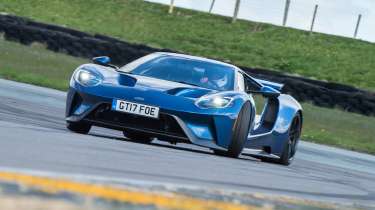
There’s an intriguing story about the birth of the second-generation Ford GT road car, and it only came to light a year after it was unveiled in 2016. Because initially Ford wasn't going to build a new GT at all. For one whole year, Ford tried and failed to come up with an ultimate racing Mustang to beat Ferrari, Porsche, Corvette and Aston Martin at Le Mans. Also planned was a road-going version to coincide with the race project and celebrate the 50th anniversary of the company’s victory at the famous 24-hour race.
Eventually Ford realised the car it had been attempting to engineer bore little resemblance to a road going Mustang and thus, the marketing would never work. Ironic as that's exactly what Ford has now produced in the Mustang GT3 and its roadgoing Mustang GTD counterpart. At that point back in 2013, though, a top secret skunkworks project to build an all-new GT racer and road car, headquartered deep in the basement of Ford’s Dearborne Michigan headquarters, took precedence.
The road car that eventually went into production in 2017 took a while coming, then. It reached the point where some cynics accused the GT of being mildly off the pace beside contemporary rivals like the McLaren 720S, especially with a price tag over two times higher. But the Ford GT that did emerge is still a compelling machine in its own unique ways, even if it never quite lived up to the supercar establishment-shattering legacy of the 2005 GT it succeeded.
Engine, gearbox and performance
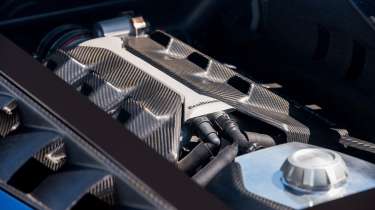
- The V6 engine is no V8 in terms of character or aural quality.
- Performance is raw, brutal and devastatingly effective
- Everything about the GT feels ‘race car’, because that’s what it is
More reviews
The GT is powered by a 3.5-litre twin turbo V6 that’s been tried and tested, and has won several sports car racing titles. It develops 638bhp at 6250rpm and a peak of 550lb ft at 5900rpm, with the vast majority of that peak figure available flat between just over 3000rpm and just under 6000rpm.
Yes this is the same Ecoboost unit as found in many Ford trucks, and no it doesn’t have the exotic voice of the engines found in European rivals (or the previous Ford GT, in fact), but when has a utilitarian powertrain ever stopped an American supercar in the past?
It features five different drive modes; Wet, Comfort, Sport, Track and V-max. In Sport and Track there is an anti-lag system that all-but eliminates turbo lag by keeping the turbines spinning irrelevant of the throttle position.
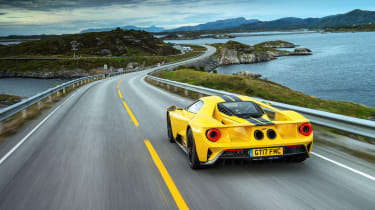
The gearbox is a seven-speed dual clutch that’s physically integrated into the rear suspension and makes up part of the rear subframe’s physical structure. This is a layout that doesn’t only feature on some of the greatest supercars of all time like GMA T.50 and Ferrari F50, but is also a key design element of the fastest racers in the world, be that Le Mans or Formula 1.

Zero to 60mph takes 2.8sec, the top speed is 216mph and, at a guess, we’d say 0-100mph in somewhere around six seconds. The noise from the twin-turbo V6 engine and the acceleration it can so readily generate is also deeply ‘racing car’ in its feel and delivery.
At low revs it sounds grainy, angry, industrial, and not especially pleasant to be honest. But as the revs rise past 2500rpm the tone changes and its acceleration gets much stronger as the V6 hones in on its torque peak. The cumulative effect is utterly dramatic, no mistake whatsoever about that.
And then there’s the way the gearbox operates, slicing up or down through the ratios with a speed and precision that you couldn't hope to replicate with a third pedal and conventional gear lever.
Ride and handling
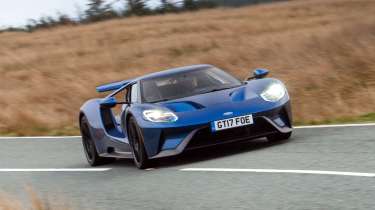
- The GT is a precision tool to drive, on road and track
- But it lacks the fidelity and transparency that makes a truly great driver’s car
- It also feels big and is a brutally harsh experience on the road
At the core of the GT lies a bespoke carbonfibre tub with pushrod suspension front and rear, plus a seven speed dual-clutch gearbox that’s integrated within the rear suspension. All the body panels are made from carbonfibre, the vast majority of its metal components are made from aluminium. All-up it weighs just 1385kg dry, so call it around 1450kg with fluids. This makes the GT lighter than any of its more obvious rivals from Ferrari, McLaren et al, says Ford.
The brakes are carbon ceramic all round, and the wheels are 20 x 8.5-inch forged alloys at the front with 20 x 11.5-inch units at the rear (full carbon fibre wheels of the same size can be specified for quite a few pounds extra, though Ford won't disclose how many - other than to potential customers). Tyres are Michelin Pilot Sport Cup 2s, 325/30s at the rear rear, 245/35s up front.
From the first few feet of travel, the GT feels alive beneath your backside in a way that only proper racing cars do. The seat base is fixed so you move the pedals and wheel towards you, a la LaFerrari. And to begin with the suspension is compliant but very stiff in its feel, and supremely controlled in its response; the braking power also immense.
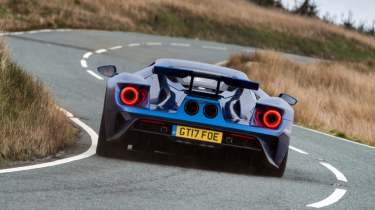
On the road it’s an intimidating machine. You know you fill every inch of your lane, often a little more as the kerdunk-kerdunk-kerdunk of the right-hand wheels hitting the catseyes telegraphs. Lamborghini Aventador aside, I’ve never driven as outsized a vehicle as this on these roads.
On the more open sections you can let the GT flow a little. Chippings clatter round the wheelarches, while the coarseness of the surface generates plenty of road noise. Coupled with the gruff, boosty soundtrack of the V6, driving the GT in the wild is an unfiltered experience.
Torque is the overriding force at work, picking you up and pushing you to the next corner – which the Ford will slice through, a squeeze of steering input enough to tack through sweeping curves and a roll of the wrists for tighter turns.
It’s an intense and effortless sensation, but one that is perhaps a little too matter-of-fact. Beyond the initial excitement of simply being in the GT you crave more connection and dynamic nuance.
The Ford GT’s biggest flaws
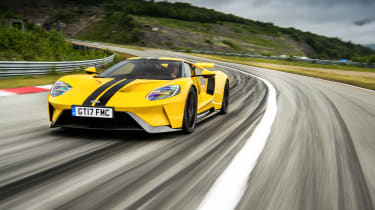
On the road the GT feels, sounds and just is a little bit rough around the edges, a touch uncouth and not as refined mechanically as you might expect. On the track, at maximum attack, all the fizzes, vibrations and noises that accompany your every move - most of which are down to the carbon fibre tub - simply aren’t an issue because everything is focused on going faster. But on the road they start to irritate you after a while. And after a long time behind the wheel I suspect they’d drive you round the twist.
Conversation is only just about possible at 50mph, and at 70-80mph it’s so loud inside the cabin you need to shout to be heard by a passenger. The sheer width out on the public road is excessive, intimidatingly so on occasion. And the fuel range is borderline hopeless with a 16mpg and 57.5-litre tank combo.
Twenty years ago all of this would have been fine, and the GT’s brawny rawness would have been deemed perfectly acceptable. Appealing, even, in a macho kind of way. But things have come so far in terms of supercar usability during that time, and in the context of its contemporaries, the GT can sometimes feel a little too extreme. It also has a boot that is smaller than tiny, with very little usable luggage space inside it.
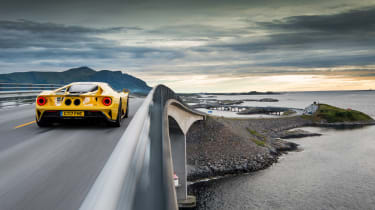
The ride is actually not bad on the road, so long as you select the comfort setting on the electronic dampers. But then there are other issues surrounding the brakes, which under light loads become difficult to modulate smoothly; the steering, which suffers from kickback on rougher surfaces, and even the engine noise, which is always very loud indeed, can't be dialled back in any way. The lack of refinement in the mid-range is something you simply never notice on the track.
Bottom line: the Ford GT is an epic car to drive – on a track – because fundamentally it’s a racing car. No question about that. But on the road it’s only so-so. Does this matter to the owners and collectors that have one in the garage? The answer is almost certainly not.
How fast is the Ford GT on track?
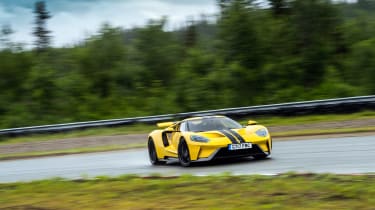
After five laps driven at a reasonable lick, all but the most skilful drivers would probably want to calm down a bit and have a rest, so much grip does it generate through the corners, down the straights, in the traction zones, everywhere. And after another five laps you would definitely need a lie down to have a good think about what this car is doing, how it is doing it, and how you can get even more out of it. Which is where the Track mode setting comes in.
To engage this you need to come to a complete stop, flick a switch on the steering wheel and then, thump, the thing drops instantly by 50mm, reducing the overall ride height above the ground to just 70mm and increasing effective spring stiffness by 100 per cent.
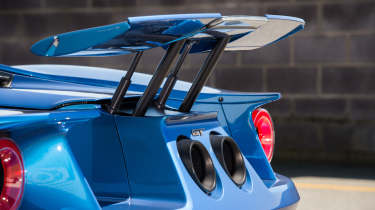
The computer controlled aerodynamic package helps it develop more downforce but less drag than any contemporary rival. There’s also an airbrake at the back and winglets at the front that move to alter the centre of pressure as the downforce increases at speed. Without these the GT would develop too much downforce at the front, relative to the rear.
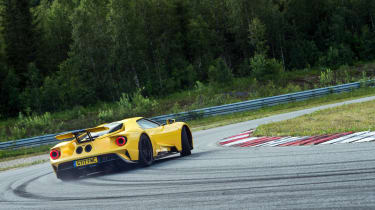
So you go out in it again and that’s when the real monster that lies within reveals its true being. It doesn't feel any faster in Track mode (because it isn’t) nor do the gear changes feel any more aggressive. But the turn-in response, the body control, the perception of grip and, most of all, the subjective power of the brakes (weirdly) all go to another level again.
In Track mode the way the GT stops for, and turns into corners becomes a little bit ridiculous, frankly. You also notice the absence of weight that it carries, and the pure precision this lends it, everywhere. In Track mode it is fair to say that the GT is utterly spectacular to drive.
The GT feels quite a lot like a full blown racing car, a fact that even its creators admit is not at all far from the truth. Strangely, though, that feeling doesn’t translate to especially sensational lap times – the 1:14.2 we achieved at Anglesey circuit fell short of other less specialised machinery from Porsche, Ferrari and Mercedes-AMG. Here’s Richard Meaden’s track test:
Anglesey track test – evo 252
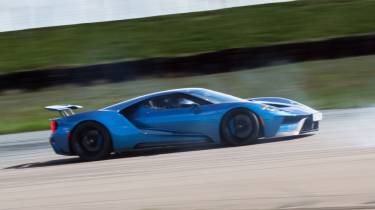
‘Has a road car ever looked more ready to attack a race circuit than a Ford GT in Track mode? Switch to the most aggressive setting and it literally drops as though you’ve been let down by a set of air jacks.
‘Not even a McLaren P1 beats it for race-car stance. It’s such a serious statement of intent that with a crash helmet on you truly struggle to believe you’re in a road car. It’s an impression reinforced by the GT’s cockpit surroundings – pared-back with plenty of exposed carbonfibre and little in the way of sound deadening to isolate you from the 647bhp V6 located just behind your shoulders.
‘With the seat fixed you pull on a strap to adjust the pedal box, bringing the brake and throttle towards your feet. The steering wheel is more of a rectangle, but it feels good in your hands, especially on the out lap of each timed run, when it feels appropriate to weave a little to help switch the tyres on.
‘The EcoBoost V6 may share more than half its DNA with the unit found in the Raptor pickup truck, but it sounds no-nonsense purposeful and provides immense propulsion. The 647bhp peak power figure is the headline grabber, but torque is the order of the day – some 550lb ft of it to be precise. In the more aggressive dynamic modes the motor engages a system to mitigate what little turbo lag there is and delivers a more intense power delivery from 5500 to 7000rpm.
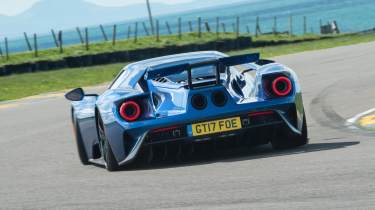
‘From the moment you leave the pitlane the GT feels quite unlike other supercars. It’s fl at and resistant to roll, and direct and responsive to small steering inputs, but not jumpy or overly reactive. That intuitive response is welcome, because while the steering isn’t glassy exactly, you don’t get much feedback through the wheel, and because you don’t sense much body roll either, you soon realise this is a car that requires you to rely on faith as much as feel.
‘It contains its weight well (think c1500kg with fluids), both through the corners and in the braking areas, and if you’re prepared to let it carry more speed than feels comfortable into the quicker corners you feel the aero catch you. As you’d expect (and want), it’s the front end that lets go fi rst. Softly and only fractionally, but enough to know you’re reaching the limit of the front tyres, or need to keep the weight transfer working on the front axle as you ask it to peel into the corner.
‘When the process clicks it’s a fantastic feeling. One I’m familiar with from racing, actually, which is a compliment indeed, as few road cars allow you to enter that zone. It’s in this heightened sensory state that what feedback you do get from the Ford really makes sense, and where you appreciate just how precisely you’re able to adjust your brake, steering and throttle inputs.
‘In this respect, the race car genes are very apparent. The weird thing is that the GT struggles against the stopwatch. The laps feel like they should be on the money. The best aren’t ragged, but nor are they overly cautious; there’s no running wide of the mark, or getting greedy on the throttle and then having to back off. We’re hustling hard, but almost imperceptibly you reach a point where the car plateaus and you simply stop finding gains.
‘Despite its uncompromising design, which ruthlessly placed racing success ahead of more rounded road car objectives, the GT doesn’t seem to have the innate aggression to attack a lap in the way you might expect. It has the grip and the traction, the braking power and the ability to carry speed into the trickier corners.
‘It feels planted in a way 99 per cent of supercars don’t. And yet, every time I cross the line its lap time is shaded by that of an AMG GT R – the best still being 0.6sec behind. Does the GT’s reliance on aerodynamics hobble it when there aren’t enough high-speed corners for it to strike home an advantage? Most likely, yes. Could I have found more time? A bit, perhaps, but the same could be said of all the cars.’
Values and buying checkpoints
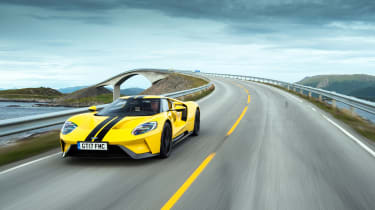
Production of the Ford GT has now ended, but not before a flurry of special editions arrived to pay homage to the car's motorsport legacy. The final road-going version, the GT LM Edition, was built in tribute to the GT's class win at Le Mans in 2016, with a series of cosmetic tweaks and a price tag somewhere north of the base car's £450,000 figure.
For 67 specially chosen customers, Ford also produced a £1.38m track-only model called the GT MkIV, generating more than 800bhp with Multimatic-developed adaptive suspension and bespoke aero. That car set a Nürburgring time of 6:15, making it the fastest car of any kind in production at the time.
Values of the second-generation modern era Ford GT are relatively steady. It’s rare they come up for sale – it’s thought fewer than 20 were sold in the UK – but when they do, they’re priced anywhere from £500,000 to over £1million, depending on the spec and whether the car is one of the range of special edition models.
Ford GT specs
| Engine | 3.5-litre twin-turbo V6 |
|---|---|
| Power | 638bhp @ 6250rpm |
| Torque | 550lb ft @ 5900rpm |
| Weight | 1385kg (dry) (475bhp/ton) |
| 0-60mph | 2.8sec |
| Top speed | 217mph |
| Price new | £450,000 (2018) |
| Value now | £500,000-£1million |