New Genesis GV60 Magma review – fake V6 sounds and lots of fun, for a Porsche price
Genesis’s first Magma performance car is a more distinctive take on the Hyundai Ioniq 5 N. Is it worth the extra £10k?

Genesis is aiming to increase its annual European sales figures fivefold by 2030, up from 2500 units in 2025. That’s an ambitious target but still a modest one overall when its US arm sold more than 80,000 cars last year, and it will be a fraction of the 350,000 cars it wants to sell each year globally by the end of the decade.
You certainly don’t see many on UK roads. That’s something the brand is hoping to change, slowly but surely, opening more dealerships and city-centre ‘Studios’, where buyers can poke around the product without salespeople breathing down their necks.
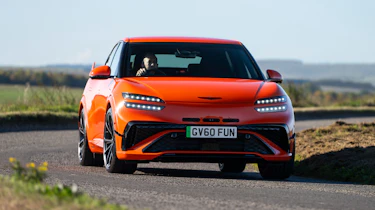
It’s also hoping to change things with the products it sells, such as the vibrant GV60 Magma. It’s the Genesis equivalent of the talented Hyundai Ioniq 5 N, the regular GV60 being the more luxury-focused sibling of both the Ioniq 5 and the Kia EV6, and it’s the first car from the new Magma performance sub-brand, whose Magma Orange hue you’ll also find on the GMR-001 Hypercar racing in the WEC under the Genesis Magma Racing banner.
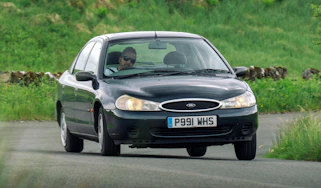
Hopefully Genesis will forgive the comparison, but the combination of a cosy luxurious model, in-your-face performance version and a concurrent brand-building Le Mans programme with an eye-popping signature colour reminds me a bit of the Rover 75, MG ZT and MG-Lola EX257 raced by Anthony Reid et al in the early 2000s.
Genesis GV60 Magma – Motors and performance
With 641bhp available in Boost mode, though, it’s even more potent than MG’s Le Mans car, let alone any of its primary-coloured millennial saloons. The Magma makes a constant 601bhp from its twin-motor setup, with 583lb ft of torque, and unsurprisingly both figures match those of the Ioniq 5 N. Performance too squares with the Hyundai, with 0-62mph in 3.4 seconds, though the Magma’s 164mph top speed betters its sibling by 3mph.
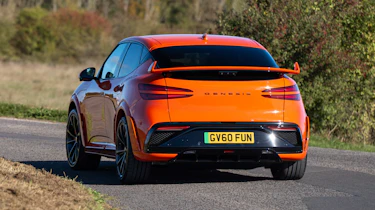
Yet Genesis is keen to stress that the GV60 Magma is designed to feel different to its Hyundai counterpart. There are the visuals for a start, which inject some attitude into the more rounded GV60’s shape, topped off by a prominent rear spoiler, the corners of which are flicked up like an airliner’s winglets.
More reviews
Inside, the regular car’s leather and silvery elements are replaced by dark hues, suede-like materials, contrast stitching (either orange or white), a set of bright orange seatbelts for the more figure-hugging sports seats, and a three-spoke steering wheel equipped with Magma and Boost buttons.
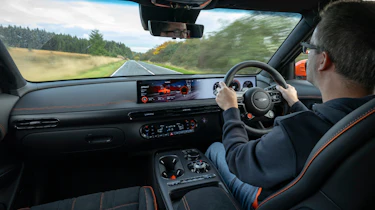
The latter liberates that full 641bhp output for up to 15 seconds, while the former can be clicked around for the Range, Comfort and Sport driving modes, or pressed to switch between GT and Sprint modes. Sprint ramps up motor response, steering weight, e-LSD behaviour and suspension control, though you’ll need to dive into the Magma setting on the central screen to find this car’s Virtual Gear Shift (VGS) and distinct virtual engine sound settings.
You’ll be familiar with how the pseudo-manual setup works now (not least because after Hyundai’s N Grin Shift, Porsche and Honda have since implemented something similar), but in the Magma the Hyundai’s synthetic four-cylinder note is swapped for a sound designed to evoke a 9000rpm V6. If you thought the Ioniq 5 N’s chosen facsimile seemed a little unambitious given the endless possibilities of synthesised engine notes, this is much more like it.
Normal driving is backed by its own soundtrack, with a typically whooshy and futuristic note that rises with speed and load, and occurs when you lift off too and the battery harvests energy with regenerative braking (something you can adjust with the same paddles that operate the virtual gears). After a while I was compelled to turn it off, though you can also just turn it down if you’d like the sound but not the slightly excessive volume.
Ride and handling
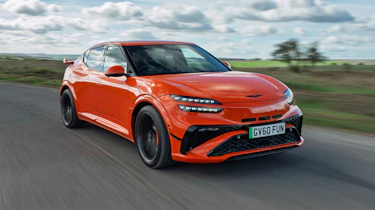
Early impressions are of a car that, despite a yawning turning circle, feels surprisingly wieldy in size. At 1.9 metres wide and 4.6m long it’s hardly small, but it seems to shrink around you a little better than the blocky Ioniq 5 N. Over pockmarked urban road surfaces the newly stiffened suspension struggles to absorb any of it, even in Comfort mode.

Thankfully, the Magma is one of those cars that settles at speed, and you can call up plenty of that once the road opens up. In honesty, there’s not much to describe here – it does the usual EV thing of catapulting seamlessly at the horizon whenever you sink your size-10, and the surprisingly weighty accelerator pedal is easier to modulate smoothly than the brake, which always feels a tad spongy and inconsistent, though doesn’t lack power with 400mm front discs to call upon.
Braking is still where you’ll mostly feel the Magma’s 2240kg, as it’s better at hiding it through the direction changes, undulations and compressions of a country road. Steering seems very close to that of the 5 N, with ideally judged weight, response and linearity, and a reassurance that the front end will do as you tell it that makes up for an absence of feedback. It’s grippy too, despite our Scottish test route being a bit dreich.
Track test
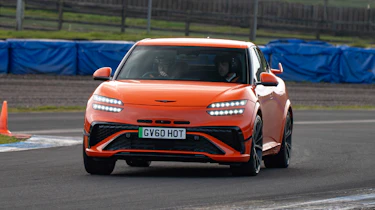
We head to Knockhill next, where like an increasing number of performance EVs, the Magma puts on an even better show than it did on the way here – all that extra engineering being easier to appreciate towards the limits of its performance than with the constraints of a narrow B-road. Here on a damp surface there’s still plenty of grip but also a more adjustable balance, and putting more load through the front tyres wakes up the steering a tad. Power out of a corner early and you’ll need to dial in some lock to correct it, too.
With Sprint dialled in and VGS selected, it pulls off a pretty good impression of something loud and combustion-powered. I reckon it’s more flat-six (specifically a Stuttgart one) than V6, but as the tone and vibration don’t change much, I found myself short-shifting a lot rather than compulsively chasing the virtual red line. The noise (which is actually audible outside the car) and engine braking do make circuit driving feel more natural though.
Price and rivals
Subjectively I prefer the way the Magma looks and sounds to its Hyundai equivalent, and it’s just as good to drive. This leaves only the £76k starting price, ten grand more than the 5 N, as the stumbling block. That’s sure to maintain a little exclusivity, though, and despite Genesis’s ambitious sales targets, it still wants a little of that, too. Outside of comparisons with its cousin, the Genesis actually compares relatively favourably. It looks like decent value next to the (admittedly bigger) Porsche Macan, which for the same money or less can only be had in £73,100 Macan 4 spec, which has just 402bhp when in boost mode. Alpine's A390 GTS is cheaper, at £69,390 but again, is down on punch compared to the Genesis.
Specs
| Motors | 175kW front, 303kW rear |
|---|---|
| Power | 641bhp (with Boost) |
| Torque | 583lb ft |
| Weight | 2240kg (291bhp/ton) |
| 0-62mph | 3.4sec |
| Top speed | 164mph |
| Basic price | £75,915 |