New Lamborghini Temerario Spyder – soft-top abandoned for Ferrari 296 GTS rival
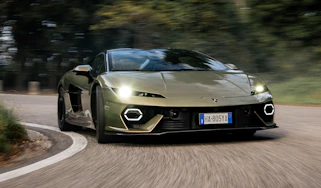
Lamborghini has revealed the pop-top version of its 10,000rpm Temerario supercar, swapping the fabric folding roof of old baby Lambos for folding metal

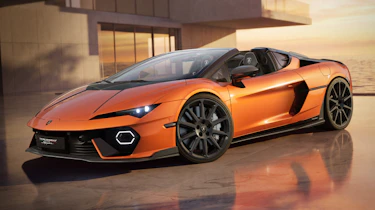
If you wanted to sum up what might be core to the Lamborghini Temerario Spyder’s appeal, you could do far worse than '10,000rpm with the top down'. Lambo’s replacement for the Huracán might have taken a step backwards in character by ditching the old V10 for a twin-turbo V8 and hybrid assistance, but you can usually count on open-air driving to claw back some thrills.
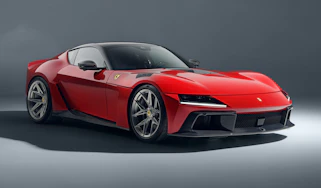
For the first time, a drop-top Lamborghini incorporates a retractable hard-top, meaning the new Temerario Spyder now takes the rigid roof path also taken by the Ferrari 296 GTS and the McLaren 750S Spider.
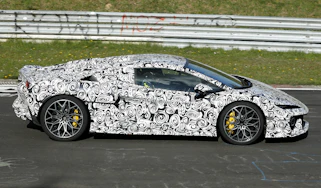
Roof closed, the profile is now more coupe-like, with Lamborghini promising benefits in cabin acoustics and chassis stiffness compared to a fabric roof. When open, the profile is similar to that of the old Huracan Spyder, with prominent aero humps behind each seat and a relatively low engine cover, which then makes you wonder where the roof is actually stored. The answer is vertically, in a cavern behind the seats, with ten electric actuators sliding the panel as close as possible to the Temerario’s centre of gravity and mass.
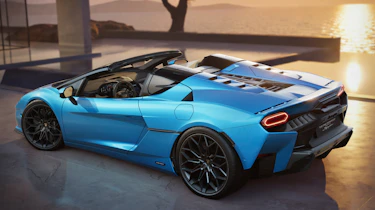
It’s a clever solution dynamically too. Lamborghini says it actually lowers the car’s centre of gravity by 3mm when the roof is open with no change to the front-to-rear balance, rather than raising it by 7mm and moving it backwards by 11mm, as a traditional arrangement might have done. You can’t, in all honesty, discern any big difference in balance in a 296 or Artura with their competing horizontally-arranged roof panels, but every little helps.

Chopping the roof out of a coupe usually requires additional bracing elsewhere to make up for the loss of structural rigidity, and Lamborghini has done exactly that, the aluminium spaceframe reinforced with new stiffening elements and redesigned structural nodes.
The Temerario’s platform is already more sophisticated than its predecessor though, so despite managing to cut dedicated structural components by 50 per cent compared to the Huracán Spyder, it’s now six per cent stiffer in both static and torsional rigidity, and nine per cent stiffer in dynamic bending. In theory, there shouldn’t be much difference between coupe and Spyder on the road as a result, though the suspension has been tuned specifically for the Spyder, promising a reduction in vibrations by 20 per cent.
Mechanically, the Spyder uses the same 4.0-litre twin-turbocharged V8 and a trio of axial-flux electric motors, for a combined 908bhp. The engine alone is responsible for 789bhp of that, and still spins to 10,000rpm, or 10,250rpm in launch control mode. The electric motors can be used to alter the behaviour of the car in cornering, but the all-wheel drive traction is useful for straight-line sprinting too.
The Spyder reels off 0-62mph in 2.8 seconds, 124mph in 7.3, and goes on to 213mph. The 0-62mph time is a tenth shy of the coupe (no doubt a function of slightly higher weight, though a CFRP Alleggerita pack, when combined with carbonfibre wheels, cuts 22kg off the total), but top speed is identical. The coupe-like roof helps there, with the arrangement designed as much for aero performance as theatre, but even when the roof is open, air is channeled around the cabin to avoid pummeling the occupants with errant gusts.
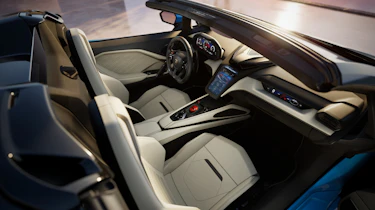
Even if you do get struck by a cool breeze, there’s a neck warmer system built into each seat, and while the cabin itself is largely unchanged from the coupe, it should be a meaningful improvement for previous owners of the Huracán Spyder, with more room in all directions and improved visibility too. Drivers up to two metres tall are now accounted for, while the luggage compartment under the bonnet is good for 112 litres, or a pair of two airliner cabin-sized bags.
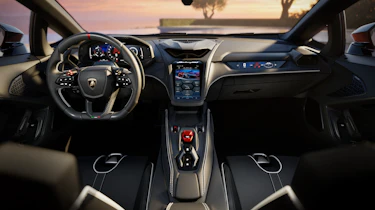
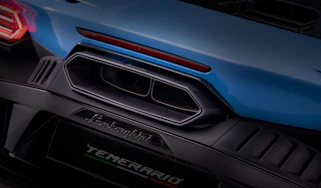
As well as the Allegerita package, the Temerario Spyder is of course customisable through Lamborghini’s ‘Ad Personum’ programme, including a selection of harlequin paint finishes (think TVR’s flip paint, though Lamborghini may not welcome the comparison), liveries that work with the Temerario’s lines, and other details. The soundtrack meanwhile is handled by Sonus Faber (inside the car) and Akrapovic (if you tick the 11.4kg titanium exhaust option).
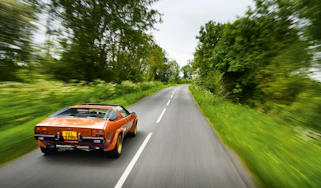
The launch of the Temerario Spyder, incidentally, marks fifty years since the brand’s first open-topped car, the Silhouette, which had its own completely removable roof panel.