Evolution of the Porsche 911 GT3: original battles latest after 25 years
Porsche’s 911 GT3 has set the benchmark for finely focused, road- and track-going sports coupes for 25 years, we plot its evolution by comparing an original example against the very latest
'The first fat, heavy drops fall lazily from the sky and drum on the roof of the Porsche like dried peas on a biscuit tin; clearly, there’s no sound deadening behind the roof lining.’ Not my words but John Barker’s in issue 12 of evo back in 1999. The Porsche 911 GT3 was a brand‑new model-line then, a water-cooled replacement for the last air-cooled 911 Carrera RS, and the car world was still getting to know it. What exactly was this lower, lairier 911 with an unfamiliar badge?
JB dashed from Britain into France in the original 996-generation GT3 to get to know it better and glimpse a total eclipse of the sun in the process, dodging crowds doing the same in Cornwall. (‘It was a deeply moving experience, never to be forgotten. And the eclipse was pretty special too.’) Naturally, it chucked it down for most of the journey. A couple of months prior, Dickie Meaden had driven the 996 GT3 for the first time in Germany. It chucked it down there too. And a few months later, the GT3 triumphed in a soggy evo Car of the Year test in Scotland. This car was turning out to be something special.
> Used Porsche Cayman GT4 (981, 2015 – 2016) review: a flat-six hero from £55k
More reviews
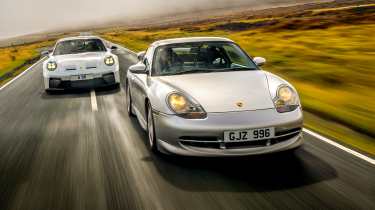
Twenty-six years on, I’m in the elephant-ear-shaped Recaro of an Arctic Silver first-generation 996 GT3, driving across the North York Moors. Aptly, it’s chucking it down. But this time it has company: the LED headlights of the latest 992.2-generation 911 GT3 shine through the murk in the rear-view mirror, bisected by the 996’s taco wing.
We’re here with the current bookends of Porsche 911 GT3 history not only for a spot of time travel, but to discover how much things have changed, what direction the model has evolved in, and whether anything’s been lost along the way, or alternatively whether it’s a car that has improved out of all recognition.
The GT3 has certainly altered plenty: it has experienced multiple platforms, engines and a host of technologies since its introduction in spring 1999. But in other ways it’s been an ever-fixed point on the performance car map: it’s occupied the same place in the 911 range, hung on to rev-happy naturally aspirated engines, prioritised corners over straight lines, and increased its kerb weight as scantly as possible.
Persevering through the rain, we’re rewarded not by an eclipse but something still pretty special: cresting a ridge, we emerge from pea-soup mist to a temporary blast of golden sunshine and a perfect rainbow arcing across the valley below. It’s the ideal opportunity to park up under this spectral semicircle and to compare ancestor and descendent side by side with contributing writer Antony Ingram, who’s been at the new car’s wheel.
The 992.2 dwarfs the original 996. The 2025 car’s 20- and 21-inch wheels look enormous in comparison to the older machine’s 18s, and Antony points out the front tyres on the new car are only 20mm narrower than the rears on the 996. The older car’s straight-hipped shell looks plain and unadorned compared with its great-great-grandchild’s more complex surfaces. However, its lowered ride height (30mm lower than the regular 996 Carrera) gives it a floor-hugging, race-car-like stance, as does the purposeful camber of its split-rim wheels.
The latest car’s brakes (optional £9797 ceramic-composites in this case) look like manhole covers compared with the original’s – which back in 1999 were considered pretty beefy. They were borrowed from the 911 Turbo, because in some respects the first GT3 was something of a parts-bin special. Like so many great cars, it was created by a small group of people as a semi-skunkworks side-project, in this case led by Roland Kussmaul, the experienced motorsport and special road car department manager. Porsche was moving away from the GT2 racing category in which the earlier 993-gen 911 had competed, and into a newly introduced lower-tier class: GT3, hence the name. In addition, it needed to homologate the 996 for racing in its own one-make Porsche Supercup. The distinctive rear wing, chin spoiler and sills were adapted from the aero kit option already available for the regular 996 Carrera, as were the wheels. The engine was adapted from that in the 911 Turbo, minus the turbochargers and modified to rev heartily.
It will be forever known as the Mezger engine, after fabled Porsche engineer Hans Mezger’s original design – though he retired in 1993 and some credit for the GT3’s motor must also go to Herbert Ampferer, who refined elements of the Mezger-designed flat-six that powered the 911 GT1 Le Mans car. For the GT3, the 3.6-litre dry-sump unit was given titanium con-rods, allowing it to rev to 7800rpm, while 360 PS (355bhp) gave it a neat 100 PS-per-litre specific output. Race versions revved to 9000rpm – something that would become a USP for later-generation 911 GT3s. The Mezger motor culminated in 2011’s 997.2 GT3 RS 4.0, by which time it developed 493bhp at 8250rpm: one heck of a final hurrah. Emissions regs meant a new engine for 2013’s 991-gen GT3, with a 9k red line cushioning the blow for diehard Mezger enthusiasts. A significant evolution of that engine sits in the tail of the latest-generation car.
The new car’s tail is topped by a rear wing with ‘swan-neck’ mounts, wrapping over to hold it by its top surface and keep the air flowing underneath – the most important bit – as clean as possible. It’s a much bigger spoiler than the original’s idiosyncratic semicircle (sometimes nicknamed the ‘Pac-Man wing’ as well as the taco mentioned earlier, for obvious reasons), which was replaced by a more conventional, and effective, design for 2003’s 996.2 GT3 update. It’s indicative of how the GT3’s appetite for downforce has increased with its performance over the generations. Conversely, customers can still opt for a wingless rear with the Touring pack option first introduced on 2017’s 991.2, for a more subtle, under-the-radar kind of GT3.
Despite its limited-budget, needs-must origins, there’s a special magic in the 996 greater than the sum of its parts. The rainbow fades (but not before photographer Andy Morgan has captured it on camera), and I climb back into the silver GT3. The Mezger has a distinctive, mechanical sound at idle, and the whole car rocks and trembles slightly to the cylinders’ horizontal thrum. It feels eager, impatient to get going. The clutch pedal is heavy and I instinctively slide the seat a touch closer to give my leg a bit more leverage. This year-2000 car, kindly on loan from RPM Specialist Cars where it’s currently for sale, doesn’t have the optional Clubsport pack (bolt-in half roll-cage, fire-retardant seat trim, cut-out switches), which fitted a single-mass flywheel for swifter response at the expense of a grumpier idle and trickier pull-away. No worries here: a light tickle of throttle, lift the clutch and you’re smoothly away, accompanied by a lovely, throaty roar from the flat-six.
As John Barker put it in 1999, ‘There’s something uniquely satisfying about the delivery of a hugely powerful, normally aspirated engine that a turbo motor just can’t match. That willingness to knuckle down and forge on from modest revs makes every flex of your right foot an event.’ In eCoty ’99 (evo 015), David Vivian described it as ‘the quintessential 911 noise, but perhaps better than we’ve ever heard it before’. Despite its gruff note from low revs, the engine revs so keenly and freely. You can see how the Mezger has become so revered. In Barker’s eloquent words: ‘The sound starts as an angry, guttural rumble before hitting a sweet mid-spot where the note lightens and it feels like the engine has got the measure of the GT3’s weight… when you think it can’t get any better, the noise jumps a couple of octaves and a howl to prickle all your prickly bits fills the cabin.’
The gearbox is the six-speed from the 993 GT2. Contemporary reports mention it can be balky if rushed but this 58,000-mile car’s transmission feels great – a longer-throw than later models but nice and positive. The steering is relatively heavy – it shifts gently in your hands as the car’s weight balance does likewise – and as with the steering and clutch, the brake pedal requires a little bit of muscle. The ride is firm, certainly by the standards of the 1990s, and relatively uncompromising. But it’s not crashy; it still breathes with the road. Along with much firmer springs and dampers than the contemporary Carrera – and racier geometry – adjustable anti-roll bars and spring platforms were all part of the GT3 spec, as were stronger wheel bearings and a limited-slip differential.
The low ride height makes me nervous of bumps but the 996 doesn’t ground out at any point. It’s a joy to calmly work your way down the gears on the approach to a corner before tucking the nose in, feeling the weight shift and the rear suspension squat subtly as you gently feed in the throttle and the Mezger begins the next verse of its singular song. There’s no traction control: that ‘comes courtesy of SRF, or Sensitive Right Foot as it’s more commonly known’, as Meaden put it in his original first drive (evo 009). It’s a totally involving driving experience, flowing and absorbing. Even in this iffy weather, I’m grinning from ear to ear.
Swapping with Antony and hopping into the new car, I find myself in a much bigger environment. To share the 996’s cabin with a passenger is a pretty cosy experience, but in the 992 you feel as though you’re sitting miles away from them. Unlike in the older car, your legs stretch out in a perfectly straight line without an offset pedalbox (this car having the dual-clutch PDK transmission, so no clutch pedal). Controversially, Porsche went PDK-only for the 991 GT3 in 2013 before reintroducing a manual gearbox option on the 991.2 in 2017 in response to customer demand. Today it still offers both transmissions, priced identically as part of the car’s £158,200 basic price. It’s the same price whether you opt for a Touring or winged body, too.
There’s still a gear-selector lever in the PDK-equipped car rather than the little plastic switch in regular 992s, and you can push-pull it to shift gears rather than use the paddles if you choose. The 4-litre flat-six – still without a turbocharger in sight – starts with a twist of a key-like switch in exactly the same part of the dashboard where you’d insert the ignition key in the 996. Whereas the rest of the 911 range has adopted a push-button start, the GT3 has retained the twist-switch because it’s easier to start the engine quickly if you spin and stall on a trackday; as with the shifter lever, it’s the kind of detail that comes from hands-on testing and a different approach to regular Porsche models. It’s typical of the GT department that has grown around the GT3 – a relatively small team that works in conjunction with the motorsport department and has broadened its remit over the years to create the Cayman GT4 series and special models such as the 911 R and S/T. And, of course, there are the RS variants of the GT3; faster, grippier, higher-tech, even more track-focused creations, first introduced as a variant of the 996.2, and now individual icons in their own right. The latest 992 GT3 RS pushes the technological envelope with active aerodynamics and switchable damper and differential settings from the steering wheel.
If the RS is extra special, the regular GT3 is still a car of serious substance. For every input, you get an equal, precise output and, as with the 996, it’s totally absorbing. Though it’s a different engine from the Mezger, it shares a slightly rattly note at idle (more audible on the outside than in), but as the revs rise it’s silkier and smoother. The rev-counter (a digital one in the 992.2, a first for GT3-kind) naturally goes all the way to 9000rpm. Up in the 8000rpm+ stratosphere, the flat-six takes on an extra metallic edge to its note that, once experienced, becomes addictive – you want to visit it again and again. The Mezger engine is a marvel; to drive it is to fall under its spell. But the newer engine is magical too. Despite extra catalytic converters and filters to meet tighter emissions requirements than ever, in the higher reaches of the rev range it still sounds as dizzyingly loud and intense as ever. It still prickles all your prickly bits.
An appealing tenet of the GT3 that hasn’t changed is that it isn’t about straight-line speed: Porsche has kept power at a little over 500bhp, because more than that would require bigger brakes, more cooling, more weight, more energy, more complication. As always, the GT3 is all about corners. In fact, the 992.2 actually has a smidge less torque than the car it replaced, due to those additional cats. To compensate, it’s been given a slightly shorter final drive ratio to keep acceleration as keen as before.
Even if the PDK transmission is less involving than an H-pattern on the road, it does allow you to keep both hands on the wheel throughout the sweep of revs, and the rapid-fire ping of each upshift and fast-twitch throttle-blip accompanying each downshift holds its own motorsport-like appeal. And on track – where a high percentage of GT3s are used regularly – there’s no denying PDK’s effectiveness. ‘I don’t think there’s a quicker-reacting DCT out there than these latest PDKs,’ Antony comments.
The 992’s cabin is relatively luxurious after the 996’s deleted centre console, blanked-off switches and absence of sound deadening in the rafters (press a finger against the roof lining and it flexes, nothing but a sliver of fresh air between it and the metal above). As with the older car, however, there’s only a thin layer of carpet and a GT3 emblem behind the new car’s seats. And, in this case, a roll-cage – like the original it’s available as an option, but it’s now made from carbonfibre and rather than being part of a Clubsport pack it’s a component of the Weissach Pack, which among other enhancements includes various carbon body panels and suspension components, and adds an eyewatering £19,531 to the bottom line.
On the move, today’s GT3 is a stark contrast to the original. The brakes feel sensitive initially, with much less pressure required on the pedal. Likewise, the steering feels so light, so fast and responsive. It’s a little disconcerting at first, but before too long you tune into it. Front-end grip is simply remarkable. Further down the valley the road tightens into switchbacks and the response from the front axle is quite something. In part this is down to the double-wishbone front suspension, a first for road-going 911s when introduced on the 992.1 GT3 in 2021, and taken directly from the RSR Le Mans racer – emphasising the close relationship between Porsche’s motorsport and GT car departments. Also contributing is rear-wheel steering, which first appeared on the 991.1 and is so subtle in operation you barely feel it at work.
It’s a handy tool, as the 992 feels an awful lot bigger than the 996. That said, while the size difference is certainly noticeable, it doesn’t feel too big for the road as some modern performance cars do. You feel totally in touch with all four corners of the car and can place it accurately. ‘I don’t think the 911 has got “too big”,’ agrees Ingram, ‘but it’s less of an intimate experience now. It feels more like driving a full-blown supercar in how low you sit, how much metal there is around you. Some might like that, but it may be even slightly intimidating compared with the old car, despite knowing you’re driving something much more capable and safe.’
A common factor to both cars is a firm ride. Naturally, today’s car has adaptive dampers, but their softest setting is still on the unforgiving side. The quality of the suspension movement, however, is so adept that – like the 996 – it doesn’t feel crashy or too uncompromising for British roads. In fact, it’s a thoroughly useable car considering what it’s capable of on a racetrack. I drove the 992 up to the shoot from the Midlands and other than rowdy road noise it’s amazing how civilised it can be on a long journey. The 996 is harder work. ‘It’s not an everyday 911, the GT3. It bombards your senses every step of the way,’ Barker concluded back on that eclipse-chasing drive.
Equally, it’s thoroughly special to drive, perfect for weekends or road trips. Compared with the 992, you feel the nose bob a little over bumps, and understeer build more readily than in later 911s. In some ways, it reminds me more of the 930-gen 911 we tested as part of the evo Eras 1980s test in issue 334 – it feels almost as close to that car as it does the current GT3. Which is absolutely not a criticism. ‘The 996’s performance, size, visibility… all feel scaled to road driving. And it doesn’t have that floppiness of some ’90s cars in comparison to modern ones,’ Antony says. ‘It’s a car I think you’d enjoy getting to know – working up to its limits, finessing the gearshift, eventually playing with the weight transfer. The ride is perfectly liveable too – firm, but somehow also fluid, another balance that the best ’90s and early ’00s performance cars seemed to find.’
He’s a fan of the 996’s steering too: ‘There’s little I’ve driven this side of an Elise that’s so talkative. I don’t mind that it doesn’t have the precision and instant response of the new car, because it feels more natural, human – the difference between having a conversation with a friend in the pub and asking ChatGPT a question.’
In practically every metric, the 992 is an objectively better car. But both are unforgettable driving experiences. You could argue the latest car, if it has a flaw, is that its limits are almost too high for the road. As Antony comments: ‘Its basic capabilities are so high that road driving can verge on frustrating. I daren’t think what speeds you’d be doing before the 992 comes fully alive.’ Conversely, the 996 could gain a shade more precision. But there’s still a common thread running from one to the other; you absolutely feel the original GT3’s DNA in the 2025 car, refined to the nth degree.
There were only 106 UK-registered 996.1 GT3s, and RPM Specialist Cars estimates there may be as few as 33 currently licensed/roadworthy examples. Values vary from £67,000 (the asking price of the car tested here) to £85,000+. When new the original GT3 was priced £11,500 (around £22k in today’s money) above the regular Carrera; for the current GT3 that gap is a little over £50k more than the base Carrera, but given its capabilities, it still feels like extremely good value. Before options, that is; this well-equipped press car cost more than £200k.
When the 996 GT3’s split-rim alloys first rolled onto the scene, few would have imagined it would spawn such a revered model line and its descendents would become such key players in the performance car market and on the trackday scene, or that it would become the instigator of multiple competitors. Like eclipses and double rainbows, it’s a phenomenon best experienced at first hand. Now, as then, there’s nothing quite like it.
Specs
| Porsche 911 GT3 (992.2) | Porsche 911 GT3 (996.1) | |
|---|---|---|
| Engine | Flat-six, 3996cc | Flat-six, 3600cc |
| Power | 503bhp @ 8500rpm | 355bhp @ 7200rpm |
| Torque | 332lb ft @ 6250rpm | 273lb ft @ 5000rpm |
| Weight | 1479kg (PDK) | 1350kg |
| Power-to-weight | 346bhp/ton (PDK) | 267bhp/ton |
| 0-62mph | 3.4sec (PDK) | 4.8sec |
| Tyres | Michelin Pilot Sport Cup 2 N1 | Michelin Pilot Sport N3 |
| Top speed | 193mph (PDK) | 187mph |
| Basic price | £158,200 | £76,500 (1999) |
| In today's money | - | £147,400 |
Thanks to RPM Specialist Cars, where the 996 GT3 is for sale. Visit rpmspecialistcars.co.uk for more details.
This story was first featured in evo issue 339.