Porsche 918 Spyder (2013-2015) review – the original hybrid hypercar that Porsche won’t replace
The 918 Spyder is still without a replacement, with the Mission S previewing a car for the segment below. These hybrid hypercar shoes would be difficult to fill anyway…
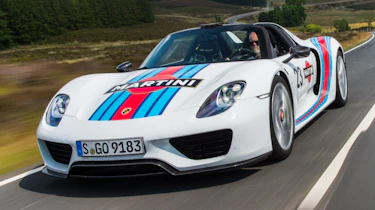
The Porsche 918 Spyder is Weissach’s hypercar successor to the seminal Carrera GT, employing very different technologies and with a very different philosophy. In place of the old analogue icon, came a hybrid, paddle-shift, four-wheel drive technical tour de force.
Its gestation was a protracted one, with the car first arriving as a concept in 2010 and not being ready as a production-ready machine fit for journalist assessment until the end of 2013. For this we can blame the impossibly complex task of integrating electric motivation with that of a high-revving combustion engine, across two driven axles, in a way that feels in any way natural. And the fact Porsche jacked up the horsepower partway through development to compete in that most famous of automotive arms races with Ferrari and McLaren. Yes, the 918 is but one prong in the hybrid hypercar holy trinity alongside the LaFerrari and P1.
The result was easily one of the all-time great demonstrations of Porsche’s technical and engineering might. But also of how that excellence can be filtered and distilled to create not just a numerically impressive driving experience, but a thrilling one.
Engine, gearbox and performance
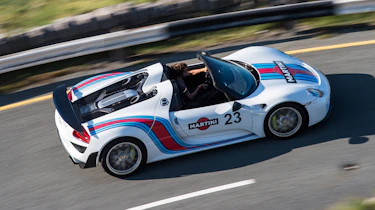
- Electric-only mode is strangely satisfying, even in screaming V8 hypercar
- The engine is a ferocious thing and is every bit the motorsport thoroughbred
- PDK transmission and calibration of the whole powertrain makes driving the 918 a doddle
More reviews
Group tests
In-depth reviews
You already know many of the big numbers and tech specs associated with the 918: the 6:57 Nürburgring lap time, the 875bhp total power output and 944lb ft of torque, the Veyron-chasing 2.6sec 0-62mph, 7.2sec to 124mph and 19.9sec to 186mph acceleration times, on the way to a 214mph tip speed. Plus the Prius-bashing 70g/km CO2 figure.
Those astonishing numbers come courtesy of a 4.6-litre flat-plane crank V8, derived from the race engine in Porsche’s RS Spyder LMP2 car. It’s good for 599bhp at 8700rpm and a 9150rpm redline, working in concert with an electric motor on each axle. The most conventional bit in the equation is the seven-speed paddle-operated PDK dual-clutch transmission.
When you drive a 918 Spyder, you need to get to grips with its numerous modes. ‘E’ for E-Power allows, courtesy of the 6.8kWh battery, a limited (c/12-mile) stretch of electric-only driving and for you to leave the house without irritating the neighbours with the boom of a race-derived 4.6-litre V8 breathing through top-exit exhausts. Not that many 918 owners live on the average cul de sac…
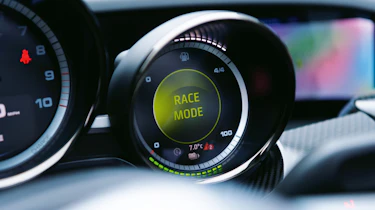
With a fully-charged lithium-ion battery, it’s no problem to power up to 70mph on the motorway (93mph flat out) and then cruise on into town without using the V8. It’s a magical sensation and it also underlines how complete this car’s abilities are. The seamlessness with which it can segue from electric to hybrid to pure internal combustion and back again is remarkable.
God only knows how hard it’s been to fine-tune the calibration of all the different control software to make this possible, but it works brilliantly. If there’s an issue, it’s that once you’ve driven on urban roads in near-silence, you rather begrudge the moment when you have to switch the raucous V8 on to generate some more juice. Heresy, I know. To be honest, I never thought I wanted or needed a supercar that could drive silently through town, but now I’ve driven one I’m not sure things will quite be the same again.
I love the way a fast, exuberant and noisy supercar stirs your soul and tickles your adrenal glands. But to experience how relaxing it is to cut the engine and surge through a city for up to 20 miles on electric power alone, while watching expressions of wonder and bemusement from passers-by, makes those life-affirming moments when you wind the race-bred V8 to its 9150rpm limit all the sweeter.
Those moments require that you then turn the rotary control from ‘E’ for E-Power to ‘H’ for Hybrid, ‘S’ for Sport Hybrid, ‘R’ for Race Hybrid or finally pushing the little red button that engages Hot Lap for an all-out battery-depleting hoon. As soon as the switch clicks to ‘S’, the 4.6-litre V8 fires in an instant, its hard, ballsy blare erupting from the top-exit exhausts that protrude through the mesh engine cover.
The V8 engine is so, so sharp and sounds incredible as it rips up to 9150rpm. It sounds like a pure racer, but the massive low and mid-range hit gives it the feel of a car with twice the cubic capacity. In combination with the fastest, most incisive PDK ‘box you can imagine it makes for relentless and overpowering performance. The numbers might suggest otherwise but the Porsche, for the most part, feels faster than even the P1 thanks to its instant rush of torque.
The PDK is annoyingly good, punching up and down the seven speeds with precision and spookily making up- and downshifts exactly at the moment the very same thought crosses your mind.
Ride and handling
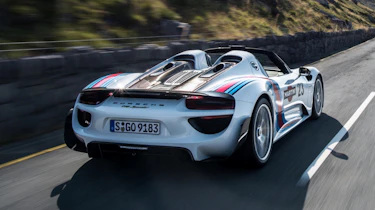
- The 918 is vastly less intimidating than you imagine and extraordinarily responsive
- On the road it’s also compliant and wieldy, molding unexpectedly well to more challenging UK roads
- For a hypercar, the usability and cohesion of this package on the road was perhaps the 918’s most impressive achievement
The 918 Spyder is every bit the hypercar, with its engine and battery bolted to a carbonfibre tub with carbonfibre subframes. That said, it eschewed pushrod-style suspension as used in the Carrera GT for more conventional double wishbones, springs and dampers, with PASM electronically-controlled adaptive dampers. Steering and agility are handled by an electromechanical rack, rear steering and torque vectoring across both axles.
The famous ‘Weissach Package’ added RS Spyder lightweight magnesium wheels, aero winglets at the rear, exposed carbon for the wing, roof mirrors, diffuser and windscreen surround, itanium chassis bolts, a magnesium roll bar and often, a slightly garish 917 racer-inspired livey. Overally weight saving was 41kg, from the quite hefty 1674kg standard kerb weight.
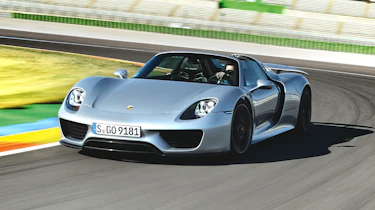
Contrary to your expectations, you can push a 918 early doors. Literally within a mile I’m chasing the balance of the car, feeling it shift from neutral to the faintest hint of stabilising understeer if I turn in too fast, or getting a gentle shimmy of oversteer as the rear Michelins yield to the assault of all that torque. As the pace car driver pushes ever harder and the circuit begins to make sense, I dig deeper into the Spyder’s reserves of performance, braking later and harder, turning in with more commitment and getting back on the power sooner and with more insistence.
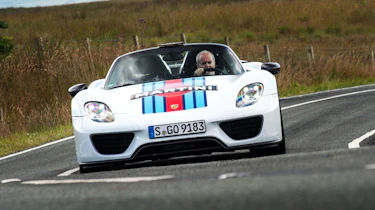
The brakes are impressive too. You can still feel there’s more than one thing going on when you press the pedal, but the way the job of slowing the car is switched between regenerative braking (up to 0.5G purely using the resistance of the motors when you back off the power) and the PCCB discs and calipers is pretty miraculous. Brake feel isn’t absolutely perfect, but it’s nothing you can’t compensate for with familiarity and sensitivity. That McLaren chose not to attempt to incorporate regen braking into the P1 hints at the scale of the technical challenge it presents.
The 918 also features rear-wheel steering, much like that on the 991 GT3. It certainly gives you a sense of hyper-agility without the need for super-quick Ferrari-style steering, the Spyder changing direction without hesitation. You get a very slight suggestion of oversteer through the seat of your pants as you initiate your steering input, but once you learn that that’s just a split-second phase, you relax into it and let the car find its own stance and balance.
Likewise, you feel the motor on the front axle come into play when you push beyond a certain point in the throttle’s travel (there’s a motor for each axle, while the V8 drives the rear only), but again it’s an almost imperceptible phase and certainly doesn’t interrupt your flow or unsettle the car. In fact it’s quite the opposite, for with practice you can use it to augment the Spyder’s poise and traction from apex to corner exit. When it comes to disguising its weight, the 918 Spyder is a magician, so although the spec sheet quotes a kerb weight of over 1600kg for either version, your brain says it’s 300kg lighter.
On exacting Welsh roads, the 918 Spyder had the number of the McLaren P1. It feels so planted, so calm and so secure, you can exploit its unhinged violence more frequently and for longer. The steering is heavier than the McLaren’s and feels a little less alert about the straight-ahead. But it has great feel and precision on lock and lets you know exactly what the front end’s doing which, in turn, engenders a feeling of absolute confidence. The sheer coherence of the chassis – the way the damping and brakes (with built-in regen but fine pedal feel) support the astonishing drivetrain – is almost spooky.
Anglesey track test against the McLaren P1 – Jethro Bovingdon
The Porsche is heavier than a McLaren P1 and feels it. The steering requires much more force, it’s slightly more reluctant on the way into turns and it just doesn’t quite have the P1’s freakish levels of response. But the engine. Wow, the engine. The 4.6-litre V8 is so sharp at the top end but with the electrical boost it feels like a 10 litre in the mid-range. The throttle response is stunning and the instant, precise, scalpel-sharp power is of such quality. The P1 has terrifying theatre but the 918’s drivetrain is more polished and gives an even greater sense of urgency.
The gearbox adds to that ultra-precise feel. It’s so fast and the paddles feel more like microswitches, yet somehow the process feels mechanical. Of course the 918 is four-wheel drive and to a certain extent it loses and scores over the P1 where you might expect: there’s a little more turn-in understeer and a little more traction to lean on. However, that sells this immensely stable yet hugely adjustable car a million miles short. Like the P1, its greatest trick is to make close to 900bhp feel just about right.
It never feels overwhelmed but neither do you feel any in-built fudge to protect you from the power. It gives you everything clean and true, and you can exploit every joule without fear. The four-wheel drive, the torque vectoring, the electrical assistance... it’s almost invisible. You just drive, pushing beyond a little understeer here, provoking oversteer there, playing with the 918 like you might a Boxster S.
If you want a hypercar to take to trackdays, buy the P1. It’s lighter, more responsive and kinder to its tyres (amazingly so). But don’t for a second think it outmanoeuvres the Porsche. The 918 has more mechanical grip in lower-speed corners and, incredibly, it carries just as much speed through the quickest corners here, too. It’s also massive fun. They both are. It’s great to know that the pursuit of extreme performance isn’t at the expense of simple enjoyment.
Interior and tech
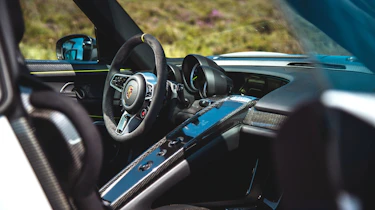
Several 918 firsts latterly appeared on other Porsches. The smaller 360mm diameter wheel for example was used next in the GT3 RS and subsequently found its way into the second generation of 991s. The rotary switch in the wheel that swaps between drive modes is also now familiar in ordinary 911s. Finally the gorgeous seats were subsequently adapted for the 911 GT3 and Cayman GT4 models, though it’s now been replaced in the latest GT3 with folding carbon buckets.
If you step into a 918 Spyder today, you will still be amazed by the quality and sense of exclusivity. The central architectural beam that houses a screen and various ancillary controls is just stunning.
The 918 Spyder features one major difference from its hypercar rivals, and that's hinted at in the model's name. Rather than a fixed roof, the 918 has removable roof panels that can then be stored in the front luggage compartment and doing so transforms the 918 experience - and allows drivers to appreciate the contrast between electric running and the Porsche's vicious 4.6-litre V8.
And naturally, as a Porsche, everything is beautifully trimmed and built with precision. You get a little extra comfort in non-Weissach cars, with extra sound insulation and plusher seats, but those opting for the faster car will hardly skimp on luxury.
Porsche 918 Spyder – values and buying checkpoints
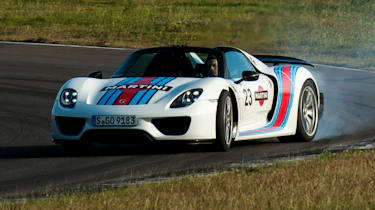
It’s funny to remember today, in a world and market that’s finally woken up to just what an extraordinary car the 918 Spyder is, to consider that to begin with, Porsche struggled to sell them all. At the time of our first drive of the completed production car in early 2014, just half of the 918 cars set to be produced, with a starting price of ‘just’ £647,000, had been sold. Of the holy trinity it is indeed the most numerous but that hasn’t gotten in the way of values jumping these last couple of years. Today you won’t pay less than £1.5million to get behind the wheel, with most priced closer to and upwards of £2million.
One key part of the 918’s constitution has slowed this rise in demand: its battery, or rather market anxiety around the battery’s reliability and how expensive it is to maintain. Its lifespan is said to be between 10 and 15 years, though that’s if it’s been charged and discharged sympathetically. That means driven regularly and kept charged up and not left for long periods with low battery power. A replacement will be over £60,000. Unlike the McLaren P1 and Ferrari LaFerrari, there has yet to be an upgrade option for the Porsche’s battery, that increases range or performance.
Specs
| Engine | V8, 4593cc, plus 95kW (front) and 115kW (rear) electric motors |
|---|---|
| Power | Power 875bhp @ 8500rpm |
| Torque | 944lb ft @ 6600rpm |
| Weight | 1674kg (1634kg Weissach) |
| 0-62mph | 2.6sec |
| Top speed | 214mph |
| Price new | £647,000 |
| Value now | £1.5million-plus |