Renault 5 review - forget it’s electric, it’s simply a great supermini
Almost a year since we first drove it, does the new Renault 5 still impress beyond the hype? Absolutely.
evo verdict
The Renault 5 is the electric car the market has so desperately needed. The antidote to electric SUV behemoths, it demonstrates perfectly that small(ish) urban electric can have huge appeal. Its petrol predecessor owned the school run, the supermarket dash and the short haul commute to the station. The R5 glides silently to fill those tyre tracks.
Dare to read any comment accompanying a Renault 5 post and you’ll read: ‘I really like this, even though it’s an EV’, ‘I would have this, even though it’s an EV’. It’s one of the first electric cars to break through the negative sentiments of what was a seemingly impermeable and sceptical majority. People’s minds haven't changed about EVs because of the Renault 5. They just like the Renault 5 regardless of how it’s powered.
With style, however, has to come substance and the French hatch delivers in spades – it’s this that has sustained the Renault 5’s success in the wake of the initial hype, kept the orders coming in and the factory pumping them out at full capacity. Not only is it irresistibly stylish, but it drives well, it’s nicely appointed, well equipped, technically competent and above all else, relatively affordable, especially now it qualifies for the new Electric Car Grant. Yes, its range could be better and if its battery wasn’t impacted by cold weather quite so much there would be little to criticise the R5 for.
More reviews
Not only do you want it more than the alternatives from Peugeot and Mini, it’s objectively better, a car about which your heart and your head can sing in concert. The Renault 5 is a car from which all other manufacturers struggling with sales could earn an awful lot. Make it desirable, make it good, make it make sense. Ford paying Renault to use the R5’s platform for the next Fiesta tells you just how right the French brand has got it.
Engine, gearbox and technical highlights
- Max of 148bhp
- 252 mile range (claimed)
- Multi-link rear suspension
In many ways the new Renault 5 is entirely conventional. It’s a shade under four metres long, making it shorter than a modern Clio; for a more familiar frame of reference, it’s two centimetres narrower than the gen3 Renault Sport Clio 197, nearly seven centimetres shorter, and over centimetre shorter in height. It has five doors, and four-and-a-bit seats. It sits on an all-new platform, called AmpR, and uses conventional steel construction, though use of multi-link rear suspension is a notch more sophisticated than most B-segment cars.
As tested in top-spec E-Tech 150 Iconic trim (£26,995), it has a 148bhp motor driving the front wheels, a 52kWh battery pack slung underneath for a claimed 252-mile WLTP range, and tips the scales at a chunky-for-a-supermini but not-bad-for-an-EV 1456kg. A hybrid Clio E-Tech comes in at 1323kg, so in some respects the usual EV bloat hasn’t made a huge difference, though it’s not a kerb weight, nor a power-to-weight ratio at around 100bhp/tonne, likely to get Jean Ragnotti hot under the collar. Entry to the Renault 5 range starts with a £22,995 118bhp 40kWh model good for 192 miles of range.
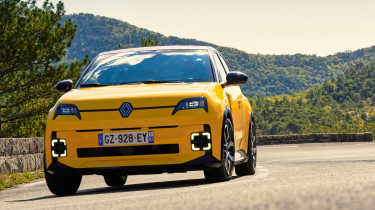
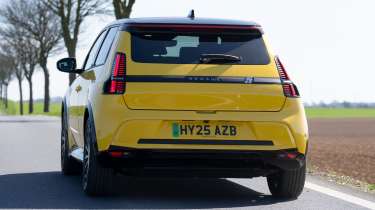
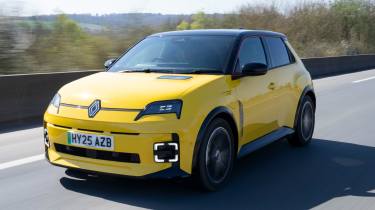
We don’t usually dwell on aesthetics, but given the splash it makes everywhere you go, and given it’s sure to be one of the reasons people will buy the Renault 5 over other electrified superminis, it’s probably worth at least a paragraph or two. To these eyes it looks fabulous, more hot-hatch than most actual hot hatches, and even better in the metal than in pictures. Beyond the raw aesthetic appeal, it’s actually a masterful exercise in design to disguise bulk. You sit high in the Renault’s cabin to the point that you sometimes find yourself eye to eye with crossover drivers at traffic lights.
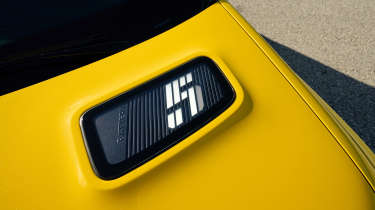
Renault’s keen not to call it a retro design, and while it obviously draws inspiration from its 1970s-1990s namesake, you could strip away all the historical baggage and still be staring at a sharp, distinctive and exquisitely detailed shape in its own right.
Retro references include the basic trapezoidal shape common to all 5s, a hint of the old car’s rectangular headlamps in the new model’s headlights, and the vertically mounted tail lights. Then there are the flared arches, square daytime running lights in the bumper, and an up-and-over detail around the roof that respectively nod to the 5 Turbo’s box arches, fog lights and roof spoiler.
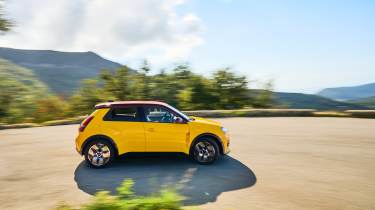
Squint a bit and you could call the hidden rear door handle a throwback to the original car’s inset handles too. You can get the new 5 in black or white, but you’ll be doing the world a disservice if you don’t opt for Pop Yellow, the similarly vivid Pop Green, or the Renault Clio Williams-style Midnight Blue.
Performance, ride and handling
- Exceptional refinement
- Quality if not thrilling dynamic feel
- Plenty of performance for daily use
Perhaps because the Renault 5 is front-drive only, the engineers have programmed some build-up into the way it steps off the mark. There’s not the neck-snap you get from some electric cars, but there’s enough torque to give your hands something to do if you accelerate hard from rest, out of a tight corner or on a wet road. It’ll spin its wheels on damp surfaces with the traction control still engaged, and out of junctions and hairpins too, so it has its moments of hot-hatch enthusiasm and feels good for its claimed eight-second 0-62mph time.
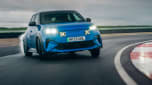
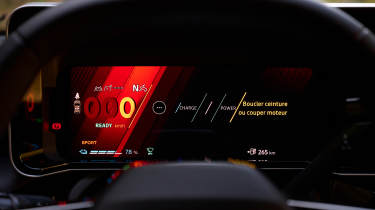
Cycling between Normal, Eco, Sport and ‘Perso’ does the usual driver mode things: with no active dampers the software changes are limited to steering weight, accelerator response, and – in Eco mode – pegging back the air-conditioning, power and top speed to save energy.
After about ninety seconds in Normal you end up switching to Sport for your first few exploratory miles in the Renault 5. Happily, it does also retain whatever mode you set it to when you come back having gotten out and left it. Sport mode, or having the sport setting for the powertrain in the customisable Perso mode, makes the low-end acceleration a touch more responsive while the extra steering weight is welcome. Plus, being an electric car, Sport doesn’t mean the car will bellow brainlessly through villages at 6000rpm in second gear as a dual-clutch, petrol powered hot hatch might.
We’ve now driven the Renault 5 up and down the hills and mountains of the Côte d’Azur, in and around London and across the UK’s myriad concoction of roads from motorways to single lane B-roads. All have proven to be a great place to exercise Renault’s electric hatchback. The surprisingly taut but nicely damped ride feels from a class above and from a more premium car, with a quietness to the damping and a sophistication in how it manages body roll, absorbs poor surfaces at speeds and remains settled. You can sense the stiffness of the structure, which has allowed Renault to fine tune the spring and damper rates to create such a resolved handling car.
> The 500bhp Renault 5 Turbo 3E is a rally icon revived
There is a small trade off for the high speed refinement and that’s at lower speeds when sudden under-wheel jolts come through into the cabin with a rubbery thunk. It certainly doesn't absorb or dismiss every little imperfection.
It’s clear that Renault has set the 5 up as a car primarily to be safe and predictable. The steering is keen but not as quick as a Mini’s and the 5’s weight means it never feels quite as agile as a lighter hatch. Its mass can catch out the suspension over continuous undulations, taking longer to settle. Positive brakes with a natural feel and pedal travel adds to the quality offered by the suspension. There is the sense that all of the behaviours it exhibits have been honed with a detailed approach.
The brake pedal has a welcome firmness, with impressively intuitive integration of friction braking and regen at the pedal, making it more satisfying than the regenerative effect when you lift off in the ‘B’ transmission mode, which isn’t quite strong enough for one-pedal driving. You do tend to leave the regen off and just drive it like you would any other car.
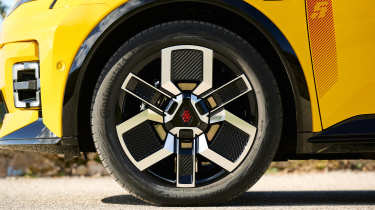
Other than the slightly disconcerting EV sensation of being able to hear the tyres scrubbing around on the asphalt, the Renault 5 still meets you halfway. Grip from the relatively narrow (195-section) and not especially sticky (Continental EcoContact 6Q) tyres is perfectly decent and the low-feedback but well-weighted and sensibly geared steering, smooth powertrain and tied-down chassis mean it’s easy to get into a satisfying flow.
Charging and efficiency
What about efficiency? Being under 1500kg the R5 is relatively lightweight for an electric car. No other EV seems to have nailed that precarious equation of finding the right size battery to provide enough range but also keep the weight down. This is a small car after all, not designed for motorway mile munching.
You’ll struggle to achieve less than 3.7 miles per kWh, which roughly translates to a steadfastly dependable 190 miles of real world driving. Drive like a saint, or keep your driving urban and you’ll see upwards of 200 miles or more on a charge – not quite the stated 252 miles but you can attribute that to flaws in the testing procedures and not the Renault itself. No charging session at 100kW takes more than 30 minutes to get it up to 80 per cent either.
However, those figures are for when the sun is out and the ambient temperature is in double figures. When we tested the car in the autumn the full-charged range dropped to 160 miles and the miles per kWh to under three. With the R5 feeling so resolved and from a class above you feel at ease running with the quicker traffic on faster roads, the car shrugging off any small car sensations. Which, of course, means you chew through more kWs.
Driver’s note
‘You get a sense in every compression it goes through and every twist of the steering wheel that this car’s behaviour and how it communicates with its driver has been agonised over and refined by people who really care and know what they’re doing. It’s not an outright thrilling driving experience because that’s not what its purpose is, but it is a quality driving experience.’ – Ethan Jupp, evo web editor
Interior and tech
- Excellent seats
- Largely quality feel
- Intuitive user interfaces
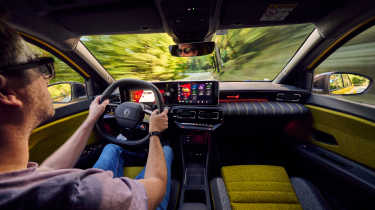
The R5’s vibrancy isn’t confined to its exterior design. There’s recycled fabric and colour-coded piping and stitching splashed across the seats, door cards and dash. The seats are absolutely fabulous, looking like a modern interpretation of the mad, Gandini-designed 5 Turbo bucket seats, with prominent bolsters (a feature across the range, and something the old Renault brochures once proudly boasted as having a Petale design) and an H-shaped graphic also referencing the seats in the Turbo.
A blocky digital instrument pack and Google-based infotainment display is hardly novel in 2025 but could be considered a callback to the Turbo’s dash pod, though the original never got a ChatGPT-powered digital assistant called ‘Reno’.

The padded area in front of the passenger (leatherette or a denim-style material on other trims) is a more direct reference to the original’s ridged dashboard, and if you’re being generous, the steering column-mounted gear selector (which can be personalised with various 3D-printed designs) might be called a descendent of the earliest 5’s dashboard-mounted gear lever.
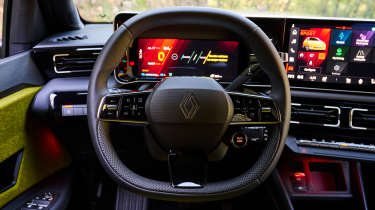
Even ignoring the look, first impressions are pretty good. You feel a little perched even with the seat adjusted low, but that’s been a feature of Renault hatches, hot or otherwise, for a while and not helped here due to the battery sitting under the floor. But the seats are supportive, the fabric feels great, and good height and reach adjustment for the wheel ensures there’s no bother finding a decent driving position, though with the seat set for an average height driver, space for those behind is already getting tight.
That column-mounted shifter makes the right-hand side of the wheel feel a touch busy, and setting the wipers to full monsoon rather than selecting Drive didn’t happen only once. But, being an EV, this is about the extent of your interaction with the transmission. There’s a little dial on the wheel labelled ‘Multi Sense’ and this is your driving mode selector.
Adding to the sense of quality of the Renault's 5 underpinnings, so too does the interior add to the premium quality feel. Compared to the cheap poundland interiors of all crossovers and small SUVs the Renault 5 demonstrates that a lower price point doesn’t have to mean a lower level of quality, whether that’s how the car drives or the fit and finish of the materials. The small, and most medium sized cars, from Germany’s big three car manufacturers claim to build their models to the same, if not higher quality standards, of the Renault 5 but simply can’t match this latest French supermini.
Price and rivals
For the Renault 5 the key competitor is the electric Mini Cooper E at £26,905, along with others including the Fiat 500e that starts at £20,995, Peugeot’s £30,105 E-208, and the £27,505 Vauxhall Corsa Electric.
It’s a bit of a motley assortment, but common themes include pricing that stretches from £22,995 basic (for the 119bhp standard range car) to £28,995 for a 148bhp 'iconic five'. Given that the R5 falls well under the £37,000 threshold, the 5 is also part of the Government's £650 million Electric Car Grant, giving every new buyer £1500 off at the point of purchase. That means a basic 5 can leave a dealer costing the buyer just £21,495.
With the 5 Remault has left the door wide open for the 217bhp Alpine A290 as the hot hatch offering in the sector, and if the 5 feels a little too mild, another seventy horses and a chassis tuned with slightly more adjustability goes some way to fixing that. What you do get with the 5 E-Tech is an immensely likeable electric hatch that drives better than it needs to, provides up to 200 miles of real world driving depending on conditions and, for the time being at least, turns more heads than a supercar. Regardless of the colour it is painted.
| Motor | Single e-motor, front-wheel drive |
|---|---|
| Power | 148bhp |
| Torque | 181lb ft |
| Weight | 1456kg (103bhp/ton) |
| Tyres | Continental EcoContact 6Q |
| 0-62mph | 8.0sec |
| Top speed | 93mph |
| Basic price (before grant) | £22,995 |