Lamborghini Countach LP400 (1974-1978) review – the ultimate supercar?
The Lamborghini Countach set the template for all supercars that would follow. But does the real thing live up to the legend?
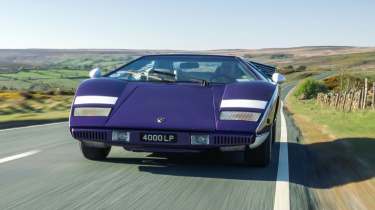
The question as to which car was the first ever supercar is one of those enjoyable debates that can never be definitively answered. But the definitive poster supercar will always be the Lamborghini Countach.
The Countach was first revealed at the 1971 Geneva motor show and made even the most exotic of contemporary cars look old-fashioned. Including the Lamborghini Miura. Barely five years on from the Miura’s debut, Lamborghini had ripped up its own blueprint and redefined the supercar even before rivals had come up with their answers to the original.
Okay, that’s not quite true; in 1967 De Tomaso launched the Mangusta, and the Maserati Bora was also revealed at Geneva in 1971. But the Countach looked like it had landed from another planet. This was car design as art, an absolute visual statement clothing a tubular chassis cradling one of the world’s most charismatic engines. Whether it was actually the fastest car in the world or not, it didn’t matter – it looked like it was.
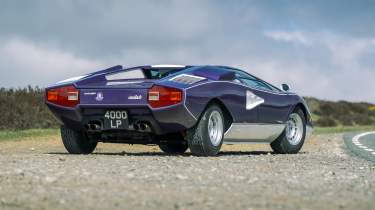
The name, as the story goes (and like all the best stories, there’s more than one version), came when a technician saw the show car as it was being hurriedly prepped for Geneva and was so awestruck he exclaimed ‘Countach!’ – a word in the local Piedmontese dialect which doesn’t have direct English translation but is something along the lines of ‘cor blimey’ – only a little more emphatic.
There was, however, a sizeable gap between the show car’s debut and the production car. The Countach eventually started rolling off the line in ’74, with Maserati’s Bora reaching customers a few months after the ’71 show and Ferrari’s first mid-engined, 12-cylinder production car, the 365 GT4 Berlinetta Boxer, on sale in ’73. An unfortunate by-product of that delay was that it hobbled Miura sales while prospective customers hung on for the Countach.

Still, when it did arrive, it made a serious impression. The design was much changed from that ultra-clean original show car but it was not a jot less striking. It seems incredible that Marcello Gandini designed the beautiful, curvy Miura and then the radical, wedge-like Countach. He did say, though, that he thought the Miura was too easily accepted and not what he’d have designed had he been given a completely free hand.
Dramatic as it was, the Countach didn’t come out of nowhere. In fact, you could consider it the result of going to a wild extreme and then winding it back a bit. At the Turin show in late 1970, a few months before the alien Countach was beamed down onto the Bertone stand at Geneva, Gandini and Bertone presented a car that subjugated practicality to style so completely that it made the car from the opening credits of The Pink Panther Show look like a sensible SUV. The Gandini-designed Lancia Stratos Zero was knee-high, so low that normal doors were redundant. The Countach was almost conventional compared with the Zero.
Lamborghini Countach in detail
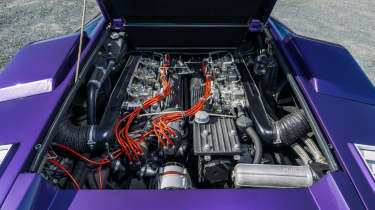
Everything bar the basic V12 engine changed from Miura to Countach: the look, the fundamental mechanical layout, the method of construction… Even the way it came about was turned on its head. The young engineers at Lamborghini had presented the naked chassis of the Miura first, but with the Countach the exterior was shown first. This created issues, not least with engine cooling, resulting in add-on scoops and extra vents that changed its look but didn’t dull its impact, maybe even added to it.

The Miura took barely a year to turn into a production car but it took Lamborghini three years to make a road car out of the Countach. During that time it changed from the LP500 to the LP400 – from a 5-litre V12 to the familiar 4-litre, and from 440bhp to 375bhp – though the claimed top speed was trimmed by only 5mph to ‘185mph-plus’. LP stands for Longitudinale Posteriore, describing the longitudinally mounted engine position behind the occupants, and 400 for four litres.
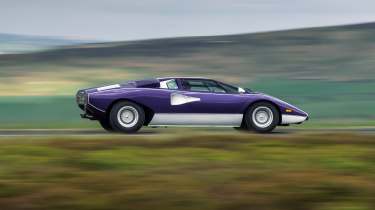
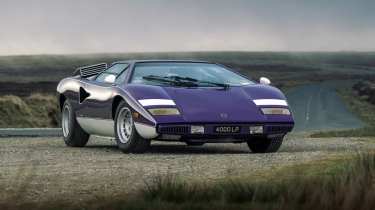
The smooth show car’s side-gills became side windows with air intake boxes above, and the body sides gained NACA ducts, which also gave somewhere to hide the door buttons and fuel fillers. A periscope rear-view mirror was intended, hence the shallow channel in the roof panel, and although the idea was abandoned, the small window and roof channel survived on the early cars.
Driving the Lamborghini Countach LP400 – John Barker
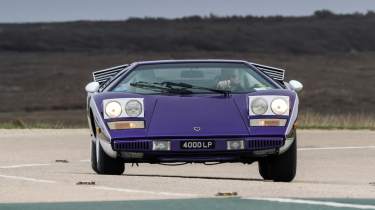
I’ve driven an LP400 before, but that was 30-odd years ago on a Performance Car cover shoot that also included a Ferrari Daytona, F40 and the new Jaguar XJ220 – four generations of the world’s fastest car (claimed). My abiding memory of the Countach, which I think was for sale for about £30k, was that there was so much mechanical busyness from the V12 as the revs climbed that I bottled out well short of the 7500rpm red line.
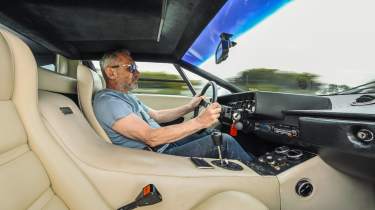
Today, being a chunk older, the flexibility required to pop open the scissor door, slide over the fat sill, fall into the cradle-like driver’s seat and then hook my legs in will probably leave an equally strong impression. For all its presence, the LP400 is not a big car. Installed, you feel very much at the pointy end and, even if you’re only 5ft 8in, like you’ve picked a size too small.
As James says, the seats look like the scoop shape left behind in a tub of vanilla ice cream, but they should have gone for a second scoop: the laid-back screen and sloping door bring the A-pillar almost to your forehead, your hair brushes the headlining, and the rear-view mirror is set too low. The solution is to slouch, stylishly. Completing the challenge, the Countach has one near-useless door mirror, the most awkward handbrake in the world, and while the shallow instrument pod is attractively packed with tiny, watch-like instruments, they are all totally unreadable on the move.
The layout invented by Lamborghini’s engineers has the V12 pointing backwards and the gearbox filling the transmission tunnel so that the gearlever connects to the nose of the ’box. Drive has to go back past the engine to a rear differential, but all the major masses are within the axles. It’s a very direct gearshift, too. Not the lightest, but very positive and much sweeter if you rev-match and heel-and-toe on downshifts.
The V12 is an immense presence, tactile and aural, drawing breath through six twin-choke carburettors. It has a much more gravelly delivery than a 12-cylinder Ferrari engine of the period, and its sonic signature is very familiar because it remained the same through all of its upsizings, right up to the last and biggest, the 6.5-litre in the Murciélago. The higher the revs, the more treble you get and the more vividly you can imagine all the valves and springs and gears and chains and everything else whirring. And, just like the first time, I consistently bottle out of going all the way to 7500rpm.
The unassisted steering starts uncomfortably heavy but proves quite manageable on a flowing road, hence the small steering wheel, while the car beneath you feels nicely biddable, its mass well-damped. You’re always aware that there’s a big lump of engine just over your shoulder, though… There’s a decent sense of connection with the tarmac, but that connection could have been even greater: the LP400 was supposed to get Pirelli’s new low-profile P7 but it wasn’t ready in time, so the teeny tiny 14-inch alloys are fitted with 205/70 and 215/70 XWX Michelins.
‘I find loads of feel in the steering, and compared with a later QV model I’ve driven, I find this a bit easier to read. You can definitely sense that there’s a lot of weight behind you – I didn’t push it beyond six or seven tenths – but I loved driving it because the car communicated very well what was going on.’ - James Taylor, evo deputy editor
There’s an inescapable pleasure-versus-pain ratio with the Countach, though. When it’s good, it’s very, very good, and when it’s not it all feels like a bit too much effort. And then you get out and it has instantly drawn a crowd and you look back and you see this incredible car – no less incredible now than it was in 1974 and, indeed, at Geneva in ’71.
‘Driving back to the hotel at the end of the photoshoot, the Countach was really enjoying the cool, clear evening air. It felt so strong, so angry and sharp and aggressive in a way that other supercars from this era don’t. But most of the time everyone else enjoys it probably more than you do. It’s the absolute AAA-list rockstar of the decade, but not necessarily the one I would want to drive home in. Knowing a friend who owns one is probably the best situation to be in.’ – Richard Meaden, evo editor-at-large
Values and rivals
Such a small number of LP400s were made (reportedly 157 cars) and that rarity, plus its historical significance, means values have become scarily elevated. Exceptional cars can top £1m, and according to The Classic Valuer, the lowest price paid for an LP400 this decade is around £237,000. Median price is around the £460,000 mark and a car in sub-concours condition which drives well can expect a valuation of around £600,000.
The Countach is such a singular car that direct rivals are few. Ferrari’s Berlinetta Boxer is perhaps the closest but it has a character closer to a grand tourer than the Countach’s racing car crossed with a concept car. The Boxer is a wonderful machine and more polished and well-resolved overall though the Countach is more exciting and dramatic. Maserati’s Bora is even more of a relaxed, practical grand tourer in ethos.
Other ’70s-era supercar stalwarts include the Aston Martin V8 Vantage, Porsche 930 Turbo and BMW M1 – the latter of which itself began life as a project engineered by Lamborghini. Values of all of the above top six figures for driveable cars in good condition, with some Boras dipping below the six-figure bracket at the time of writing.
Specs
| Engine | V12, 3929cc |
|---|---|
| Power | 375bhp @ 8000rpm |
| Torque | 266lb ft @ 5500rpm |
| Weight | 1300kg (293bhp/ton) |
| 0-60mph | 5.4sec |
| Top speed | 180mph |
| Price new | c£18,000 (1974) (£175,000 today) |
| Value now | C/£500k-plus |