Porsche 911 Turbo (1974 - 1989) review – why the 930 was the original 911 wild child
Arriving as the supercar began to reach its stride in the mid-1970s, the 911 Turbo has always been a thorn in the side of the exotic establishment
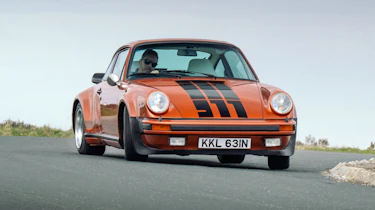
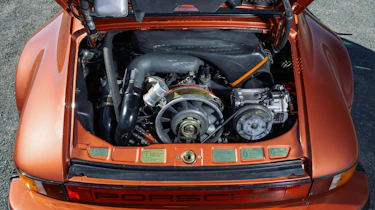
As the 911 RSR Turbo and 917/30 were proving the performance potential of turbocharging for Porsche in motorsport, Stuttgart wasted no time in strapping a large Kühnle, Kopp & Kausch turbocharger to the road-going 911’s 3-litre air-cooled flat-six. The result was the first in a 50-plus year, seven-generation (so far) dynasty of 911 Turbos. Then as now, it was the perennial thorn in the side of the exotic establishment, offering supercar performance but with the (relative) subtlety and usability of a more everyday sports car.
Introduced in 1974 in 3-litre 260bhp form, it was upgraded in 1977 to 3.3 litres and 300bhp, with the addition of charge-air cooling. The 930 served all the way through to 1990, but not before (finally) receiving the G50 five-speed transmission in 1989.
The 930 is an icon of the era – a symbol of success in both the 1970s and the 1980s – with its broad hips and whale tail some of the most recognisable performance car iconography of all time. It also had a fearsome reputation, rarely suffering the antics of the talent-lacking yuppies with which they were popular. Reacquaintance with an early 911 Turbo during our 1970s supercar Eras test proved an eye-opening experience.
Porsche 930 Turbo 3.0 – evo Eras test, John Barker
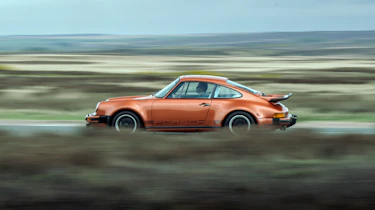
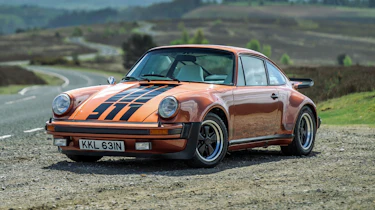
Up close with this immaculate 911, I can’t decide if I’ve stepped into a period Porsche brochure or I’ve been sucked into an AI-generated image prompted by the question ‘What did crazy Porsche 911s look like in the mid-’70s?’ Stephen Ozin’s 930 Turbo is so perfect yet so unusual, I could believe either.
That copper colour is officially Salmon Metallic and those massive ‘911’ decals are officially ‘safety stripes’. How so? They make the car more visible in the mirrors of cars in front on the autobahn or race track, apparently. Better than a blinking indicator, I guess.
More reviews
In-depth reviews
- Porsche 911 Carrera GTS review – why Porsche's T-Hybrid is also one of the best
- Porsche 911 Targa review – the opposite of a purists 911, but still superb
Long term tests
Reviews
- Porsche 911 Challenge review – this £200k racer might be the most fun 911
- Gunther Werks Turbo review – part Porsche 911 Turbo, part hypercar
- Porsche 911 GT3 S/C review – does a convertible GT3 really make sense?
- Porsche 911 (992.2) GT3 Manthey Kit review – a road-legal race car with a warranty
- Porsche 911 GT3 RS Manthey kit review – the ultimate Nürburgring toy tested to the limit
If you think the exterior is striking, brace yourself because it’s just softening you up for its interior. Swing open the door and you’re greeted by seats trimmed in ice-white leather and the floor trimmed in shaggy brown carpet made from the pelts of a couple of dozen teddy bears. Crazy.
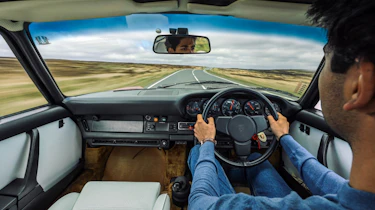
Then you drop into the driver’s seat and it’s all totally familiar, which is remarkable given that this car is exactly 50 years old. That’s the power of morphing slowly away from the original design, decades of gradual evolution. It probably also helps that the ‘classic’ 911 look, as epitomised by this generation of 911, is still very present thanks to companies like Singer, which have gently exaggerated the look of these cars.
Some things do feel different, though. The majority of classic supercars have offset pedals, but when you first get into the 911 you wonder why the clutch pedal is so stiff: that’s because the offset is so great you’re pressing the brake. Then there’s the gearshift. The gearlever is long, bent and sprouts from a rubber gaiter on the floor under the dashboard, while the knob on top shows it has only four speeds. Four? In 1975? Yes. And it’s enough.
The 911 Turbo comes with a reputation. It earned the nickname ‘the widow-maker’. Seems a bit dramatic for a car with ‘only’ 260bhp but we’ll see. For now, the Porsche feels an awful lot less intimidating than contemporary supercars, being so much smaller and narrower, and while you might not feel so low-slung, the seats offer superb support and visibility is excellent. And you get two door mirrors, and they’re a decent size so you can actually see things in them.
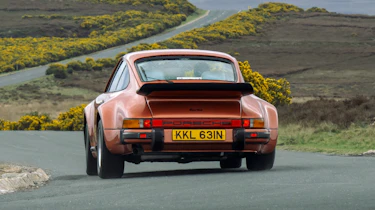
There had been turbocharged production cars before the 911. The very first was the evocatively named Oldsmobile Jetfire (1962) and in Europe a decade later we had the BMW 2002 Turbo. The 911 really got the ball rolling though, and not just in terms of production cars.
So how does it go? Well, forget today’s subtle and effective turbos that boost from hardly any revs and behave almost like superchargers. Instead imagine that pressing the throttle to the floor is like lighting the fuse on a firework. Not much happens low down but all that changes as the tacho needle swings for 3000rpm.
Suddenly it feels like a giant hand has swept in from behind and is shoving the car up the road, and that push just keeps on coming. The long gearing necessitated by having just four ratios seems to contain the turbo’s explosive force and the 911 reels in the horizon with seemingly inexhaustible boost, those four gears perfectly chosen to make the most of 260bhp.
The steering is heavy, surprisingly so, but there is some dynamic malleability in the sense that you can modulate the throttle to manipulate the tail-heavy weight distribution and use weight transfer to effect some change in the cornering line. Partly this is because the Turbo is narrow and light and you have the room, partly because it’s on low-profile tyres.
The 911 Turbo was one of the first cars offered with the option of Pirelli’s first low-profile tyre, the Cinturato P7, and customer demand was so great that Pirelli could barely keep up. The Italian tyre-maker wasn’t the first to market with a low-profile radial, though.
Michelin launched its TRX a year earlier but decided a low-profile tyre needed a specific rim design and, to avoid mis-fitting, took the decision to make its tyre metric in diameter. After an initial flush of interest, TRX became the Betamax of the tyre market, doomed by the need for a specific rim, just like the Dunlop Denovo run-flat tyre before it.
Does the Turbo deserve its widow-maker reputation? With the engine slung out beyond the rear axle line, coming into a corner too hot and having no option but to back off wouldn’t be ideal, particularly in the wet. A more difficult question for the 911 is this: is it really a supercar? It’s easy to fall for how exploitable and effective it is, how it does so much with so little, but is it a bona fide supercar? Perhaps not, but it’d still be wonderful to live with, own and drive.
Porsche 930 Turbo – values and buying guide
The Porsche 930 Turbo is an old car – between 36 and 52 years old at the time of writing in August 2026. The days of cheap 911 Turbos and there being plenty of rough and ready cars that need TLC are long gone. Most that remain are strong examples that have already undergone all the requisite rust remediation, engine and gearbox work.
Spanning almost two decades, with numerous upgrades along the way, values for Porsche 930 Turbos vary enormously. What you can be sure of is that you won’t be paying less than £70,000 for a well looked-after but well-used early example. Desirable options include the limited-slip diff, the G50 five-speed transmission and Sonderwunsch (special wishes) options and features that mark certain examples out as unique. With the right spec, values can rise to as much as £400,000.
Specs
| Engine | Flat-6, 2992cc, turbocharged |
|---|---|
| Power | 260bhp @ 5500rpm |
| Torque | 253lb ft @ 4000rpm |
| Weight | 1195kg (221bhp/ton) |
| 0-62mph | 5.2sec |
| Top speed | 155mph |
| Price new | £15,497 (£123,500 in today's money) |
| Value now | £70,000-£400,000 |