Dodge Charger review – it’s fun, but is it still a Ford Mustang rival?
One of the last muscle cars standing hedges its bets with a choice of pure ICE and pure electric power. We drive both
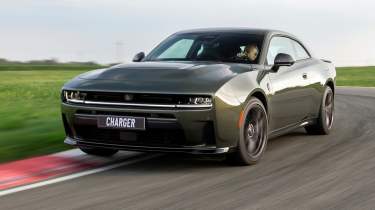
As it celebrates its 60th anniversary, the Dodge Charger is officially on sale in Europe – and that includes the UK. With some caveats: the model is being imported to various European markets via partners KW Automotive rather than being sold through Dodge’s parent company Stellantis’s dealer network. In the UK, it will be available through two retailers, one in Essex and one in Oxford. While some of the previous 2006 - 2023 generation Chargers were independently imported to Europe and the UK, they were not official European-market cars. That’s changed.
One of many changes, in fact. From launch in Europe (order books are already open at the time of writing, with first European customers expected to receive their cars imminently) the Charger will be available with a choice of two doors or four, and all-electric or pure petrol power.
> A Ford Mustang saloon might finally be coming – ‘Mach 4’ four-door rumoured to arrive by 2030
That adds up to four Charger variants, two of which are petrol Sixpack versions (so called because they’re powered by an in-line six-cylinder engine) and two electric Daytona versions:
- Dodge Charger Sixpack R/T: 3-litre twin-turbo, 420bhp, 468lb ft, 0-60mph 4.6sec
- Dodge Charger Sixpack Scat Pack: 3-litre twin-turbo, 550bhp, 531lb ft, 0-60mph 3.9sec
- Dodge Charger Daytona R/T: dual-motor electric, 536bhp, 403lb ft, 0-60mph 4.2sec
- Dodge Charger Daytona Scat Pack: dual-motor electric, 670bhp, 627lb ft, 0-60mph 3.3sec
More reviews
Group tests
- Ravage Alpine A110: France's perfect sports car made even more perfect
- Alpine A390 v Hyundai Ioniq 5 N – are these EV crossovers fun as well as fast?
- Ariel Atom 4R v Ariel Nomad 2 – is grip more fun than slip?
- Ariel Atom 4R v Caterham Seven ‘evo25’: power-to-weight heroes go head-to-head
- Audi Quattro, RS2 and RS3: five-cylinder icons head-to-head
- Who makes the best GT car? Aston Martin v Bentley v Maserati
- BMW 230i M Sport v Volkswagen Golf GTI Clubsport
- Caterham Super Seven 600 v Super Seven 2000
- Great Ferrari hypercars driven: 288 GTO, F40, F50 and Enzo head-to-head
- Hardcore Ferrari V8 specials go head-to-head
In-depth reviews
- Abarth 600e review – electric hot hatch with surprising character
- Alfa Romeo Junior review – small Italian crossover to rival Ford's Puma
- Alpine A110 R (2023 - 2026) review – the flawed but fantastic Porsche Cayman GT4 alternative
- Alpine A390 review – France's flawed rival to the Porsche Macan
- Alpine A110 review – the sports car Lotus should be building
Long term tests
- How lowering the roof on the Abarth 695C is a threat to my driving licence
- Alpina B10: Alpina B10: end of term report
- Alpina B10
- My £200k Aston Martin DBX707 comes with a built-in shower I didn't ask for
- My Audi S8 can’t make me hate it, even if its safety systems are often terrible
- Why you've probably been driving the Audi TT RS wrong this whole time
- Living with this £40k Caterham Seven even makes the KFC drive-thru memorable
- Caterham Seven evo Edition revealed – bespoke 420R joins the Fast Fleet
- It has a VW Golf R engine, but the Cupra Leon is quietly old-school
- Cupra Ateca VZN Fast Fleet test – four months with Cupra's hot crossover
Reviews
- Abarth 695 (2012-2024) review – why we’ll miss Italy’s Mini Cooper S rival
- Abarth 500e 2023 review
- AC Cobra 289 review – British sports car with an American V8 heart built to fight Ferrari
- AC Cobra 378 Superblower MkIV 2021 review – another V8 Cobra, but with a GM heart this time
- Acura Integra Type S 2024 review – a Honda Civic Type R with added restraint
- Alfa Romeo 33 Stradale 2025 review – a rare Italian jewel beyond compare
- Alfa Romeo Tonale 2023 review – 276bhp Speciale version tested
All of the above are available with two- or four-door bodies, and all are all-wheel-drive, with the ability for Sixpack cars to be switched into a purely rear-driven 2WD mode, a little like some BMW M cars, and the Daytona Scat Pack into a dramatically rear-biased Drift/Donut mode.
The battery-powered Daytona model isn’t the big news as it’s already been on sale in the USA for nearly two years. Its straight-six sibling is much fresher on the block, having only been on sale for a few months Stateside. We’re experiencing all variants, albeit briefly, at Stellantis’s Balocco test circuit and the surrounding roads.
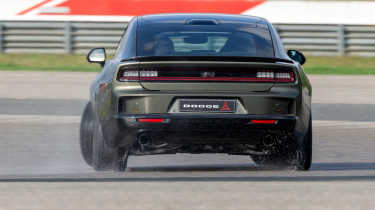
The eighth-generation Dodge Charger: an overview
This eighth-generation Charger is an all-new car rather than an evolution of the long-running previous model. It is built upon Stellantis’s STLA Large platform, which has been designed to accommodate multiple powertrains and is also used by Jeep and potentially in future models from Chrysler, Alfa Romeo and Maserati. All versions of the new Charger are built in Ontario, Canada.
It’s a large car, more than 5.2m long and more than 2m wide. That’s partly for presence, and partly to give it a broad footprint for grip. Dodge describes it as being in ‘widebody’ spec as standard.
That also makes it a roomy car, with five seats and more space for rear passengers than the discontinued Challenger model the Charger also indirectly replaces. As well as having the option of rear doors, the new Charger is also a hatchback. While its overall shape is that of a traditional sedan/coupe, the boot is accessed by a top-hinged tailgate, described by Dodge as a ‘hidden hatch.’ The rear seats can be folded near-flat, too. Part of the Charger’s remit is to be a practical option that could fit into different customers’ lives.
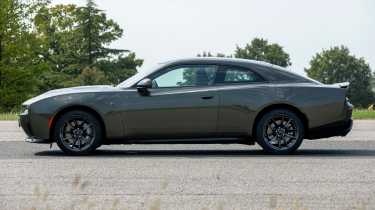
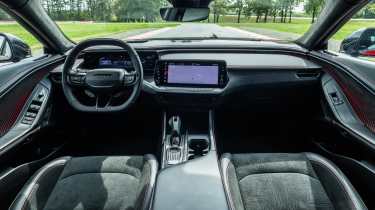
The interior is less dated than the previous generation, with a large touchscreen centre-dash and widescreen digital dials too, with configurable displays. European-spec cars get the larger screen, which is an option in the US, as standard. Helpfully, there are still physical controls for key functions like air-con. There are also still plenty of hard plastics, and perceived quality feels a step behind many European cars, though the gap is closer than in the previous-gen car.
The B-pillar is in a different position depending on the number of doors. In two-door Chargers it’s much further back, and if the seatbelt isn’t clipped into the front seat it’s quite a stretch to reach over your shoulder for it.
More engine options, and special SRT performance versions, may follow in the future. Dodge recently announced a high-performance Super Bee version for the USA to launch in 2027, which will squeeze up to 600bhp from the Sixpack engine.
The petrol version: the Dodge Charger Sixpack
- Cleaner ‘Hurricane’ inline-six replaces V8
- Predictable handling despite high weight
- Feels wide on narrow roads
The new in-line six (based on the Hurricane engine which is shared with other Jeep and RAM models in parent company Stellantis’s stable) is more efficient and cleaner than the previous Charger’s V8 engines for emissions regulations, yet is capable of higher like-for-like performance.
You sense Dodge has been at pains to give it some of the same character of the old V8. Its warm, rumbly sound is enhanced by the interior speakers and since around 88 per cent of peak torque is available from 2500rpm and 96 per cent by the mid-3000s, it has some of the tractable, muscular feel of an eight.
The Scat Pack’s 130bhp power increase comes from different turbos with higher boost pressure, forged pistons, twin fuel pumps and freer breathing for induction and exhausts alike. Both variants use the same eight-speed auto transmission.
Our first experience of the Scat Pack is in a straight line to experience its acceleration and its Launch Control and Line Lock functions, selected from the central touchscreen. The latter, like on the Ford Mustang, keeps pressure in the front brakes and releases the rears to allow the rear wheels to be spun on the spot to warm up the rear tyres, however the system was not working on our particular test car. Launch Control was impressive however, as is straight-line speed in general. It might be a heavy car, with a DIN kerbweight of around 2109kg, but it can certainly get a move on.
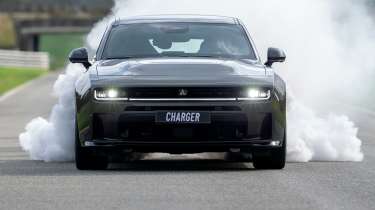
Dodge did not allow us to lap the handling circuit ourselves but instead gave us a passenger ride in a Sixpack Scat Pack with a professional driver. In 2WD mode with all the stability systems switched off, they drove neatly and tidily for the first half of the lap and indulged in drifts for the second. The Charger was impressive in both scenarios. It’s clearly a road car, not a track car, and a heavy one at that, and so the driver gets their braking done early and wipes plenty of speed off before turn-in, using the slow-in, fast-out approach, but the front responds well and the rear follows faithfully. The long wheelbase also clearly makes it very predictable in a tail-out scenario. The suspension feels relatively soft, even with the adaptive dampers in their firmest mode, and there’s a reasonable amount of body movement.
You sense there’s a smidge of lag from the twin-turbos compared to an NA engine but the straight-six is smooth and flexible overall. And so it proves on the road too. The Charger is a stable car which handles well overall. Big bumps are absorbed nicely but there’s a little bit of thumpiness from smaller bumps. All European cars ride on 20-inch wheels, with Track Pack-equipped cars having slightly wider tyres. There’s a little more body movement than most conventional sports saloons but the Charger is tidy overall.
Gearchanges are nice and crisp in auto mode but can be a little more hesitant in manual mode via the small paddles mounted to the back of the steering wheel. The upshift paddle also incorporates the volume controls for the stereo which doesn’t leave you much paddle to get hold of. One of the first times I go for an upshift I change the volume instead, running into the soft rev limiter.
The paddles might be small but the car does feel big, particular on the rural country lanes and old villages surrounding Balocco. You sense it may feel a little too large for many British roads, urban and rural alike.
The electric version: the Dodge Charger Daytona
- Electric Daytona features twin motors and 100.5kWh battery
- Drift mode sends torque rearward for oversteer
- Artificial sound provides speed context, but may become overbearing
Electric Chargers are badged Daytona, with two electric motors, 400V architecture and a 100.5kWh battery with a 550kW peak discharge rate.
The rear drive module incorporates a mechanical limited-slip differential, and we sample it on the skid pan at Balocco where we can experiment with the Drift/Donut mode in the Scat Pack model. This does not make the car purely rear-driven as the front can still come into play for balance but it does send 100 per cent of torque to the rear to initiate a slide. The long wheelbase makes it easy to balance the car on opposite lock and it’s a lot of fun, though a different feeling from a rear-wheel-drive petrol car. In fact, the way the electronics modulate the motors’ torque makes it possible to have your foot flat to the floor while holding the Charger sideways, a curious sensation.
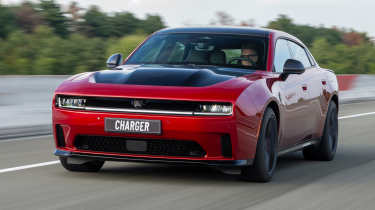
One of the biggest talking points is the Daytona’s sound. It uses a system Dodge calls the Fratzonic Chambered Exhaust, with speakers and passive radiators to produce an artificial sound much like a rumbling, and very loud, V8. You can blip the throttle and ‘rev’ it in neutral, a little like Abarth’s electric hot hatch and Hyundai’s Ioniq 5 N. It’s entertaining – up to a point – and gives useful context to the speed but you may find you wish to switch it off after a while.
The Scat Pack features two track modes, a Drag Strip mode for maximum power for short bursts and a Race Track mode which cools the battery for sustained laps. In a straight line it’s even quicker than the Sixpack Scat Pack, despite being around 500kg heavier.
On the road, it too is a smooth driving experience, avoiding the hair-trigger acceleration of some other performance EVs. The paddles used for manual-mode gearchanges in the Sixpack cars can be used to change the level of regenerative braking in the Daytona, and in the most pronounced mode it’s close to a one-pedal experience in urban streets, while in the lowest regen mode it coasts and decelerates much like the petrol car.
Price and rivals
- UK prices start at £62,688
- Available with electric or petrol power
- Closest rival is the £58,670 Ford Mustang
Prices in the UK, excluding local registration fees but including VAT, will start at £62,688 for the two-door Sixpack R/T, with the Scat Pack variant costing around £4000 extra – it’s worth the extra outlay for the performance and additional driving modes it offers. Four-door versions cost around £1600-1700 more than equivalent two-doors, depending on spec.
The electric Daytona will start at around £77,000 for the two-door R/T, with the Scat Pack variant again costing around £4000 extra. Four-door Daytonas are a little more expensive, with an increase of around £4000 versus the two-door.
The Daytona Scat Pack’s 670bhp makes it the most powerful muscle car on sale today. It’s not necessarily been a car traditionalists have embraced, however. It has been a slow seller in the USA, where it’s been available for nearly two years. It’s a car that’s more interesting and characterful than the vast majority of EVs and it’s certainly not without charm. However the version of the Charger with the broadest appeal is the Sixpack, particularly in Scat Pack spec.
In terms of direct competitors, the £58,670 Ford Mustang is the only other traditional US muscle car still standing. The Dodge differentiates itself by being bigger and more practical than the Mustang coupe, as well as its choice of EV and petrol power in one body style. From Europe, the BMW M3 and M4 could perhaps be considered rivals, in terms of muscular performance and switchable AWD/RWD drivetrain. The BMWs are much more expensive, starting above £90k in the UK, but also have more polished handling and interior quality, as well as being smaller and lighter.
The Charger’s bulky size and left-hand-drive only configuration as well as Dodge’s niche brand status in the UK are likely to make it a rare sight on British roads.
Nonetheless, while there are other obvious compromises, I found myself liking it a great deal. In a world where the traditional muscle car has almost disappeared and creating such cars to fit around modern regulations and uncertain markets is harder than ever, Dodge has pushed to retain as much of the Charger’s spirit as possible while making it a practical option for different types of buyers. You’d need to be a brave buyer to take the plunge but in return you’d be getting a car that’s like little else, and in Sixpack Scat Pack trim, one that’s a lot of fun.
Dodge Charger specs
| Sixpack R/T | Sixpack Scat Pack | Daytona R/T | Daytona Scat Pack | |
| Engine | Straight-six, 2993cc, twin-turbo | Straight-six, 2993cc, twin-turbo | 2x e-motors, 400kW total | 2x e-motors, 500kW total |
| Power | 420bhp @ 5200rpm | 550bhp @ 6200rpm | 536bhp | 670bhp |
| Torque | 468lb ft | 531lb ft | 403lb ft | 627lb ft |
| Weight | 2184kg (195bhp/ton) | 2109kg (265bhp/ton) | 2616kg (208bhp/ton) | 2606kg (261bhp/ton) |
| 0-60mph | 5sec | 3.9sec | 4.2sec | 3.3sec |
| Top speed | 127mph (limited) | 177mph (limited) | 135mph (limited) | 135mph (limited) |
| Basic price | £62,688 (2-door) | £66,725 (2-door) | £77,067 (2-door) | £81,104 (2-door) |