Polestar 3 review – electric SUV updated to face the BMW iX3
Polestar’s stylish electric SUV has big competition now from BMW and Mercedes-Benz, so an update was in order
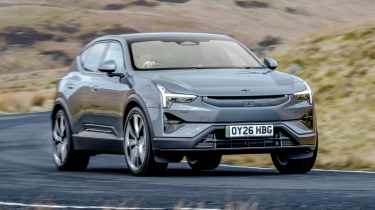
The Polestar 3 electric SUV is one of a number of new models to join the Swedish marque’s range in the last couple of years. But things evolve quickly in the EV space and what was a compelling alternative to the previous BMW iX in 2024, now has the updated longer-range iX and more urgently, the range monster iX3 to contend with as well as the new Mercedes-Benz GLC Electric. An update is in order, then. Enter, the 2026 Polestar 3 800-volt.
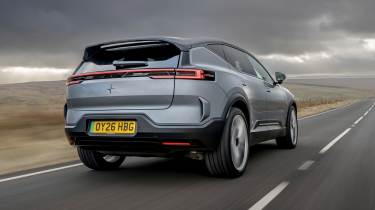
Despite what you might infer from its name, the 3 is larger than Polestar’s 4 crossover. As with all Polestar models, it’s said to possess a performance edge, the firm claiming this c2500kg SUV ‘feels more like a sports car’. It still looks sharp at least, its strong cues offering rare visual distinction in the crowded SUV space, that’s at best anonymous and at worst egregious when it comes to aesthetics. All of the change is under the skin, with a new electrical architecture, upgraded batteries and motors, tweaked dynamics and a nominally lower kerb weight.
Performance, charging and range
- Dual-motor feels plenty fast enough even with a 150bhp deficit to the performance
- Real-world efficiency in summer from 2.8mi/kWh, which equates to c300 miles of real range in the Dual Motor
- 800-volt architecture now means an easy 200kW+ real world charging speed
More reviews
A new electric rear motor, means power and performance are boosted compared to before the 800-volt update. The rear-motor model has 329bhp and 354lb ft, the dual-motor 536bhp and 546lb ft and the flagship performance model a stonking 670bhp and 642lb ft. The Dual Motor now has more power than the old Performance and the performance is the most significantly boosted model, its new output finally making it more powerful than the most powerful 536bhp Polestar 4.
The dual-motor 800-volt model we tested splits the rear-motor and the Performance in terms of potency but offers the best theoretical range. Its 0-62mph time is a very respectable 4.6sec and using what it has available in practice, you really don’t miss the extra punch and sub-4sec 0-62mph time you get from the Performance.
Truthfully, the more relaxed 6.4sec acceleration performance of the rear-motor feels like enough in the real world in our experience. Throttle response can be adjusted with either ‘Range’ or ‘Performance’ settings but is progressive regardless of mode, without the twitchy, jabby feeling of some faster EVs with their overeager throttles.
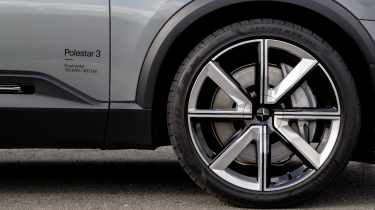
Official range for the Dual Motor is 402 miles, though if you spec the new 22-inch V-spoke alloy wheels, this drops to 394 miles. During our test, which involved precisely zero sympathetic or hypermile-style driving, we saw 2.85m/kWh efficiency. That equates to a theoretical range from 100 per cent to empty of around 300 miles in the Dual Motor.
Given the official range of the single motor and Performance sits at less than 375 miles, whichever way you cut it, the revolutionary BMW iX3 and Mercedes-Benz GLC Electric still have the jump on the Polestar 3 in terms of range and efficiency.
The rear-motor gets a 92kWh battery pack, while the all-wheel drive cars get a 106kWh battery pack, replacing the old 111kWh pack. With the new 800-volt architecture, charging speeds are improved officially by 25 per cent, with a theoretical maximum speed of 350kW. On a 300kW charger without any preconditioning, our test car jumped straight to 220kW-plus. We added 23 per cent charge, or just over 60 miles of real world range, in eight minutes at this speed.
Ride and handling
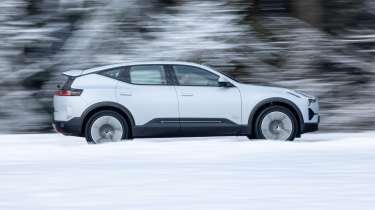
- Worthwhile air suspension standard on dual-motor models
- Dual-motor models feel more agile thanks to simulated limited-slip diff
- Steering and brakes have an upmarket, well-tuned feel
In an effort to make the 3 more engaging and efficient, Polestar has installed a trick ‘dual-clutch’ torque-vectoring unit on the rear axle for the dual-motor cars, taking the place of a conventional limited-slip differential. Developed by BorgWarner, the system also allows the rear motor to completely disconnect while in low-demand scenarios.
A squirt of throttle on the exit of a corner will have the Polestar 3 shimmying around to your chosen direction of travel, and the power isn’t crudely delivered either. While the 3 is not as playful or natural in feel as something like Porsche’s Cayenne Turbo electric, it’s pleasingly neutral when pushing on. Its considerable mass does become apparent during consecutive direction changes, but plan ahead for the weight transfer and it’s easily managed.
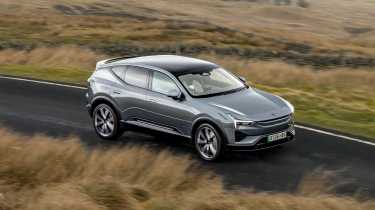
A 50:50 weight distribution and an identical centre of gravity to the Polestar 1 coupe are certainly impressive, but they don’t change the fact that the 3 can weigh as much as 2605kg (the single-motor model can trim this down to 2315kg, mind). While a hefty kerb weight is to be expected from an EV of this size, the laws of physics are hard to beat.
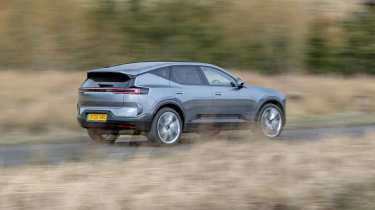
The 3’s Geely-sourced Scalable Product Architecture 2 platform feels more upmarket than many, enabling the 3 to conduct itself with more precision than the 4 thanks to the standard fitment of active air suspension on dual-motor cars, with passive dampers standard on the rear-motor car. The middling ‘Nimble’ mode is the sweet spot, with more control than ‘Standard’ but with a less jarring ride than ‘Firm’.
That said, our car with the new 22-inch wheels telegraphed more disruptions through the chassis than would be ideal. We also took a pre-update car on a road trip across Europe, which proved to be more than refined enough for the job.
The steering software has also been tweaked for this update, with revisions to the anti-roll bars also included. The weightiest ‘Firm’ mode feels the most natural in what is a broad electric SUV. While ‘Light’ is useful during urban manoeuvres, those who pay attention to how their car feels will want ‘Standard’ at least, if not the heavier setting.
The steering isn’t bustling with information, but reassuring heft and good off-centre response inspire confidence, with just enough feedback being sent through the rim to convey a sense of load. The rack is a little slow, but on most roads it suits the 3’s character well.
The Brembo brakes are up to the task, however, with strong regenerative braking blending with the conventional stopping efforts provided by 400mm front and 390mm rear discs. Unlike in some EVs, Polestar gives you the option to turn regenerative braking off entirely, giving the pedal the most reassuring, natural feel, with a longer, more linear action. Despite the slight degradation in feel that it brings, we found that the middle regenerative braking mode is the best for a spirited drive, with the closest replication of conventional engine braking allowing for a more familiar feeling of flow.
Interior and tech
- Cabin quality is pleasingly strong
- Minimal digital aesthetic and software isn’t unattractive…
- … though touch-heavy controls and switchable wheel controls aren’t the most intuitive
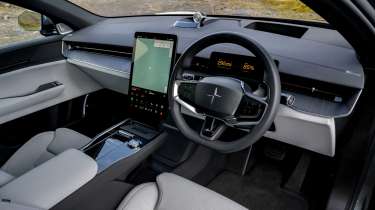
Step inside and it’s immediately clear that the 3 means business, with an abundance of black ash wood, repurposed aluminium and plush leather. In typical Polestar style there’s a focus on sustainability, but the use of higher-end materials gives the 3 a more conventional luxury feel than you’ll find in other models in the range, with fewer bespoke materials and visibly recycled elements.
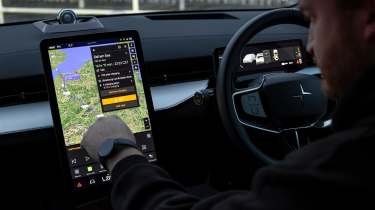
Inside as outside, very little has changed for the 800-volt Polestar 3, at least on the surface. There’s the same minimal 9-inch digital dash and vertical 14.5-inch portrait infotainment display with Android Automotive software. The same tiled user experience remains and with a minimal array of physical buttons, navigating it for even the most basic functions takes time to get used to. Thankfully climate controls are easily accessed at the bottom of the screen, with dynamic and safety systems a few clicks away.
Split-screen functionality and customisable widgets aim to make the user experience more fluid, but more physical buttons for certain controls would be welcome. The software is still attractive, though BMW’s Neue Klasse is now dangerously modern-looking by comparison. The new Nvidia computer should keep the UI snappy for longer, though.
Most frustrating is how you adjust the mirrors and steering wheel, activating via the touch screen then using the universal controls on the steering wheel. Could we not have just had physical controls? In any case, they’re adjustments you rarely need to make, so not something you need to deal with often. Thankfully, the seat and air-vent controls are manual.
The wheel and these controls are actually oddly different to those on the Polestar 4 because of the difference in platform (the steering wheel itself has a higher-quality feel). We’re told the Polestar 4 has more in common underneath with a Lotus Eletre than the Polestar 3.
Piano black trim and hollow-feeling window controls aside, the 3 appears as substantial as you’d hope for a car of this calibre. Build quality is great overall, with most touchpoints feeling reassuringly solid. Insulated glass all round (and active noise cancellation with the £5000 Plus pack) makes for a very refined experience.
Price and rivals
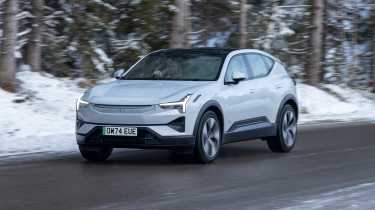
In the not-so-distant past, the Polestar 3 wouldn’t have had many rivals, but things have gone a bit mad over the past couple of years. Now as well as the Polestar, there’s BMW’s iX3 and the Mercedes-Benz GLC Electric to choose from, if range and dynamics are your priorities. Both are £10,000 cheaper at their entry point than the £66,540 rear-motor too but the Polestar is much more stylish than both.
Likewise the larger BMW iX, which you could still have instead, though it starts from £75,405. That said, the base xDrive45 does offer more performance and AWD, compared to the rear-motor Polestar.
The Dual-Motor is the sweet spot, with enough performance and the most range, available from £74,540. The Performance jumps that price to £82,040. That said, prices jump by £10,000 once the current sales offer ends on 30 September 2026, though you can be sure new discounts will be applied given the struggles in the new car market at the moment.