New Porsche Cayenne Electric review - Bugatti performance in an SUV… but why?
Porsche’s Cayenne Turbo Electric is enormously powerful and technically impressive. The question is; who will buy it?

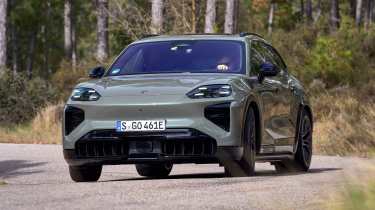
The Porsche Cayenne Electric goes on sale this summer with a two-pronged model line, the base car and the flagship Turbo. The latter boasts power and performance to mulch your insides and have you questioning the laws of physics but can also play the relaxed, luxurious SUV when you dial back the anger.
It wades into the enormously popular premium SUV market, albeit with only two truly direct rivals, the Lotus Eletre and BMW’s iX. It won’t be long before the latter is replaced by the upcoming iX5. In Turbo-form the Cayenne Electric is the most powerful Porsche production car yet made.
The real question, however, is how many will actually pay out the £130,900 Porsche is charging for the top model, or indeed the £83,200 it charges for the base car, given market unease around premium EVs. Especially given the Cayenne doesn’t deliver the leap on in terms of driving range that new models from other brands have of late. It’s telling that Porsche does emphasise the ‘freedom of choice’ it gives its buyers, by keeping the current combustion and hybrid Cayennes on sale alongside the Electric.
Powertrain and technical highlights
- 800-volt PPE architecture from the Macan
- 113kWh battery delivers up to 398 miles of range
- Formula E tech in the Turbo’s oil-cooled rear motor
More reviews
In-depth reviews
- Porsche Cayenne review – sharper than a Range Rover Sport, but more desirable?
- Used Porsche Cayenne (2010-2017) review – not the prettiest SUV, but a remarkably capable one
Reviews
- Porsche Cayenne Coupe Electric review – Ferrari Luce too pricey? Porsche has a solution
- Porsche Cayenne GTS Coupe 2024 review – the SUV that might tempt you out of an RS6
- Porsche Cayenne Turbo GT (2021-2023) review – can it take on the Aston Martin DBX707?
- Porsche Cayenne Turbo S E-hybrid review - more is more, is less
- Porsche Cayenne Turbo review and pictures
- 2013 Porsche Cayenne S Diesel review
The Cayenne Electric runs on a development of the 800-volt Premium Platform Electric architecture we’re already familiar with in the Macan, albeit with some upgrades to the battery setup. The 113kW pack features modular replaceable cell pouches for improved repairability. The pouches also sit in a sandwich of liquid cooling to improve efficiency and performance.
Like the new BMW iX3, the Cayenne Electric can charge at a peak of 400kW and hit 80 from 10 per cent in 16 minutes. Newly introduced for the Cayenne Electric too is the option of wireless inductive charging. This consists of a pad you can install in your garage, that starts charging the car at 11kW once you position the car above it, without any need for plugging in. And yes, it’s fully pet-safe. The standard Cayenne Electric has a WLTP-certified 398-mile average range, while the Cayenne Turbo Electric offers 387 miles of range. To improve range the Cayenne Electric has active flaps in the nose that open and close depending on prevailing cooling and aero demands. The Cayenne Turbo Electric also has active blades that extend from its flanks rearward at speed, to nominally reduce drag.
The Cayenne electric in all its current forms features a motor on each axle. In the Turbo Electric the motor has Formula E-inspired direct oil cooling tech. This flows coolant along the copper windings, instead of through a jacket outside the stator, keeping the motor cooler under higher loads. This informs its massively increased output, as well as its 600kW peak regenerative braking ability. Porsche claims 97 per cent of braking needs will be handled by the regenerative system for most drivers.
While the standard Cayenne Electric is good for 402bhp in standard form (436bhp with the push-to-pass button pressed), the Cayenne Turbo Electric has 845bhp, or a massive 1140bhp with the boost function.
As standard all Cayenne Electrics run on air springs, though Porsche’s hydraulic Active Ride system is a £6799 option on the Cayenne Turbo Electric (and now the Cayenne S). Also optional (perhaps concerningly given the Turbo’s £130,000 starting price) is rear-axle steering, for £1389. On the Turbo, you get the Porsche Torque Vectoring Plus limited-slip diff as standard. Carbon ceramic brakes are also an option, at £7592 while Pirelli P Zero R performance summer tyres come optionally if you select 22-inch wheels – the SportTechno multi-spokers on this car, with the Pirellis, are £3174.
Performance and 0-62mph time
- Veyron-matching 0-62mph in 2.5sec in the Turbo
- Cayenne Turbo Electric has 1140bhp and 1106lb ft in launch mode
- You rarely max out the Turbo’s regenerative abilities on the road
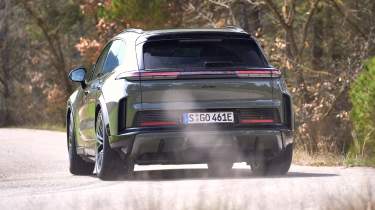
The ferocity with which the new Porsche Cayenne Turbo Electric tackles its 911 Turbo S-matching 2.5-second 0-62mph run makes you only want to undertake it once. And it’ll deliver those numbers repeatedly within reason. Its 1140bhp and 1106lb ft in launch mode (845bhp standard) make it the most powerful production Porsche yet, and renders the Lotus Eletre R a silver medalist in the hundred-click dash. Its rear axle alone can in rare conditions output almost twice the power of the original 521bhp Cayenne Turbo S of 2005.
On the road I don't feel the full force of the 600kW regenerative abilities – the digital regen’ needle only swings three-quarters of the way around the dial with the most severe braking I dare throw at it. Acceleration and braking between mountain hairpins in the Cayenne Turbo Electric is accompanied by the new slightly spurious synthetic Electric Sport Sound suite, that emulates the sound of a V8 when the drive mode is set to Sport Plus.
Range and efficiency
The flip side of using all that performance is what it does to the range. Over the course of our time in the car, which admittedly was not the type of driving these cars will typically experience, we saw an indicated range of about 250 miles, or efficiency figures in the region of 2 - 2.5mi/kWh. We’d be disappointed if away from the Pyrenees, real-world situations didn’t see Cayenne Electrics beat Lotus’s Eletre further and deliver closer to 3mi/kWh or in the region of 300 miles of real world range. Especially in a world where new models from BMW and Mercedes are getting closer to 400 miles of real world range. What it would drop to when making use of its 3.5-ton towing capacity, that you get with an off-road pack, I dread to imagine…
Happily it does at least charge quickly, accepting juice at up to 400kW. For reference, the updated Taycan is nice and swift when it’s charging at 270kW. Porsche will also provide buyers with three years of Porsche Charging Service Plus, reducing costs to 39p/kWh at Ionity public chargers and Porsche Centres.
Ride and handling
- Composure and agility are hugely impressive
- … albeit contingent on ticking some expensive option boxes
- The most refined and luxurious Cayenne yet
The (£7592) ceramics are strong and pedal feel is at least more consistent than the Taycan. I am however feeling the majesty of the rest of the Cayenne’s arsenal of tech – this is Hadron Collider levels of physics law-bending.
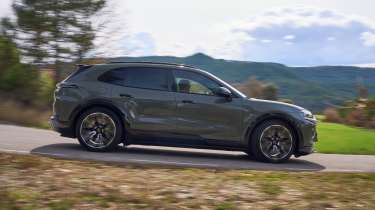
The optional Active Ride hydraulic pump-equipped dampers on the Turbo I’m driving are controlling if not eliminating the body’s movements as I brake and corner, the natural yaw and roll characteristics familiar from the very best fast estates. At turn-in, the optional rear-axle steering is twisting the back wheels in opposition by up to five degrees, aiding prompt and willing responses to my steering inputs. There’s none of the latency you’d expect from this sort of car.
The standard PTV+ limited-slip diff meanwhile, lets me tighten the car’s line with the throttle, or even overcome the prodigiously grippy (optional) Pirelli P Zero Rs and carve a neutral or oversteering arc. On what is a world-famous cycling route, a 2.6-ton SUV should feel like a Humpback navigating a sluice gate. On the contrary, only its physical girth belies its bidability.
Twist the wheel-mounted drive mode dial from Sport Plus to Comfort and the Cayenne lopes between toll booths at a 74mph canter, active cooling flaps closed and drag-reducing aeroblades deployed. It was never frenetic as some fast EVs are, but now there’s an appreciable calm as it shrugs off all the pretension of a car with Veyron-dwarfing power reserves.
The long throttle is never jerky, the steering is silky and the hydraulic dampers fully relaxed (even on ‘22s) but quietly diligent. If the cabin is the club, Active Ride is the bouncer and 90 per cent of the unruliest thunks get turned away. Unlike the hint of tyre roar from the Pirellis.
I did test the basic Cayenne Electric (that’s 120kg lighter thanks to its weedier rear motor) that not only wasn’t fitted with Active Ride, rear steering or PTV+, but isn’t actually available with them. It’s still very capable and plenty quick enough for most, but definitely feels more like an SUV – the roll, agility and body control characteristics are impressive but more typical of what you’d expect from this sort of car. The Turbo (albeit with a lot of extras attached) emulates a big fast estate with truly uncanny ability.
Interior and tech
- New curved ‘flow display’ is distinctive
- Some physical controls are retained
- ADAS nannying is easy to switch off
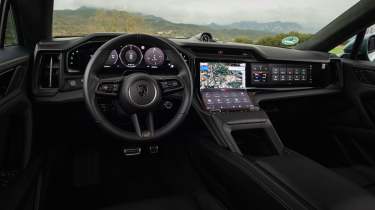
The interior itself is a big step on for the Cayenne – airy but still cocoon-like and opulent, and in ways familiar in terms of the digital dials, fit and finish. In others, the game has moved on.
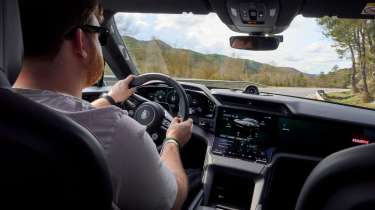
Porsche’s 45-degree curved portrait OLED ‘flow display’ is the first of its kind in a car and replete with the latest software. It’s crisp, responsive and hides fewer essential controls behind myriad menus. Happily some of the climate controls are physical, with toggles for temperature and intensity, though the direction is still dictated Taycan-style via the infotainment. Speed warnings and lane assist are mercifully easy to deactivate too, via wheel-mounted hot keys, a button on the instrument binnacle or through the infotainment.
New features include a new AI Voice Pilot feature that you can talk to and ‘Mood Modes’ that adjust your seats, the stereo, the climate control and mood lighting – not features coming to the next GT3 RS, I’m sure. What is significant is that Porsche claims this is the most luxurious Cayenne yet, with more heated surfaces available than ever, electric rear seats optional for the first time and an optional sliding glass roof with variable light controls – a first on this car. I’m inclined to agree. The Cayenne Electric is passably refined and luxurious, if not as serene an experience as a Range Rover.
Price and rivals
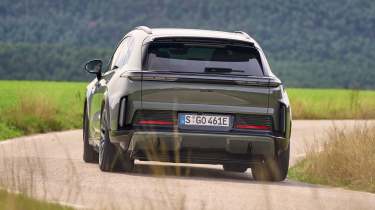
The new Porsche Cayenne Electric goes on sale in its basic form from £83,200. For that you get matrix LED headlights, eight-way comfort seats, a heated steering wheel and sound package plus as standard.
On price it undercuts the cheapest Lotus Eletre 600, which is priced from £84,990. BMW’s iX does however undercut them both, starting from £75,405, though to beat the Cayenne for (stated) range, you’ll need the £93,205 xDrive60 with 426 miles available.
The Turbo Electric is a bit steep, even if it more or less matches the £129,990 Lotus Eletre 900 Sport. BMW’s iX M70 is cheaper at £114,305 but it can’t do the things the Cayenne can. Or at least, what it can do with the optional hardware. The Turbo Electric is £130,900 starting, before adding Active Ride, rear-steering, 22-inch wheels and summer tyres adding close to £20,000 more…
In reality, A 536bhp Cayenne S Electric with those options to bestow it those dynamic virtues, plus 18-way sport seats, 22-inch wheels and Pirelli tyres for £5000 less than a basic Turbo (ours was specced up to well over £145,000), ought to be all the Cayenne Electric anyone could possibly want. If it has to be a Cayenne, the GTS V8 is still the one we’d pick…