From hacking toy cars to working with NASA, Apple and SpaceX: the story of Racelogic's Julian Thomas
Julian Thomas built the company behind the VBOX into a global technology brand with remarkable reach. He races historics and moderns for fun – and for the data

The influences that would direct Julian Thomas’s future were firmly established early on. His first motoring memories revolve around Silverstone circuit, still his local track, a stone’s throw from Racelogic’s Buckingham base. ‘I remember going with my dad to watch the touring cars when I was about nine,’ he says. ‘We’d go in his Opel Ascona – rear-wheel drive – and if I really pushed him, he would do donuts on the grass in the parking area.
‘I also remember listening to radio commentary of James Hunt at the Silverstone Grand Prix in 1977. I’d built a Lego car with a steering wheel I could operate, and I’d marked out Silverstone on the shagpile carpet. I followed the commentary and drove the car around this track, leaving skid marks behind, trying to emulate James Hunt. I did the whole Grand Prix.
> Meet the man who turned a Lotus Exige into a 270mph hypercar
‘Dad’s business was electronic control systems for industrial manufacturing plants, and one Christmas he’d bought me something really simple: a light switch, a light bulb and a battery, and he taught me to wire it and turn it on and off. I was probably six. And I spent the next week playing around with it, shorting the battery out, having to get a new one, and blowing the light bulb. It utterly fascinated me. I just got it.’
A while later, a Sinclair ZX80 computer with a whole 1KB of memory came along, and at school at lunchtime Julian shunned football and fought for time on the BBC computer with six other students.
‘Dad used to do a lot of work for Kellogg’s on their production lines, where he would put sensors that detected if the boxes were the right way up and detect various defects. We created a system… When I say “we”, from age 11, I used to do his programming because he didn’t have anyone in the company who could program.
‘I also worked on a system at the Coca-Cola canning factory in Milton Keynes. Some cans were upside down and if they went into the filling machine the wrong way up, Coca-Cola would go everywhere. So we put in a sensor that detected the depth of the can. Due to the latency of the sensors and the computing you then had to get the timing just right to have a high-pressure blast of air to blow that can out.’
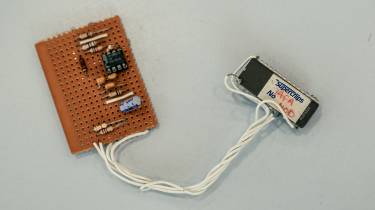
Julian found another application for the system. ‘I had a Scalextric set and I thought if I put one of the depth sensors across the track, it would detect the car going past. I’d made an automatic lap timer. Soon I was trying to get my lap times down. I tried Blu Tack on the tyres but that just got flung off, so I coated them in Copydex glue, let them dry, and knocked a second off my lap. But they’d only last two laps, so I’d made a qualifying tyre! Even aged 11 I was using technology to find lap time!’
Julian went on to study electronics at Durham University. However, electronics was at such an embryonic stage that, post graduation, he was the only one of his peer group with a job to go to. Sadly, it wasn’t working with his dad: ‘My father had become ill and died of motor neurone disease while I was in university, but he’d introduced me to Pete Wales at Superchips and I went to work there.’
Older readers will remember Superchips adverts from the back pages of car magazines, offering massive power hikes on turbocharged cars. ‘I was their chief hacker. Back then there was no chip protection. They never thought a 21-year-old would get a soldering iron out and have a go at it. Then car makers began to use encryption. Peter said, “If you can crack the [Ford] EEC-IV, I’ll buy you a Fiesta Turbo.” He knew how to motivate a 23-year-old who was into cars! I worked all hours and cracked it. And, fair enough, he bought me one. We got 300bhp out of it for a few months before it exploded.’
Ironically, hacking was impacting Superchips’ business. ‘His competitors were just copying the chips. I’d spend months cracking something new and two weeks later they’d put the EPROM in a reader and make 10 of them for £20. I said to Peter, “I’ve got this idea for encryption of the chips,” and he said, “That’ll never work. Carry on with your day job.” So I did it in my spare time. One day I walked into his office, gave him a chip and said, “Copy that.” He put it into his reader: garbage, garbage. Random garbage every time. Then I plugged it into the car and the car ran beautifully.
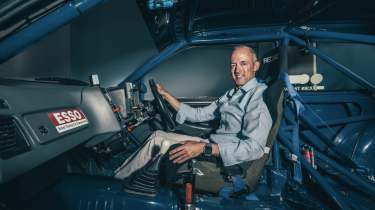
‘He said, “I told you not to do that, but anyway, now you’ve done it, tell me how you’ve done it.” I said, “No, but you can buy them from me.” I borrowed £10,000 off my mum to start Racelogic in early ’92 and sold 500 of them to Superchips in the first year, which set my company off. His business absolutely took off because no one could copy his chips.’
This was almost a sideline, though. ‘The business plan was designing an aftermarket traction control system for race cars. My plan was to sell it into the BTCC, which was just exploding in popularity. I planned traction control, variable trumpets, differential control, gearbox control – that’s why it’s called Racelogic. But traction control was banned in BTCC and I remember opening Autosport and reading “Traction control banned in WRC” and thinking, there’s my business gone. So I turned to road cars and started selling traction control for highly tuned road cars. We sold it to Rolls-Royce/Bentley for their production cars, Aston Martin too, and that helped build the company up.’
What really put Racelogic on the map was the VBOX. ‘When I was developing traction control I was measuring the 0-60 times and I wanted the truth. To time a four-wheel-drive car on gravel you need a speed reference. I spoke to John Grist at Datron, who did the Correvit system, but one rock breaking the lens of that and it’s no good. So I thought, could you use GPS? This would have been 2001. Bill Clinton had recently turned off the scrambling on GPS and I thought, well, that changes everything. Suddenly you can measure a kilometre to within a centimetre and measure your speed super accurately.
‘I bought a very fast-updating GPS system that had just come out, put it on a car, did an acceleration run and got this perfect curve with each gearchange shown beautifully. I was like, “Oh, this is a product.” So that led to the very first Racelogic “brick”. For a number of years John Grist absolutely hated me, because I took away all his business with the GPS system.’
Julian enjoyed a series of quick road cars around this time. ‘I had a 205 GTI 1.9. Loved it. Then I got a gen-two Mazda RX‑7. Gorgeous car, dreadfully unreliable; those rotor-tip seals. Learned to drive sideways in it. After that was a Porsche 944 Turbo S, a Silver Rose edition, then I had a Cossie, then a BMW Z3 M, the Roadster with the 3.2-litre engine. Fantastic engine, dreadful chassis.’
The development of Racelogic’s data logging and analysis systems was essentially driven by Julian’s desire to understand why other drivers were faster. ‘I used to go to the James Hunt Racing Centre in Milton Keynes to play in karts because they would lap time you. I managed to get the fastest time one day and then someone came along, said, “Which kart did you use?”, grabbed a helmet, got in it, and beat me by probably a second a lap. I wanted to know why. He couldn’t explain, he was just one of those naturals. So I thought, “What data logging system can I make to work out what he’s doing?”
‘I made my own box, stuck it on the kart and invited him back. I had to write special software to overlay everything, but then I could see, went out and found half a second. But I could never match him. He became my chief salesman. I then developed it into a video system. I’d bought a Caterham and I’d get him to drive it then look at the video and the data. I was getting closer and closer and closer to him. Then one day I showed it to somebody and they said, “Oh my God, you should sell this.” That’s how the Video VBOX came about.’
Over the coming years, the breadth of Racelogic’s GPS products expanded far beyond lap timing. You might have seen the company’s work in live, augmented-reality graphics at the recent Ocean Race Europe. It has also developed an indoor positioning system, which has many and diverse uses, and a GPS simulator, used to test GPS receivers; it’s called LabSat and customers include NASA, Google, Apple and SpaceX.
The VBOX work meant that going racing was almost inevitable for Julian. A chance meeting with racer Nigel Greensall led to him joining the Fun Cup, the endurance series for identical, Beetle-style cars. ‘He helped with the lap timer too, suggesting a delta that gives you a plus or minus as you go around the track. I raced with him for years, and I got closer and closer to him by spending hours analysing data. Jade, my wife, would tear her hair out. I’d be sitting there late at night on my laptop going: “There’s a tenth. Where is it? Where is that tenth?”’
An expensive visit to the Silverstone Classic saw him leave as the new owner of an E-type racer. ‘It was quite different to drive. The fact that the brakes didn’t work and it didn’t handle… Then I worked out that the race meetings were spread over three days, so you’d spend most of it just sitting around watching other people have fun. So I then bought a Chevron B8, started racing that. Still a bit too much sitting around, so I bought a Ford Falcon as well.’ In 2018 he won the FIA Masters Historic Sports Car Championship in the Chevron with Calum Lockie.
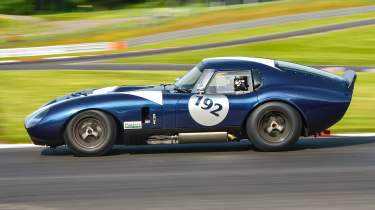
For some reason, the Jaguars in the Masters championship were penalised. Annoyed, Julian looked at what was winning the races, bought a Cobra Daytona Coupe and went to Andy Wolfe (‘brilliant engineer and driver, lovely guy’) and said, ‘Can you make this the fastest Daytona?’ First time out it was two seconds a lap quicker than anything else. ‘Andy said, “We’ve created a monster!”’ For the first few years nobody could beat it.
Julian also bought an Audi R8 GT3, and again used a VBOX to get himself up to pace. But his favourite race car is an ex-BTCC Kaliber Sierra Cosworth RS500: ‘It wants to kill you. The problem is, once the wheels start spinning, the turbo boost increases and the wheel spin increases. It’s this closed-loop cycle, and if you don’t catch it within that first half second, it’s gone.’
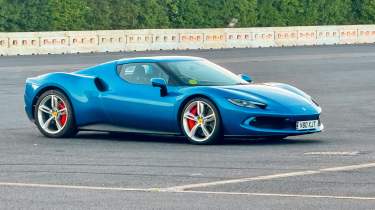
Back on the road, a Ferrari 360 was replaced by a 458, then a 488, and currently Julian drives a 296 GTB, which is ‘ridiculous’. He also has an Aston Martin DB6, which is rather special to him as it used to be his dad’s. ‘My mum had to sell it 28 years ago when my father passed away. Twenty-five years later, I was sitting in my office with a friend who said, “What car do you want next?” and I said I’d like to track down my dad’s Aston DB6.’ He googled the number plate and it came up as a lot in a Bonhams auction, taking place the coming weekend. ‘The guy my mum sold it to had had it all that time.
‘I went to the auction with my cousin, Ollie, and he just sat, jabbing me in the ribs. “Higher, Jules, higher. You won’t regret it.” And I bought it for ten times what my mom sold it for.
‘Usually it’s parked in my garage. I cycle to and from work and when I arrive back, I pull into the garage, walk past it and I just tap it or stroke it or flick the headlights or something, because it’s that link to the past, to my dad, who, you know, got me into cars and electronics because he was into cars and electronics.’ It’s safe to say they are passions that have served Julian particularly well.
This story was first featured in evo issue 338.