Gran Turismo creator Kazunori Yamauchi on the challenges of car game development
Almost 30 years after it was launched, Gran Turismo continues to go from strength to strength. We sit down with its creator, Kazunori Yamauchi, and find that he’s still as driven as ever


Depending on what generation you belong to, your untreatable, irremediable obsession with cars will have been fostered through differing means – today’s through reels and YouTube, those from a few generations back via brochures, magazines, staring through dealership windows and hanging off catch-fences at race meetings.
My generation? We’re a mixed bag. I had all the mags (evo most consistently, obvs) and grew up watching a certain motoring TV show. But once I’d finished scouring The Knowledge and Sunday night’s programming had switched to Planet Earth, I’d scuttle upstairs and fire up the PlayStation. I’m told that around the same time, the early 2000s, a similar device in the corner of evo’s office was a reliable instrument of press-week procrastination, with the same game in its disc tray being Gran Turismo.
> Polestar 4 SUV spied – Porsche Macan EV and Tesla Model Y rival finally gets a back window
In June 2025 the franchise crossed the 100-million-unit barrier. The scale of its influence is difficult to measure or estimate. Come the close of 2027, it will be 30 years old, and yet its creator is as dedicated as ever to ensuring it stays true to its core tenets.
We joined Kazunori Yamauchi and the Gran Turismo team alongside the team from Polestar at the FAT Ice Race earlier this year. The two were collaborating on the introduction of the Swedish company’s new flagship, the Polestar 5, to Gran Turismo 7. Cue some hot laps of the ice racetrack, mostly sideways, courtesy of Polestar’s rallying hotshoe and development ace, Joakim Rydholm. Away from the ice, we sat with Yamauchi to chat all things Gran Turismo.
We put it to Yamauchi that his game has shaped the global car enthusiast hobby as it is today. It’s the place where future (now current) drivers found and anointed their icons: GT‑R, Supra, Lancer Evolution, WRX STI, RX‑7, NSX et al. He adds an observation of his own: ‘I’ve been making Gran Turismo for 30 years now. But when I look back, you know, the first users of Gran Turismo 1, many are actually now in positions of importance in manufacturers in the car industry. They’re the people who took an interest in cars, who got introduced to cars through Gran Turismo and decided to make it their careers. I think that’s really big.’
So who is playing Gran Turismo today? ‘It’s very unusual for a video game because we have players that are teenagers all the way up to people who are 60 and above too,’ says Yamauchi. And that plays into how the game is shaped, and the variety of its car list: ‘Things like driving pleasure and the core culture is something that is always changing. You get feedback from a lot of different communities saying, you know, we want this car to be in the game. They say, “We want more sports cars from the ’90s from Japan,” or sometimes more working cars [what other car game features the Suzuki Carry kei truck?]. If you look at places like China, there’s actually a young generation that’s only driven electric cars. So car culture is something that’s always evolving and changing.’

How does he decide which cars make the cut? There are two ways: ‘One is where the car manufacturer approaches us and says, “We’re going to be making this car in the future; would you be interested in including it in Gran Turismo?” And the other is… I like this car; I want it in the game.
‘We’re living in a time where we can get a lot of feedback from the community directly. So there are times when they bring up cars I hadn’t noticed before and I realise, “Oh yeah, this will be a nice car to have.”’ Which manufacturers has he turned down for a spot on the game? ‘I cannot answer,’ says Yamauchi with a wry smile.
He is rightly proud that Gran Turismo still lives up to its tagline, The Real Driving Simulator, in a world of sim rigs and computers that cost orders of magnitude more than a real car. That takes serious work behind the scenes, but the goal remains authenticity – getting across the idiosyncrasies of how the cars deliver their performance, rather than hamming up the experience.
‘First you need an accurate, precise physics engine that simulates the car and how it’s supposed to move,’ Yamauchi explains. ‘Then you also need a very detailed and precise computer graphics model, including both the exterior of the car and the interior. It takes eight months for us to do both the appearance and the physics for how the dynamics of the car work.’ Back in the days of GT1, each took more like two hours. Such is the price of progress.
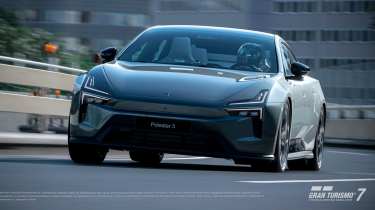
‘Cars have become more and more complex over the years. You have all these different types of electronic management systems. So there’s a lot of different controls that go into the drivetrain and the differential and everything. Those types of systems tend to be unique for every different car. Take all-wheel-drive systems – it’s different when you look at Volkswagen, then Audi, Nissan or BMW. And you can say the same thing about EVs as well, that you can control even more precisely. In the Polestar 5 on the ice track, the dynamics of the way they move was completely different to, say, the Porsche Taycan.
‘When we try to recreate EVs, the level of precision that we have to really look at with all these systems has become even more complex than before. When you input all this data and the specifications into the physics model, it has to operate like the real car. I test-drive the car at the end to make sure everything is okay. Then you need not just tracks, but beautiful environments. For example to reproduce the Nordschleife – the Nürburgring – took us four years.’
We ask whether he ever gets pushback from higher-ups at Sony; whether he was ever told to cut corners or that the process takes too long. The answer is not anymore: ‘Up to about Gran Turismo 5, yes. Nowadays, not so much.’
The biggest challenge in terms of developing and improving the very latest physics models, he says, is tyres. His team has gone to enormous lengths over the years to develop a physics engine that can account for innumerable components within a car’s dynamic make-up, but simulating tyres – how they deform, how tyres of different sizes and compounds do so differently, then how each tyre’s behaviour changes across temperature and wear cycles, in different conditions and on different surfaces, and doing so by working with notoriously secretive tyre companies – is the toughest nut to crack.

‘So things like the suspension, the drivetrain including all the gears, connecting the engine up to the transmission to the differential – there’s not that much discrepancy in terms of reality versus what we simulate. In terms of tyres, even the manufacturers are mysterious in how they do things. We do what we can with what we have.
‘The way the contact point changes is something that we can’t really figure out so easily. You have things like heat affecting the grip, and the tyre wear affecting the grip. The level of grain that happens when you have certain conditions on the track, it’s something that we just don’t have yet.’
Of course, there’s more to Gran Turismo than simply racing nowadays. It’s as much a photography simulator and virtual car ownership simulator as it is a driving simulator. It’s hard to believe the Scapes feature is almost a decade old now because it’s still a mind-blowing piece of software, allowing you to place your car in real-life landscapes. Today there are thousands of options, from the Scottish Highlands to the Golden Gate Bridge, and there’s a huge subset of players who spend more time taking photos of their cars than they do driving them, the game fostering real car photographers of the future too. Likewise livery editing, because Gran Turismo is now also an incredibly detailed graphic design platform.

GT’s detail, and the fact that it offers more than one way of enjoying a car, is what appeals to manufacturers, who often give their car to the Polyphony Digital team before anyone outside their own team has driven it. The game is where many people experience specific cars for the first time and where the seed is planted for them to pursue ownership of the real thing. Polestar actually conducted private digital test drives of the 5 ahead of the real car being available. Michael Manske, head of brand, marketing and communications and Polestar, tells us: ‘It was important that they get our car right because this may be the first time people are exposed to it. In the two weeks the time trial was live on the game, we had 160,000 people sign up to drive the car.’
‘You don’t always get the opportunity to really test drive a car thoroughly before you buy it,’ adds Yamauchi. ‘Gran Turismo is something that allows you to actually experience the car as it is.’
His workplace may be the virtual car world, but he’s a real-world driving enthusiast who’s owned an eclectic collection of cars over the years, from Nissan GT‑Rs to Ford GTs, and has contested the Nürburgring 24 Hours multiple times, winning the SP8T class in a GT‑R in 2011. While he remains at the helm, we can be confident that Gran Turismo will continue to foster new generations of car enthusiasts for many years to come.
This story was first featured in evo issue 348.