Ford Focus RS (Mk3, 2016 - 2018) review – the last proper fast Ford?
The Mk3 Focus RS looks like it’ll be Ford’s last RS, certainly with petrol-only power, for a while if not ever. Did the legendary badge go out on a high?
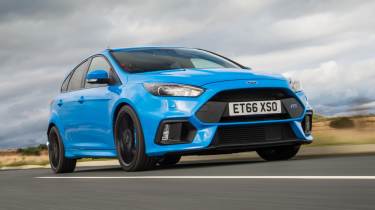
For the 2016 Focus RS, Ford employed seriously high-tech systems to manage a vast power output, with a four-wheel drive chassis that responds to the demands of its driver with all the agility of a lighter, smaller and simpler machine. In other words, more is more, with the Focus RS Drift Mode just one of a raft of features that cemented the model into fast Ford folklore.
But while the Focus RS didn’t quite fit the standard evo mould for a pure, unadulterated hot hatch, there’s absolutely no doubt that it was vastly effective and thoroughly engaging in its own special way. The high-tech, all the bells and whistles approach is arguably closer to the concept of the Nissan GT-R. The result was a car that divided opinion, some loving its bare-knuckle bruiser character and others finding it contrived and discordant. What all can agree the Mk3 Focus RS isn’t, is boring.
Engine, gearbox and performance
- 2.3-litre turbocharged ecoboost four-cylinder engine
- 345bhp and 347lb ft, 0-62mph in 4.7sec and a 165mph top speed
- Four-wheel drive with a manual transmission
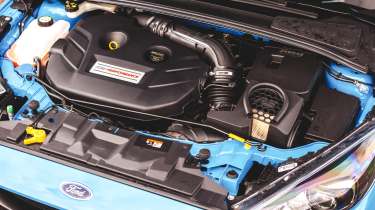
The Mk3 Focus RS dispensed with the warbling in-line 5-cylinder engine that bestowed the Mk2 with huge amounts of charm. Instead it shares the 2.3-litre Ecoboost engine with the European entry-level S550 Mustang of the time.
It has a different turbo to deal with a higher flow of gasses, the material that makes the head casting and the piston liners is different, and there’s a bigger intercooler, radiator and oil cooler. The intercooler is so big that, when first tested, it cooled the air to the point water vapour started to appear in the intake, such that it had to be blanked off to reduce how efficient it is.
More reviews
The Focus RS produces 345bhp and 347lb ft of torque, that's enough to propel it to a maximum claimed speed of 165mph and we recorded a 0-60mph time of 4.7sec. Even though you can only get the Focus RS with a conventional manual, it still has a launch control system to help you get the quickest possible start off the line. It does however require you to abandon all mechanical sympathy and side-step the clutch then hammer each gear in. The Focus RS copes amazingly well with this sort of abuse, though.
The gearbox itself isn’t technically very impressive, but it is competent and the shift is clear, quick and easy. The rest of the drivetrain is worth going into more depth.
The engine feels strong and eager. It doesn’t have the most linear power delivery, a definite boost is felt at 4000rpm and then again at 5000rpm. But, it feels like it wants to rev right to its limiter, even if the noise it makes isn’t exactly scintillating. Ford have tried hard to make it sound more impressive than most 4-cylinder turbo engines on the market. And although they’ve not failed, it’s really only when the exhaust pops and crackles on overrun when the engine makes anything but an ordinary noise.
As all fast Fords have done, the third generation Focus RS punched above its weight. It delivers remarkable amounts of acceleration and speed for what was a relatively small amount of money.
Ride and handling
- AWD system defines its feisty, changeable character
- Damping too; fidgety at low-speeds, mixed at pace
- Steering is hyperactive and a little lacking in feel
As remarkable as most of the numbers are, there’s one that seems slightly unimpressive; the weight. The RS tips the scales at a hefty 1524kg (although it was a little bit more at 1567kg, when we weighed it). That’s 162kg more than a Focus ST. A lot of that extra weight is likely the 4WD drivetrain, but that of course is central to the Focus RS’s character.
Much was said about the Focus RS’s four-wheel-drive system when new, particularly its Drift mode. So how does it actually work? The front axle is much like that of a conventional front-wheel-drive car. There’s an open, non-locking differential that distributes torque to the front wheels, though this was swapped for an LSD in the Edition and Heritage models.
As well as the front driveshafts the diff also rotates a permanently spinning propshaft that sends torque to the rear axle. This propshaft turns a pinion and then a crownwheel within a rear diff housing. Just as the propshaft is being continually turned, so is the crownwheel and pinion. Instead of allowing the rear wheels to turn at different speeds by using gears the rear differential uses two clutch packs, one on each driveshaft that can fully open and allow each rear wheel to spin independently.
When both of the clutch packs on the rear axle are open, and no torque is being sent to either rear wheel, the RS is essentially a front-wheel-drive car. As soon as the clutch packs in the rear axle begin to close they immediately send torque to the rear wheels. And, as each of the clutch packs can work independently of each other, and vary the amount of torque they distribute almost instantly across the axle, they can make huge changes to how the car behaves.
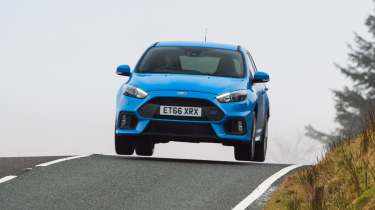
With the car in Drift mode, the system can send huge amounts of torque to the outside rear wheel to induce an exaggerated yaw movement to put the car into a slide. The rear diff can then vary the torque across the rear axle to maintain a slide as the driver keeps their foot pinned. What’s more, the rear axle is geared 2% quicker than the front. So every time either of the rear wheels is engaged, the back is trying to overtake the front. The over-speed rear amplifies the already naturally agile rear axle.
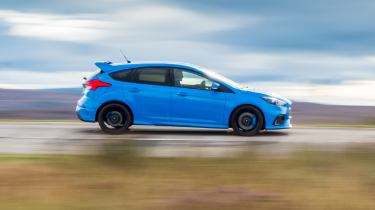
The Focus RS is certainly a firm car. On UK roads it’s probably just on the cusp of being too stiff. The ride is fidgety at low speeds, however above 50mph or so it starts to smooth out anything but the most severe bumps.
When the road becomes more demanding, and the bumps become crests that can really upset a car, the Focus maintains supreme control. The body remains well supported in compressions, and never seems to get close to bottoming out. Large undulations, that could confuse the body and cause it to become out of sync with the road, are dealt with quickly and effectively.
If you fancy trying the firmer dampers on the road, then a button at the end of the left hand stalk will allow you to make them 40% stiffer without you having to put the car into full track mode. But it doesn’t take long for you to realise that they are far too firm, and vertical inputs are transmitted into the car and don't improve the RS's composure.
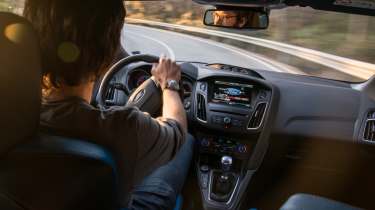
The RS has very quick steering that feels very sensitive to even minor inputs. The sometimes-bumpy ride does mean that, as you’re jolted around the cabin, you can inadvertently add steering inputs you don’t want to. This means on rough roads you constantly have to correct the steering.

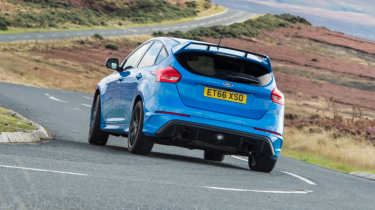
But the hyper-active steering works brilliantly with the front-end. There’s plenty of bite, especially if you trail brake a little, and the front responds immediately. This pointy front end endows the RS with a naturally neutral to oversteer balance on corner entry. It behaves very much like an aggressively set-up front-wheel-drive hot hatch, and can use a throttle lift to agitate the rear end.
The chassis allows some roll, but it’s very controlled and acts more of a barometer for how much grip the Michelin Pilot Super Sports have in reserve. It’s most useful mid-corner, as it allows you to judge when to get on the throttle. Be smooth with your inputs and the RS will carry huge speed through a corner. If you haven’t unsettled the rear, there are times where it feels like the drivetrain is fighting with the tyres. There’s a sense it’s almost tearing itself apart and it can create a pulsing, bouncing movement throughout the car.
The rear end of the Focus can be persuaded to step out more easily on a wet road. However in the dry, if you’re aggressive on turn in and then on the power early, the rear will trace a greater arc than the front. It does require a lot of commitment and a well-sighted corner, though.
If you aren’t as committed at the start of a bend, and you try to induce some oversteer just on the exit in the dry, nothing really materialises. There is a sense of an exaggerated yaw movement, that even with more throttle sadly never turns into oversteer. This is the only time the Focus RS ever feels contrived. But considering the control the systems have over the car, that’s mighty impressive. In the wet, and over much bumpier terrain, the rear finds less grip and breaks away more naturally.
If what you really want is some lairy, sideways action – and you’re within the safe confines of a circuit or closed road – then you can experiment with the Focus’s Drift Mode. When selected, the GKN 4WD system sends a large proportion of the available torque to the outside rear wheel to induce a slide.
With the Focus in Track mode, with the traction and stability control fully turned off, it will still perform power-on oversteer. It isn’t quite so easy to provoke, but the result feels similar to that of Drift Mode, just not quite so easy to sustain a long slide. Neither mode makes the RS feel like a proper rear-wheel drive car, but no other 4WD car offers this level of riotous playfulness.
There’s no doubt the RS is an extremely effective and fast car. There’s a real quality to the way it rides and how cohesive the package feels; the steering, rate of roll and drivetrain have been engineered to perfectly complement each other.
Bedford track test – James Disdale
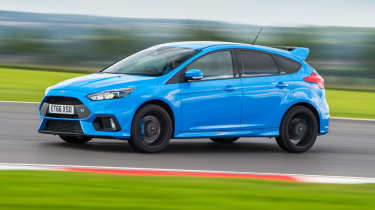
It’s a punchy thing with impressive traction out of the hairpin and it’s keen to flick left-right-left through the Club Chicane. The surprise is that in corners with enough room for a sustained throttle, it power oversteers. Pulling through the second part of New Pif-Paf especially, the tail edges gently wide, kissing the kerbing on the outside and firing the Focus neatly out on a trajectory for the next clipping point. It’s an unusual sensation in a fast hatch.
Through the faster turns that complete the lap it can be guided in on exactly the chosen line, but if you’re abrupt with your input it can snap into oversteer. It’s also oddly reluctant to turn into the medium-speed corners, lacking the bite to change direction, as if its mass is running away with it, and the brakes start to feel the pressure at the end of the third flyer, but overall it’s a good performance at 1:26.9 – 0.7sec slower than an FK8 Civic Type R but 0.9sec faster than a 2017 Cupra Leon 300.
evo car of the year 2016 result – Dan Prosser
One of the most hyped cars of the year, the Focus RS arrived in Scotland with a huge reputation to live up to. Ultimately it fell short of expectations. Its most ardent supporter was Henry Catchpole, who voted it into seventh position. ‘It’s a hot hatch that you can grab by the scruff and thrash,’ he says. ‘It’s not a particularly fine-dining driving experience, but I like the occasional Burger King’. Conversely, its most strident critic, Stuart Gallagher, describes it as a conflicted car, commenting, ‘If there’s an automotive equivalent of bipolar disorder, the Focus RS has it.’
Ford Focus RS Edition – a front LSD makes all the difference
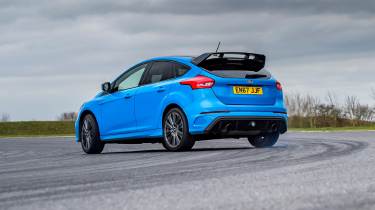
'At low speed the only evidence of the new addition’s presence is a subtle tightening of the steering when you lift off the throttle as the diff shifts its loadings. Go faster and its effects are more obvious. For starters, there’s greater stability on the way into corners, the differential helping to keep the Focus arrow straight and steady, even when working those Brembo brakes hard.
'The steering is as meatily weighted and precise as before and there’s the same strong turn-in bite, but squeeze the throttle on the exit of a bend and you’ll discover the old car’s torque steering habit has been knocked on the head, even on bumpy and heavily crowned tarmac. Where the standard car’s nose would weave around as the four-wheel drive system frantically shuffled torque around, the Limited simply hunkers down and fires along the road.
'This less wayward approach gives you confidence to more fully exploit the Ford’s unique handling balance. You can now lean hard on the RS coming out of corners and start working the rear axle to get that subtle rear-wheel drive sensation that helps point the car’s nose into the apex to allow you to get on the power earlier. Overall, it gives the car a more sophisticated and polished feel, and while some drivers will miss the old car’s slightly ragged and raw character for most, the gains in precision more than make up for it.' – James Disdale
Interior and tech
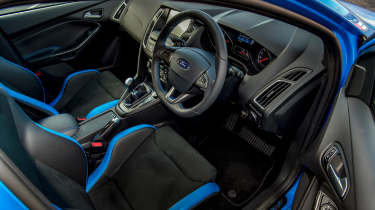
The interior is the Ford’s Achilles’ heel. It’s much like a standard Focus interior, with very little that defines it as a hot hatch. It doesn’t have the finish, or quality of the materials of its rivals – even the similarly priced Golf R feels significantly more premium.
The biggest issue is the placement of the front seats, even with the optional Recaro bucket seats you just can't get low enough in the cabin to really feel apart of the car. Add to this Ford's old SYNC 2 infotainment system and iffy ergonomics of the gearstick and handbrake and the RS's interior starts to feel like a bigger compromise than you would expect to make for an RS against more sound rivals like the Golf R and Audi S3.
As it’s a Focus though, it’s practical, big enough for 5 people and has a relatively large boot.
Values and buying guide
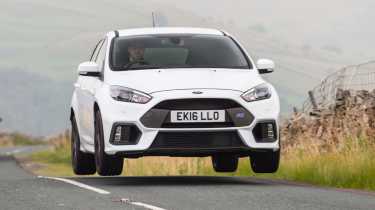
If the Focus’s fast Ford image is a point of discomfort for those outside the Blue Oval’s almost cult-like fanbase, it does little to discourage values. The fast Ford market is its own entity, the values of RS-badged products nicely fortified.
The third-generation Focus RS is by far the most numerous and as such, values haven’t rewarded long-term keepers as those who kept the previous generations are now being rewarded. At the time of writing (August 2026) early high-mile cars are in the £15,000 range, though for any example with less than 60,000 miles you’ll be paying upwards of £18,000. By contrast, examples of the orange Heritage edition and Red edition with low miles are priced over £40,000. At the time of writing, we saw a Heritage edition with fewer than 500 miles listed for over £70,000…
Mk3 Focus RS reliability was mixed right from the off, with engine issues related to coolant loss from cracked blocks and failed head gaskets. Many of these issues were fixed early and chances are, at up to a decade old, all cars you’ll be considering are sorted. Still, never a better moment to remind you, diligent service history is a must.
Be sure to test drive your chosen cars and feel for a slipping clutch, as these wear hard when the car’s launch control is used. If the rear differential was not regularly serviced as it should have been, it’s likely to emit a whine, too. Also check the brakes and tyres for age and wear. Don’t be put off by cars with Mountune upgrades, as these were Ford-certified at the time.
Specs
| Engine | In-line 4-cyl, 2261cc, turbo |
|---|---|
| Power | 345bhp @ 6000rpm |
| Torque | 347lb @ 2000-4500rpm |
| Weight | 1547kg claimed (227bhp/ton) |
| 0-62mph | 4.7sec as tested |
| Top speed | 166mph (claimed) |
| Price when new | £32,265 |