Kia EV9 GT review – the Defender Octa has nothing to worry about
Kia's given its large EV SUV the GT treatment. The result isn't as impressive as its EV6 GT sibling

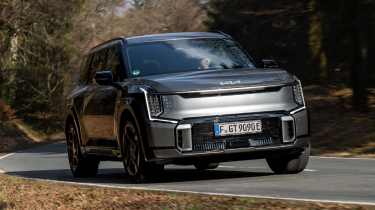
Looking to nuzzle its way into the curious collection of vehicles that is the performance SUV market is the new Kia EV9 GT, a high-performance variant of Kia’s biggest and most expensive car, with inspiration and engineering know-how from the smaller EV6 GT, and by extension the related Hyundai Ioniq 5 N.
The performance SUV is a category of car none of us ever really needed, but one which has on occasion resulted in something rather amusing; think original Cayenne Turbo, Bronco Raptor, Stelvio Quadrifoglio, Defender Octa. They’re the antithesis of the Elises, Caterhams, French hot hatches and hardcore Caymans and 911s we adore, but we know big fun and great engineering when we see it, so we admire them all the same. The EV9 GT is five metres long, seats up to seven, and is powered by electricity, but can it count itself among the best hot SUVs?
Powertrain and technical highlights
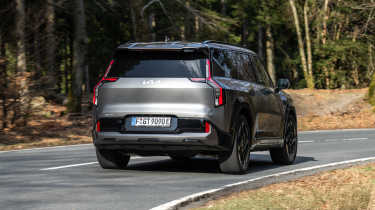
We should probably start with the basics here, as the EV9 isn’t really in core evo-reader territory. It sits squarely (visually and conceptually) at the top of Kia’s range, measuring in at 5015mm long and nearly two metres wide before you count the mirrors, and 1780mm tall. That’s similar in length to a Defender Octa with a spare mounted on the back, a touch narrower, but getting on for half a foot lower. Kia offers six- and seven-seat versions, and ordinarily the EV9 comes in rear- and all-wheel-drive versions, with a single motor and dual motors respectively.

The EV9 GT is dual-motor, with a 139kW unit at the front axle and 235kW at the rear, making it a rear-biased setup. Its total 374kW output equates to 501bhp, with torque of 546lb ft. The motors are supplied by the same 99.8kWh nominal, 96kWh usable battery pack as other EV9s, and on paper the range is similar to that of the cooking models, with a claimed 316 miles, 2.8mi/kWh efficiency, and 210kW charging, for a 10 to 80 per cent boost in 24 minutes.
More reviews
To cope with the newfound output the EV9 adopts every technological trick Kia can throw at it: electronically adjustable dampers, adjustable by-wire braking, Electronic Dynamic Torque Vectoring Control (eDTVC), an electronic limited-slip differential (e-LSD), a set of 21-inch wheels that are 2kg lighter apiece than the 21s on other EV9s, and Virtual Gear Shift, as per the smaller EV6 GT and the Ioniq 5 N’s e-Shift system.
As such it can create virtual gear ratios that you flick up and down through with the same paddles that are normally used for adjusting the regenerative braking. The behaviour of almost all of this – suspension, steering, brake response, motor response, e-LSD behaviour – can be tailored to taste through a personalised MyDrive mode, or all whacked up to the maximum with a new GT mode button on the steering wheel.
Performance, ride and handling
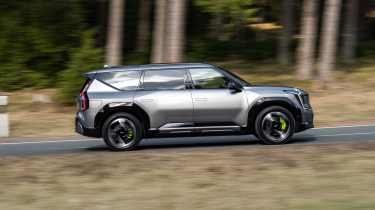
There’s one more number to consider in relation to the GT’s powertrain: 2718kg. That’s the car’s kerb weight, and while not vastly more than the already porky 378bhp, 2648kg EV9 AWD, it’s enough to take the edge off the GT’s performance. 500bhp in a conventional car can feel pretty rampant, but the 0-62mph time of 4.6 seconds tells part of the story here; a 394bhp, 1565kg Audi RS3 covers the same sprint in 3.8 seconds, despite a notionally imperfect internal-combustion power delivery.
That’s not to say the EV9 GT doesn’t feel quick, because obviously it’s still pretty brisk by any standards, let alone those of a seven-seater family car. Our test car wore Michelin Pilot Alpin 5 winter tyres (mandatory until late March in parts of Germany) rather than the Continental SportContact 6 tyres fitted as standard equipment, but even on wet roads it launched cleanly away from rest, and it could squirt into the outside lane of the Autobahn pretty easily too.
You could spend days tailoring the MyDrive mode to your tastes, so flitting between Normal, Sport and GT modes was the order of our test. Power delivery in Normal is… well, fairly normal, with a noticeable delay and a ramp up if you ask for full power, presumably to stop commuters launching into the car in front in a traffic queue. It’s more linear in Sport, while GT gives you everything, initially feeling quite jumpy but certainly masking the weight you’re suddenly trying to put into motion.
I couldn’t honestly feel the difference between the Normal and Sport settings for the by-wire braking, but in other ways the changes in the up-to-11 GT mode, which also relaxes traction and stability control, are more profound. Steering weight bumps up several notches (feeling appropriately heavy for such a large vehicle), and more noticeably the EV9 GT feels much more balanced through corners, as the eDTVC and e-LSD are more inclined to feed power rearwards as you lean into the accelerator through a corner – the slick roads exacerbating this effect.
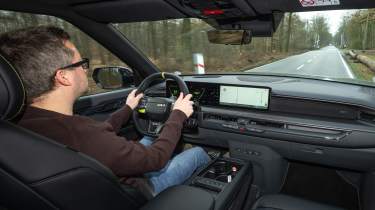
Is it fun though? More impressive than entertaining, I’d say. For all the cleverness beneath, the GT simply can’t hide its mass, so it always feels a bit lumbering. The sheer size discourages you from pushing hard on most roads, conscious that you’re already taking up most of your lane and have a lot of momentum to stop.
The brakes do an admirable job of reining things in, and aren't prone to fading, but need a fair squeeze to shed your speed. The ‘manual’ gearchanging feels a bit gimmicky here too. The piped-in sound is fairly synthetic and it’s not a car that encourages you to take it by the scruff of the neck like an Ioniq 5 N.
On the few bits of German road that could be said to have a poor-quality surface, the ride felt pretty knobbly too. Even if that doesn’t bother the driver in a performance car, it might bother your other five or six passengers. It settles down at motorway speeds, but a big electric family car, even a fast one, should arguably be a little more relaxed everywhere else too.
Then there’s the range: in mixed driving, including some enthusiastic runs up and down a few twisty roads north of Frankfurt, combined efficiency of 2.1mi/kWh would see that 316-mile official range drop to more like 200 miles, and that’s from fully charged to fully empty. You can’t overcome the laws of physics.
Interior and tech
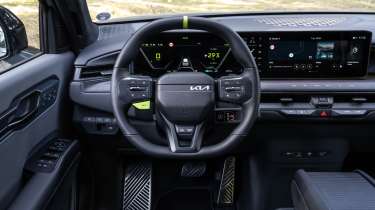
Inside, the EV9 GT is as likeable as the regular car. It’s a little dark in there (maybe one day the industry will overcome its ‘grey/black equals sporty’ association) but enlivened slightly by flashes of ‘neon yellow’ on the steering wheel and seats, and a neon yellow glow from the ambient lighting.
The three-spoke wheel feels good to hold and the instruments are smart and easy to read – with a racier theme called up when you select GT mode. Hooking up an iPhone proved no bother either – Kia tends to get this stuff right.
The GT gets more prominently bolstered seats than the standard EV9 and they look and feel great, with fabric centres to prevent you sliding around but enough squidge to remain comfortable over several hours. Opt for the six-seater (a grand more than the seven-seater) and the second-row seats are similarly trimmed but not quite as bucket-like, but the seven-seater has a three-person bench, and there are a couple more seats at the back, which will still comfortably fit shorter adults.
It’s certainly no less practical than any other EV9, it’s similarly well equipped and well made too. Kia’s tech is also straightforward and easy to appreciate – the little blind-spot screens that flash up when you indicate are a neat touch.
Price, specs and rivals
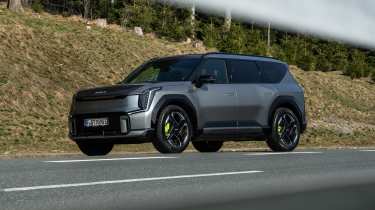
At £82,235 for the seven-seat EV9 GT and £83,235 for the six-seater, you’re looking at Kia’s most expensive car yet. We can remember saying that about the Kia Stinger GTS a decade ago, at nearly half that money.
Even more so than the Stinger, it’s a little difficult to figure out who might buy an EV9 GT. It’s not really agile or entertaining enough to pull off that hot hatch or fast wagon-style duality of something you could use as a family car but also have fun with down a B-road, and the compromised ride and range both chip away at its family-hauler capabilities.
Still, Kia UK isn’t expecting huge sales from what it’s fully aware is a niche vehicle. It would also point out that to get equivalent performance from the only car with similar space and seating capability, the Volvo EX90 in either Twin Motor or Twin Motor Performance trim, you’re looking at a minimum of five grand more, and with a few more boxes ticked, the Swede’s knocking on the door of £100k.
The Kia’s definitely a lot more fun than the boaty Volvo, and it’s cheaper and more practical than something like the new electric Cayenne, which starts at £83k (though goes a lot further on a charge). But it’s unlikely to join the likes of the Alfa Romeo Stelvio Quadrifoglio and Defender Octa on the list of our favourite fast SUVs.