Maserati Ghibli (2013 - 2023) review – Italy's BMW 5-series rival that got a Ferrari V8
Stylish and much improved in Trofeo guise, but Maserati’s mid-sized saloon was still a way short of the best in its class
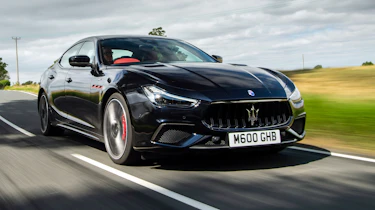
Yes, it does share some components from the Chrysler parts bin, and you probably forgot that it existed at all, but if you enjoy your supersaloons with a unique slice of character and personality, the Maserati Ghibli might just be for you. While the performance of earlier iterations left us cold, its final years brought the V8-powered Trofeo into the equation. Italy’s answer to the BMW M5 was a whole lot more compelling.
As with the Quattroporte, Maserati added a Trofeo model to the Ghibli line-up, which meant that for the first time the smaller of the two saloons from Modena had an eight-cylinder engine, where previously only a choice of six-cylinder petrol or diesel units was available. And where the infotainment system might be borrowed from Chrysler via the Stellantis parts bin, the V8 is 100 per cent European and home-grown in Italy.
> Maserati Ghibli Trofeo Fast Fleet test – 4000 miles in the Ferrari-powered saloon
Engine, gearbox and performance
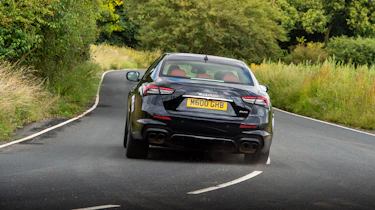
- Ferrari V8 is dripping with character and makes the top-end Ghibli furiously fast
- ZF 8-speed transmission has its own Maserati set-up and character
- The Trofeo is the Ghibli's potential realised, with V6 and four-cylinder variants not quite there
Developed by Maserati but built by Ferrari, the twin-turbo V8 of the Trofeo is related to the F154 motor you’ll find in all V8-engined Ferraris from the Portofino to the SF90 (although the link weakens as you get closer to the 986bhp hybrid hypercar). Changes for the Trofeo include a wet sump in place of the Ferrari’s dry sump set-up and a cross-plane crank instead of the flat-plane item favoured by Maranello, the latter a prime reason why the Ferraris rev to 8000rpm but the Trofeo peaks at 6750rpm. And while the Ferrari and Maserati share the same bore size, the latter’s stroke is shorter, which is why it’s 3.8 rather than 3.9 litres.
More reviews
It means the Ghibli’s power is checked at 572bhp – I know, how will we cope? – while peak torque is 538lb ft and available from 2250rpm. Now clearly these are hardly outputs to be sniffed at, even if the obvious German rivals all deliver over 600bhp and a twist more torque. Until, that is, you spot the porky 1969kg kerb weight and your heart sinks just a little.
> This Maserati wasn’t a very good car in many ways. Here’s why I loved it anyway
But here’s the thing: the Trofeo has a level of performance for a car of its size and weight that feels pretty much spot-on for enjoying on the road without attracting the wrong sort of attention. It’s plenty quick enough, but rather than focus on sprint times (62mph is reached in 4.3sec) and lap times, the Trofeo exudes a confidence and sense of purpose at being very much its own kind of supersaloon, one that can still make encouraging progress but doesn’t require you to have your legal team on speed dial.
Left in its Normal mode, the Trofeo’s V8 feels more in tune with your expectations of a GT car. It gathers momentum with an effortless gate, the revs barely troubling the midway point on the tacho as the eight-speed ZF auto slips between ratios. On long journeys it relaxes you, carrying speed without ever causing your heart rate to spike – which makes you question why rivals feel the need to be so highly strung even when they’re in their mildest settings.
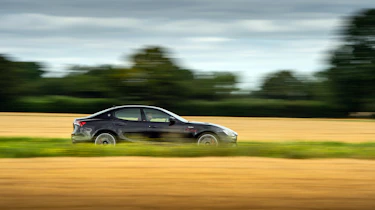
A switch to Sport mode or Corsa, the latter also disabling the stability control and only allowing the firmer of the two damper settings, provides sharper reactions and a more intense V8 experience. Both modes up the ante, quickening the responses and opening the exhaust valves significantly so you can hear the passion that every Italian V8 is made with. There are no over-the-top pops and bangs, exaggerated roars and rasps, just a cultured tone you’d expect from an understated Italian sports saloon.
With the revs building faster and with a heightened sense of adrenaline, the V8 gets into its stride. It’s not as quick to rev as its distant cousins from Maranello, nor does it have that fiery top-end punch or the low-down throttle response Ferrari has achieved with its turbocharged V8. And yes, the twin-turbocharged eights from Germany generate more noise and deliver a level of performance a tier higher – as you’d expect of engines producing the power they do. But chances are you won’t care, because the Trofeo’s approach to being a supersaloon is from a previous generation, one that feels just as suited to today’s world as it did to the one of more than a decade ago.
Step down to the lesser S variant of a few years prior and the Ghibli was available with a 2979cc twin-turbo V6, built for Maserati by Ferrari in Maranello. It has 20bhp more than in the earlier car at 424bhp, yet is also a touch cleaner at the same time. Despite the similarity in size to Alfa’s 3-litre twin turbo V6 – also built by Ferrari at Maranello – this engine bears no resemblance to the Alfa unit because it is a 60-degree V6. Whereas the one in the Alfa is a 90 degree V6 and is essentially a Ferrari V8 with two cylinders removed from one end.
The gearbox in the Ghibli is the ubiquitous ZF eight-speed auto (think anything from BMW 5-series to Range Roveri) albeit tuned by Maserati to behave in its own individual way. You can engage manual by pressing a button in the console, at which point the gearbox won't kick down, even if you mash the throttle open at 40mph in sixth gear. Similarly it won’t upshift unless you pull the right hand paddle, to a point where you can bounce it off the rev limiter in a chosen gear and still it won’t change up. Maserati claims a 0-60mph time of 4.9sec for the S, which isn’t bad for a car that weighs 1810kg and has ‘only’ 424bhp. Top speed is 177mph. The Ghibli was also available with a four-cylinder in various states of tune, including GT Ultima, offering plenty of standard kit, but a comparatively measly 325bhp 2-litre.
Ride and handling
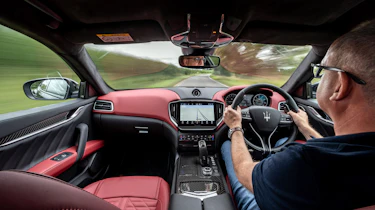
- Ghibli has a benign balance and a GT car gait, rather than that of a truly engaging super saloon
- There's more body roll than you'd expect from German rivals
- The upside is it's often a more refined experience than an F90 BMW M5 or Mercedes-AMG E63
With Skyhook dampers standard on the Trofeo (there’s double wishbones at the front and a multi-link set-up on the rear) the units are continuously variable but do offer two distinct settings, with comfort a priority in Normal and ICE (as close to an eco mode as you can get in a 572bhp supersaloon) and a harder setting when Sport or Corsa are selected. Left in the softer setting, the Trofeo’s chassis is remarkably calm and supple with a level of bump absorption you’d expect from a car that prioritises luxury over performance. The trade-off is a fair bit of body roll, and there are times on poor surfaces where a brittleness to the ride can filter through to the cabin as the 21-inch wheels struggle to disguise their mass.
Some of the body roll is addressed when you firm the dampers up and, when you do, the ride is still more compliant and settled than in anything carrying an AMG, M or RS badge is in their softest setting. The electronic steering, while quick for this era of Maserati, isn’t as pointy as many today, but you soon settle into enjoying its calm front end, and it allows you to place it on the road with precision and thread it neatly through a turn, leaning on the chassis and working with the feedback.
The Pirellis sound and feel like they are going to give up early in the game, but push through the initial vagueness and hint of understeer and they bite hard (if noisily) and you can adjust your line via steering or throttle application depending on your mood. The mechanical diff in the rear axle takes longer to hook up than today’s faster, more sophisticated electrical items, but it does mean you have more say in the car’s balance and attitude.
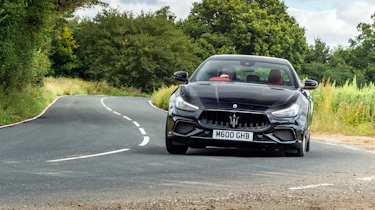
It might not bludgeon the tarmac into submission, or chase the horizon like a puppy honing in on a ball, and if you want the fastest, most aggressive, supercar-like supersaloon the Ghibli Trofeo isn’t for you. If, however, you like your performance to be served more subtly, with a degree of desirability that doesn’t make you feel like you’re out to set a fastest lap with every drive, the first V8-engined Ghibli is that car.
In its more ordinary forms, the Ghibli’s re-occurring weight issue is its biggest detractor, as it is nothing like as dynamically sorted as the benchmark Jaguar XF or BMW 5-series. Despite using an old school hydraulic power steering set up, the helm is numb and isolates the driver from exactly what the front wheels are doing.
Maserati bills itself as a manufacturer of GT cars, which alludes to a certain level of dynamic capability. In sport mode, with its optional adaptive dampers switched to their firmer setting, the Ghibli is competent and composed across a winding road without ever being really thrilling. The Pirelli P Zero tyres find good grip and body control is strong, but the balance is so benign that there’s no real incentive for chasing the car to its limits.
Living with a Maserati Ghibli Trofeo – John Barker
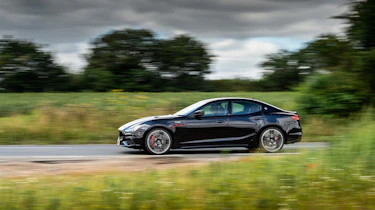
'Thumbs up, head nods and heel swivels. The Maserati Ghibli Trofeo has star quality, no question. Maybe the number plate (M600 GHB) attracts attention, but I think that it’s more likely the rarity of seeing – and possibly hearing – the biggest, baddest Maserati saloon in the wild. The fact that it’s finished in under-the-radar black only adds to the spot, making the Ghibli Trofeo as cool as any I-Spy 50-pointer.
'It’s as refined as a big saloon ought to be, and it is huge. Open the boot and the floor seems to disappear off down a tunnel – I swear you could get a full-size ladder in there without dropping the rear seats. Yet the cockpit manages to feel cosy thanks to a low driving position. There’s a slightly brittle edge to the ride that hints at the Ghibli’s sporting intent, but to get unequivocal confirmation that there’s a V8 under the bonnet you need to select Sport mode.
'This makes the exhaust note heavier and more resonant but even then the Ghibli is not as brash and attention-seeking as a Mercedes-AMG E63 S or Audi RS6. It’s more a ‘speak quietly and carry a big stick’ sort of saloon, and the Ferrari-derived 3.8-litre twin-turbocharged V8 delivers an awful lot of stick.
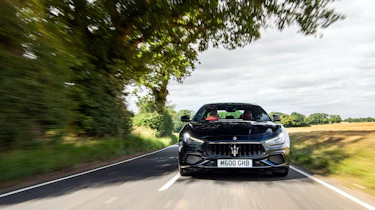
'The headline figure is 572bhp but it’s the 538lb ft of torque from just over 2000rpm that widens your eyes and troubles the rear tyres. Traction control keeps it from becoming a riot but allows just enough overspeed to give you a good idea of what you’d have on your hands if you turned it off. You’d need a lot of room for starters. Black paint might shrink it visually but pick up the pace and the Ghibli’s size and weight command your attention.
> BMW M5 review – it’s more powerful but is the extra weight a problem?
'I took it to the north Norfolk coast and there were plenty of interesting, flowing B-roads to enjoy, but they felt a bit tight in the Ghibli, especially at this time of year. Dynamically, I’d like to get to know it in more temperate conditions; single-figure temperatures and slick dampness are not conducive to relaxed exploration. In Normal mode the secondary ride can feel busy, yet body movements are a little free and the sense you get through the wheel is that in a tight corner the front tyres will probably push wide if pressured.
'Switching up to Sport tightens things up and gives the ride and body control a more consistent feel, as well as giving the engine more voice and putting the gearbox on high alert. I preferred to engage manual mode and work the V8 in the lower reaches, upshifting as soon as the ’box allows to bathe in its full richness. It reminds me of the Jaguar XJR, another out-size saloon with an amusingly old-school power-to-grip ratio. The interiors of both also have more innate style than anything designed in Germany, and more HMI foibles too, but they’re all part of the charm, aren’t they?'
Values and rivals
So no, the Ghibli didn’t quite have the complete package to take on Germany’s finest 600bhp-plus supersaloons, even in range-topping Trofeo-form, but it’s a different experience. Not that it would have cost you any less, as it started from £104,200 before options.
Mercedes-AMG’s E63 S cost from £116,995 in its last, Final Edition form, while BMW now charges from £111,405 for its new (and admittedly much more potent) hybrid M5. Porsche’s Panamera GTS now costs from £125,600, and despite a power deficiency is still one of the best of its kind to drive. Still, none of the German alternatives have the soul of the Maserati, and while that might sound like a cop out, there’s just something about trundling around your local town in a V8 Maserati that makes all the difference.
Ghibli prices now start from less than £10,000 for the earliest 2014 examples with serious miles, perhaps making it one of the biggest badge (if not bang) for your buck cars on the used market. The last-of-the-line Trofeos are rare but when they do appear, are usually available for between £50,000 and £90,000, as of September 2026.
Maserati Ghibli Trofeo specs
| Engine | V8, 3799cc, twin-turbo |
|---|---|
| Power | 572bhp @ 6750rpm |
| Torque | 538lb ft @ 2250-5250rpm |
| Weight | 1969kg (295bhp/ton) |
| 0-62mph | 4.3sec |
| Top speed | 202mph |
| Basic price | £104,200 |