McLaren 675LT (2015-2017) review – McLaren’s answer to the Ferrari 458 Speciale
McLaren took a few years to find its stride and the 675LT couldn’t have been a more spectacular demonstration that it had done just that
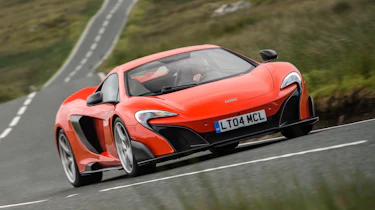
McLaren’s ‘LT’ brand, launched with the 675LT, incurred a few eye-rolls on its arrival in early 2015. LT stood for Longtail, referencing the lengthened-by-641mm version of the McLaren F1 that raced in the late 1990s. At just 33mm longer and in no way a homologation car, the links between the old legend and McLaren Automotive’s first lightened, tautened track special were tenuous at best.
Now, over ten years on, we know that if a McLaren wears an LT badge it’s likely to be one of Woking’s most thrilling models. Many drives of the 675LT on road and track, alone and against rivals, left us convinced this was arguably McLaren’s ‘Speciale moment’. An example of what is still a five-star high watermark for the company – potentially McLaren’s best ever car – can be yours for less than a new 750S, or half the price of a specced-up Ferrari 296 Speciale.
Like your favourite band’s first album, the first McLaren LT still has something special about it, even by comparison to its excellent progeny. It was a labour of love, its creators fastidious in executing on a purity of vision with deliciously overindulgent engineering. Paul Saunders, who was at McLaren for ten years before co-founding McLaren specialist V Engineering, tells us it was intended to be very little short of a McLaren P1 minus the hybrid tech.
Engine, gearbox and performance
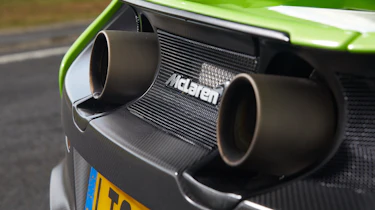
- 50 per-cent new V8 compared to the 650S
- 666bhp and 516lb ft. Feels like a lot more – almost P1 fast
- Ignition-cut aids shifts and adds exhaust crack drama
More reviews
The 666bhp 3.8-litre twin-turbo V8 was 50 per cent new, featuring upgrades derived from the P1 hypercar. The M838TL is 10kg lighter than the 650S’s V8, with different turbos, camshafts, lightened con-rods, revised cylinder heads and a more powerful fuel injection system.
> How to buy a used McLaren supercar bargain
New exhaust manifolds fed into a lightened titanium system with a new crossover silencer for more exotic vocals. The dual-clutch transmission’s shift times were halved to 40 milliseconds thanks to F1-style ignition cuts, giving the LT its signature thundercrack gearchanges.
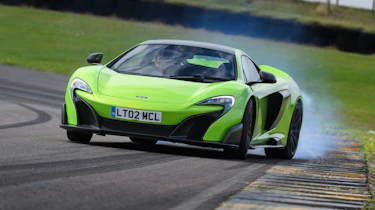
‘With the powertrain portion of the ProActive Chassis Control system dialled back to Normal, initial throttle response is slugged to the point where the 675LT feels almost sleepy, the seven-speed double-clutch transmission extreme short-shifting to the resonant drone of the McLaren’s lightweight titanium exhaust system behaving like a rapidly stepped tone-generator heading for the basement.
'There’s enough low-down torque to indulge the software’s laid-back approach and you know all 666bhp is waiting at the end of the throttle travel should you need it, but the built-in torpidity feels a little contrived all the same. Wind it up and the performance is extraordinary, enough to haul in a fully-lit 991.1 GT3 RS with 80 per cent throttle. The engine doesn’t feel turbocharged at all, just stupefyingly energetic with a superbike-like appetite for revs sliced up by those 40-millisecond ignition-cut gearshifts.
‘That 666bhp claim seems distinctly conservative, the LT feeling a whole layer of manic quicker than a 650S and more like a 99th percentile P1. A little quieter with a more linear delivery and not so much wastegate pissshhh and flutter. But from memory on the road, there can’t be much in it.’ – David Vivian, evo 213.
Ride and handling
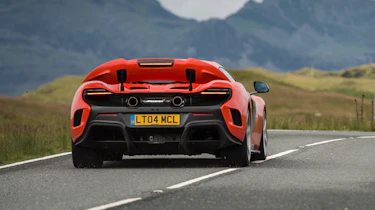
- 675LT feels alive compared to 650S and 12C
- Most of the refinement is retained thanks to PCC…
- … but the steering can feel busy on the road
A 50 per cent larger rear wing to earn it the LT name and an 80 per cent larger front splitter were among a raft of aero changes, adding up to a 40 per cent increase in downforce (at 186mph) compared with the 650S.

As per the tried and true track star formula, McLaren cut 100kg in addition to adding power. Carbon bodywork joined the lighter engine, losing 35kg, while a 1mm thinner windscreen saved 3kg. Shaving 30kg and also contributing to an overhauled dynamic feel, revised suspension featured P1-derived uprights and wishbones, new hubs, and more aggressive geometry to sharpen the LT’s responses.
The springs were lighter and stiffer at the front (by 27 per cent) and rear (63 per cent), and the front ride height was reduced by 20mm. McLaren’s hydraulic Proactive Chassis Control suspension system was tuned in concert for added focus while maintaining a degree of compliance – keeping taught and connected in hard cornering then decoupling at a cruise. The result? Still one of the sharpest, most complete driver’s McLarens there’s yet been.
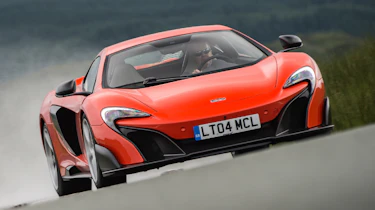
‘The McLaren’s behaviour on the Llanberis Pass exposes telling contrasts. If a chassis can have good posture, the 675LT’s definitely does. It scythes through the series of smooth, high-speed bends with staggering elan and composure. The suspension and damping make it feel as if the road’s sharp edges are smothered with a cushioning layer of silicon that draws the sting, pulls the punch of what would be harsh single-wheel inputs.
‘The LT’s steering is less disciplined than that of a Porsche 991.1 GT3 RS and feels like it’s trying too hard to deliver masses of feedback. It’s very busy around the centre and the tyres have a bad habit of sniffing out cambers, forcing you to make constant small corrections, especially under braking. Yes, you can lean on the front and it responds faithfully and cleanly to your inputs, but ultimately you can’t feel precisely what’s going on and you need a dose of faith that the car is as good as you think is.
‘It is, of course. For me, it’s the best McLaren since the F1 and asks questions of the P1 that McLaren probably didn’t intend. It also matches the 991.1 GT3 RS punch for punch in the pursuit of driving fast on a great road with a richness of feedback that nails all your senses and a pulse-quickening intensity.’ – David Vivian, evo 213
evo Car of the Year 2015 – Stuart Gallagher
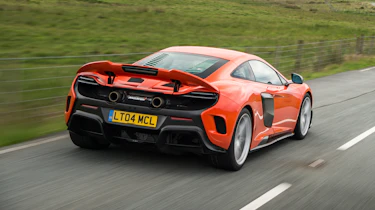
In issue 213, splitting Porsche’s 991.1 GT3 RS from McLaren’s new 675LT came down to whether you preferred sausages to bratwurst. It was so close we couldn’t call it, but a week on the North Coast 500 gives us the answer we’ve been searching so hard for. There are a number of reasons for the LT’s triumph over its Weissach nemesis for second place, chief among them the leap the ‘Longtail’ makes over previous McLaren road cars.

‘This is the first time I’ve ever really connected with a McLaren road car. It felt so sweet and immediate at medium speeds, but every time I had a proper thrash in it I stepped out shaking with adrenalin.’ – Dan Prosser
‘It gave me one of those unforgettable drives. The McLaren leaves nothing on the table. What an intense car. It’s like a racer on slicks: it gives you confidence to lean on the front end. The understeer from the 650S is gone and now it’s super-agile and accurate.’ – Jethro Bovingdon
‘The 675LT is everything you sensed lay latent in the 12C. You get an incredible connection with the front end. Then you wake up to the brilliance in the suspension and drivetrain.’ – Nick Trott
Values and buying checkpoints
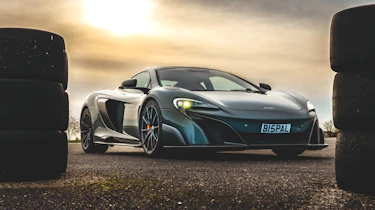
The 675LT has also earned the most important acclaim: that of those who bought them and those who look after them. John Thorne, founder of specialist Thorney Motorsport, says it’s one of the most reliable McLarens, attributing the depth of engineering to the company’s healthy bank account at the time of its development. Paul Saunders calls it ‘possibly McLaren Automotive’s finest hour’. ‘When the 675 and P1 were being developed, it was a great time to be at McLaren. We worked with great people, under a great leader in Ron Dennis.’
How different the 675LT is from the 650S used to be a pain, given its bespoke suspension components once cost four times more to replace. The Proactive Chassis Control hydraulic accumulators also lose pressure over time, which you can feel through both the ride and the steering given the systems are connected.
Happily, V Engineering can now re-bush existing wishbones and offer a Senna-based, rechargeable accumulator upgrade representing significant savings. They can also sort leaks in the Graziano gearbox, a relatively common problem that used to necessitate a £20,000+ transmission replacement. Stories of those lightened con-rods not being strong enough usually come from those who have added power to their cars without strengthening the internals.
Indeed, some of the fewer-than-200 thought to be in the UK (500 coupes and 500 Spiders were made overall) are currently available for under £250,000. You’ll pay more for rare paint and the optional exterior carbonfibre.

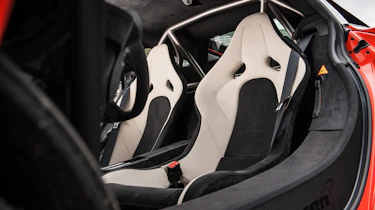
Likewise a roof scoop (coupe only) and Club Sport and Club Sport Pro packs (both got a titanium roll cage and harnesses, the latter got a fire extinguisher and Pirelli P-Zero Trofeo R tyres ). Spiders command a premium too. The LT magic is there in all of them. Just get one that’s been well looked-after, has been inspected by or is known to one of the specialists and, preferably, has the P1-style ‘Racing’ seats.
Limited-run and relatively dependable, the 675LT is, say those in the know, a McLaren unlike most. And McLaren ownership in general should be a lot less daunting with the knowledge and expertise that’s now out there. That the 675LT still suffers from the deflated values typical of the marque is something we’d urge all in the market for a five-star supercar to capitalise on sooner rather than later.
Specs
| Engine | V8, 3799cc, twin-turbo |
|---|---|
| Power | 666bhp @ 7100rpm |
| Torque | 516lb ft @ 5500-6500rpm |
| Weight | 1328kg (510bhp/ton) |
| 0-62mph | 2.9sec (claimed) |
| Top speed | 205mph (claimed) |
| Price new | £259,500 |
| Value now | From £200,000 |