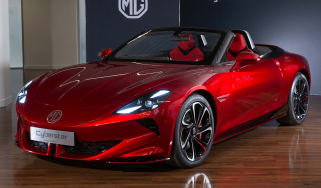
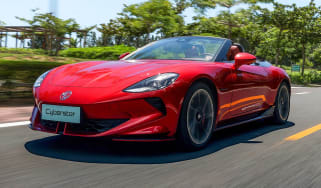
MG Cyberster review – stunning to look at, but not to drive
MG is back to building roadsters, this time powered by batteries. Does the Cyberster deliver a convincing open-top driving experience?

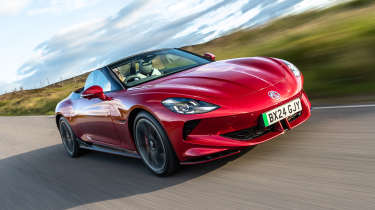
If you buy an MG Cyberster, prepare for every journey to take a little longer than usual. Not because the Cyberster is slow (it’s anything but), but because people will stop you to talk about it. Everywhere. All the time.
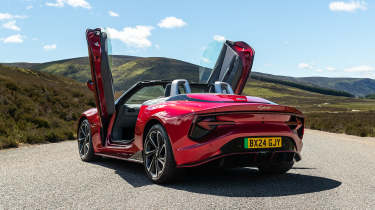
Parked up in a layby during our test, bikers rode past at walking pace to drink in the new electric roadster, and drivers squeezed their cars in behind it for a good look around and a chat. ‘Is it a Lamborghini?’ asked one, presumably because the MG’s electric scissor doors were hanging in the air. Another wondered whether it cost £150,000, and his brain struggled to compute the fact that you could almost buy three Cybersters for that much. As a halo product to create a buzz around MG, it absolutely nails the brief – but what about as a sports car?
This is a really important car for a number of reasons. For one, the Cyberster marks MG’s return to building roadsters, picking up a lineage that stretches back to the T-Type models from the 1930s, followed by the MGA, MGB and most recently the MGF. At launch in 2024 it was also one of the only two-seater electric sports cars that sensible money could buy, and that remains the case today. In fact most manufacturers are turning their back on the concept, most notably Porsche as the launch of its electric 718 hangs in the balance.
More reviews
The Cyberster was a long time in the making, too. MG first teased the prospect of a new electric roadster with a show car back in 2017, which steadily evolved into the Cyberster concept shown at Shanghai in 2021. From that, a production version was greenlit by MG bosses, riding on the same architecture as the MG4 hatchback and clothed in toned-down, road-ready bodywork. The final car went on sale in 2024, and prices start from £55,245 for the rear-drive Trophy or £60,245 for the dual-motor GT – in the same ballpark as an Alpine A110, which itself will be relaunched as an EV next year.
Design, interior and technology
- Turns heads like nothing else at this price
- Electric scissor doors are a cool party trick but slow to operate
- Fiddly infotainment and high seating position are snags in an otherwise attractive cabin
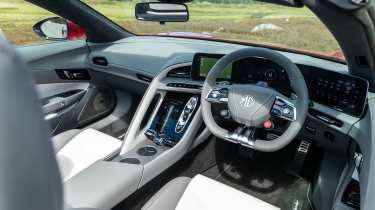
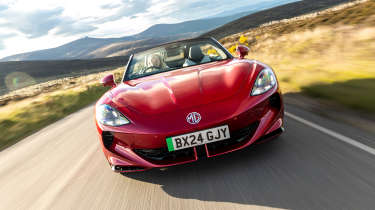
Even in production form, the Cyberster has more than a hint of concept car about it. It's similar in size to a BMW Z4 but draws the eye like something much more exotic and expensive, to the point where you can (almost) forgive the cheesy arrow-shaped light clusters at the rear. The doors are electric and swing open with the touch of a button on the window trim (or the key) – it's a cool party trick, but the speed at which they open is just slow enough to make you wish for a normal hydraulic strut after a while.
Climb inside and the wraparound dash is reminiscent of a C8 Corvette’s, so too the seemingly random layout of some of the controls. You close the door with a rocker switch on the centre console, and above that you’ll find a bank of gear selector controls next to a touch screen where you switch between drive modes. There are a further three screens behind the steering wheel, with a dial readout in the centre, navigation and media on the left and more settings and trip information on the right. The Cyberster isn’t a car you just jump in and drive – familiarising yourself with the HMI takes time, and is best done sitting still.
Once you finally lift your eyes from the screens you’ll notice that the seating position is surprisingly high. The Cyberster’s battery pack is beneath your backside, raising the seat and meaning that tall drivers may find their hair peeking above the windscreen – good for a quick blow-dry, but not for the nestled-in feel you want in a sports car. The wheel (a good size but a little too thick) does extend out of the dash far enough to get comfortable, though, and there’s an exciting sense that you’re in something new, unique and really rather special.
Powertrain and performance
- Rear and four-wheel drive available, with up to 496bhp
- Up to 316 miles of range from a 77kWh battery
- Boost mode unleashes supercar pace in the GT, with 0-62mph in 3.2sec
Get going and the silence of the powertrain amplifies the environment around you, whether it be the rustling of leaves or chatter from bystanders (usually: ‘Is that an MG?!’), putting you in close touch with your surroundings. Gliding along at normal pace with the roof down is a calming and satisfying experience.
But there’s a big red button on the steering wheel begging you to push it. It’s marked Super Sport and unleashes everything the powertrain has got – in the case of the dual-motor GT, that's 496bhp and 535lb ft of torque. Sink into the throttle and the Cyberster pings between corners with massive thrust, forcefully ripping up to motorway speeds and feeling easily good enough for its quoted 3.2sec 0-62mph time. Seamless, instant EV acceleration is a familiar sensation by now, but being exposed to the elements gives it added intensity – if not of the ‘wailing straight-six’ kind.
The single-motor, rear-drive Cyberster Trophy has 335bhp and 350lb ft, giving it a slower (but still brisk-feeling) 5sec 0-62mph time. Removing the front motor sheds 100kg and improves range. The Trophy gets 316 miles from its 77kWh battery compared to 276 in the GT, with both charging from 10-80 per cent in 38 minutes.
Ride and handling
- Poor suspension control, particularly given the performance on offer
- GT weighs nearly two tons and feels it on an undulating road
- Calm at a cruise but lacks the bandwidth and handling ability a GT needs
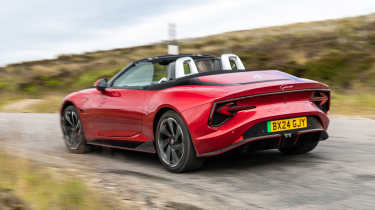
If there’s anything to stop you from using the massive potential of the powertrain, it’s that the Cyberster has a lack of suspension control that can be alarming when the road gets challenging, and breaks trust between car and driver. It’s just about tolerable at normal speeds, but the faster you go, the more the body feels out of sync with the road, bouncing across the surface and struggling to keep all four tyres in firm contact with it. Our test route was in the Scottish Highlands where the heavily undulating tarmac pushed the Cyberster’s composure to the limit, the tyres catching air and its belly grazing the ground more than once.
MG stresses that the Cyberster is a GT rather than a pure sports car, but even considered as such, it lacks composure and the ability to entertain when the moment allows like the best GTs do. Carry speed on an uneven surface and the Cyberster is hard to read, finding bite but then releasing grip as the suspension loads and unloads over bumps, making every one of its 1985kg felt. The brake pedal is solid underfoot but it needs a firm push to reign in the mass, too. Driving quickly is an exercise in management rather than fun, and the same is true in the rear-drive Trophy.
The lighter Trophy does feel keener to turn but also a little more jittery in its ride quality. There isn't an exploitable rear-drive balance to be enjoyed, either – the inside rear spins up out of low speed corners (and sometimes through bumpy high speed ones) and the transition to oversteer feels scrappy. With the front motor also dragging you forward, the GT is able to mask this to an extent.
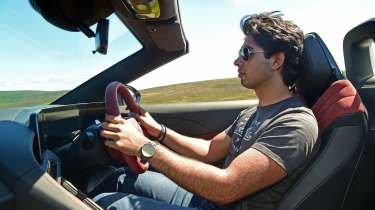
It doesn’t take long for you to back off and drive around the limitations of the chassis, carrying less speed and guiding the car with a lighter touch. In these moments you can find a better flow with the Cyberster, particularly on smooth roads. There’s a hint of shimmy through the steering rack but the relaxed rate of response allows you to place the car accurately, the torque from the motors gives you effortless flexibility and you go back to enjoying the silence and your surroundings. The ride is compliant and fades into the background, and miles are ticked off in style and comfort.
Does that let the Cyberster off the hook? Not quite. An MG roadster – the first for decades – should do more than make you feel good while cruising, and there’s very little incentive to use the massive performance it offers. It feels like more time needs to be spent on tuning the chassis to deliver better control and fluidity, which would ultimately support its GT credentials and unlock more rewarding elements in the driving experience.
Price and rivals
Given that demand for electric performance cars is still far from where it needs to be, many manufacturers have either postponed or canned their EV sports car plans. That means, for the moment at least, the Cyberster stands alone in the market as the only electric roadster available for sensible money. The Trophy comes in at £55,245 and the GT at £60,245, and though the Cyberster has its flaws as a sports GT, you do get an awful lot of performance and style for the price.
Even if you go petrol powered, c£60k sports cars are few and far between. Porsche’s 718 Cayman has gone off sale (with the launch of its electric replacement uncertain), the BMW Z4 is no more and production of Alpine’s A110 will end imminently. Having said that, there’s still the likes of the Ford Mustang GT (£58,670) to choose from, and if you stretch your budget beyond £70k, you can bag a BMW M2 or something more specialised, like Morgan’s Plus Four. Each of these is more rewarding than the Cyberster but only the Morgan comes with a convertible roof.
Of course, you can always venture into the used market where there’s a huge selection of sports and GT cars, with everything from Porsche 911 Targas, Mercedes-AMG GTs and Lexus LC500s available for the price of a new Cyberster.