Is it finally time for Honda and McLaren to build the ultimate hypercar?
Driving a Honda NSX took Meaden right back to his earliest road-testing days, and inspired an idea...
Our recent ’90s supercar test was a real nostalgia trip for me. Entering the decade as a late-teenage reader of magazines and wannabe road tester, by 1993 (and after a lot of hustling) I’d secured my dream job in the road test department of a new title called Carweek.
It’s a frustrating fact of a young road tester’s life that you’re not immediately tossed the keys to whatever exotic car might be in the office car park. When you happen to work for the sister title to Car – the magazine through which I’d lived all my vicarious supercar dreams – that was especially galling, but probably for the best. Besides, it made the weekend I was eventually trusted with a Honda NSX all the sweeter.
> Honda NSX (1999 - 2006) review: Japan's original supercar
Senna-spec – that’s to say red with a black roof – it was the first mid-engined car I’d ever driven and therefore my first supercar. Heading home on Friday afternoon, I was on cloud nine. The weekend was a blur of pretty much non-stop driving, visiting mates and, er, ‘developing’ my nascent (read non-existent) mid-engined driving skills by bombing up and down an unforgiving set of corners known as the Pirbright Bends with my wingman, Tim, alongside me. Thirty-three years after the event, I’d like to thank Honda chief test driver Motoharu Kurosawa, Ayrton Senna and Saturo Nakajima for developing the NSX’s evidently idiot-proof on-limit handling…
Driving Paul Brace’s immaculate NSX this month took me straight back to that epic weekend. From the feel of the door handle and smell of the interior to the crispness of the white-on-black dials and blood-red needles, getting back into the NSX was unexpectedly evocative. No matter how much I’ve fought not to become blasé around supercars, I’ll concede that decades of exposure have inured me more than I’d like. Sliding the delightful Monel alloy key into the ignition, and hearing that distinctive Honda starter motor spin to bring the surprisingly gritty 3-litre VTEC V6 to life was truly restorative. So far as the fizz in the pit of my stomach was concerned, I was 22 again. Though at 55 it was more likely to be a misfiring gallbladder.
Not long after taking home the NSX, I drove my first Ferrari: the oddball and vanishingly rare Mondial T ‘Valeo’, no less. Fitted with a clutchless gated-shift manual that was the forerunner of the F1 paddleshift. Naturally, I was buzzing to try a Ferrari for the first time, but beyond my youthful euphoria, the reality of that Mondial was far less special than the Honda. Thankfully I didn’t take it to the Pirbright Bends, for its spikey handling might have ended my career before it had really got going.
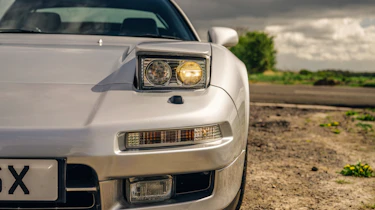
It still puzzles me that Honda’s first mid-engined supercar should have been so technically superior yet ultimately something of a dead end. How can it be that Japan – a nation renowned for meticulous engineering and a fanatical love of motorsport – has built only two true supercars in the NSX and LFA? Each made an indelible impression, yet neither ever seemed destined to be anything beyond a beginning and end in themselves.
To be fair to Honda, there were advanced plans to succeed the Mk1 NSX with a front-engined, all-wheel-drive, V10-powered super-GT that promised to combine the dazzling complexity and sophistication of the Nissan GT‑R with a searing race-derived powertrain akin to that of the later LFA. We have the 2008 global financial crisis to thank for its eleventh-hour cancellation, but even if it had made production, it’s hard to imagine Honda now having a two-decade bloodline to rival Ferrari’s 599, F12, 812 and 12 Cilindri.
Ironically, the car that eventually marked Honda’s return to supercars – the pioneering hybrid twin-turbo V6-engined ‘NC1’ NSX – was so far ahead of its time there simply wasn’t a market for it. Fewer than 3000 units were sold. The bitter irony of McLaren and Ferrari successfully building twin-turbo V6 hybrid supercars can surely not be lost on Honda’s senior executives, but they must also be cognisant of how these cars are struggling on the used market.
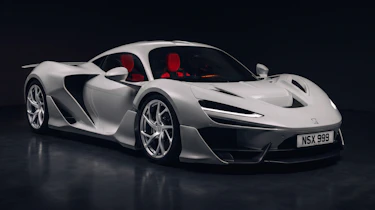
Given the apparently limitless appetite for ultra-low-volume, ultra-high-price boutique specials, perhaps Honda’s next New Sports Car eXperimental should be a reflective project that celebrates its greatest adventures (not the current misadventure with Aston Martin F1) in internal combustion. With 2030 and 2031 being 40-year(!) anniversaries of Senna’s second and third F1 drivers’ titles, respectively achieved in McLarens powered by 3.5-litre V10 and V12 Honda engines, perhaps it’s time for the two brands to collaborate once more, this time on the mother of all hypercars: rebodied W1-based chassis by McLaren; screaming, naturally aspirated stick-shift powertrain by HRC. Perhaps a little like our render pictured above...
This story was first featured in evo issue 349.