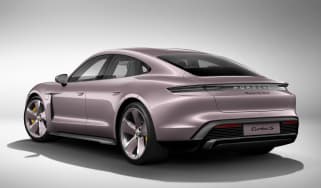
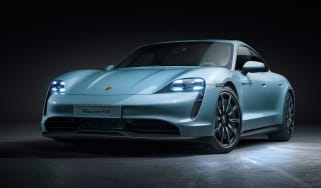
Porsche Taycan review – it's still one of the most complete electric cars on sale
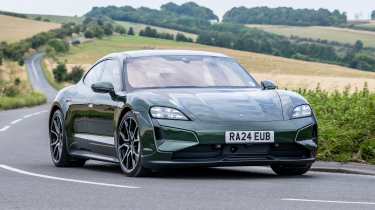
The Taycan is one of the most broadly talented EVs you can buy, with class leading performance, range and genuine Porsche DNA in the way it drives

For
- Drives like an electric Porsche should
- Performance ranges from brisk to barmy
- Current version has a competitive range and charging speeds
Against
- Expensive, with poor residuals
- Interior is a little touchscreen-heavy
- Saloon isn’t as practical as some rivals
evo verdict
The Taycan was a good car at launch in 2019, and it’s a better one today. The EV world is moving fast but thanks to a significant mid-life update in 2024, the Taycan isn’t being left behind. It’s still among the most desirable electric cars around, has more performance and range than before, lightning-fast charging capability, and drives… well, like a Porsche. It’s not a 911 or Cayman but it does share some DNA with Porsche sports cars, as well as being quiet, calm and comfortable when you need it to be. Only limited practicality for the saloon - and the UK’s public charging network - really hamper its luxury GT credentials.
Background and model range
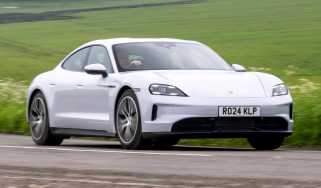
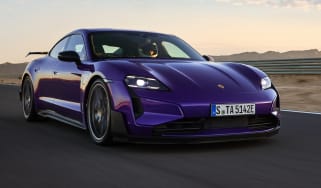
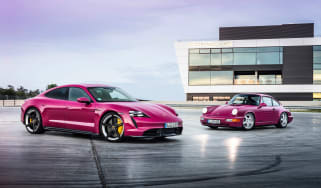
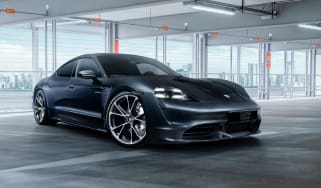
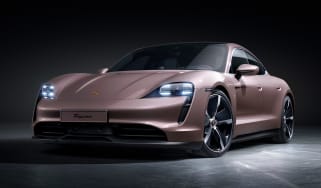
Such is the rapid pace of EV development that it always feels like there’s something around the corner to set a new benchmark, shifting the goal posts of what an electric car can do. But even though the second-gen Porsche Taycan is two years old now, it's still at the top of its game. The 2024 facelift saw the Taycan take a huge step forward in every key metric - from performance, range and charging speed to cruising comfort and dynamic ability - to make one of the most desirable EVs on the planet even better, and the benchmark for premium electric saloons.
More reviews
Reviews
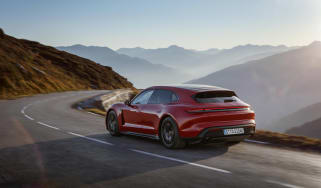
- Porsche Taycan GTS Sport Turismo review – why this is the only everyday electric performance car you need
- Porsche Taycan RWD 2025 review – a good car at a good price, but mind that depreciation
- Porsche Taycan Turbo GT Weissach Package review: two seats, 1020bhp and £186,300
- Porsche Taycan Cross Turismo 2022 review – a sports utility vehicle done right
The high-end electric car market has proven to be a tough nut to crack - just look at Taycan residuals, and how many premium brands have put their EV plans on hold - but in purely objective terms the Taycan is deeply impressive. Its combination of style, polished driving dynamics and build quality - not to mention its ability to teleport when you plant the throttle - make it one of the most rounded EVs you can buy, even if it lacks the sheer desirability and character of a petrol super-estate like an Audi RS6.
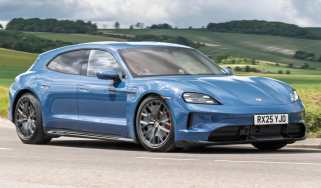
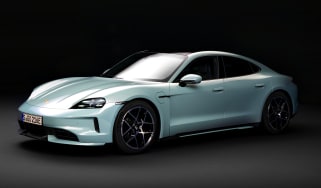
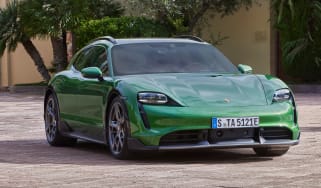
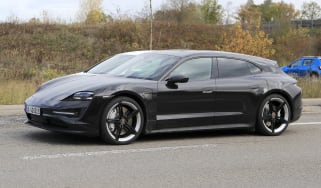
The Taycan comes in a variety of forms, including a Sport Turismo estate, a jacked-up, plastic-clad Cross Turismo and a track-honed Turbo GT. There’s a model for almost every use case – if you have the cash, that is. The Taycan doesn’t come cheap, starting at more than £88,200 and stretching all the way to an astonishing £189,200 in its flagship form; big money, but that’s the price you pay for what is an electric saloon with the quality and driving dynamics you expect of Porsche.
Powertrain and technical highlights
- Rear- and all-wheel drive models available
- Turbo GT develops well over 1000bhp
- Cross Turismo brings taller suspension and body cladding
All Taycans save for the entry-level model have an electric motor on each axle, with a two-speed gearbox on the rear motor and flat battery pack running the length of the cabin. It has a 97kWh capacity, and compared to the original Taycan, the Gen 2’s unit is more energy dense, so despite having a larger capacity it’s actually lighter.
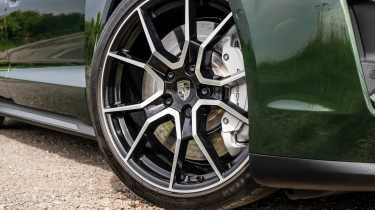
The J1 platform that underpins the Taycan packs a raft of sophisticated chassis technology to harness all that performance. It supports air suspension (fitted as standard), a torque vectoring rear differential and, new for the Gen 2, optional active suspension – called Active Ride, in Porsche speak. The system uses electrohydraulic pumps to control the support from each damper, with the ability to counteract acceleration, braking and cornering forces to keep the body level. The standard suspension consists of two-chamber air springs with two-valve adaptive dampers (steel springs are no longer an option). Carbon ceramic brakes are available, too, with mammoth 420mm and 410mm discs gripped by ten piston calipers.
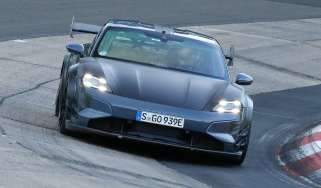
The Turbo GT can be ordered with a Weissach Package at no extra cost, which deletes the rear seats and adds carbon buckets up front, as well as carbon B-pillar, door mirror and side skirt trims. This saves a total of 75kg compared to the non-Weissach car, but at 2220kg the Turbo GT is still a heavyweight. It also gets a larger fixed spoiler to boost total downforce to 220kg, as well as Active Ride suspension with a Weissach-specific tune.
For less money than the Turbo GT, the GTS is your other option for a more driver focused Taycan. It comes with a unique driving sound, 20- and 21-inch alloys and bespoke suspension tuning, with a Porsche Torque Vectoring Plus rear differential coming as standard. As an option, you can spec a GTS-specific Active Ride system.
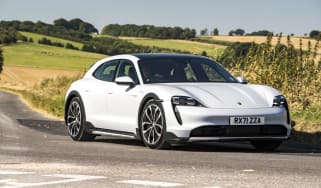
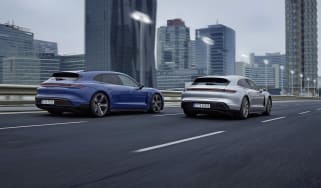
At the other end of the spectrum is the Cross Turismo, which sits 20mm higher than standard and comes with a Gravel drive mode to improve traction on loose surfaces. It's only available with four-wheel drive and in 4, 4S, Turbo or Turbo S spec, and weighs around 30kg more than the equivalent saloon. The normal Sport Turismo estate is more road-biased and loses the plastic body cladding and raised ride height.
Power, top speed and 0-62mph
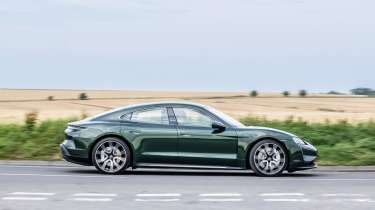
The facelifted Taycan is more powerful across the board. The Taycan’s peak power output comes under launch control and overboost, which in the base rear-drive version results in 429bhp. The 4S, meanwhile, generates 510bhp from two motors. The GTS is where the output figures get loopy, with a peak of 690bhp. The Turbo takes a big jump to 872bhp, increasing to 939bhp in the Turbo S. In the Turbo GT, you get a Lamborghini Revuelto-beating 1020bhp.
The base rear-drive version takes just 4.8 seconds to get from 0-62mph. The 4S’s extra power and traction cut that down to 3.7sec, with the GTS trimming four-tenths from that. The Turbos, meanwhile, move up to hypercar levels of thrust. The standard Turbo completes the benchmark in just 2.7sec, the Turbo S in 2.4, and the Weissach-equipped Turbo GT a faintly ridiculous 2.2sec. The Sport Turismo matches the saloon's acceleration times, though Cross Turismo versions are about a tenth slower to 62mph.
The Taycan’s two-speed transmission helps maintain some of that potency at higher speeds, with the base car topping out at 143mph. The 4S and GTS, meanwhile, top out at 155mph, with the Turbo and Turbo S reaching 162mph – not very impressive in the context of their mammoth power outputs, but more than the Mercedes-AMG EQE53 (137mph) and BMW’s i5 M60 (143mph). 180mph for the Turbo GT is a bit more like it (opting for the Weissach Package raises this to 190mph).
Model |
Power |
Torque |
0-62mph |
Top speed |
| Taycan | 429bhp | 310lb ft | 4.8sec | 143mph |
| Taycan 4S | 590bhp | 524lb ft | 3.7sec | 155mph |
| Taycan GTS | 690bhp | 583lb ft | 3.3sec | 155mph |
| Taycan Turbo | 872bhp | 656lb ft | 2.7sec | 162mph |
| Taycan Turbo S | 939bhp | 819lb ft | 2.4sec | 162mph |
| Taycan Turbo GT Weissach | 1020bhp | 915lb ft | 2.2sec | 190mph |
Driver’s note
‘Turbo models have truly astonishing performance, but even the single-motor Taycan can out-sprint many sports cars.’ – Yousuf Ashraf, evo Senior Staff Writer
Performance, ride and handling
- It might be an EV, but it still feels like a Porsche
- Impressive precision and body control for a heavy car
- Active Ride resists body movements remarkably well
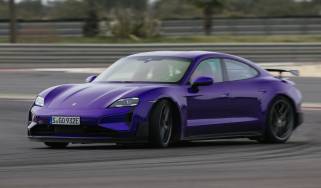
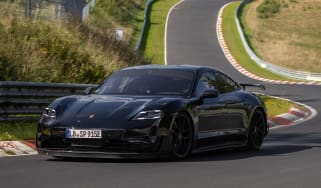
Drive a Taycan Turbo and it’s hard to fathom that there are two even quicker models in the range. The instant, violent performance is pretty much unusable unless you’re on a well-sighted road, and it pulls relentlessly up to motorway speeds and beyond. The Taycan’s push-to-pass function unlocks even more performance for ten-second bursts – the way it catapults forward from a standstill needs to be felt to be believed.
Find yourself in a Turbo GT, and a launch control start is just about the most violent thing you can experience in a car aside from being rear-ended by a bus. There’s an initial phase where power overwhelms traction, but the Turbo GT still finds phenomenal forward drive from rest and continues to pile on speed well beyond 140mph.
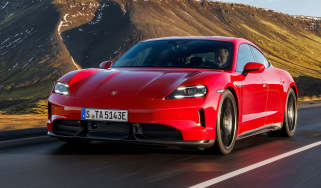
But while the Turbo GT will win any YouTube drag race you throw at it, the 4S is easily fast enough to satisfy your needs as a fast GT car. It's still absurdly quick and flexible but you can find a better flow with it, surging between corners rather than squirting between them in a blur. Unless you’re an insatiable power junky, you really don’t need anything more.
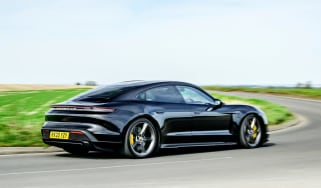
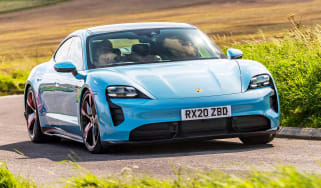
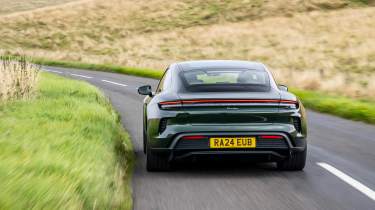
Rather than the performance, it’s the Taycan’s uncanny precision and accuracy that steals the show. There’s genuine Porsche DNA in everything it does, making it one of the most satisfying EVs to drive of them all.
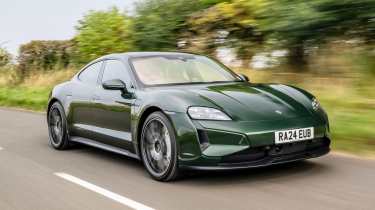
When fitted with rear-axle steering, its responses are crisp and beautifully measured, allowing you to commit into an apex with one clean sweep of the wheel. The steering is light and direct and while there isn’t much granular feel through the rim, it's easy to place the car accurately and lean into the available grip. Early Gen 2 cars we’ve driven had poor brake feel, with a light and springy initial travel, but later examples have been better – firmer on initial application and more consistent, although still lacking some initial bite.
Take liberties with the Taycan - all 2170kg of it (in its lightest form) - and it really starts to impress. The facelift introduces Porsche’s Active Ride tech that first appeared on the Panamera, which enables precise control of suspension forces at each corner of the car. It does away with conventional anti-roll bars and uses electro-hydraulic pumps to regulate flow inside the dampers to compensate for pitch and roll.
As a result, the body is extremely well supported and you don’t need to slow down your inputs to allow the weight to settle, which feels a bit alien in such a heavy car. The Taycan doesn’t feel light per se – you’re still conscious of the enormous forces the tyres are dealing with – but Active Ride makes use of all four contact patches by distributing the loads evenly across them, no matter what you throw at it. The (now standard) air suspension setup is impressively poised and flat to begin with, and Active Ride accentuates these qualities.
Does this translate into a more entertaining driving experience? In some ways, yes. It gives you more confidence and encourages you to dig deeper into the Taycan’s abilities. But it does mean that the Taycan can feel slightly clinical in the way it picks apart a road, and it doesn’t offer as much gratification as Hyundai’s Ioniq 5 N with its more interactive driving experience and greater sense of fun.
You need to work the Taycan hard – really hard – for it to feel alive. Reach the limit of the tyres and the chassis feels stable and neutral; you get either a nibble of front-end push or a quick twist of oversteer, and while the Taycan does break away tidily, this feels like a by-product of provocation rather than a natural part of the cornering process. Admittedly, this won’t matter to most owners.
For them, the fact that the Taycan is now better able to lean into its role as a long-distance electric GT will be more valuable. As well as the extra control, the Active Ride system allows the Taycan to flatten large bumps like a luxury saloon, and it wafts along more smoothly – and more quietly – than before.
Where the new suspension isn't as effective is over broken surfaces and high-frequency bumps, which still resonate and vibrate through to the cabin. Switching to the softest damper setting introduces a touch of vertical movement at speed but doesn’t filter out this brittleness. As such, Active Ride feels like magic in certain scenarios, but more conventional in others.
The Cross Turismo rides 20mm higher than the saloon and Sport Turismo, but the Active Ride tech means that body movements are still tightly controlled in the firmer damper settings. In the softest mode, you do get a slight sense of the higher centre of mass, but by-and-large, the saloon's sharpness, consistency of response and precision are all there.
Driver’s note
‘No, it isn’t some giant EV drift Porsche that’s determined to silently assassinate tyres. But in this new more potent form, it is now quite quick, unlike the original base Taycan.’ – Ethan Jupp, evo Web Editor
Efficiency, charging and running costs
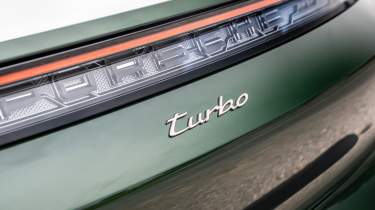
- Facelift brought significant range and efficiency improvements
- Up to 421 miles of range
- Some of the fastest charging rates on the market
With a kerb weight of well over two tons and neck-snapping performance, the Taycan will chew through tyres if driven hard, but the brakes should at least hold up well to normal driving (regen is used to slow the car for 90 per cent of the time, rather than the friction brakes).
The extra range of the Gen 2 Taycan means you’re likely to spend less time topping up at public chargers, potentially making it more cost effective to run (if you have access to home charging, that is). The rear-drive Taycan achieves a very competitive 421 miles from a full battery, and despite its energy-sapping additional motor, the 4S still achieves nearly 400 miles. The Turbo and Turbo S get 391 miles, with the GTS dropping slightly to 389. Predictably, the track-oriented Turbo GT is the least efficient with 344 miles of range, or 345 with the lightweight Weissach Package.
The Gen 2 Taycan is one of the quickest charging electric cars on the market thanks to 320kW capability, and a revised thermal management system that allows faster rates to be maintained in a broader range of conditions. A 10-80 per cent top up takes just 18 minutes.
Interior and technology
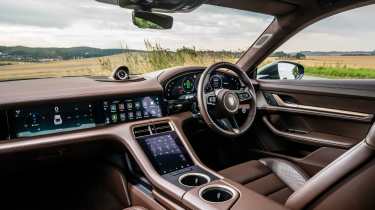
- Feels more like a sports car than saloon inside
- Rear seat and boot space a little small
- Turbo GT with Weissach pack feels genuinely special
Nothing much has changed inside the new Taycan, but that's no bad thing. Slide into the driver's seat – made easier with the Active Ride system’s ‘easy entry’ function, which boosts the car up on its springs by 55mm – and the Taycan has a genuine sense of occasion, with a small-diameter steering wheel and the peaks of the wheel arches extending into your view ahead. You don't sit as low as you do in a 911 (thank the floor-mounted batteries for that) but there's definite sports car DNA in the cocooned driving environment, and build quality is excellent throughout.
As is all too common in 2026, the Taycan’s control surfaces are almost entirely digital, but the climate controls are at least a permanent fixture on the lower pressure-based haptic display. Porsche's latest PCM infotainment system is one of the more intuitive on the market, and it gets Apple CarPlay+ functionality as part of the facelift, along with an updated charging planner to plot the most efficient and quickest points to top up during a journey.
The Turbo GT’s interior is altogether more focused if you go for the Weissach Package. Carbon bucket seats hold you securely in place and you’re presented with a suede steering wheel adapted from the GT3 RS, complete with rotary switches for drive modes and PASM settings. There’s also a paddle for activating the overboost function, designed to fall easily at your fingertips when cornering on track.
Seats and boot space
If we have a criticism over the cabin, it's that the Taycan still isn't as roomy as it should be for a five-metre saloon – the rear seats are claustrophobic for adults. The estate versions free up more rear headroom but it's still not a place to stretch out, and there isn't quite as much boot space as you might expect. You get 446 litres compared to 407 in the saloon, where an M3 Touring offers 500 litres. Still, there is at least an 84 litre front boot to stash odds and ends if you need it.
Prices and buying options
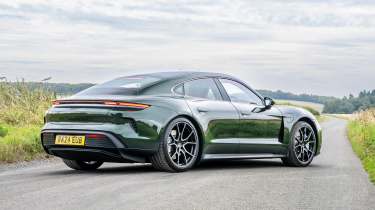
Ground floor for the Taycan range currently stands at £88,200, or a grand more if you want the Sport Turismo. Things rise quickly from there: the Black Edition and Taycan 4S are the only others that sneak under six figures, at £95,700 and £96,200 respectively, with the 4S Black Edition coming in at £102,000.
Then it’s another jump to the £118,200 Taycan GTS, £135,200 Turbo, £162,200 Turbo S, and £189,200 Turbo GT, though strangely, adding the Weissach Package doesn’t bump things up further. In the Cross Turismo range meanwhile, the entry-level 4S Cross Turismo starts at £99,200, while the Turbo is £138,200 (two grand more than the equivalent Sport Turismo) and the Turbo S Cross Turismo is £165,200.
If this all sounds a bit much, there is one saving grace: depreciation has been pretty savage on the Taycan so far, so you can probably save five figures on any of the above by opting for a dealer demonstrator or a car that’s only a year or so old.
Equipment and specs
In common with much of the Porsche range, the various Taycans are separated more by their drivetrain than equipment levels, bar one or two details here and there – a special wheel or colour option, some subtle exterior detailing, that kind of thing. Expect leather trim across the range (though a leather-free Race-Tex option is also available), a three-screen setup in most models (driver display, centre touchscreen, lower air conditioning touch display), electric seat adjustment, and more.
The standard wheel size is 19 inches even on the standard Taycan, though that steps up to 21 inches by default from the Black Edition. The most significant visual changes come with the Turbo GT and its aero flicks and forged 21-inch wheels, and inside with its fixed-back bucket seats.
Rivals
You need only look across the Porsche showroom to spot one of the Taycan’s potential rivals – the Panamera. Porsche’s combustion-powered saloon starts and ends at a similar price point to the Taycan (from £89,400 for the standard Panamera to £175,100 for the 771bhp Panamera Turbo S E-Hybrid), has a similar 911-inspired fastback roofline, and is similarly good to drive, powertrain preferences aside. If you’re not convinced by electric power, the Panamera still ticks the sports and luxury boxes very well indeed.
Look elsewhere and the choices quickly get overwhelming. The Mercedes EQE and BMW i5 could both be considered Taycan rivals, though both lean more towards space and luxury than the Porsche’s sports-car-adjacent appeal. Audi’s e-tron GT is another, and is largely similar to the Taycan under the skin – in this case, Audi has toned down the sporting feel ever so slightly in favour of touring comfort.
Neither Tesla (with the Model S) nor Lucid (with the 1200bhp+ Air Sapphire) sell their Taycan rivals in the UK, but one UK brand (by way of China) does have a car that takes aim directly at the Taycan: the Lotus Emeya. With a starting price of £84,990 it’s in the same ballpark as the basic Taycan and has the performance and handling to match the Porsche. Like the Taycan, it’s also probably best sampled at the lower end of the range, where performance is still plentiful, pricing is lower, and range is higher.
Another we’re chucking into the ring, purely for fun, is the otherwise very different Hyundai Ioniq 5 N. It doesn’t have the Porsche’s image and its form factor is more Qashqai than 911, but Hyundai’s engineers have done a stellar job making an EV that isn’t just fast, but great fun to drive too, and a whole lot cheaper.
Model |
evo rating |
Price |
Kerb weight |
Power |
0-62mph |
| Taycan 4S | 4.5 | £96,200 | 2250kg | 590bhp | 3.7sec |
| BMW i5 M60 xDrive | 4.0 | £97,845 | 2370kg | 593bhp | 3.8sec |
| Lotus Emeya 600 GT SE | 4.0 | £94,990 | 2555kg | 595bhp | 4.2sec |
| Hyundai Ioniq 5 N | 4.5 | £65,800 | 2235kg | 641bhp | 3.4sec |