Subaru WRX STi (VA, 2014-2018) review – the end of the line for the hardcore Impreza family
The end of the line for the WRX STi wasn’t even an Impreza, but it represented the end of Subaru’s rally-inspired machines in the UK
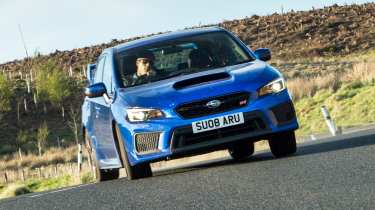
It was one of the cars that defined ‘the thrill of driving’ and delving into our archives reveals that in the early days of the magazine there wasn’t a month that went by without a Subaru Impreza appearing in a test, a feature or the pages of our Fast Fleet section.
Yet when Subaru pulled the plug on its World Rally Championship operations in 2008, the Impreza and its WRX successors lost both their way and buyers. Ten years on, Subaru decided to pull the plug altogether. The last WRX STi to grace the UK, the VA, lasted here from 2014 to 2018 and until 2021 in other markets. Rather than go out with a whimper, the VA WRX was treated to a special send-off with the Final Edition.
Engine, gearbox and performance
- The 2.5-litre boxer turbo is old-school in feel, compared to say, VW’s EA888
- Likewise the notchy six-speed manual transmission
- It’s an anachronistic but characterful package compared to more modern hot hatches
Unlike many of today’s torque-rich turbo engines (VW’s EA888 is a prime example), the Subaru’s flat-four requires some effort to give its best. It’s not exactly laggy in its delivery, but you have to work the 296bhp and 300lb ft 2.5-litre beyond 4000rpm to find its sweet spot.
More reviews
In-depth reviews
Reviews
- Subaru Impreza Turbo (1994-2000) review – an affordable modern classic rally icon
- Subaru Impreza WRX STI (Mk1, 1994 - 2000): review, history and specs of the rally icon
- Subaru Impreza 22B STI (1998): a rally-inspired icon
- Best Impreza Colin McRae Edition review – homage to McRae's championship 555 racer
- Subaru WRX STI (2014-2019) review, specs and prices
- 2013 Revolution Project STI Nurburgring review
A handful of JDM specials saw a power jump – the S207 had 320bhp, the S208 almost 330bhp. In the US, the S209 got almost 340bhp. In Japan, the TC380 had just under 380bhp. The main difference: These used the older EJ20, not the 2.5-litre all UK cars used.
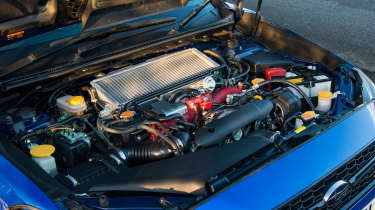
With our 2.5-litre cars, there’s the familiar thrum at idle, which increases in volume and intensity as the revs rise, but the WRX’s motor never finds its voice like the earlier 2-litre models. Yet there’s the same sense of lethargy at low to medium engine speeds, and it’s only over the last 2000rpm or so that the Subaru comes to life, at which point it takes off with real urgency. It’s not sophisticated, but it adds the sort of character that marks the WRX out as something a bit different.
It’s no slouch, with the sprint from standstill to 62mph taking just 5.2sec. That might sound unremarkable in an era of Audi RS3 saloons that will smash the benchmark acceleration test in under four seconds, but the Subaru is still a mighty quick car, provided you’re willing to work at it.
Adding to the unique feel is the six-speed gearbox. It’s not the last word in precision or slickness, but you can throw the wand-like lever around the gate with surprising speed. It feels robust, too, like it’s been lifted straight out of a Group N rally car.
Ride and handling
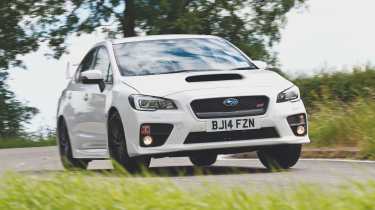
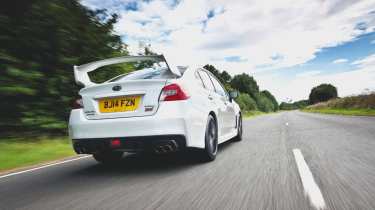
- Extraordinary 4x4 agility and adjustability
- Steering is quicker than in older WRXs but not razor-sharp
- Brakes are potent across the range
The suspension uses a strut layout at the front with a double wishbone rear axle. The dampers are passive, though these were revised for the Final Edition to compensate for the larger wheels.The body is 140 per cent stiffer than the previous generation, while there is 16 per cent less body roll. This is thanks largely to spring rates that are 22 per cent stiffer at the front and 6 per cent stiffer at the rear and upgraded anti-roll bar mounting points for more toe-in at the rear. The steering is still hydraulically rather than electrically power assisted and the rack is 15 per cent quicker thanks to the ratio being changed from 14.8:1 to 12.7:1.
The familiar Multi-mode centre differential is in place with auto and manual settings, plus Auto, Auto+ and Auto- modes. The basic torque distribution is 50:50, but if you choose Auto+ it limits torque and increases stability in slippery conditions, while selecting Auto- allows more torque to be sent to the rear wheels.
For the Final Edition, the centre differential (known as the Driver’s Control Centre Differential, or DCCD) is under complete mechanical control. As before, you can adjust the aggressiveness of the differential using the small rocker switch mounted on the transmission tunnel. The other major mechanical change is reserved for the brakes, with discs at the front that grew from 326mm to 340mm, clamped by six-pot Brembo calipers finished in day-glo yellow.
The permanently engaged symmetrical four-wheel drive system delivers ferocious traction regardless of conditions. There’s none of the ever-so subtle slip you get in a Haldex controlled system; the Subaru just puts all its power down, making you feel that not a single horsepower is wasted. It’s particularly impressive out of wet, leaf-strewn junctions, where the STi simply grips and goes.
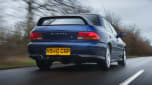
There’s still nothing quite like a Subaru when you’re unpicking your favourite stretch of backroad. Even when going slowly it constantly reminds you that you’re behind the wheel of something out of the ordinary. You can hear and feel the transmission doing its stuff, while the firm ride is just the right side of anti-social. Yes, it makes the WRX occasionally frustrating on the daily grind, but against the backdrop of contemporary VW Group products sharing the same engine, architecture and DSG transmission, this is something that should be celebrated.
Of course, some Subaru quirks remain, such as the steering, which retains the same light and slightly glassy feel off the straight ahead that keeps you one step removed from the action. Yet once you learn that the grip is there, you begin to trust the set-up and rely on its precision and natural weight of response.
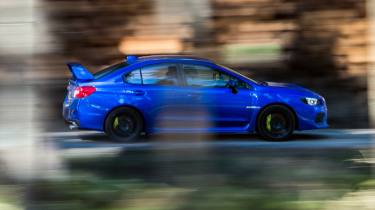
You also have to be more measured with the throttle, particularly in slippery conditions, because there’s no sophisticated torque vectoring there to keep you seemingly magnetised to your line – get greedy with the throttle and the Subaru’s four-wheel drive set-up will push the nose wide. The good news is that a little lift is all that’s needed to get things back on track. Better still, an even bigger lift or a dab of the brakes will bring the WRX’s tail into play – this is a four-wheel drive car that gives you options.
The Subaru only really comes alive when you take it by the scruff of the neck and drive it with real conviction. It’s lumpy and a bit truculent when mooching because it’s not in its comfort zone – it wants to be thrashed as hard as you dare so that it can reveal its motorsport-inspired alter ego. Do this and the stiff damping and grumbly transmission make sense, because with some decent load working through them they allow the WRX to cover ground at astonishing speed and with real poise and control.
Then there are the excellent Brembo brakes, which benefit from a firm pedal action and strong, fade-resistant retardation. Before long you’re convinced that with some harnesses, a roll-cage, some knobbly tyres and a sump guard, the Subaru would be ready to do battle on the Wales Rally GB. There’s the effervescent spirit of a competition car desperate to burst out of the STi – and that’s not a claim that you can level at the hugely competent but ultimately clinical VW Group posse.
Subaru Impreza WRX STi Final Edition – one last drive
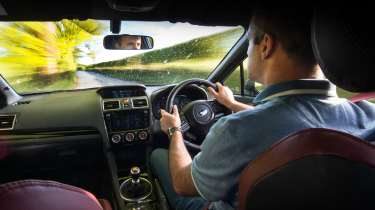
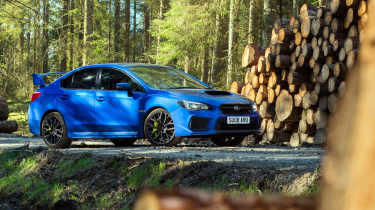
‘Today, Kielder is host to a very blue WRX STI Final Edition, although that’s due to some cheeky inquisitiveness on our part and an unlocked gate. It is spectacularly beautiful amongst the towering Sitka spruces, with shafts of sunlight illuminating the mossy trenches and nearby gushing streams, dancing playfully across the Subaru’s blistered bonnet; driven at speed in the middle of a November’s night it must be hell on earth.
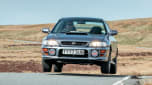
‘I expected to get frustrated with the Final Edition on the way up here, but I wasn’t. It is now an old car, and in many ways feels it: the larger wheels and the upgraded brakes, headlamps and infotainment system on this 1-of-150 run-out model can’t change that. It’s not a car to make life easy for the driver, because you really have to work at it to access the performance it ultimately offers. I’ve never liked the rather flaccid 2.5-litre engine, which lacks the steely anger and the extended rev range of the gritty old 2-litre lump, especially compared to earlier engines with their unequal-length manifolds and characteristically gruff and thrummy exhaust bark.
‘Moreover, the greater swept volume doesn’t appear to bring plentiful torque, in spite of the claimed 300lb ft figure, because the Final Edition is fairly uninterested below 4000rpm. However, from that point on you have a reasonable band of blissfully smooth, boost-fed urge, where the flat-four makes almost any in-line four appear uncouth thanks to its inherently inertia-free delivery. Yes, the gearshift is stiff from cold and the interior functional – doubtless hard-wearing, but lagging so far behind in that modern touchy-feely sense it’s laughable.
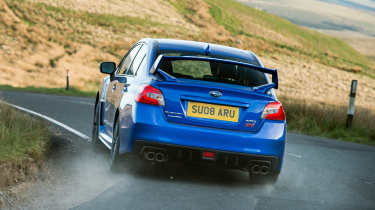
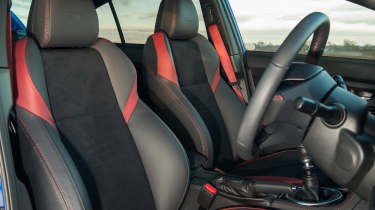
‘The driver’s seat is supportive but also set so ludicrously high I am almost peering out from underneath the header rail. And despite the claimed ‘quick rack’ the steering still seems slightly slow compared to the current wrist-flick norm, with just a hint of vagueness immediately around the straight-ahead. Driven at five-tenths the Final Edition often seems out of sync – recalcitrant, loose of limb yet needlessly stiffly sprung, and awkward like a teen on their first date.
‘But there are also times when it seems to gather itself together and almost float above a demanding road – still, yes, even in 2018. Get it right and it’s so involving, authentic, and you realise that however good the modern turbocharged hot hatch is, there isn’t, and never will be, anything quite as effective and exciting as a blown flat-four partnered to a full-time four-wheel-drive system. Most onlookers think it’s a bit naff; many find it downright embarrassing, verging on offensive. But I like that: it’s the opposite of middle-class conformity, of a fast Golf or Audi. The tuts, the withering glances of disapproval? Fantastic.
‘We’re well into Scotland now, and as night comes, the cooler air is gobbled up by the bonnet scoop, each wheel clawing at the road in the kind of furious quest for traction usually the preserve of a cartoon cat. The stone wall-lined lanes become a greyish tunnel, a wild-eyed luge run lit by the Scoob’s headlamps, my left arm a blur of cog swapping, chasing the rev limiter, attempting to extract everything the car has to offer, feeling the tail edge out under power, the whole experience so much more vivid, of depth, than that of say, a Golf R, albeit probably no faster.
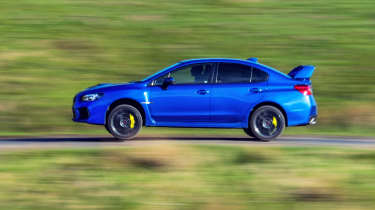
‘As the racket falls silent as abruptly as it began, a million thoughts suddenly, overwhelmingly barge their way to the front of my mind. Reading that first group test of an Impreza Turbo 2000 in Performance Car magazine, circa 1994; the cheeky test drive of a new Impreza Turbo wagon, even though the ink was barely dry on my driving licence; standing in the dark in a Welsh Forest, walking past the smouldering and unidentifiable wreckage of a privateer Impreza WRC, beams of torchlight flickering across its bodywork as it lay suspended in the bracken; a wild night-time drive in a ‘Blob Eye’ WRX STI as a young road tester.
‘So many snapshots, sounds, faces: these are my Impreza memories, and so many of you, I know, will have your own, probably far more impressive, more vivid than mine, of places you’ve been, drives you’ve had in a Subaru, and of the people associated with them. And then the internal video reel lurches to a stop, while behind me a father, with surely the heaviest of hearts, carefully drapes a fabric cover over a now-silent car with which his son gave so much joy to so many.
‘It’s not just this journey that’s over: it’s the end of the Impreza Turbo in the UK. No more. Finished. And then we leave, and I rinse that flat-four for the next ten minutes, until the beep of the upshift is a near-constant, for one reason, and one bloody glorious reason only: if in doubt, flat out.’ – Adam Towler
Values and buying checkpoints
These boxer-fours aren’t without their issues. Rod bearings, ringlands on the pistons and turbochargers are known failure points. Look out for grey smoke from the exhaust and a lack of boost as a sign of the turbo having issues and blue smoke for oil use. In an ideal world, you’ll get the oil tested too, for evidence of wearing internals. Squeaks and clunks could indicate tired links and bushes. Plenty of service and clean MOT history is desirable, as are tyres and brakes with good life in them.
WRX STis haven’t jumped in value quite like the Imprezas of the 2000s. As such, there are plenty available still in the £10,000 region. The catch? Many have done pretty serious miles, in the 100,000 region. For closer to 50,000 miles, you’ll be paying £15,000 or more. Closer to 20,000 miles and you’ll be paying upwards of £25,000. Then the Final Editions are in another league, priced from over £35,000.