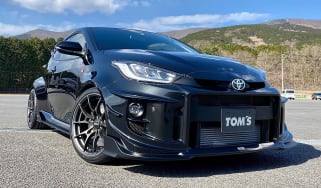
Toyota GR Yaris review – a modern-day hot hatch icon
The original Toyota GR Yaris won us over instantly, but with the second-gen version and subsequent Aero Performance model, it’s evolved into an even more capable package
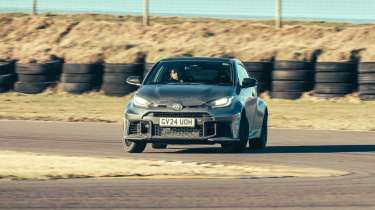
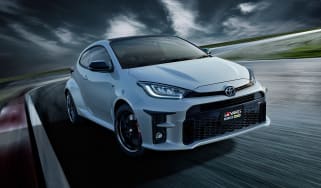
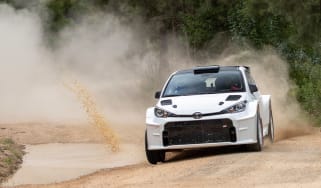
It’s hard to overstate the hype that surrounded the original Toyota GR Yaris when it launched in 2020. It was a hot hatch of the kind we hadn’t seen in years: a turbocharged, four-wheel drive rally homologation special in the mould of Lancia’s Delta Integrale. It was bold, and though a punchy c£30,000 asking price raised some eyebrows when it went on sale, we were glad Toyota had the guts to build it.
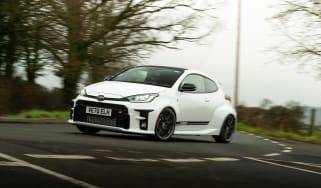
As it turned out the GR Yaris was worth every penny, and one of the best hot hatches of the modern era: fast, involving and exceptionally capable, with a sense that every key component had been engineered to an exceptionally high degree. And it was here to stay. Better than expected sales across the original’s four-year tenure pushed Toyota to develop a heavily revised second-gen version, enhancing the package, addressing criticisms and extending its life – albeit with a reduced supply in the UK.
The Gen 2’s substantially increased £46,045 asking price verges on absurd for a three-door supermini, but Toyota has updated the car to such fine detail (that we’ll get into) that we can almost forgive it. For 2026 a new Aero Performance model arrived too, with bodywork modifications, a rally-style vertical handbrake, improved steering and – applying to all 2025/26-spec models – an even more rigid body structure. These iterative developments have made a brilliant car even better, cementing the GR Yaris as an all-time great hot hatch. Read on to find out why.

Engine, gearbox and technical highlights
- 1.6-litre turbo three-pot boosted to 276bhp for the facelift
- Variable permanent four-wheel drive system
- Aero Performance adds bodywork modifications, retuned steering and vertical handbrake
More reviews
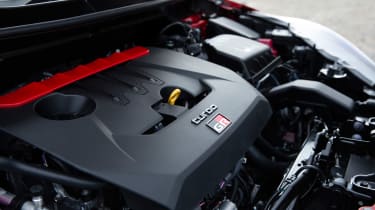
For the Gen 2 GR Yaris, Toyota liberated an extra 19bhp and 23lb ft from the purpose-designed G16E-GTS 1.6-litre three-cylinder engine, bringing its outputs up to 276bhp and 288lb ft. Important to note, however, is that later Gen 2s have a lower peak torque figure than 2024 models, with a drop to 254lb ft owing to stricter emissions regulations. Still, the top speed and 0-62mph times remain unchanged, at 143mph and 5.2sec respectively.
The Gen 2 engine upgrades deliver strength as well as power, with a stronger valvetrain, new exhaust valve material, increased fuel injection pressure and stronger pistons, all tested in the Japan Rally Championship. All new European cars also get a cooling pack as standard, with an additional sub-radiator and a water spray system for the intercooler, triggered by a button on the dash.
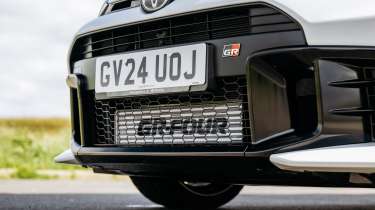
That power is sent to all four wheels via the GR-Four all-wheel-drive system, the logo of which is printed prominently on the car’s front sub-radiator. Though the first the GR Yaris was exclusively a manual, with the update, an eight-speed automatic is also available.
There are three settings for the permanent all-wheel-drive system, which splits torque front to rear via an electronically controlled coupling. The torque splits have been revised in the new car: Normal mode divvies torque 60:40 front:rear, but in Track mode the balance shifts actively between 60:40 and 30:70, apportioning more to the rear on corner exit. There’s also a Gravel mode, which nominally splits torque at 53:47. In the old car, normal equates to a 60:40 torque split with a front bias, Sport flips that with a 30:70 split, and Track is 50:50.
Structurally, the GR Yaris is a combination of base Yaris structure up front (GA-B) and the slightly larger Corolla/C-HR (GA-C) at the rear.
This wider rear track has allowed Toyota to design a totally bespoke rear suspension design with double-wishbones that both allow for the rear-axle drive shafts and the fitment of a rear locking differential. A double wishbone design also allowed engineers more freedom with the GR's camber and castor adjustments, fine tuning the setup exactly the way it wanted it. The front suspension still uses a relatively mundane MacPherson strut design, but the geometry is completely different to a basic Yaris.
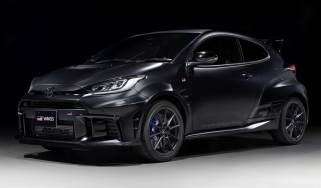
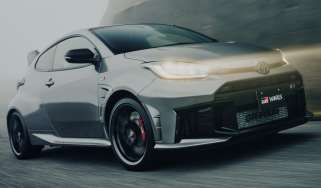
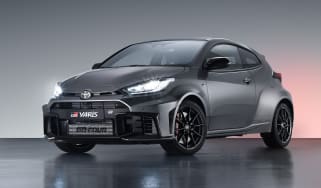
Overall, this makes the GR Yaris body 90mm lower and 55mm wider than a standard Yaris, sharing only its front and rear lamps, and its door mirrors. Yes, it may be a small, three-door hatchback, but the GR is a very special piece of kit designed specifically for the intended job. It's so specialised that the GR Yaris is built largely by hand in the same Japanese facility used for constructing the Lexus LFA. Like the supercar there is carbon in the Yaris’s construction but only in the composite-reinforced plastic roof skin. Meanwhile aluminium is used for the doors and bonnet, helping keep weight down to a modest 1280kg-1310kg (depending on spec).
The Gen 2 car has stiffer spring rates, by 28 per cent at the front, 11 per cent at the rear, and an uprated front anti-roll bar and extra bolts fastening the front dampers to the body, which is also intended to improve steering response and feel. That’s aided and abetted by a stiffer bodyshell than before, with a 15 per cent increase in the number of spot welds and amount of adhesive applied to the structure.
The Aero Performance model gets further upgrades, to the tune of a manually-adjustable rear wing, a new vented bonnet, a tweaked lip spoiler and air outlets behind the front wheel arches. There are also slats in the rear bumper, plus a flat floor below the fuel tank. The changes are functional in that they reduce lift to improve high-speed stability. The changes don’t impact the car’s acceleration or top speed figures.
Other tweaks include a vertically-mounted rally-style handbrake, recalibrated steering software and a further stiffened body structure – the latter being applied to all 2025/2026 models.
Driver’s note
‘It may carry advanced hardware but there’s an honest and robust feel to the way the Yaris goes about its business, with grumbly tones from the engine, heavy and communicative steering and a sense of solidity in the way it tackles bumps.’ – Yousuf Ashraf, evo Senior Staff Writer.
Performance, ride and handling
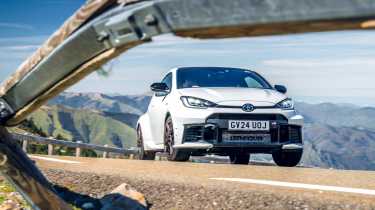
- Fabulous composure, traction and agility
- Punchy engine with a broad spread of usable power
- Handling balance could be more playful and lively
If your only experience of a three-cylinder engine is a 1-litre Ford EcoBoost unit, you may be wondering if a triple can cut it in a serious hot hatch – but any such concerns are banished the moment you get the GR Yaris moving. Its engine is gutsy low down, but then really enjoys revving, and the subsequent surge of power throws the little car along at an amusingly rapid pace.
It feels much stronger than the figures suggest; with the benefit of complete traction not a single one of those turbocharged horses is wasted, the performance further boosted by some nicely stacked gear ratios that aren’t too long.
The revised engine feels noticeably more urgent, with a boostier feel. You can hear the turbo whooshing, on- and off-throttle, and see its response visually on the digital instrument panel, where a neat graphic shows the turbo’s pressure and response in real time.
The six-speeder feels even better than before too; GR’s engineers have obviously been hard at work because somehow the shift is swifter, sweeter and less baulky – and it’s not like it was bad before. There’s still a switchable rev-match function to blip the throttle automatically on downshifts (something it does neatly, and without unnecessary theatre – just the right amount of revs, no more, no less) but it’s still possible (and fun) to do it yourself if you prefer.
The auto option is an eight-speed torque converter with shorter ratios, and though you lose an element of interaction, it does give the car an even greater sense of urgency. The shifts aren't as crisp as a DCT, but with no pause between gears the Yaris feels more relentless, and it's easier to carry speed into braking zones and condense your downshifts into a shorter space. Ultimately, the manual suits the GR's character more, but the auto plays into its ability to maximise every drop of the available performance.
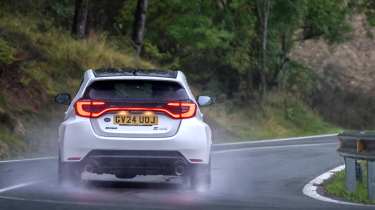
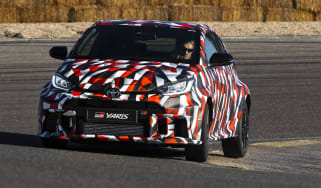
But the energetic powertrain is just one part of how the GR Yaris generates its pace. More important is how tenacious, composed and grippy the handling is. The Gen 2 is a little stiffer than the old car but it still has an impressive ability to lap up tricky surfaces and stay locked on line, while feeling generally more responsive than the original.
You’re very much in touch with what’s going on at all times, not only through the steering and pedals (brake feel is excellent, incidentally; it’s easy to feel the moment at which ABS begins to cut in) but also through the chassis itself. And you’re more keyed in to it all, thanks to the Gen 2’s lower-set seat.
Whereas the old model sometimes felt as if you needed to be driving it hard before it came to life, the new one feels more alive, more eager at all road speeds, while also – slightly firmer ride apart – feeling more useable day to day, with less road noise and (mostly) better ergonomics.
In Normal mode, the GR Yaris’s natural balance is toward understeer, but in Track mode it’s a positive, pointy thing. Get on the power early and you feel the torque balance helping this muscular little car squat and spring from a tight corner. You can also feel the Torsen limited-slip differentials at each end doing their thing.
On the original GR Yaris the Torsen diffs were part of the optional Circuit Pack, which also included forged wheels, Michelin Pilot Sport 4 S tyres and upgraded brakes, and added £3.5k to the price. Since most of the 20,000 cars sold in Europe were Circuit Pack versions, that’s the only spec available on the current car.
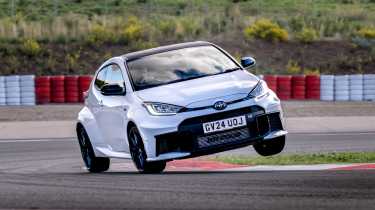
Unlike a front-wheel-drive hot hatch, the four-wheel-drive Toyota’s cornering repertoire is three-dimensional. It isn’t about simply getting the front to turn in and then managing traction on the way out, rather the Yaris will rotate and then power through, the primary objective for the driver being to see just how early they can get on the throttle
The answer, often, is even earlier than you thought. Perhaps the Yaris could be more aggressive still at the front end, for as it stands it’s much closer to an old Subaru Impreza than a Mitsubishi Lancer Evo in character. The Aero Performance doesn’t change that, but it does bring a more precise and keener edge to the dynamics by virtue of its stiffer shell and clearer steering feedback.
Driver’s note
‘There are much more powerful hot hatches out there – like Audi’s RS3 and the Mercedes-AMG A45 S – but the little Toyota leaves them choking in its wake, feeling every bit as grippy, agile and secure as you’d expect a road-going rally car to feel. And hardly slower, if at all.’ – John Barker, evo Editor-at-Large
MPG and running costs
A side effect of having so much performance and short gearing to access it is that despite its economy car cylinder count, each uses a quite astonishing amount of fuel. Official figures suggest as much as 34.3mpg is possible, but having lived with a Gen 1 GR for six months we averaged just 25.6mpg. The performance to consumption ratio doesn’t feel out of whack, mind, because as mentioned above, the GR is insatiably quick across the ground.
What reinforces a feeling of thirst is the tiny fuel tank; concentrate hard and you can almost see the needle drop under acceleration. Other than fuel use, though, Toyota’s usual reliability factors ring true, with our six months coming with not a single unforeseen cost – it even held on to its rubber despite multiple track days over some 5000 miles.
Interior and tech
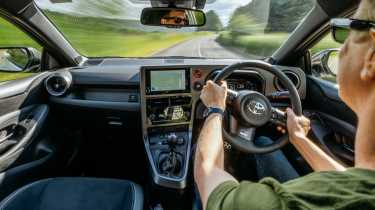
Inside the updated GR Yaris, it’s all change. Most importantly, there’s a better driving position to put you more in touch with it all. You sit 25mm lower than previously and look out across a 50mm lower dashboard. The rear view mirror, which previously sat slap-bang in your line of sight, has been moved too. Instant improvement all round. There’s a little more reach adjustment in the steering column as well.
It would be a stretch to describe the new dash as attractive, with a blocky facia that’s functional to the point of utilitarianism. It works well, though, with everything angled toward the driver just-so, and within easy reach.
There still aren’t many places to put things in the interior, bar a couple of cupholders, tight door pockets and an awkwardly shaped oddment bin behind the handbrake (still a proper, manual lever, which still decouples the transmission’s connection to the rear driveshafts when pulled hard, to facilitate handbrake turns. And in the case of the Aero Performance, mounted vertically on the dash).
Overall, the new digital dash display looks great: it’s clear, easy to read and, in Sport mode, changes the traditional rev-counter to a rally-style bar across the top of the screen, all the more rally-esque if you snag the rev limiter, which is a mildly thrilling rat-tat-tat hard stop rather than a soft limit. The Gen 2 also gets a more modern touchscreen with satnav as standard; it’s not the slickest system but it does the job.
The old car took a much more as-necessary approach to interior design but in spite of the problems addressed in the new car, there were high points. Elements that felt absolutely right and are preserved in the new car include the high-mounted gearlever, that falls to hand almost perfectly. The pedals also are well placed for heel-and-toeing, plus the steering wheel itself is thin-rimmed and feels just right in the hands.
Toyota GR Yaris (Gen 1) long-term test
By John Barker, first published in evo issue 322
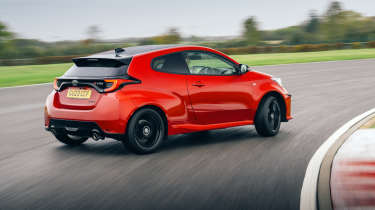
‘The Yaris arrived with little more than delivery miles on the clock. It looked perfect, outside and in, and although the seat position is high, there’s something uniquely appealing about the strong character of the GR Yaris; the heft of its gearshift and the heavy, loping note of its turbocharged triple. I decided to forego full throttle for the first 1000 miles, partly, I admit, in the hope that the fuel economy would improve from the average shown on the trip computer: just 21.7mpg…
Our long-termer isn’t a Circuit Pack model. The giveaway is the wheels, which are not as thin-spoked and are shod with Dunlop Sport Maxx rather than Michelin PS4 tyres. Mechanically, its suspension isn’t as stiff and its anti-roll bars are a little softer, but more significantly it’s missing the front and rear Torsen slippy diffs of the Circuit Pack.
I had thought there were only two pre-facelift Toyota GR Yaris specs, but it turns out there was a third, simply called ‘GR Yaris’, which is what we have here. Maybe it should have been called the ‘Inconvenience Pack’, because it doesn’t have satnav, heated seats, a head-up display or parking sensors, and only has six speakers for its sound system rather than eight. Perhaps the only convenience is that it was £2k and £3.5k cheaper than the Convenience and Circuit Pack models respectively when it was on sale.
Compared to the Circuit Pack car, you notice the softer suspension, with a less sharp turn-in, especially in the wet, yet there seems to be no payback in terms of ride quality. As for the diffs, on the road their absence isn’t obvious, apart from when hauling hard out of tight turns in the wet, and even then stability control manages slip and keeps a lid on things.
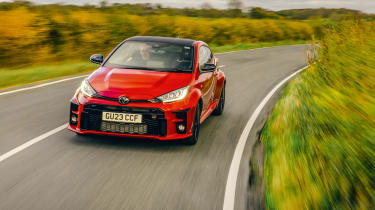
The first long journey took me to Morgan in the Malvern Hills. It was a steady run there and back, and although the average mpg crept up, I was afraid the little Yaris was going to prove thirstier than an early morning Brit in a Gatwick bar. I knew it was a 50-litre tank, yet closing in on empty I’d done only 250 miles, suggesting around 25mpg. I was surprised when the pump clicked off at 36 litres. That meant about 33mpg, but there couldn’t be 14 litres left, could there? Is it actually a 40 or 45-litre tank?
Our time in its replacement has shown that the Gen 2 GR Yaris is a proper step on, especially in its dynamics. The new car is also only available with the Circuit Pack – sensible decision – yet you can still get into a satisfying groove with our standard car. The engine is quite the character. It’s a bit grumpy at low revs; it pulls fine but shakes like the revs are half what they are and is much happier with the needle up at 2000rpm. Beyond that there’s a glorious swelling of torque that seems enormous for a 1.6-litre three-pot and comes with a deep, confident, guttural note. A two-wheel-drive car would struggle to contain and deploy it but the four-wheel-drive Yaris takes it in its stride.
It’s a car that attracts a fair bit of interest too, and in one wet roundabout the combo of torque and traction can illustrate what all the fuss is about. Then came a drive back from Wales in the midst of Storm Isha. The route took in some of my favourite roads, twisting and turning, falling and climbing, with the extra challenge of standing water. The Yaris devoured them. It was at its most awesome in the most challenging parts, agile and poised, its ride soaking up difficult surfaces without effort.
Despite the conditions, I never once wished I had the diffs or the dynamics of the Circuit Pack, or the set-up of the Gen 2 car. Dialled in to our long-termer’s characteristics, exploiting its natural ability and using generous slugs of torque, I’ve discovered that even a standard first-gen Yaris is a formidable, engaging and satisfying car to drive.’
Prices, specs and rivals
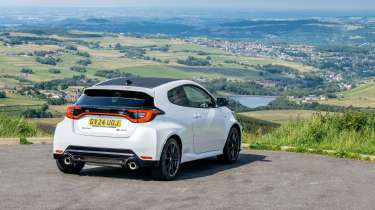
When it first arrived, the original Toyota GR Yaris was available in three flavours: base (£30,020), Convenience Pack (£32,200) and Circuit Pack (£33,520). Mechanically, the first two are identical, with the Convenience Pack car building on the interior specification with integrated satnav, a larger JBL stereo, head-up display and parking sensors.
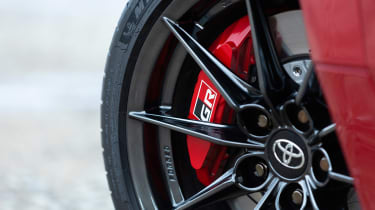
Circuit Pack cars didn’t share those interior upgrades, instead bringing those key changes under the skin that made best use of the GR’s chassis. These include larger brakes, forged Enkei wheels with Michelin PS4 rubber, a stiffer suspension tune and locking differentials on both axles.
For the Gen 2, the range is simpler due to there being no Convenience or Circuit packs: the base car costs £46,045 while the Aero Performance is £48,995. Direct rivals to the GR Yaris were always varied and few, but especially so now, as manufacturers have killed off many of our favourite petrol hot hatches.
The king of the small hot hatchback used to be the Ford Fiesta ST, which was substantially cheaper than the Toyota before it went off sale in 2023, but down on power and front-wheel drive only. The Hyundai i20 N was also a key rival from below before it too received the axe.
At the other end of the size spectrum is the Honda Civic Type R, which is no longer on sale but can be bought nearly-new for similar money to the Toyota. It’s the only modern hot hatch that matches the Yaris’s unrelenting focus and stunning capability. For a similar price (and something brand new) there’s Volkswagen’s Golf GTI Edition 50, which early signs suggest is a car with meaningful extra sharpness and track capability than the regular version, if not the bespoke feel of the Toyota or Honda.
The Audi RS3 and AMG A45 S occupy the most premium end of the hot hatch market at over £60k, and while they offer more performance and configurability than the Yaris, they’re more detached and less involving. With that said, the RS3's wonderful five-pot engine and advanced four-wheel drive system make for an intoxicating mix that runs the Toyota close on the road, and beats it on track.