Hyundai Ioniq 5 N review – showing Porsche how to make a fun electric car
Hyundai’s Ioniq 5 N is a fascinating take on the electric performance car, with some of the most complex electronics you’ll find on a series-production EV. The results are superb
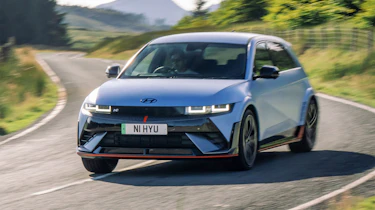
We knew Hyundai had been bold with the Ioniq 5 N when it first debuted. Now with a couple of years under its wheels and a few less ambitious rivals that have arrived since, Hyundai’s N division is vindicated in the decisions it took and the lengths it went to. For the Ioniq 5 N is far more than an EV with the wick turned up – it’s a deeply thought-out piece of engineering, with a number of unique features to supplement it as a compelling answer to the question of whether electric cars can be fun.
The result? The 5 N is a genuinely enjoyable and intriguing machine. In many ways it makes a virtue of its all-electric powertrain; in others it deliberately mimics the behaviour of traditional combustion-engined performance cars. More so than most, it’s a car that needs time to fully get to know: having driven it extensively on the road and turned a few laps on track, it still feels like we’re at the very beginning of understanding its strengths, weaknesses and the full depth of its abilities. But one thing is clear, Hyundai has built a genuinely fun all-electric driver’s car, possibly the best of its kind.
Powertrain and technical highlights
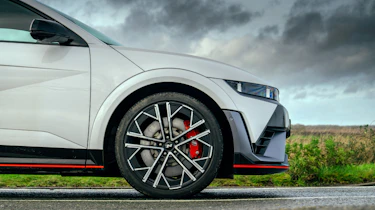
- Twin-motor, one on each axle, with an eLSD at the rear
- Four-stage adjustable dampers
- N grin shift gives the car a ‘power band’ and eight ‘gears’
More reviews
The Ioniq 5 N is, of course, based on the regular Hyundai Ioniq 5 electric family hatchback/crossover. It’s had a very thorough overhaul, however, with fundamental engineering changes to the chassis. The body-in-white gains 42 additional weld points and extra bonding adhesive to increase rigidity, alongside stiffened front and rear subframes. The steering rack has also been reinforced, with stronger mounting points for the N-specific battery and motor setup.

Two motors – one at each axle – generate a combined 601bhp (an extra 40bhp is available for ten-second bursts via a boost button on the steering wheel, with the moderately toe-curling name N Grin Boost). Despite a chunky 2.2-ton kerb weight, this results in a 3.4sec 0-62mph time and a 161mph top speed. Next to a conventional fast crossover the 5 N is overweight, but in the context of current plug-in hybrid performance cars – such as the 2.4-ton G90 BMW M5 – it’s not absurdly heavy, and Hyundai has put measures in place to counteract the mass and manage the car’s energy output at high loads.
The rear motor uses an electronically controlled differential to distribute torque between the rear wheels, and the system is fed by an 84kWh battery with its own radiator and cooling circuit to provide repeatable performance on track. That’s very difficult to achieve in an energy-hungry EV, but Hyundai promises to have cracked it, thanks in part to the platform’s 800V architecture, which allows for rapid charging rates (up to 350kW) and comprehensive heat management.
The fact that track capability is on the cards at all says a lot about the depth of engineering Hyundai has thrown at the Ioniq 5 N. It has also thrown an awful lot of configurability and driving modes into the mix, controlled from shortcut buttons on the wheel and deeper menus within the dash-mounted touchscreen. From N Active Sound, N e-Shift, N Battery Preconditioning, N Torque Distribution, N Pedal, N Drift Optimizer to N Race, the number of adjustable parameters is dizzying, covering among other things steering weight, throttle response and power distribution. Crucially you can also adjust the N’s damping, across four different levels, to tailor its aggression to the road (or track) you’re on.
Driver’s note
‘It’s easy to be cynical, but it’s soon evident that a lot of very serious engineering has gone into the 5 N. The steering is supremely accurate with linear weight build-up and response, the brake pedal feels spot on and there’s a subtle tension to the way the car reacts to bumps, softening the edges while retaining control. Only occasionally does it feel its weight.’ – Peter Tomalin, evo contributing editor
Performance, ride and handling
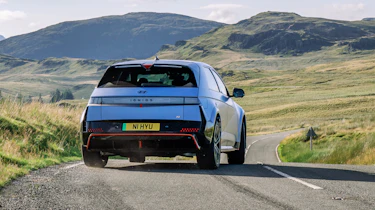
- Vicious speed almost superfluous
- The damping and balance are most impressive
- … plus the fact it actually engages you
Leaving the configurability alone in the 5 N’s default drive mode, it’s an entirely easy and straightforward car to operate. Interior fit and finish is impressive, as is refinement from road and wind noise at speed. It feels much like most mainstream EVs, only with rather nicer steering: progressive, and relatively feelsome (with three configurable levels of weighting, naturally). The ride is a little firm as speed builds out of town and onto rural roads, with the spring rates feeling rather tough, no doubt in deference to the 2.2-ton kerb weight.
In the firmest of the three damper modes, it can feel quite jarring and the softest mode is the best fit for most road scenarios. But – and here’s the first sense that this is no ordinary family EV – it controls its mass very well indeed. As we gradually up the pace, it begins to feel like a more traditional 4WD performance car: if you attack a corner, it swiftly settles, takes a set and arcs through the bend with a little bit of yaw. With the low centre of gravity, there’s no untidiness on corner exit and – unusually for an EV – you can start to get into something of a flow.
There’s ultimately only so much you can hide from the sheer mass at play, but Hyundai’s N engineers have hidden it pretty thoroughly. Most of the time, it feels like a car that weighs 400kg or so less than it really does, although it never feels like a small car on mountain roads it always feels a bulky car dimensionally. The accelerator map is gentle and it accelerates smoothly, rather than savagely unless you use the Grin Boost button, at which point it can exhibit ballistic straight-line pace should you wish.

The intrigue deepens when you begin to experiment with more of the settings within the N menus. Most notably, the option to simulate the sound and response of a petrol engine and a paddle-shift gearbox. In N e-shift Mode, the Ioniq 5 N can simulate an 8000rpm petrol engine connected to an eight-speed dual-clutch gearbox. The torque curve, rev limiter, shift response and engine braking have each been calibrated to mimic a petrol car, and the effect is actually very convincing. Though you’re never entirely fooled, it does feel uncannily realistic.
And the point is not to fool the driver, or to be a gimmick, but to help the driver: feedback from many drivers who’ve spent time in EVs, particularly while driving enthusiastically, finds that many feel disoriented or occasionally nauseous without the normal bearing points of engine noise and gearchanges to orientate themselves while driving. Work your way through the sweep of artificial revs (even hitting a false limiter, should you wait too long to change up in manual mode) and performance builds in what feels like a more natural crescendo. On upshifts, the system temporarily backs off the power and on downshifts, it uses regenerative braking. You can downshift using ‘engine’ braking to tuck into corners just as you might in an i30 N.
Driven in this mode, the car is slower than it might otherwise be in terms of ultimate pace, but more engaging. It’s perhaps a shame that Hyundai got the tricky part – the calibration – right, but has made it sound so silly. The distorted synthesised engine note sounds like it’s been ripped from Gran Turismo 2 (though maybe that’s being unkind to the game.) The fake exhaust pops and crackles on the ‘overrun’ are a little cringeworthy too.
There are three choices of sounds, one akin to a sort of rorty four-cylinder, one a little like a higher-revving engine, and one modelled on a jet engine (a jet engine that can be bounced off a rev limiter). But they work – they really do give you a sense of how fast the car is accelerating or decelerating, and it’s fascinating to hypothesise on how it may evolve the system further.
On the braking front, a brake-by-wire system continuously blends regenerative motor braking and the regular hydraulic brakes – even when the ABS is engaged on tarmac surfaces, retaining 0.2g of regenerative braking right at the point of lock up. Hyundai’s engineers say that no other EV on the market currently deploys motor braking to this extent, and that as a result the brakes last longer on track than those of an i30 N, despite the Ioniq’s much greater kerb weight.
| Hyundai Ioniq 5 N | Alpine A390 GTS | Porsche Macan 4 Electric | |
|---|---|---|---|
| Motors | Single front, single rear | Twin rear, single front | Single rear, single front |
| Power | 641bhp (with overboost) | 464bhp | 402bhp |
| Torque | 546lb ft | 608lb ft | 479lb ft (launch control) |
| Weight | 2235kg (291bhp/ton) | 2121kg (222bhp/ton) | 2330kg (175bhp/ton) |
| 0-62mph | 2.3sec | 3.9sec | 5.2sec |
| Top speed | 161mph | 137mph | 137mph |
| Basic price | £65,010 | £69,390 | £71,900 |
There is also an N Pedal function, which uses aggressive regenerative braking to drive at speed without needing to touch the brake pedal. Senior Hyundai engineers say it is possible to drive around a circuit at a decent lick of pace without once touching the brake pedal. In this mode, it’s easier to mobilise the rear end when you back off the accelerator mid-corner. Its switch-like action is difficult to modulate smoothly as you get used to it, and it’s best experimented with on track rather than on the road, particularly as it can instigate lift-off oversteer.
The N Drift Optimizer, an oversteer mode that enables you to slide around, is best used for shredding an expensive set of 21-inch Pirellis within a few corners, and it doesn’t actually make drifting very easy (or enjoyable, compared with a conventional car). The way it works is bizarre, seeming to only give full power when the wheel is dead straight and straightening the car up after a slide quite quickly. With that said, once you’ve learned its quirks you can pitch the 5 N into a controllable drift and the system seems to work with rather than against you – even if it’s hard to hide the weight and complexity at play.

On track the car acquits itself remarkably well. As on the road, it’s most engaging and less dizzying with the gearshifts and sounds switched on, and it’s far more agile than one might ever expect of such a heavy car. In some ways it’s reminiscent of cars such as the AMG GLA 45, although it’s a little less adjustable and you can feel the extra mass through some quicker corners. Here’s the thing though: it makes you smile and want to explore more of what it can do, more so than you might expect for such a heavy car.
And without flattening the battery after a few laps. Although Hyundai had a mobile truck acting as a charging station for our track session, engineers said that in most scenarios, a morning of 30-minute sessions on the circuit was only reducing the battery from around 100 per cent to 75 per cent each. And that in many cases, the front brake discs were not getting hotter than 100deg C.
Driver’s note
‘Everyone should know by now that the fake gears and noise add a layer of interaction to the Hyundai Ioniq 5 N. Once you drive it and you get over that feature, the way it carries itself along a road, the balance it exhibits on-throttle, start to shine – this is a disarmingly charming driver’s car. Hyundai’s N division has somehow hewn the 5 N into a generally engaging car, that feels two-thirds its mass at the kerb, that has you wishing you could drive hard for more than 200 miles at a time without charging it.’ – Ethan Jupp, evo web editor.
Range and charging
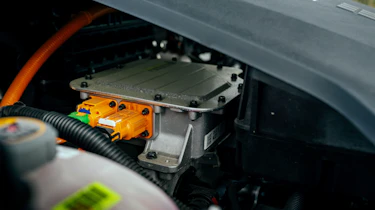
- 800-volt electrical architecture allows 350kW charge speeds
- 10 - 80 per cent in under 20 minutes at those speeds
- Needed when driving it hard, given 200 miles is realistic
On the road, the official WLTP range is 278 miles, but expect that to plummet when frequently using the car’s potential. With that said, we used up around half the battery during a morning’s driving on a range of roads, from city centre streets to motorways to steep mountain passes and fast A- and B-roads. Between a fast commute and a day of driving hard on B-roads, you’re looking at 200 miles of range from a 100 per cent charge.
The 5 N should be quick to top up, too, with the 84kWh battery in theory taking 18 minutes to go from 10 to 80 per cent when plugged into a 350kW charger.
Interior and technology
- Skateboard platform means the 5 N feels airy and spacious…
- … but it doesn’t ruin the seating position.
- Boot space is slightly down compared to the standard car
The 5 N’s interior perhaps isn’t as specialised as the rest of the package (and a bit gloomy thanks to the extensive use of black trim), but it’s still a pleasant place to be. You get an N-specific steering wheel with drive-mode shortcut buttons and paddleshifters, a taller centre console and sports seats to go with the Ioniq 5’s usual architecture. Somehow the skateboard platform doesn’t mean the seating position is poor – you can get nice and low in the buckets. Boot space is down to 480 litres from 527 but that’s still a useful amount of space.
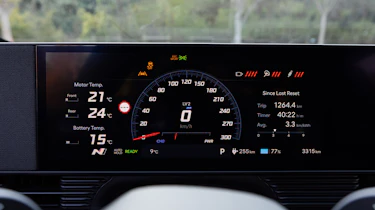
As with the base car, there’s a dual display panel ahead of you with a digital dash (with a rev counter, for use with the N e-shift Mode), with the drive modes being accessed via the touchscreen. Fiddling with these is best done at a standstill, because the array of configurable elements is baffling. Thankfully, controls that you’ll commonly use – like the radio and climate functions – remain physical.
Price and rivals
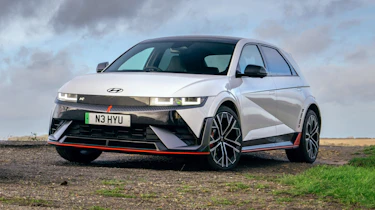
There’s no denying that £65,100 is a huge sum of money for a hot pseudo-crossover, but it’s hard to think of any sub-£100k EV that matches the Ioniq 5 N for its dynamic ability and sense of fun. You’ll need to look at the £88,200 Porsche Taycan to get anywhere close, and though it’s one of the most accomplished EVs on sale, it’s more straight-laced and less entertaining than the Hyundai. Meanwhile the cheapest Macan Electric is still £3k more than the Hyundai, significantly less powerful and feels like less of a purpose-built performance product. The Alpine A390 is similarly-sized, not as hardcore or thrilling but enjoyable and detailed in its engineering. You’ll need GTS spec for the full 464bhp, at £69,390.
At the lower end of the market there’s the Alpine A290, which costs £34,500 in GT Performance trim. It’s currently the best electric hot hatch in its class but it’s not an outright thriller, offering a more pure but less vivid driving experience than the Hyundai without as much customisation, or a simulated ICE mode. The A390 crossover is a much closer match, with 464bhp and three electric motors packed into a fastback body, but we haven’t driven it in production spec.
From within the Hyundai Group stable there’s the Kia EV6 GT, which has recently been subject to an update to give it a 5 N-matching 641bhp and a simulated ICE mode with six ‘gears’. It’s a definite step on from the old GT but we’ll need to drive it back-to-back with the Hyundai to find out whether Kia has executed the formula to the same high level, for less money (£59,985).
Hyundai Ioniq 5 N specs
| Motors | 223bhp front, 378bhp rear |
|---|---|
| Power | 601bhp (641bhp overboost) |
| Torque | 546lb ft |
| Weight | 2235kg |
| 0-62mph | 3.4sec |
| Top speed | 161mph |
| Battery | 84kWh |
| Price | £65,100 |