Lamborghini Huracán Evo (2019-2023) review – the improved V10 supercar still had its flaws
The baby Lamborghini got a mid-life upgrade to become the Evo. It was an improvement, but not perfect
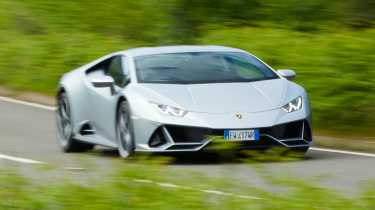
The Evo was Huracán 2.0. In simple terms it was the familiar aluminium and part-carbonfibre structure of Lamborghini’s ‘junior’ mid-engined supercar, with a Performante-spec V10 dropped in. This alongside the kind of advanced chassis technology and corresponding electronics hitherto reserved for the firm’s most aggressive niche variants.
It served between 2019 and 2023, with the RWD and hardcore STO version joining, in addition to the mad off-road Sterrato, before the Huracán saw out its days in Tecnica form.
Lamborghini Huracán Evo – upgrades
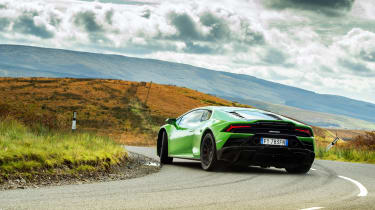
The 5.2-litre naturally aspirated V10 powerhouse, enshrined in the bay beneath a glass cover, benefits from titanium intake valves and a (very) free-breathing exhaust a-la the Huracán Performante, to bump to 631bhp, exceeding the 602bhp of the original Huracán. That also makes it 20bhp more powerful than the similar V10 found in the Audi R8 Performance available at the same time.

Its torque output of 442lb ft also exceeded that of its Ingolstadt relation (by 14lb ft), but these figures are still overshadowed by the then current Ferrari of the day, the 488 GTB that extracted 661bhp and 561lb ft from its twin-turbocharged V8. Moreover, when the GTB was replaced by the F8 Tributo and its 710bhp Pista-spec motor, the Evo was clearly left considerably behind in the power race. Given it weighs 1422kg ‘dry’, compared to 1370kg ‘dry’ for the 488 GTB, the raw numbers suggest that the bull is more ‘gasping to keep up’ than ‘raging’ out front.
More reviews
Should such numbers matter to you, the 1422kg (dry) all-wheel drive Evo reaches 62mph in 2.9sec, 124mph in nine dead and will go beyond 201mph. It’s also 5.7sec quicker around the handling circuit at Nardò compared to the car it replaces.
But really, which intelligent evo reader cares that much about the numbers? Since when have stats alone made a great driver’s car? In 2020 we were well into an era where many manufacturers believed that the epitome of a very-high-performance car was to have a power figure beginning with a seven and we simply do not agree with that philosophy. A great evo car – an evo icon – should be as much about mass reduction, handling fluency and driver interaction as Top Trumps-winning power and torque figures. It’s why the Lamborghini Huracán Evo’s other attributes made up for its power deficit, and then some.
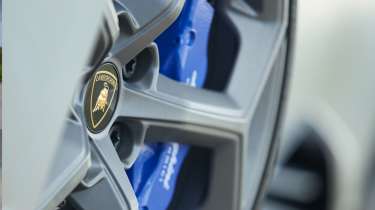
Beneath the Evo’s sharper looks Lamborghini massaged the hybrid aluminium-carbon chassis, focusing its attention on the dynamics, and specifically the electronics. It featured for the first time on a Huracán, four-wheel steering (from the Aventador) and four-wheel torque-vectoring (a first for the company at the time).
Along with the four-wheel-drive transmission and dynamic steering – which is the only type available due to the fitment of 4WS (for every ten degrees of front steering angle applied, one degree of rear steering angle is added, up to a maximum of three) – these systems are controlled by what is called Lamborghini Dinamica Veicolo Integrata, or LDVI for short, a piece of tech designed and developed in-house.
Comprising a single ECU, LDVI is fed data from all four corners of the chassis, throttle, gearbox, steering and brakes, and through its algorithms can command each of the systems it controls accordingly. So, for example, while the Evo may be rear-wheel drive for most of the time, LDVI will distribute torque to the front axle when it sees fit, while nipping the brake on a rear wheel or two if it feels that’s necessary, too. It might even decide a tenth of a degree of rear steering angle could be useful, so it will apply that as well – simultaneously and without the driver noticing.
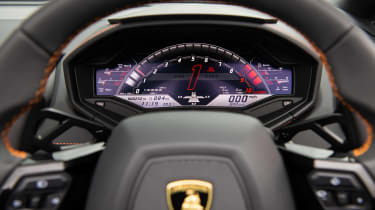
Lamborghini billed LDVI as a ‘feed forward logic’ controller, whereby it learns your style and characteristics to pre-empt your next move, rather than simply reacting to what is happening. Of course, it’s no mind reader, but it can prime the car’s systems in anticipation of what you will need them to do next as it measures yaw, pitch and roll through the active damper units.

Brake pressure and steering angle are also added to the mix along with the throttle opening and the level of grip from each corner, leaving LDVI to process and respond accordingly within 20 milliseconds.
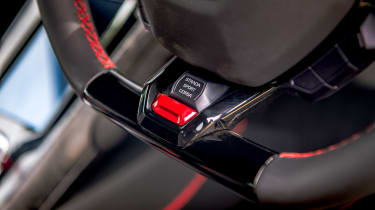
There are three driving modes – Strada, Sport and Corsa – and you’ll drive once in Strada before using the toggle at the base of the steering wheel to select Sport or Corsa. Very much of note is the fact there is no individual or ‘Ego’ mode in Lamborghini speak, which would allow you to mix and match, say, a more compliant ride with the most aggressive powertrain settings.
The Huracán Evo RWD is conversely less complex and less powerful, with just 611bhp and 413lb ft. There’s no rear-wheel steering, no torque vectoring, with the traction and stability systems recalibrated to manage how the power is used at the rear axle alone.
Driving the Lamborghini Huracán Evo
My early impressions of the Evo – anyone’s for miles around, in fact, I’ll guarantee that – were all about the engine. To be perfectly honest with you, it could be mounted in the most gruesome glassfibre-and-space-frame monstrosity of a low-budget kit car and there’d still be much to commend overall. It really is that stellar.
Starting in the Evo’s Strada drive mode, one of three modes selectable via a switch at the base of the steering wheel, it leaves the exhaust in its quieter setting, and the baritone bark fades into the background. A determined prod of the throttle elicits a buzz-saw growl from the intakes in the rear haunches, and with the windows cracked ajar, there’s the breathy suck of air being ingested and the hiss of the throttle bodies. It feels more living entity than internal combustion engine, and it’s hard to imagine it’s related to the usually rather demure engine in the R8.
Naturally, with its seven-speed twin-clutch ’box and the technology Lamborghini fitted at the time, the Evo is perfectly capable of adapting to being a fine long-distance companion. It’s a considerable trek to Anglesey from the Home Counties for my chosen test route, but the Evo does a decent job, and at least it gives me the chance to try to fathom the infotainment upgrade the Evo gained, which dragged the old car’s dated Audi interfaces right into the present day of the time. The Tron-style graphics on the touchscreen certainly look seriously cool, but even after a number of hours I’m still a bit puzzled about how you adjust the volume.
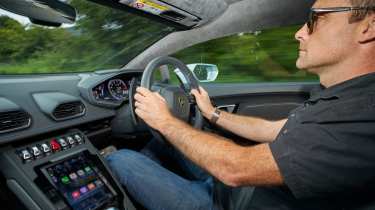
Arriving at Anglesey I venture out onto the circuit, flick past Sport mode and into Corsa, and let the V10 really sing. It’s hardly a lengthy or conclusive track session, but it still speaks volumes about the Evo’s deportment. It explodes down the straights, ripping to 8000rpm in the lower gears, and brakes with all the conviction you might expect, and I’m soon pitching the Evo into Anglesey’s broad hairpins to see what happens when it begins to move around. The answer is nothing. As much as I try to deliberately unsettle the car – and with ESP off – the Evo wants to do one thing and one thing only: it will grip, and grip, and then it starts to push wide at the front.

My first reaction is to be rougher with the car, to get it to break traction, but that’s a mistake: for all its bombast the Evo needs a much more delicate approach, and an acceptance of what it is and what it needs to get the best from it. It doesn’t feel a natural track car, but that’s not to say it can’t scythe around the lap in convincing fashion, and despite the feeling of heft there’s an almost hyper-real sense of agility. This agility is born from the clever new LDVI.
What’s troubling me is the realisation that the Evo doesn’t offer the amusingly termed Ego mode as seen in the Aventador S and SVJ that were on sale at the same time, and also the Urus: in other words, an individual mode, which allows you to tailor the car to how you want it, when you want. I’m already wondering if this will be a real issue, because with so many fundamental elements of the car’s dynamics governed by LDVI – not just, for example, the ride quality – an inability to match car with road could have significant ramifications.
In Sport mode, the deep-chested growl of the V10 at cruising revs gets a little wearing after a while, boring, as it does, somewhere deep in your skull. More to the point, the damping is definitely on the firm side, particularly if the surface isn’t great, where you really notice the abrupt rebound by the way your body is jiggled around.
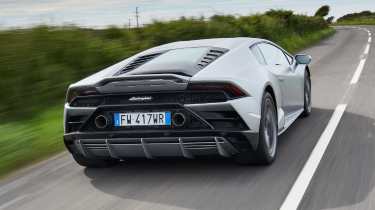
Returning to Strada provides reasonably compliant damping, and the quiet exhaust, but it also gives light and weirdly disconnected steering; it’s not bad once on lock, but the weighting away from the straight-ahead is very artificial, as is the self-centring (Sport and Corsa are more direct, with a better build-up of weight, but still offer no feel whatsoever). Furthermore, as the M56 starts to give way to more scenic, verdant A-roads, I miss the snappy gearshifts of Sport, having to make do with slurred, less definite changes instead.
Time to try Sport again, then. However, it soon becomes clear that it makes the exhaust note simply too loud to be used often. Yes, I feel like that’s an astonishingly un-evo thing to say, but this is a car where people can hear you coming from quite literally miles away, and this isn’t Sicily in the 1960s. This is the UK and driving quickly, responsibly, albeit potentially not quite to the letter of the law, for fun, needs to be approached with a more sensitive mindset. The ironic postscript to all of this is that with this exhaust, there’s no way the Evo is going to make it onto any trackday in the UK.
Once we’re in the Peaks, the roads become really tough. They’re often quite narrow, which immediately puts the Evo on the defensive, because it always feels a big, chunky device, more so than a 488. Here, the driver modes issue is really brought to the fore and threatens to overshadow everything that’s good about this car. With cyclists, ramblers and village residents around, I really don’t need the Armageddon of the unrestricted exhaust.
Neither do I need the Sport damping, which is a little too firm for these demanding and poorly surfaced roads. As for Corsa, it may enable the Evo to be astonishingly lively, and remove the annoying auto upshift near the red line found in the other modes, but the rigidity of its damping means there’s no way I’m even going to try it out here.
But Strada just doesn’t cut it. It allows me to get into a rhythm, yet the dampers are slackened off to such an extent that they’ll use up almost all of their stroke before checking the car’s body. As soon as there’s an awkward bump, the Evo feels vulnerable, and a couple of times when there’s a blind compression there’s an agonising scrrch as the front of an expensive Italian supercar grinds itself into the Derbyshire asphalt.
The upshot is that I’m constantly flicking between Strada and Sport and finding neither really does the business, and that’s so frustrating because it gives the impression that the car has been set up for those who want something loud and stiff-riding on the King’s Road, rather than those who actually want to enjoy driving the car in an environment conducive to driver enjoyment.
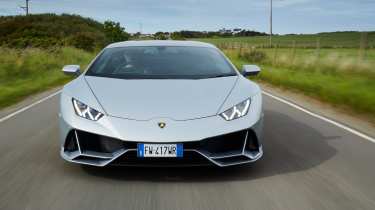
The next morning I step out of our overnight accommodation and there’s a freshness to the breeze that betrays the overnight shower of rain. The Evo is in the corner of the car park, dozing under an overhanging lime tree, and a film of moisture clings seductively to the satin silver paint (it’s actually called Grigio Atlas, but it looks like silver to me). The thing with the Evo is that, for all its faults, you can forgive it almost anything when you spot its dramatic form – that first glance is like a bolt of electricity up my spine.
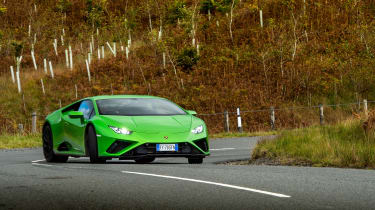
Inside it’s also pure theatre. The seats are still less than perfect, even though these aren’t the infamous buckets, but it’s amazing how a bit of ache in the backside and thigh can be neutered by the extraordinary theatre of spending time with this car. It remains quintessentially a Lamborghini, with an ability to attract attention like nothing else; favourable attention too, in the main.
The occasions to really let rip in the Evo on the public road are few and far between, and when I do illicitly let it rev right out in, shall we say, ‘a gear’, not for the slightest second do I think, ‘Oh, this car is nearly 100bhp down on a Ferrari F8.’ That’s the thing about big horsepower: over a certain number, and with a reasonable power-to-weight ratio, it all starts to feel academic anyway.
From conversations had previously with Lamborghini’s senior management, we know that they cherish the naturally aspirated V10 as a point of difference to their competitors, and they’re absolutely right to. More than ever, it is the key reason for desiring this car. However, the Evo feels hamstrung by frustrating self-inflicted software obstacles. The LDVI set-up may well be clever, but if it can’t contribute in the appropriate way, it’s wasted.
Driver’s note
‘It's amazing how natural it feels when you pick up the pace. Like the similar R8 the Huracán’s steering has improved over time. The weighting remains a little artificial but the response is now predictable. Despite driving only the rear wheels it makes the Huracán Evo RWD feel friendlier than you’d expect, without the risk of suddenly overwhelming the tyres. It’s not a car to get moving around on the road, but you sense a car that could be great fun on a circuit, letting you build up to its limits progressively.’ – Antony Ingram, evo contributor, who reviewed the Huracán Evo RWD.
Lamborghini Huracán Evo track test
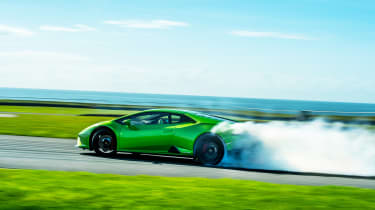
What it lacks in headline figures compared to a Ferrari 488 GTB or McLaren’s 720S the Huracán Evo makes up for with a soundtrack the aforementioned could only dream of replicating.
It’s a given that the Evo is going to sound good – it makes a wonderfully multi-layered, rich-in-texture spine-tingler of a noise – but it also feels nothing less than supercar potent even though we’re only experienced it on Bahrain’s Formula 1 circuit, an environment that can make even the fastest of roads cars feel like a fully laden school bus taking on a hill. Not so the Evo. It piles on speed between the apex of the corner you’re leaving and your next braking point with such conviction that if it wasn’t for the distinctive ten-cylinder howl you’d swear blind there were a dozen pistons pumping away over your shoulder. It even shrinks the stupidly long pit straight, as demanded of modern circuits by the F1 circus, with the same kind of disdain a Caterham has for weather gear.
The steering still lacks feel and feedback and remains disconcertingly light no matter what speed you’re travelling at or how much lock you have applied, but it feels less of a hindrance and barrier to enjoyment than before. It turns in with remarkable precision, not overly quickly in a bid to make you feel you’re closer to an edge than you perhaps are, just crisply and decisively when you ask it to hook into a curve and drag its nose through to the apex.
What is noticeable is how the steering wheel remains remarkably calm in your hands. Gone are the constant little adjustments the original Huracán’s steering required through and out of a corner. If you have any previous experience on track with the Evo’s predecessor it will take you a lap or two to process the new Huracán’s desire to work with you rather than against you. The speed you can carry into a corner is a big leap forward, while where you can build speed through and out of a turn is where the new car feels to have made its biggest and most significant dynamic gains.
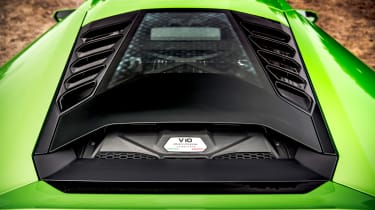
If this sounds like Lamborghini has tamed its supercar for the masses, fear not: it will still step out of line and gladly dump you off your line if you treat it in such a way that deserves an equally uncouth response. But it feels so balanced when you’re driving up to its limits, when the front Pirelli Corsas are on the brink of thinking about relinquishing grip as you reach peak mid-corner speeds, or when the rears are ever so slightly losing the war on traction on corner exit.
So much of this is down to you being able to meter out the engine’s very analogue power and torque delivery with a precision equal to that of the car’s very digitally focused chassis control. You quickly become sucked into the Evo’s insatiable appetite for thrills that don’t solely rely on increasing tyre manufacturers’ profits.
What we can take away from this track drive is that the virtual shortening and lengthening of the Huracán’s wheelbase via its use of rear-wheel steering eliminates the old car’s high-speed nervousness and eradicates its low-speed clumsiness. It makes sense of the dynamic steering, which for all its faults in terms of what a driver seeking the purest thrills is after, works so much better now it has a direct (digital) link to the rear axle.
How the torque-vectoring has been unobtrusively integrated means you don’t notice it nipping away here, there and everywhere, so it doesn’t cause a distraction. And the car still has that devilish engine to call upon, something that should never be ignored. Ever. – Stuart Gallagher evo, Editor in Chief
Lamborghini Huracán Evo RWD evo Car of the Year 2020 result – 3rd
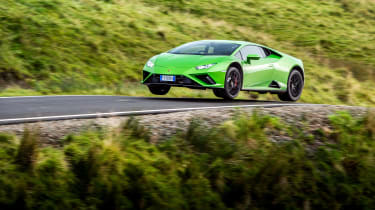
‘If Porsche’s Cayman GTS was an expected pre-event podium finisher in evo Car of the year 2020, the rear-drive Huracán wasn’t expected to go beyond our Anglesey shoot-out. But eCoty delivers the unexpected, and the Lambo’s performance was certainly that – and a great big slice of excitement no matter what the drive you had in it. That the Porsche finished seventh in 2020 was a shock to all.
‘After the disappointment of the Audi R8 RWD, the Huracán was a breath of fresh air. ‘I couldn’t believe how much more convincing the Huracán was. Sharper, more direct, more intense and more immediate, it’s just as you’d hope it would be. The engine is spectacular – like it’s powered by nitroglycerin, not gasoline,’ was evo’s Editor at Large Richard Meaden’s summary. Contributing Editor Henry Catchpole was impressed with the fluidity of its suspension and how it addresses the issues of previously potentially great Lamborghinis in terms of brakes, turn-in and gearbox.
‘So intoxicating was the Huracán that Editor at Large John Barker placed it top in his scores (alongside the F87 BMW M2 CS), saying: ‘It’s far from flawless but I can forgive it, because there’s such a richness to the experience.’ I thought it drove like it looked: nose down sniffing out the grip, tail a little raised to provide mobility when required, a genuine street fighter you want on your side.
‘But it was contributing editor Jethro Bovingdon who was transfixed by the Evo: ‘It’s not an exaggeration to say that paying £164,000 for this engine and ’box would be a wholly reasonable thing to do. But – and it’s a big, almost unprecedented but – the rest of the package is properly, no-excuses-required brilliant, too. Finally! This thing is absolutely joyous.’’ – Stuart Gallagher, evo Editor in Chief
Values and rivals
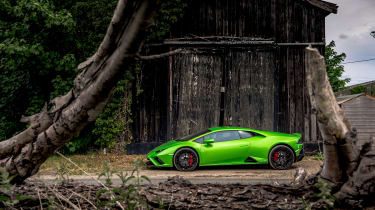
And now comes the bad news. The Lamborghini cost £206,000 on the road at launch in 2019, which might come as a bit of a shock if you have always considered a Huracán to be an Audi R8 or McLaren 570S rival. At that starting price Lamborghini drove up to Ferrari and McLaren’s respective showrooms and asked the 488 and 720S to step outside. That's brave but equally, that howling V10 engine was about as unique an offering as it got in the era of turbocharging.
Prices at the time of writing (May 2026) go as low as £160,000. Huracáns are willing, usable supercars whose owners like to be seen driving them and as such people do put miles on them. Therefore, immaculate service and MOT histories are particularly essential.
Pay attention to the condition of the brakes and tyres too. Uneaven tyre wear can both be a symptom and cause of differential issues. Not something you'll need to worry about in the RWD so much. The RWD being the newer, not so year-round-usable model (and so with fewer miles generally), is generally more expensive, with prices from £170,000.
Specs
| Lamborghini Huracán Evo RWD | Lamborghini Huracán Evo | |
|---|---|---|
| Engine | V10, 5204cc | V10, 5204cc |
| Power | 602bhp @ 8000rpm | 631bhp @ 8000rpm |
| Torque | 413lb ft @ 6500rpm | 442lb ft @ 6500rpm |
| Weight | 1389kg (dry) (440bhp/ton (dry)) | 1422kg (dry) (451bhp/ton dry)) |
| 0-62mph | 3.3sec | 2.9sec |
| Top speed | 202mph | 201mph+ |
| Price new | £164,400 | £198,307 |
| Value now | From £170,000 | From £165,000 |