McLaren GTS review – the entry-level McLaren you forgot existed
The McLaren GT returns with a new name and more power, promising grand touring credentials in a supercar package


You forgot this existed, didn’t you? The McLaren GT, or GTS as it’s now known. Embarrassingly, we nearly did too. The GT has been around since 2019 as the softer-edged, most-useable entry-level McLaren, but when it was updated to become the GTS in late 2023, nobody seemed to notice. Not only because the updates were almost undetectable to the casual observer, but also because a year earlier the Artura had been launched to redefine what a baby McLaren could be. As a truly next-gen product with a bespoke V6, hybrid drive and a brand new carbon structure, it left the GTS sitting awkwardly in the range, and seeming out of date before it even arrived.
But perhaps we were wrong to ignore the GTS, because on paper it’s a refreshingly pure supercar in the context of more modern rivals: mid-engined, rear-drive, with no batteries or electric motors in sight, all of its power coming from a 4-litre twin-turbo V8 alone – a rare thing in 2025. Having eight cylinders instead of six is a key point of difference to the Artura, so too the general approach of the car, says McLaren. It’s been engineered to have a more rounded, refined character, to fulfil the GT part of its name. This extends to the tuning of its suspension and electro-hydraulic steering, plus the trimming, insulation and packaging of the interior, which includes an expansive rear luggage area that extends from behind the seats, over the engine and to the tail.

As part of the update, the GTS has a lightly tweaked exterior with new vents for better cooling and airflow to the V8, which is marginally more powerful than before. Changes to the combustion phasing and ignition timing tease out an extra 14bhp, bringing the total to 626, and at 1520kg it’s a hair lighter too (though the saving is from the standard fitment of carbon-ceramic brakes, which were optional on the GT). A new nose-lift system boosts usability, too, and it does work swiftly in practice – raising or lowering in as little as four seconds.
More reviews
Though certainly more useable than other carbon-tubbed exotics, the previous GT didn’t lope along with the grace and refinement of a traditional grand tourer, and the GTS follows the same theme. It doesn’t hide its supercar core, from the drama of lifting the dihedral doors, swinging yourself over the tub and sinking into the seat, to the start-up theatrics. The V8 whaps into life with a hollow flat-plane blare and buzzes through the structure – not intrusively, but enough to have the wheel tingling in your hands at idle.
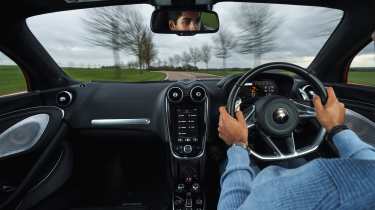
Not much has changed inside save for new upholstery options, and as a result the cabin does feel a bit last-gen – mainly in terms of the HMI, which doesn’t have Apple CarPlay or Android Auto capability, either via a cable or wirelessly. In 2025. Plenty of glass area (helped by the £5200 electrochromic panoramic roof option) does give it an airy feel, however, and the materials are generally high quality. The metal speaker grilles of the optional Bowers & Wilkins hi-fi are a particular highlight, even if it feels like they could grate the skin from your knuckles.
It’s still no Continental GT rival inside, then, but once underway the GTS has its own virtues – those typical of most McLarens. Namely steering that’s measured and tactile, a fabulous driving position and a level of compliance that you don’t expect from a supercar. The body is free to move on its springs and that gives the GTS a relaxed feel as it flows over a smooth, undulating surface. That’s despite it using conventional springs, anti-roll bars and adaptive dampers, instead of the sophisticated hydraulically cross-linked setup you’ll find on a 750S, which does away with roll bars entirely. It feels compact as you thread it along too, somehow more like a sports car than a supercar or GT.
Its performance definitely falls within the latter two categories though. Under light loads the V8 is happy to fade into the background as the seven-speed dual-clutch transmission slips through the ratios, but take manual control via the tactile aluminium rocker paddles and it takes on a fierce edge. On a damp road the power is heavily reined in by the TC, but the delivery intensifies as you pick up speed and gain traction, building to an addictive rush. The GTS is not as rabid as a 750S, or even the older and similarly powerful 650S, but it feels revvy and sharp when fully lit. The only disappointment is that the V8 doesn’t sound any more exciting than an Artura’s V6, yet it lacks the snap and response of that car’s hybrid system.
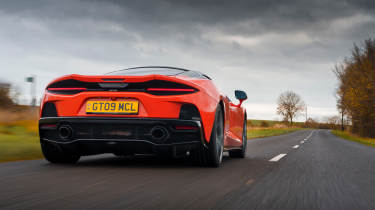
When the road surface gets challenging, the GTS is less cohesive than its sibling too, and its sense of comfort and refinement comes undone slightly. It’s largely smooth and controlled, but sharp bumps and intrusions can thunk through the tub and kick back through the wheel, and the rush of the tyres filters in over rough tarmac. As a result you don’t feel totally cocooned and isolated from your surroundings, at least not as you would in a true GT.
But there’s a flip side, because the GTS is more alive and involving than, say, a Maserati GranTurismo when you aren’t cruising, and guiding it from corner to corner, riding the torque and enjoying its clear, measured responses, can be immensely satisfying. At speed the stiffer damper modes (usually Sport, sometimes Track) are needed to stop the body moving too freely, but even then it feels light on its feet and wieldy.
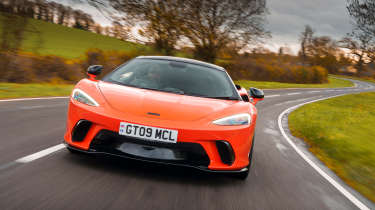
There’s fun to be had beyond the limit, too. In the wet the front end is strangely tricky to read and fully lean on, but the rear is totally transparent. With the ESC in Sport mode (or switched off) the GTS is fantastically controllable when it breaks away, and you can precisely meter out the power to tease out small, satisfying slides on the way out of corners. Given it has an open diff, it feels like sorcery.
If the GTS were the only car McLaren made we’d applaud it for its distinctive and compelling dynamics, and (infotainment aside) how useable it manages to be. You really could commute in it and cover long distances, because while it doesn’t fully lean into the GT role, it’s a supercar with impressive bandwidth. The trouble is, the Artura is more impressive again, in every sense: faster, more competent, more vividly exciting and just as easy and undemanding in normal driving. It’s the future of McLaren, and in some ways, the GTS feels like the past.
Living with the McLaren GT
Have you ever found a pen that makes your writing feel neat and flowing and easy all at once? That’s the feeling of the McLaren GT’s steering. After many cars with electric power steering, the feel and connection of the McLaren’s hydraulic power assisted steering is obvious before you’ve left the car park.
It would be a couple of hours before I would revel in its feel again, as having switched into our GT for my turn behind its wheel, I headed due west on the A14 and M6 before dropping down the M5, final destination the Morgan Motor Company. So, a good test of its GT credentials right away.
> Lamborghini Aventador SVJ (2019) Long Term test – five months in the £500k supercar
Rewind slightly, and while the wide, dihedral-opening door gets you closer to the seat when getting in, and also means you won’t dirty your trouser leg on the sill when exiting, popping the door is a bit clumsy and you have a quite a drop into the cockpit. Then you have to figure out the mess of buttons down the side of the seat to get it to whirr towards the wheel from its ‘comfort access’ position.
On the positive side, the seats are long-distance good, the steering wheel is small and well shaped, forward visibility is great and the ride is genuinely cosseting. The engine sounds a bit clattery on start-up but settles to a quiet hum at a cruise and, apparently, returns excellent economy: two hours later, the trip showed 32.5mpg. Managing editor Eveleigh reckons he’s seen 34.5mpg.
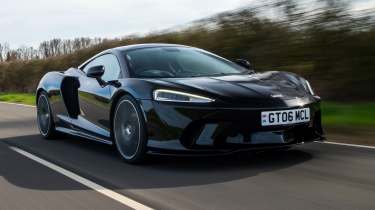
It’ll mooch happily, then, and on the bumpy back road near home it trod very softly, which was impressive. Sure, it felt a little free over some big bumps but it’s pretty well judged, and in its Sport setting the chassis feels much better tied down but still retains some plushness. It’s a shame some bits rattle when you hit bumps hard.
The 4-litre V8 unquestionably has all of its claimed 612bhp when you get the opportunity to rev it out to 8250rpm, and that steering is an utter joy when you encounter curves and corners, seemingly calmer and more unflappable than the chassis, which is more vague in its feedback. I had no inclination to wind back stability control; the warning light frequently blinks in the wet. But, hey, it’s the GT; there are plenty of sportier McLarens for derring-do.
I’m not sure about our car’s rather sinister, Hotblack Desiato spec of black with black wheels, blacked-out glazing, black window surrounds and black buttons that light up black when you press them. What a pain it is to clean. But over the ten days I had the GT, remarkably I saw nothing but very positive reactions. Meanwhile, brim-to-brim calculations showed it averaged a more realistic 20.1mpg.
No matter; I found it more everyday useable than I was expecting and enjoyed it much more than I anticipated, too. I’d jump at the chance to run it for longer. – John Barker, evo issue 297