Porsche 911 GT3 (992.2) review – is this the best 911 GT3 ever?
A new look, cleaner engine and S/T-inspired chassis upgrades are key changes for the latest 911 GT3. Has the formula been perfected?
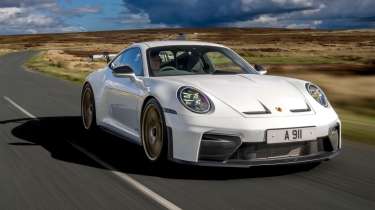
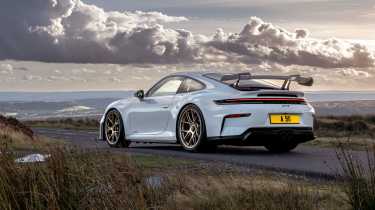
This is the new – not clean-sheet new but thoroughly updated, ‘992.2’ generation – Porsche 911 GT3. Since the 992-generation Porsche 911 family has entered its updated ‘992.2’ phase, the GT3 has been overhauled in turn with a host of updates, some big, some small. This is evo’s in-depth review of the Porsche 992.2 GT3 based on our tests on road and on track, in Spain, Germany, France and in the UK.
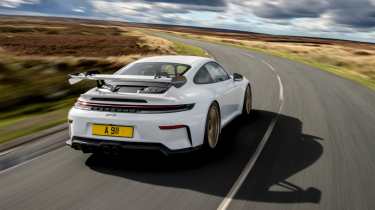
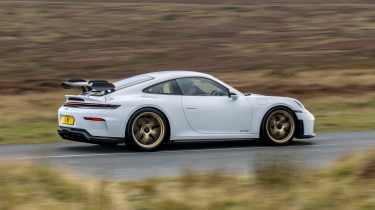
Straight from launch, the 992.2 is available in two body styles: the ‘regular’ winged GT3, tested here, and the more understated ‘911 GT3 with Touring Package,’ without the rear spoiler – reviewed separately here. For the first time – also due to customer demand – the Touring is now available with the option of rear seats.

Until now, the GT3 has always been a strict two-seater, not least because its one-piece bucket seats could not fold to enable access to the rear of the cabin. New folding carbonfibre seats have been engineered to solve this, but you’ll need to pay an additional £5390 if you want them in lieu of the standard manual sports seats (or optional electric ones).
The 992.2 GT3 is still available with a choice of six-speed manual or seven-speed PDK dual-clutch transmissions, with both paddles behind the wheel and a push-pull gear selector in the same place and shape as the manual car’s gear lever.
More reviews
In-depth reviews
- Porsche 911 Targa review – the opposite of a purists 911, but still superb
- Porsche 911 Cabriolet review – going top-down is no longer a compromise
- Porsche 911 Carrera S review – the daily 911 that’s quicker than a GT3
- Porsche 911 review – more complex than ever, but still the best sports car
Reviews
Whichever body style and whichever gearbox you go for, the starting price in the UK is the same: £158,200 at the time of writing.
In addition to the choice of body styles, seat count and transmission, there are also option packs such as the Leichtbau package, to take the Touring in a more racerish direction, and the Weissach package, taking the regular GT3 in a more RS-ish direction.
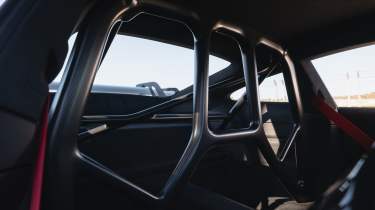
The Weissach pack is a pricey option at around £15,000, and includes a half-rollcage made from carbonfibre and the bonnet, roof and certain suspension components likewise, including a unique rear wing. The rear anti-roll bar, coupling rods and shear panel are made from carbonfibre-reinforced plastic. It also integrates lightweight door panels and some extrovert styling changes, including an outline of Porsche’s Weissach test track graphic on the front grille and rear wing. A section of the bonnet’s carbonfibre is exposed, to create a stripe. In combination with that pack, you can also spec magnesium wheels – which cost another £13,759 at the time of writing.
Our introduction to the 992.2 GT3 at its first official media launch began with Porsche sharing research into what existing GT model customers wanted from this new car. Excerpts of data were displayed from a survey of 2000 Porsche GT customers (of cars such as the 911 GT3, GT3 RS, Boxster Spyder, Cayman GT4, GT4 RS and others) around the world, asking them their likes, preferences and – pertinently – wishes for future GT models.
The vast majority prefer a high-revving naturally aspirated engine to turbocharging; they’re also happy to prioritise performance over everyday comfort (with audible brake and axle noises, for example); they’re not big on driving modes, and they’d very much rather their car be rear-wheel drive than all-wheel drive. And when it comes to powertrain, only nine per cent consider a hybrid powertrain to be ‘very much fitting’ for a Porsche GT car, and 33 per cent consider it ‘not at all fitting’. (For fully electric, the ‘not at all fitting’ vote rises to 58 per cent.)
Those customer wishes have ensured that the GT3 hasn’t evolved into a different animal in its journey from 992 to 992.2.
Many of the advances from 992.1 to 992.2 GT3 are detail tweaks rather than step changes. Much energy has been put into combatting ever-tightening regulations. The 992.2 features additional catalytic converters to meet emissions regs, and all kinds of detail engineering has gone on within the engine to keep its magic 9000rpm. Torque has reduced a touch but eight per cent lower gearing (as per the S/T) combats it. Mandated safety systems such as lane-keep assist now feature too, but can be easily switched on and off.
It also features new technology, such as electric power steering software that can actively compensate for tyre wear and temperature for consistent response.
And there’s still something about every response to every input in the GT3 that feels spot-on. The 992.2 GT3 retains the special magic of its predecessors.
Engine, gearbox and technical highlights
- 4-litre flat-six remains naturally aspirated
- No hybrid power, 9000rpm redline
- Choice of manual or PDK transmissions
As before, power comes from a naturally aspirated 4-litre flat-six, with a 9000rpm redline.
A big challenge for the 992.2 GT3’s engineers has been homologating it for various markets around the world without losing the core attributes its customers demand – natural aspiration, a 9000rpm limit and a low kerb weight, to name but three. For example, the 992.2 must comply with American exhaust particulate regs 40 per cent tougher than those the 992.1 GT3 had to meet in 2021. To do so, there are now four catalytic converters. (‘It’s not something we like very much, but we have to do it,’ says the GT3’s project manager, Jörg Jünger.)
To compensate, the individual throttle bodies have been redesigned, camshafts adapted for longer valve opening times, and all manner of measures have been undertaken to optimise cooling.
The manual gearshift is lovely – similarly short and snappy to that of the limited-edition 911 S/T but more user-friendly since the GT3’s clutch and flywheel are more forgiving.
While the 4-litre flat-six is quieter than before at low revs, it still makes a heavenly racket up at the top end. The PDK gearbox option makes it easier to keep both hands on the wheel for that magic sweep to the red line and is a perfect partner on track, but on the road the manual gives an extra degree of tactility and involvement.
The 911 S/T is more of a challenge to drive well, demanding both concentration and the time to get fully under its skin. The dopamine hit when you get it right is greater, but this GT3 has a broader envelope and you can enjoy it more of the time.
The S/T has influenced other aspects of the GT3, including its suspension. The damper software has been updated for faster response, and the bump-stops have been redesigned for greater control toward the limit of travel. One of the highest-tech elements of the 992.2 GT3 relates to its steering. Software now adjusts the EPAS’s response for tyre wear and temperature, ensuring consistent feedback.
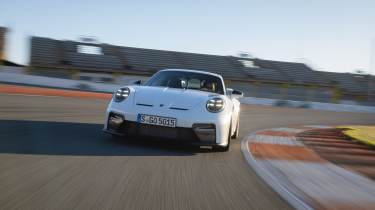
Rear-wheel steering is standard, and its natural and unobtrusive in feel. Together with the aerodynamics – evolved from the predecessor for more balanced downforce at higher speeds – it gives the GT3 great stability in fast curves, while also helping it pivot around hairpins.
Driver’s note
‘The steering is exquisite: very direct but calm, and once that fabulous engine starts closing in on 9000rpm… It’s a wonderful thing.’ – John Barker, evo Editor-at-Large, who drove the Porsche 911 GT3 during evo's 2025 Car of the Year test
Power, torque and 0-62mph time
- Peak power as before, torque dips slightly
- Shorter overall gearing to compensate
- 503bhp, 332lb ft and 0-62mph in 3.4sec
Just as the 992’s magic 9000rpm rev limit remains, so does the same 503bhp peak power output. Peak torque is a little less than before – 332lb ft rather than 347 – and to compensate Porsche has given the car lower gearing. You can still spec the GT3 with a six-speed manual gearbox or a seven-speed PDK, and both have eight per cent shorter gearing than before. (The manual unit is the same as that fitted to the limited-run Porsche 911 S/T, incidentally.)
With PDK, the 992.2 GT3’s official 0-62mph time is 3.4 seconds. With manual, it’s 3.9.
A little bit of top speed is sacrificed as a result of the shorter gearing – although it’s still north of 190mph – but tractive force on the wheels is stronger all the way through the gears. And this has never been a car about top speed anyway; of all 911s, the GT3 is all about corners. For the record, however, quoted top speed is 194mph for the manual with winged body, and 193 for the PDK equivalent. Porsche quotes the same performance figures for the car with the wingless Touring Pack bodywork.
Driver’s note
‘It wants to be driven hard and is so rewarding when you do, which perhaps is also the only minor criticism – as GT3s have sought to achieve more with the same power, so the chassis has become increasingly hardcore, and that means they are slightly tougher, more unyielding road cars as a result. The precision of the steering and the yowling 9000rpm top end of the flat-six make it so deeply engaging and exciting, yet it still has that 911 shape and 911 ergonomics that make it easy to use.’ – Henry Catchpole, evo Contributing Editor, who drove the Porsche 911 GT3 during evo's 2025 Car of the Year test
Porsche 911 (992.2) GT3 specs
| Engine | Flat-six, 3996cc |
| Power | 503bhp @ 8500 |
| Torque | 332lb ft @ |
| Weight | 1462kg (350bhp/ton) |
| 0-62mph | 3.4sec (PDK), 3.9sec (manual) |
| Top speed | 194mph (manual), 193mph (PDK) |
| Basic price | £158,200 |
Performance, ride and handling
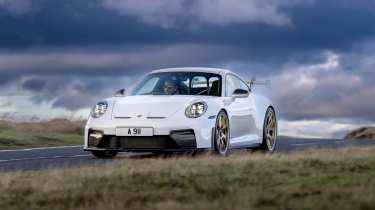
- Remarkably consistent handling, on road and track
- More stability under braking than 992.1 predecessor
- Remains one of the most communicative cars on sale
It’s funny how 500bhp can seem rather modest in 2026, compared with the warped performance of many supercars. But the fact the GT3 has less straight-line pace than some matters not one bit. This car is more about corners than straight lines, more about power-to-weight than outright power, and how the engine feels rather than how quickly it can push you down the road. You need to use revs to get the best from it, and it’s the opposite of a chore to do so.
In an interview with evo, Porsche’s director of GT cars Andreas Preuninger explained that 500bhp, in conjunction with a kerb weight his engineers fight to keep as low as possible, is an ideal number for the GT3. ‘We believe the sweet spot for a sports car is around 500 horsepower and 1500 kilos with driver and fluids, because the higher the horsepower gets, the more beefed up the chassis must be, and the more agility suffers,’ he said. ‘I’m absolutely sure that driving connection has to do with weight and the engine. It's not only power, it’s power-to-weight, and how the power feels in the car.’
Truthfully, the GT3 is more than quick enough in a straight line. And in corners, it’s thoroughly at home. A lower pivot-point for the front suspension, as per the GT3 RS, has been adopted to combat dive and maximise braking stability. Feel and feedback is well telegraphed, and you always feel completely in touch with what’s going on.
Some evo testers have found the electric power steering a little light in weight but there’s no denying its accuracy or its sparklingly clean, linear response. It’s remarkable how it can filter out so much intrusion from challenging road surfaces yet still put you completely in touch with them.
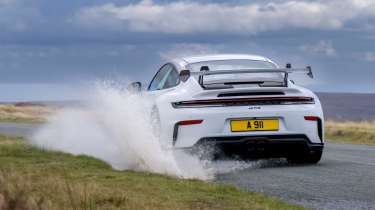
Ride quality is very much on the firm side but the quality of wheel and body control prevents it from feeling jarring or out of sorts on the majority of roads.
A driver training course at the Nürburgring Nordschleife for a separate evo story underlined the 911 GT3’s capabilities emphatically. Having picked up a GT3 with PDK transmission and Weissach Pack up from Cologne airport and driven straight to the Ring, in two days we covered around 600 miles. More than 400 of those were on the circuit, in sweltering summer heat. The Michelin Pilot Sport Cup 2 tyres had a thorough checkover at the end of Day One, and were in remarkably good shape. They didn’t need replacing at any point and, on Porsche’s advice, we didn’t even change the pressures from regular road settings. All we had to do was keep putting fuel in the car. And at the end of the two days, we drove it back to the airport.
Very few cars could take that kind of punishment and remain consistent, lap after lap. With such faithful and clear responses and balance, it was a perfect tool for learning the track. With a little bit of downforce in the fast sections of the track, it was stable at speed but not overly dependent on aerodynamic grip. The brakes impressed too.
All of those qualities shine brightly on the road, too. Despite its circuit capabilities, the GT3 is a well-rounded road car. There is a fair bit of tyres noise on the move (as there is in many modern 911 variants) and a bit of a whine from the differential. But all things considered, this is a comfortable car to do big motorway miles in. You could park it on the street in a city, then drive to a circuit in another country and lap quickly, before returning home. Not many cars have that breadth of ability.
Driver’s note
‘This feels like the GT3 back to its best. I’ve had some great drives in it [during this test], the kind you don’t want to end. Everything’s so precisely telegraphed. It makes you reassess what’s possible with a road car.’ – Stuart Gallagher, evo Editor-in-Chief, who drove the Porsche 911 GT3 during evo's 2025 Car of the Year test
MPG and efficiency
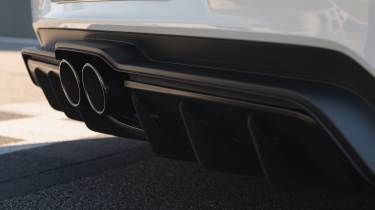
The GT department’s painstaking work on the exhaust filters, ITBs, cams and cooling improvements have all added up to boost efficiency but not at the expense of driveability and engagement.
Porsche quotes N0x emissions of 13.6mg/km. WLTP figures are 20.6mpg combined with the manual gearbox and 20.5 with PDK, and 310 and 312g/km respectively in terms of CO2 emissions.
The GT3 requires high-performance tyres, measuring 255/35 ZR20 at the front and 315/30 ZR21 at the rear. From the factory it is fitted with special ‘N’ marked Porsche-specific tyres, with track-focused Pilot Sport Cup 2 R tyres available as an option.
Replacements aren’t cheap but the good news is that the GT3 looks after its tyres remarkably well, even on track, so they’re unlikely to need replacing as often as most cars of this performance.
Interior and tech
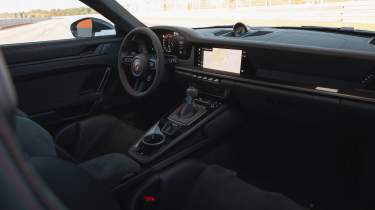
- New digital instrument panel
- Shortcut button for ADAS settings
- New 2+2 seating option available
One of the biggest interior changes from 992.1 to 992.2 is the addition of a digital instrument panel, including a computer-graphic rev-counter in place of the analogue tacho that’s been a 911 hallmark since the beginning. This was the source of controversy in some quarters but the rev counter is still sited centrally in the same position, and Porsche says it’s now easier to view while driving at night. In Track mode, it rotates so that the redline is at 12 o’ clock, as per a classic competition car.
The other big change is the addition of a rear seat option, for the GT3 Touring only, responding to demand from customers with young children. The rear seats are accessed by folding the regular four-way adjustable seats, but it’s also possible to spec the car with optional folding carbon bucket seats. At the time of writing, they cost £5390.
An even pricier option is the £15k Weissach Pack, which in addition to the exterior carbon fibre panels, aero upgrades and suspension upgrades, alters the interior with a roll-cage made from carbon fibre, lightweight door inners, Race-Tex fibre trim in places, and enclosed six-point harnesses (though you can choose to use the regular seatbelts instead). The outline of Porsche’s Weissach test track is embroidered into the seats’ headrests. Equipped in this spec, the GT3 has a more hardcore feel, with more road noise making its way into the cabin.
As with previous GT3’s the driving position is very low. The optional bucket seats feel oddly upright at first, yet testers of all heights have found that they become remarkably comfy after a few miles of getting used to them, and are less fatiguing than many shell seats over long journeys.
All the driver assistance systems that are now essentially a requirement of modern cars are fitted to the 992.2 GT3 – including lane keep assist, speed limit warning, and so on – but a physical switch on the dash brings them all up on the touchscreen swiftly, enabling you to toggle them on and off without digging through various menus.
‘I’m sure you’ll agree with me that no customer will buy a GT3 for its driver assistance systems,’ project leader Jörg Jünger said, at the car’s launch.
evo Car of the Year 2025 – result
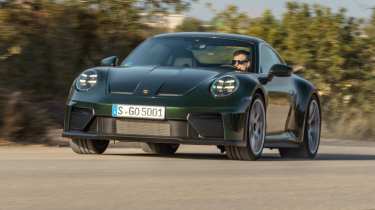
You could argue that the GT3 doesn’t move the game on in an era that includes some extremely clever, complex and forward-thinking sports and supercars. But then you drive it, and you understand why it’s stood still for so long – its purity sets it apart from everything else, and it’s impossible not to be seduced by its poise, communication and the stunning combination of its naturally aspirated engine and manual gearbox. This 992.2 GT3 has been honed to an incredibly high level, and we couldn’t be happier that Porsche is still building it in its raw, undiluted form.
It finished second at evo's 2025 Car of the Year test, though some of us preferred it to 2024’s victor, the 911 S/T. It has a wider operating window, being less demanding but still totally absorbing at all speeds. ‘It’s better than the S/T!’ said judge Henry Catchpole. ‘The whole car feels incredibly pure and honest in all of its control weighting. Driving it up high on the Col de la Bonette at sunset with a dusty surface under the Cup 2s and only some wooden poles between you and a big fresh-air drop, it was magic.’
The Maserati GT2 Stradale also on the test looked poised to be a foil to the GT3, but that threat faded from very early on. It had no answer to the Porsche’s fabulous drivetrain, nor the finely honed precision of its controls. ‘The best EPAS I’ve ever tried,’ said John Barker of the steering, while the brakes, clutch action and gearshift are right up there too. Would it have placed just as high with PDK? Most likely, although having three pedals was a key point of difference in the group and kept you busy and engaged when not wringing every last drop from the car.
As is usually the case with the best cars, you also don’t need to tinker with modes and settings to get the best from the GT3. There’s a sense that its creators have a precisely defined target of what it should be and set out to achieve that, rather than trying to bundle multiple characters into one package. ‘It’s just the perfect antidote to modern cars that require a lot from you just to operate them,’ said Dickie Meaden. ‘The GT3 strips all of that away, and I think that’s becoming increasingly precious and increasingly special.’
So close to the top step, criticism was hard to come by, and the overall verdict was that this is the GT3 at its spellbinding best.
Price and rivals
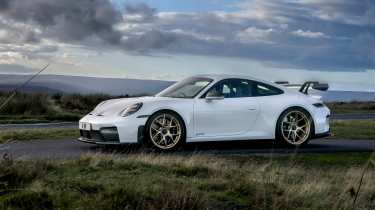
Natural rivals for the Porsche 911 GT3 are now few and far between – particularly cars with naturally aspirated engines, combined all-round road and track ability and the option of a manual gearbox.
The Mercedes-AMG GT Pro is an impressive car and like the 911, comes with the option of two seats or a 2+2 layout but, in addition to being all-wheel-drive, turbocharged and auto-only, it has a more luxurious bent than the GT3.
Aston Martin's Vantage, which uses a related twin-turbo V8 engine to the AMG is – based on our testing – a more involving car than the GT Pro (and excellent fun on track, too) but it’s a less focused proposition than the 911.
Like the AMG, the BMW M4 CS is much heavier than the GT3 and features switchable four-wheel drive. It’s a fun car in the right circumstances but doesn’t shine significantly more brightly than the regular M4 Competition.
Maserati’s GT2 Stradale has a road-racer ethos closer to the 911 GT3 but is limited to 914 cars and priced at around £270,000 – £120k more expensive than the Porsche.
McLaren’s superb 750S is a different kind of car with a similar purity of focus to the GT3, though it is more powerful and more expensive. The Artura is more comparable with the 911 in terms of market positioning but as a hybrid with a broader use remit, it’s a different animal.
Alpine’s A110 R goes off sale imminently, can lap circuits endlessly without running out of tyres and brakes, and offer a unique thrill on the road but it’s significantly less powerful than the GT3 and can feel more one-dimensional as a result.
Ferrari’s 296 Speciale is perhaps the GT3’s closest current competitor in ethos but it’s a vastly more powerful, complex car with a hybrid powertrain, and costs more than double the price.
Porsche 911 GT3 versus rivals
| Model | Power | Torque | Weight | 0-62mph | Top speed | Price |
| Porsche 911 GT3 | 503bhp | 332lb ft | 1420kg | 3.4sec (PDK) | 194mph (manual) | From £157,300 |
| Mercedes-AMG GT Pro | 604bhp | 627lb ft | 1875kg | 3.2sec | 197mph | From £179,350 |
| Ferrari 296 Speciale | 868bhp (combined) | 557lb ft (ICE) | 1410kg (dry) | 2.8sec | 205mph | From £359,779 |