Volkswagen ID.Polo GTI Clubsport Concept is VW’s 911 GT3 RS
This wild concept is what happens when Volkswagen turns one of its production cars into a track weapon, and the engineering isn’t as unrealistic as the Clubsport looks…

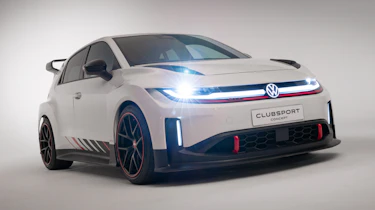
We know Volkswagen is famous for applying a psychedelic filter and a shot of steroids to its everyday cars to create some spectacular concepts. Now, as the 50th birthday of the GTI badge is celebrated, it’s gone back to the same formula with the new ID.Polo GTI Clubsport Concept. We went to see it.
This hot new supermini is inspired by everything from Volkswagen’s dominant Polo WRC cars of the 2010s, to the outrageous Golf W12 650 concept of 20 years ago. Though it stops short of stuffing a Bentley engine where the back seats are supposed to be, this is a track-focused concept that leverages electric power to create a car that VW isn’t too shy to call its 911 GT3 RS.
Design, aero, interior and GT3 RS inspiration
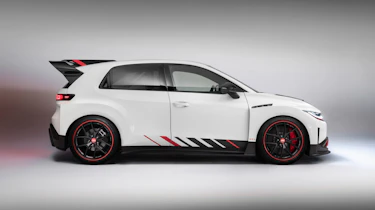
The power, performance and requisite engineering to give an electric Polo over 360bhp are impressive but the really cool part – what hits you in the face – is the Clubsport’s design.

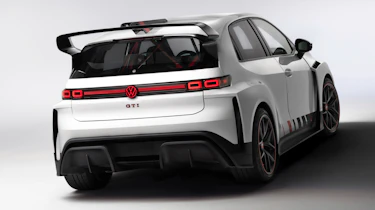
This thing is a brute, with its box arches, wild aero and touring car stance. It’s 100mm wider at each axle than the ID.Polo GTI. So wide at the back, in fact, that the rear doors had to be sealed shut, making the Clubsport Concept a brief and unlikely return of the virtually extinct three-door hatch. The front width, meanwhile, means the steering lock had to be limited to avoid fouling bodywork. Don’t try opening the boot, either, as the wing’s legs don’t allow it.
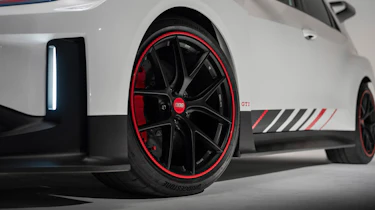
The new bodywork – from the gaping mouth, to its chunky diffuser, wing, perforated snout and arches – has been sculpted to funnel air around and through its distended form, for cooling, drag reduction and downforce. The roof, along which there are extended legs for the prominent wing, is carbonfibre. The car also sits 15mm lower than a standard GTI, on Bridgestone Potenza Race-shod BBS wheels, shrouding ceramic brakes borrowed from Audi’s RS3.
Exterior designer Tibor Juhasz told evo openly that this car is inspired by the 911 GT3 RS but also needed to be an exploration of aggression within the realms of feasibility. That’s why in terms of its ‘front-engined’ layout and battery set-up (that we’ll get to in a moment), it’s no deviation from the standard car. Inside, though, Andy Preuninger himself would offer an approving nod, I’m sure.
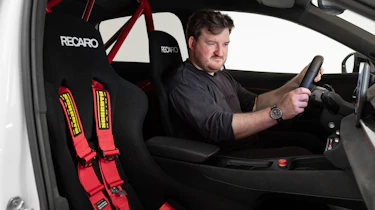
Gone are the back seats, replaced by a giant red roll cage to which belts from the five-point race harnesses are mounted. When you’re belted up, these hold you tight in the fixed Recaro bucket seats. Everything’s glazed in Volkswagen’s ArtVelours microfleece and while the infotainment screen remains, it’s been digitally decontented to include only the drive modes.
VW ID.Polo Clubsport Concept – Power and performance
Though it looks vastly different to the humble ID.Polo and ID.Polo GTI with which it’s still closely related, the fundamentals remain. It retains the GTI’s 52kWh battery pack, albeit with enhanced cooling hardware courtesy of Porsche’s Taycan.
There’s still an electric motor under the bonnet exclusively powering the front wheels. It is however, as you’d hope, much more powerful, with comprehensive re-engineering around it to ensure the Polo has a hope of deploying the increased performance.

The motor is the APP550 unit usually found in the back of more potent Volkswagen ID.7 saloons, turned and tweaked to output 362bhp (boostable to 388bhp in temporary bursts) and 406lb ft. That’s over a third more power and almost double the torque of the 223bhp, 216lb ft ID.Polo GTI you can currently buy. This allows the Clubsport to hit 62mph in 4.7sec, on the way to a 150mph top speed, with the ID.7’s motor re-engineered to spin at higher revs.
The electric motor swap hasn’t been a plug-and-play job. On the contrary, its 5mm rearward and 55.5mm upward drive outputs compared with the standard motor meant it needed a bespoke subframe, redesigned mountings and longitudinal members. High-voltage cabling and cooling apparatus have all needed to be re-routed and relocated, too.
The motor also has a re-engineered diff, to aid the front wheels – which still need to steer – in handling what is a colossal power and torque figure. There are also new suspension turrets, wheel housings and added camber, though the Polo retains its fundamental torsion beam rear axle and MacPherson strut design up front.
> Volkswagen Polo GTI (Mk6, 2017 - 2026) review – a hot hatch we won't miss
The DCC adaptive dampers remain, with a bespoke calibration that focuses on circuit performance, while there’s also a ‘one box’ system for the RS3 brakes, to improve response and tighten the packaging. Volkswagen is very proud of how the Clubsport demonstrates the versatility of its EV platform, repurposing what was a rear-drive motor for a front-drive application.
Volkswagen ID.Polo GTI Clubsport – will they make it?
This exact concept isn’t going into production, so says Volkswagen. Something of a shame, given both Renault and Peugeot are persisting to production with much more extreme high-performance hatch concepts, in the R5 Turbo 3E and 208 E-T16. However, Clubsports are an important rung in the GTI ladder, that will surely need to live on in the electric era. So don’t be surprised if a Clubsport version of the ID.Polo GTI, albeit one less extreme than this concept, appears before too long.