BMW M Concept Neue Klasse: Why 1000bhp 'makes no sense' in the next BMW M3
It's a preview for the electric M3, that will be sold alongside a petrol version

It began forty years ago with a screaming BMW Motorsport-developed 2.3-litre, 16-valve four-cylinder engine. Less than a decade later, it gained nearly a litre in capacity and a pair of cylinders, along with some trick valve timing (for the period). For the new millennium the cylinder count went up to eight and capacity to 4 litres.
Then the downsizing began, even if the performance kept climbing. Twin turbochargers and six cylinders have been at the heart of every M3 (and M4) since, but at Le Mans in 2026 BMW M revealed the next M3 powertrain: 650+bhp and zero cylinders.
BMW M Concept – powertrain
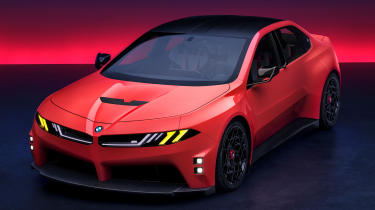
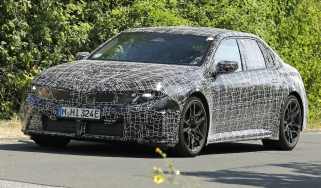
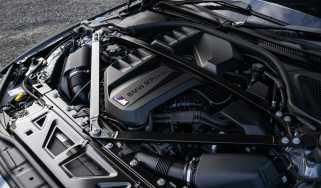
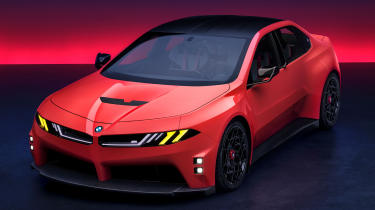
Meet the BMW M Concept Neue Klasse. Though billed as a concept, the M Neue Klasse is the new electric M3, requiring only a handful of production-friendly mods ahead of its 2027 debut. However, while the first cars off the line will be powered by BMW’s M eDrive system, built around the brand’s Gen6 electric technology, in late 2027 M will launch a mild-hybrid petrol variant with an upgraded version of the current car’s S54 turbocharged straight-six.
For now, it's kWh, volts and watts. M eDrive features four individual wheel motors powered by an electric motor on each axle. The rear motors are electrically excited synchronous, the fronts asynchronous, while both are paired with silicon-carbide inverters. All are controlled by the BMW M Dynamic Performance Control unit, a specific software controller that manages not only power and torque distribution across all four corners but also every element of the powertrain’s functionality.
This setup allows the electric M3 to run as either a four-wheel-drive car or rear-drive only, with the front axle decoupled for optimum efficiency when required. It also means, according to BMW, that the M Neue Klasse will still feel very M and very rear-wheel drive most of the time. Each individual wheel motor will also manage power and torque loads, traction and stability, and recuperation requirements back to the 100+kWh battery.
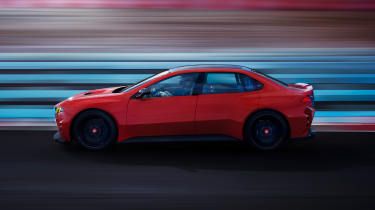
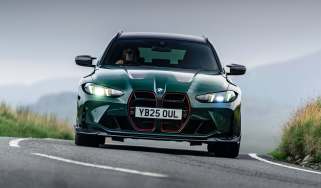
In total the new M3 will be able to produce a minimum of 650bhp and 811lb ft torque. Meanwhile, the fact that it is built around an 800-volt architecture means charging speeds are reduced by 30 per cent and the car will be able to support 400kW charging, too, though BMW is yet to disclose either charging speed or range. Our M3 CS Touring currently does circa 300 miles on 60 litres of superunleaded when driven in the manner it was designed for, so if the electrified M3 can match that then half the battle is won when it comes to sceptics of such vehicles.

On the subject of power, you might be thinking c650bhp is nothing special when rivals continue to chase four-figure outputs. However, BMW M CEO Frank van Meel is very evo in his thinking when it comes to power outputs. ‘Our direction is “power is nothing without control”. It makes no sense to drive with 1000 horsepower in the car because it’s not controllable.
‘We have very strong independent motors because you cannot transfer torque or power by driveshafts – we just have electronic driveshafts. If you add all the power of four motors you might get over 1000 horsepower but you will never need all that power at the same time.
‘It’s like a kickboxer – you need to have strong arms and legs, but you will never kick someone with two legs and two arms at the same time. It makes no sense, you’d just drop to the floor.’ A car manufacturer not chasing a headline-grabbing, class-leading power figure could just be the antidote to the 1000bhp ego club.
Performance? It’s an electric car with over 800lb ft of torque, so expect to feel sick as it reaches 60mph in under 3 seconds, but don’t expect it to go beyond 155mph. (The ICE version will take a few extra tenths to reach the performance benchmarks, but will reach a higher maximum.)
The battery, located between the front and rear axles and forming a structural element of the chassis, utilises BMW’s sixth generation of cylindrical cells, improving energy density by 20 per cent and therefore providing more range without increasing the dimensions of the battery pack. Or, if BMW was so inclined, it could reduce the size of the battery and therefore its weight, not that a target kerb weight has been declared. Meanwhile the latest oil-water cooling technology brings thermal efficiencies.
BMW M Concept – chassis and aero
Details on suspension and brakes fall under the ‘it’s a concept’ banner for now. However, the iX’s adaptive air suspension is unlikely to be used due to packaging and weight; therefore expect an evolution of the current G80 M3’s MacPherson strut front and five-link rear setup, with the latest M Adaptive dampers linked to the drive modes. Carbon-ceramics are expected to be the only brake option.
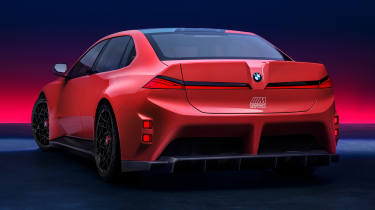
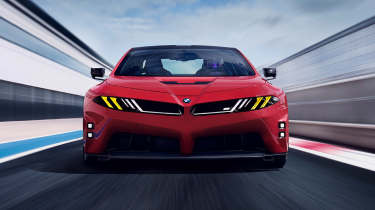
Visually the M Concept Neue Klasse has all the design elements of a current M car, with exaggerated haunches at all four corners and various air inlets and outlets around the body to cool the powertrain. The headlights and kidney grille are a single unit and the M5 CS and M3 CS models’ yellow headlights have found their way onto the M Concept.
There’s a trimaran-style front bumper inspired by racing sailboats, with the three-part design underlining the car’s technical appearance. Crucially, it provides structural support for the front splitter. There are also three-dimensional lights within the outer sections of the front bumper.
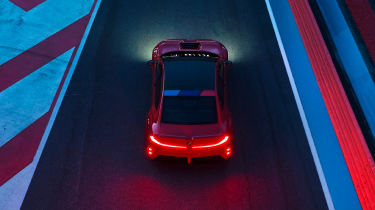
There’s a similar trimaran theme at the rear, the body appearing to ‘float’ above the rear diffuser, and a ducktail spoiler to increase downforce – or rather reduce lift – across the rear axle. All of the carbon elements are produced using ‘natural carbonfibre’ technology, which reduces CO2 emissions by 40 per cent during the production process. The technology is similar to that used by Porsche in its race cars; indeed M has been using its own motorsport department to test the same material on its GT4 cars for the last five years.
The use of an electric powertrain has allowed the designers and aerodynamicists to be more experimental: while the EV version will have the S-duct opening in the bonnet – and the more aero-optimised front splitter and rear diffuser – the petrol-engined model won’t benefit from the same aero performance.
Van Meel confirms that cooling requirements for the combustion powertrain and the fitting of an exhaust system will require a redesign of the car’s front and rear splitter and diffuser.
BMW M Concept – interior
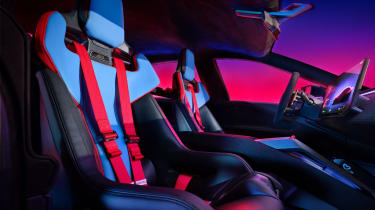
Inside, there’s a much more pared-back interior than you might expect. M5 CS-style individual bucket seats are fitted front and rear, although we hope the five-point harnesses won’t make production (as anyone who has driven a road car with harnesses will no doubt concur). We’re also not convinced a four-seat car needs a rollover bar straddling the interior. And yes, those are shift paddles on the back of the steering wheel to manage the simulated gearshifts.
Developing one car for two powertrains is no small task, especially so when Van Meel has charged his team with making the next M3 drive the same regardless of the powertrain the customer chooses. ‘It’s not about accelerating straight forward – that is more or less the easy part,’ he says. ‘The more difficult part is to do that in a controllable way, especially when you have an insane amount of power, and then also being very precise in lateral dynamics. This is what M is all about: controllability and precision.’
At a time when electric performance cars are in the headlines for the wrong reasons, the first electric M3 seems to be talking to the enthusiast more than others; how this converts to sales when both powertrains are available will be fascinating. Pricing is yet to be confirmed but first deliveries of the electric production M3 will begin in 2027 with the straight-six arriving 12 months later.