Range Rover Sport review – the car to replace short-haul flights
A strong combination of full-size Range Rover elements in a more attainable package, but objectively it’s no class-leader

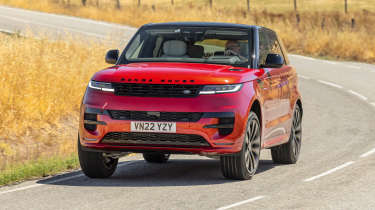
Being JLR’s second biggest selling car globally comes with some sizeable responsibility, not least in the Range Rover Sport’s case being the conduit between those who have fallen in love with the Defender (115,404 in 2025) and those who dream of full-fat Range Rover ownership alongside the 77,000 who bought one new last year. Which explains why JLR offers its RR Sport with a combination of diesel, petrol plug-in hybrid and pure V8 engines. And that’s before you get to the head banging SV…
Built upon JLR’s MLA Flex platform, the next edition to the Range Rover Sport family will be the all-electric variant, and while it won’t launch until September, we’ve already had a short drive in it here. Nevertheless, the combustion-powered Sport range is a staple of JLR’s offering, so we spent some time in it to find out if it still holds its own.
> Range Rover Sport SV review – A Defender OCTA in a suit
Its 2022 launch pushed the Range Rover Sport further upmarket and much closer to its full-sized Range Rover big brother, but at the same time provided it with a broader dynamic bandwidth to compete with the likes of BMW’s X5 and Porsche’s Cayenne. Over time, while the premium and luxury fit and finish, material quality and design has continued to evolve, some rivals have stepped up the performance of their models providing more resilient body control, clearer feedback and sharper reactions. This is an area JLR’s engineers are working on for the model’s mid-life facelift due in late 2027.
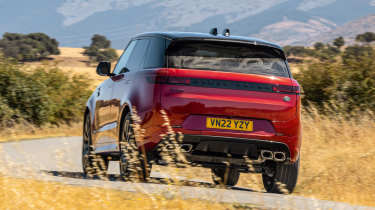
Before then, the RR Sport is still a hugely compelling proposition for those in the luxury SUV market. Being a bespoke product and not one that is required to do a multi-brand role within a Group (such as VW Group’s SUV portfolio that spans everything from an Audi Q7/8 to a VW Touareg and everything in between from Bentley through to the Lamborghini) means it feels special in everything that it does, from its cabin’s ergonomics to how it drives - on and, of course, off-road.
More reviews
In-depth reviews
- Range Rover 2025 review – there’s no need to go electric
- Range Rover review (L405, 2012-2021) – verdict, specs and rivals
Long term tests
Reviews
- 2020 Range Rover Velar SVAutobiography Dynamic review
- New Range Rover Evoque review – why it’s good enough to take on Volvo XC40
- Range Rover Evoque (2013-2019) review – with once exotic style now familiar, does the Evoque still have what takes?
- New 2018 Range Rover Sport revealed with plug-in hybrid and 567bhp SVR
While it might have a smaller footprint than a full-size Range Rover, the Sport doesn’t compromise on quality even if it doesn’t offer a long wheelbase, captain’s chairs or a third row of seats like its big brother. It provides the same peerless driving position, a level of ride comfort many saloon cars would be envious off and, thanks to its active suspension, rear wheel steering and a bespoke damping control it manages its near two and half ton bulk with confidence, delivering the reassurance that so much mass is under control.
Engine, gearbox and technical highlights
You’re spoilt for choice when it comes to powertrains, with petrol, diesel and a plug-in hybrid petrol offerings all at your disposal, the majority with six-cylinder engines with BMW’s twin-turbo 4.4-litre V8 still available for those with a fuel card and a passion for V8s.
Six-cylinder engines underpin the Sport’s powertrain strategy, though, with a 3-litre turbodiesel available in three states of tune: D240 (249bhp), D300 (300bhp) and D350 (350bhp), all are mild-hybrid models with the 350 only available is higher Autobiography trim. Torque outputs start 442lb ft with 37lb ft added with each horsepower increase up to 516lb ft. If towing or long distance drives or a combination of the two factors weigh heavily in your life, diesel will still be the optimum energy source for you. Its long-legged range makes country crossing drives an ease that renders short haul air travel redundant for many, providing the ultimate go anywhere and anytime solution.
Petrol power comes in two flavours, the aforementioned 4.4-litre V8 or the 3-litre turbocharged six-cylinder engine that’s available as a P380 mild–hybrid, P460e and P550e plug-in hybrid, their power outputs as per their names suggest: 380bhp and 406lb ft, 460bhp and 479lb ft and 550bhp and 590lb ft. The P540 V8 delivers 537bhp and 553lb ft.
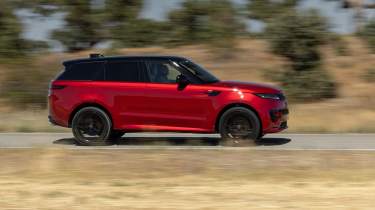
We spent six months and nearly 15,000 miles with a First Edition V8, which was a glorious way to cover all those miles, the powertrain’s effortlessness taking any level of stress or apprehension out of any journey. Every long drive felt like you had a Swiss-army knife mate at your side, seemingly unphased by anything a British autumn or winter could throw at it, including pot holes. So good, it almost made you forget the fact it returns mpg in the mid-twenties. Almost.
The six-cylinder plug-in hybrid models offer a genuine 70+ miles of electric range, but the lower output P460e PHEV feels a little strained once the battery is drained, eradicating any efficiency gains. The P550e PHEV’s additional torque helps plug that gap of low-rev torque, blending the electric range - still circa 70 miles - with the 3-litre petrol’s circa 350 miles per tank of fuel.
There’s still no escaping the fact that the Sport’s best energy source is diesel. Its range and efficiency suits so many scenarios only tax efficiency purposes would steer us towards a petrol variant. Unless someone was paying the bill, and we’d say to hell with it and go for the V8.
All models, regardless of the energy source, are fitted with an eight-speed automatic gearbox and Land Rover’s Intelligent All-Wheel Drive (iAWD) system and Terrain Response 2 with a low-range transfer box available as an option. All models come equipped with air suspension and dynamic and adaptive dampers and torque vectoring by braking. Rear wheel steering is only available on the higher trim models and plug-in hybrid models.
Performance, ride and handling
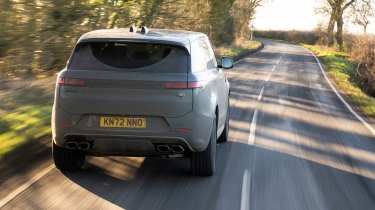
An SUV with the word ‘Sport’ in its name is attracting scrutiny, but where the early Range Rover Sport’s wore the name liberally, the current generation is the most dynamic to date and extracts the most performance from any Land Rover or Range Rover product that doesn’t wear an SV or Octa name tag.
It is still a step behind Porsche’s top end Cayenne models and Lamborghini’s Urus for outright dynamic achievement, but the Sport, regardless of the powertrain, matches other brand’s bespoke performance and luxury models in a tighter, more confident package.
All models ride with a confidence that underlies their luxury DNA: there’s no ‘head wobble’ across poor surfaces, the body control is consistent and linear making for a calm cabin for all passengers and when you begin to push there’s a level of detail and feedback that makes positioning it on the road second nature. There is a vagueness to the steering, but you can position it on the road without fear of wiping out a hedge, cyclist or whatever is coming in the opposite direction. It is, however, no RS6 or, to keep it within the family, XFR Sportbrake but its on road behaviour is still car orientated than off-road Tonka truck.
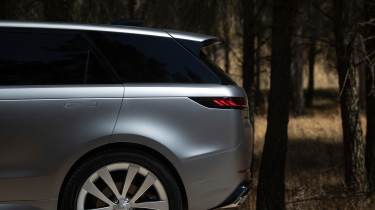
For the most dynamic Sport you’ll need to option the Stormer Handling Pack, which combines: Dynamic Response Pro, all-wheel steering, electric active differential with torque vectoring by braking and more bespoke configurable drive modes.
While the optional 23-inch wheels fill the wheel arches and provide the imposing look many want from their SUV, the 21 or 22-inch wheels and tyres are a better day to day fit. The former delivers a smoother, calmer ride and the latter blends the looks with very little sacrifice to the comfort. All season tyres are standard and remain quiet across all surfaces in all conditions, and having been designed and built to withstand JLR’s 70mph kerbstrike test, potholes are of little concern.
Interior and technology
It might sit below the full size Range Rover in the line-up but the Sport doesn’t feel second class inside. Interiors of the current models have been taken down the ‘reduction’ design route, with the only buttons the haptic type and found on the steering wheel – everything else is controlled via the central screen. It’s not as bad as it sounds, with JLR’s Privi Pro an intuitive system to use with quick processors, but physical controls for the heating and ventilation are missed because they could be used by touch and feel rather than having to divert your eyes to a screen for a moment to make an adjustment.
ADAS systems can be switched off by pre-programming one of the steering wheel’s haptic controls, the Terrain Response system now requiring you to use the screen. Once in there, the options available to you are comprehensive depending on the type of surface you find yourself on, from tarmac to mud, ruts and rock crawling. A 900mm wading depth is great for the UK’s winter floods, so too the car’s camera system that not only aids with parking but comes in very useful when tackling an off-road route or flood, the position of your front wheels visible via the screen.
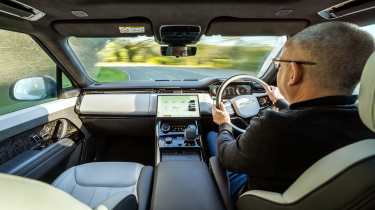
Comfort is core to the Sport’s interior layout, with front seat passengers catered for with seats that can heat, cool and massage you depending on your spec and budget, but the same commanding driving position is standard throughout.
Rear interior space wants for little, with stadium seating to allow those in the rear to see out over the front occupants, and once again if you have the budget you can enjoy the same seat functionality as those up front.
Controls in the boot allow you to drop the rear seats when loading, but if you’re opening the tailgate without the key to hand or via the interior control you need to use the external button located in the numberplate recess, so expect a dirty hand in winter.
Price and rivals
Entry to Range Rover Sport ownership starts at £77,620 for a Sport S D250 climbing to £121,270 for the P540 Autobiography. If you want a D300 you need to step up to a Sport SE that comes with a £87,010 price tag, the D350 is only available in Autobiography trim and costs £106,240. The plug-in hybrid petrol models start with the Sport SE at £91,910 for a P460e.
Rivals come from Porsche, with the Cayenne starting at £83,205 for a 348bhp six-cylinder petrol engine and ending with the £142,360 Turbo E-hybrid with 729bhp. While the Porsche has more of a dynamic remit, it lacks the refinement and comfort of the Range Rover Sport. BMW’s new X5 has just been revealed, with a range of plug-in hybrid six cylinder petrol engines destined for the line up that will include everything from regular SE trims to full blown M models.
Moving up the luxury scale is Bentley’s Bentayga. Offered with a mix of 4-litre twin-turbo V8 engines in two states of tune - 542bhp and 641bhp in the Speed - or a 3-litre six-cylinder petrol plug-in hybrid producing 456bhp, prices start from £155,555 for the standard car, rising to £265,000 for the V8-equipped Speed.