Mercedes-Benz S-class review – BMW 7-series rival majors on refinement if not thrills
Mercedes’ S-class endures, putting a magnificent case forward for the continued existence of old-school luxury limousines
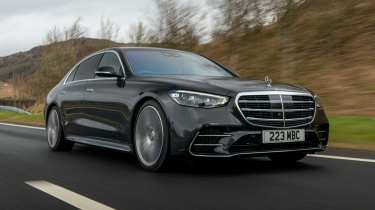
Mercedes-Benz - and plenty of others - has a long history of calling its S-class the best car in the world. Taking as read that there are horses for courses when it comes to cars, the S-class’s place as a standard-setting flagship, both in its class and as a vessel for introducing new technologies across all Mercedes-Benz vehicles, is well known.
Particular appreciation has been felt for the S-class over the last couple of years during this W223 generation, in light of Mercedes’ own attempt to usurp it with the hapless electric EQS. Even almost five years on from its 2021 introduction (not to mention almost 54 years since the breed was first introduced), it still strikes all the right notes, as we’ve been finding out.
Engine, gearbox and technical highlights
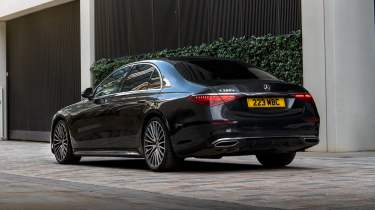
- Strong range of petrol, diesel and hybrid powertrain options
- PHEV models are c/250kg heavier…
- … but sport over 60 miles of claimed electric range
Due to Merc’s aggressive electrification strategy with the similarly sized, but completely separate and slightly limp EQS, it does without any all-electric variants, instead sticking with combustion-engined and plug-in hybrid models across the range. Though the next generation S-class is expected to feature an electric model that replaces the EQS.
More reviews
Reviews
- Mercedes-Benz S-class review – BMW 7-series rival majors on refinement if not thrills
- Mercedes-AMG S63 E Performance 2025 review – the most powerful S-class, but by no means the best
- Mercedes-AMG S63 Coupé (2014-2021): a lavish grand tourer for as little as £35,000
- Mercedes S560 Cabriolet review – drop-top S-class excels when focused on comfort
- Mercedes-Benz S-class (W222, 2013 - 2020) review - the best executive limo around?
- Mercedes-Benz S-class review - incredible levels of high-tech luxury
In the UK the engine line-up consists of six-cylinder diesel S350d and S450d, with petrol models including the S500 sharing the CLE53’s mild-hybrid six-cylinder and AMG’s 791bhp twin-turbo V8 plug-in (PHEV) S63 E Performance flagship. Bar the S63’s 4-litre V8, the petrols and diesel are all 3-litre engines.
| S350d | S450d | S450e | S500 | S580e | AMG S63 | |
|---|---|---|---|---|---|---|
| Engine | 3-litre turbocharged disel mild-hybrid | 3-litre turbocharged diesel mild-hybrid | 3-litre turbocharged petrol plug-in hybrid | 3-litre turbocharged petrol mild-hybrid | 3-litre turbocharged plug-in hybrid | 4-litre twin-turbo V8 plug-in hybrid |
| Power | 326bhp | 390bhp | 449bhp | 472bhp | 517bhp | 791bhp |
| Torque | 479lb ft | 553lb ft | 479lb ft | 413lb ft | 553lb ft | 1055lb ft |
| 0-62mph | 5.6sec | 5sec | 5.9sec | 4.7sec | 4.9sec | 3.3sec |
| Top speed | 155mph | 155mph | 155mph | 155mph | 155mph | 155mph |
Plug-in hybrid models include the S450e and S580e, utilising six-cylinder petrol engines working alongside an electric motor housed within the transmission, fed by a 28.6kWh battery. WLTP-certified electric range is in the region of 60 miles (59 at its lowest in the heaviest, long wheelbase S580e). However, full plug-in hybridity adds around 250kg to the S-class’s already sturdy mass. Indeed there hasn’t been an under two-ton S-class since the discontinuation of the W222. Regardless of engine, every model is fitted with the 9G-tronic automatic transmission.
All S-class models ride on an air-spring suspension set-up, with 20-inch wheels and tyres standard on UK models. Aside from the rear-wheel drive S350d and S450e models all S-Class models are fitted with 4Matic four-wheel drive. Rear-wheel steering is an option on higher-end variants and is especially useful on the longer wheelbase models.
Performance, ride and handling
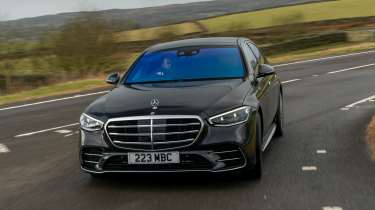
- Sumptuous ride is among the best there is
- Refinement almost second to none
- Far from the most dynamic or feelsome
Unlike its more raucous AMG applications, the S500L with its 429bhp (plus 22bhp from the mild-hybrid electric motor) straight-six is near silent on start-up, completely isolated from the cabin and is without any vibration, even when cold. Diesel-powered S-classes go about their business with a bit more of a throaty note, the S450d in particular commendable for its well of torque, all 553lb ft of it available from as low as 1350rpm.
On paper the S580e splits the difference between the petrol and diesel powertrains, with 553lb ft also available but delivered by a more refined petrol six-cylinder and its in-transmission electric motor. Plumb the S580e for its potency at low speeds and you’ll lunge away in a manner you wouldn’t expect for a c2.5ton limousine, the instant electric torque shortly joined by a 368lb ft punch from the petrol engine from 1600rpm. The spec sheet says 62mph arrives in 4.9sec in the S580e and we’d well believe it. It’s only 0.1sec quicker than the lighter S450d, mind. In the S350d and S450e? A relaxed 5.6sec and 5.9sec respectively.
Where the S580e isn't as strong as the more torque-rich diesel models is in-gear, high-speed acceleration between 50-70mph. Here, unlike from a standstill, you don’t have the instant punch of the e-motor to augment, so a plunge of the throttle pedal has S580 not responding as you're perhaps expecting for a car boasting 517bhp and 553lb ft of torque. The flip side? The versatility of being able to switch off the petrol engine altogether as soon as things get remotely urban, safe in the knowledge you’ve a healthy reserve of silent mileage left in that 28.6kWh battery.
Though a more obvious way to dictate whether you want electric, hybrid or combustion power would be appreciated. As a default setting, S-class PHEVs will start in electric mode from rest until their battery is depleted, regardless of whether you’re in a city (suitable) or on a motorway (not so much).
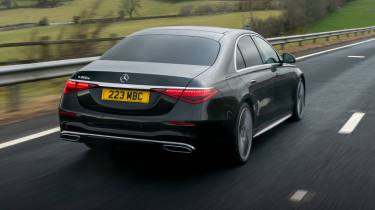
Its 9G automatic transmission is superbly smooth and very well calibrated across the board, switching between all nine of its ratios imperceptibly in smooth running. As with all S-classes, the W223, whether in hybrid, diesel or petrol form, isolates its occupants from the outside world with standard-setting skill. Spend any time in a current Range Rover and you’re left wondering whether luxury saloons really should be usurped by high-riders, for refinement and comfort. Time back in an S-class proves that guilty suspicion to be hogwash.

Make sure your chosen S-class is on the standard 20-inch wheels, though. On the 21s the S500’s ride is just too brittle, all too easily finding small bumps and ridges in the road and transmitting them into the cabin. It’s quite an odd sensation, as the air springs are capable of settling the ride on longer strokes brilliantly, creating that enviable floating sensation, only to be undermined by unwelcome noise from small bumps, vibrations and thuds as 2.3 tons of luxury saloon transfers through a 35-section tyre sidewall.
It’s worth noting too, the extra weight of the plug-in hybrid system seems to see S-classes so-equipped being more eager to explore the length of those damper strokes over undulations and the rear wheels (behind/on which the battery sits) more eager to transmit thunks over high-frequency impacts. Body control, refinement and an overall sense of dynamic cohesion are mildly better in the lighter, conventionally-powered models.
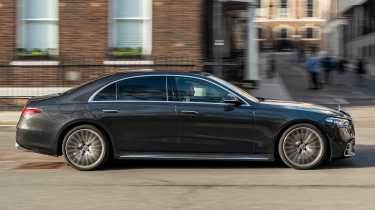
Something the S-class isn't in general, is sporty, which is rightly to be expected of something with such a clear mandate to cosset, soothe and transport in ultimate luxury. Try to pick up the pace and the S-class won’t hold itself with as much poise as a BMW’s 7-series, to the point it’ll actually go beyond feeling ‘uncomfortable’ and instead close in on ‘slightly nauseating’. With a French assassin at the wheel, we’d suspect Ronin’s famous car chase would have ended rather more hastily. Slow things down and the S-class will quickly return to its comfort zone.
Typically, feel has come at the expense of this deep isolation, so there really isn’t much thrill of driving to be had from behind the wheel. But while this might not appeal to evo on its usual metrics, the S-class's sophistication is deeply impressive nonetheless.
The S63 comes with the full battery of ride control, roll stabilisation and rear steering tech to make a more dynamic, responsive S-class – as you’d expect of an AMG. What it also does, is nudge out some of the refinement, leaving you asking what the point of the full-fat version is.
Interior and tech
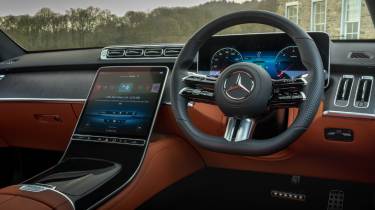
- Soft, supportive seats are more like luxury chairs
- Material quality good on the whole
- UI is intuitive once you’re used to it, though the haptics are infuriating
The S-class’s tech is of a very high standard even four years on from launch, highlighted by an intuitive (if daunting at first) infotainment system that’s since spread across to the CLE, SL and AMG GT. Navigating its various functions is a relative doddle and smartphone connectivity is near flawless, with Android Auto and Apple CarPlay.
Not so flawless, the steering wheel, which while nice to hold and decent quality in feel, is lumbered with haptic controls. As trivial a task as changing a song is a hassle to the point of distraction from the actual job of driving.
It does some simply brilliant LED headlights, and a clever three-dimensional digital instrument binnacle that, although little more than a gimmick, does bring some distinction to an element now common within most new cars.
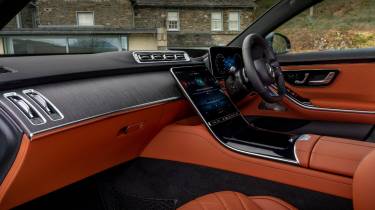
Quality from Mercedes interiors of late has been mixed, with cars such as the CLE featuring plastics that get a bit too creaky as the car traverses bumps. The E-class using fewer separate components, feels more solid. The S-class? Better than the CLE, not as solid as hyperscreen-equipped cars like the E-class.
That said, the customised Manufaktur spec of our S580e test car was hilariously opulent, including Amaretto Brown leather (almost orange) and open-pore walnut wood trim, replete with aluminium lines, like the decking on a Monegasque speedboat. That couldn’t save us completely from the glossy plastics Mercedes interiors often feature, the waterfall of piano black below the infotainment screen remaining.
Perhaps obviously, space is a luxury an S-class always affords you, especially in long-wheelbase trim. Beware the plug-in hybrid however, given it robs you of a full 190 litres of boot space (down to 350 litres from 540 litres). That’s more than an MX-5’s boot space (not saying much admittedly) lost to battery storage and one we felt directly during a suitcase-laden airport run.
MPG and running costs
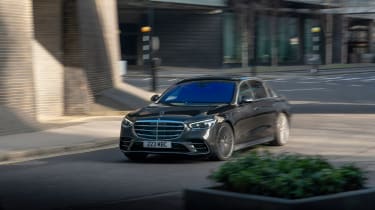
- The best S-class for you depends on use case
- PHEV best for mixed/city driving thanks to usable range
- S450d is the 40mpg+ motorway star
In our testing the S580e delivered reasonable mileage from its 28.6kWh battery – 40 miles is perfectly achievable in mixed driving. If you run it down and don’t charge it, the 367bhp straight-six will slurp through unleaded at a notable rate. 30mpg over an average to brisk journey will be an achievement. Regularly charge and manage your use of the electric element effectively and the PHEV makes an awful lot more sense.
It’s about your use case. Got a driveway, room for a home charger and spend a lot of time in cities? The S580e or indeed the S450e make sense (the latter is reasonably sluggish, mind). Do plenty of motorway miles? The S450d is the one to go for, capable of delivering real performance when called upon, then 40-45mpg (indicated) once you’ve settled to a cruise.
Price and rivals
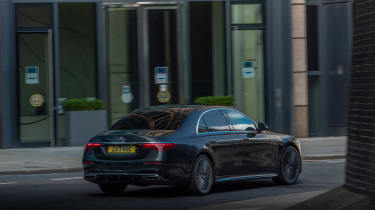
Overall, driving the Mercedes-Benz S-class really is a sumptuous and at times fascinating experience. Driven by metrics of ultimate comfort, the S-class is still in a class of its own this side of something built in Crewe or Goodwood. Just ensure it’s not on the big wheels.
Price is a thorny subject. No S-class currently available costs less than £100,000, the S350d L AMG Line Premium starting from £100,390. The caveat is that only long-wheelbase cars (originally £4000 more than SWB equivalents) feature on Mercedes-Benz’s UK configurator at the moment, as Mercedes prepares to launch the 2026 update. The S450d L is priced from £105,785, the S450e L from £111,685, the S450d L from £112,580 and the S500 L from £112,895. S580e jumps to a £119,390 starting price.
Premium Plus specification adds tech such as the 3D driver display, active ambient lighting, Burmeister sound system and head-up display. You also get the Multicontour seats, with active bolsters for support in corners and the massage function. Go all the way to Premium Plus executive in LWB spec and you’ll get electric sun blinds for the rear windows, a footrest on the back of the passenger seat and the Chauffeur Package, allowing the front passenger seat to fold forward and the headrest to be removed. In other words, ‘Dua Lipa’s ride to the Brit awards’ spec.
In terms of rivals, the BMW 7-series remains a key competitor that is both less comfortable but marginally more together to drive at a higher pace. Bentley’s Flying Spur is better to drive too but incredibly, is marginally less refined in terms of ride. Its cabin is a bit last-gen too, albeit in that deliciously stately way only Bentley can carry off. The Range Rover really is a great alternative too, that delivers if not thrills, a serene satisfaction behind the wheel. You can still configure an Audi A8 but this generation of Ingolstadt’s luxury limo is not long for this world. Where comfort and luxury are concerned, the S-class is still at the top of the game.
Is it still the best car in the world, though? Obviously it depends on your priorities, but regardless where ours are usually concerned, it remains an outstanding example of the modern motor car. The big diesel on small 20-inch wheels, please.