Peugeot 205 GTI (1984 - 1995) review – who needs the original VW Golf GTI?
The 205 GTI is as unmistakable to drive as that silhouette is to look at. Doing so should be a rite of passage
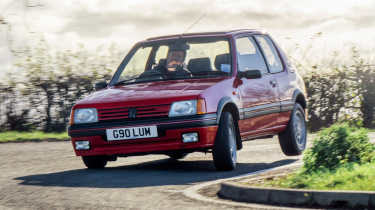
In with a shout of being the first hot hatch in the form we came to know, adore and now sorely miss, is the Peugeot 205 GTI, in both its 1.6 and 1.9 forms. Yes, the Mini Cooper S dates back to the 1960s, Abarth’s mad machinery to the 1970s, and there was a whole slew of models – Alfasud Ti, Simca 1100 Ti, Renault 5 Gordini – before the first car to go so mainstream that it took widespread credit as the first hot hatch, the Golf GTI, arrived in 1975.
But the 205 GTI was a watershed moment and a defining model of the increasingly performance car-crazed decade that was the 1980s. So performance car-crazed that a magazine by the imaginative name of Performance Car was launched to offer insight on them all. We’ve spent a lot of time back in 205 GTIs recently – a 1.9 for our 1980s evo Eras test in 2025 and a 1.6 for our retro French hot hatches test in 2026. Refamiliarisation has affirmed the GTI’s legend status.
Peugeot 205 GTI history
The 205 GTI launched in 1984, almost a decade on from the fabulous Golf of the same badge – that badge boastful that, yes, this was a car that featured fuel injection. The 104bhp of the original 1.6-litre model doesn’t sound like much, but the fact it was only charged with shunting 850kg up the road meant the 205 GTI was a brisk device, especially by mid-1980s standards. The 0-62mph sprint took a spritely 8.6sec on the way to a dizzying 120mph – that really is dizzying in a car as diminutive and minimalist as the GTI.
More reviews
> New Peugeot 208 GTi – all you need to know about the Alpine A290 rival
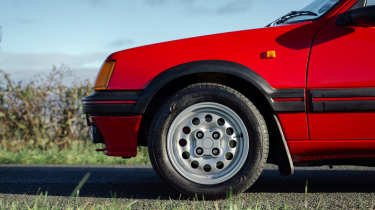
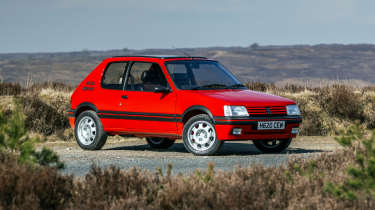
Few cars possess the timeless perfection of a Peugeot 205. Especially a 1.6 GTI on pepper pots. It’s a common misconception that Pininfarina designed the iconic hatchback, but it was the brilliant work of an in-house team. The exterior design was overseen by Gérard Welter, whose side-hustle was designing the bullet-fast WM Group C Le Mans racer that hit an all-time record 252mph along the Mulsanne Straight in 1988. The interior is by the legendary Paul Bracq, father of the Mercedes-Benz 230 SL Pagoda, first-generation BMW 3-series, 6-series and 7-series, and the influential BMW Turbo concept car, before joining Peugeot to oversee interior design.
It’s a mark of Welter and Bracq’s work that the 205 is one of the few cars that has never gone through a period where it has looked old or awkward. Today its perfect proportions, pert form and delicate details are as fresh as the day it was unveiled at the 1984 Geneva motor show alongside the production version of the 205 T16 street car. These were glory days for Peugeot.
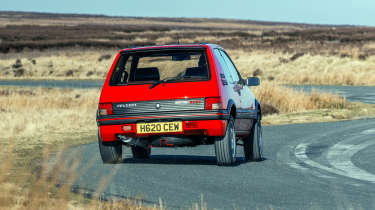
Of all the ’80s French hot hatches, the 1.6 GTI seems the most ubiquitous. It was certainly extremely popular in period, its numbers bolstered by the introduction of the more potent 1.9 towards the end of 1986. How Many Left confirms they remain a stalwart of the UK hot hatch scene, with some 1152 taxed and roadworthy 1.6 and 1.9s at the end of 2025.

Power steering wasn’t offered as an option on the 1.6 until late 1989, and this car does without. That’s a bit of a shame because the assisted rack was significantly quicker at just over three turns lock-to-lock compared to just under four for the unassisted version. I prefer power steering because it gives the 205 a responsiveness and lightness of touch that matches its looks and build, but the manual rack isn’t a deal-breaker. You just need to adjust your driving style a little. It has a combination of discs and drums for brakes, with no ABS, but with such a light kerb weight, 205s aren’t cars that need big brakes.
The 1.6’s power output was increased to 113bhp in mid-1986 thanks to a revised cylinder head and camshaft. The same year also saw the arrival of the stroked-out 1.9-litre GTI, its 130bhp dropping the 0-62mph time to 7.6sec and increasing the top speed to 124mph. Other driver-focused versions of the 205 appeared too, most notably the stripped-out Rallye with just 75bhp from its 1.4-litre engine but only 795kg to lug along. Meanwhile, phase 1.5 GTIs from 1989 onwards got an updated dash with rotary controls rather than the original sliders, along with a few exterior tweaks.
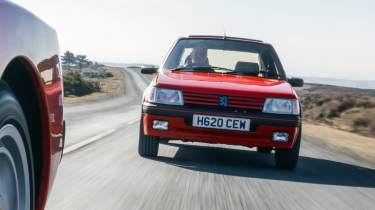
It’s the 1.9 GTI that’s remembered most famously as being the hot rod of the family, but connoisseurs know the 1.6 as the more responsive, eager engine to whip up and down the tacho with the throttle. Whichever GTI you get, you’re in for a riot (and a challenge) as it’s not of a hot hatch type that would follow years later, led by excess power and a wandering front end. Rather it was a lythe, mobile device, sometimes too eager to rotate around the driver should they lose confidence in their throttle application at pace.

Such was the volume of incidents involving GTIs, and affordable performance cars in general, that skyrocketing insurance costs all but snuffed out 205 GTI sales into the 1990s. The 1.6 was phased out in 1992, with the 1.9 given a stay of execution by fitment of a catalytic converter, until its discontinuation in 1995.
The shots of adrenaline into the brains of those who came to know the 205 GTI years ago are what burned it so indelibly in hot hatch and performance car lore, and why it enjoys the stature and status it does over 40 years on.
Driving the Peugeot 205 GTI 1.9 – Peter Tomalin, evo contributing editor

‘Details betray the Pug’s age – bolts and fixings visible through the grille, the rudimentary cradle for the spare wheel under the tail. The design inside is pleasing but some of the plastics clearly rather low-rent, and the seating position is a little high, the wheel a little low. Yet once underway none of this matters because it takes only a few miles for the 205 to get completely under your skin.

‘The gearstick is long and shaped like the business end of a golf club, the throw longer than that of any modern hatch but actually fingertip-light at speed. The steering (power-assisted on this car) is hyper-alert, with little slack in the chassis’ responses. But the ride is again supple, there’s lean into corners and you can just sense it start to pick up the inside rear wheel. It doesn’t take much imagination to know that if you overcooked it and then bailed out it could get interesting. ‘Very much a dry weather car,’ is Barker’s view.
‘The steering’s power assistance is subtle, but according to evo editor-at-large Richard Meaden it makes it a much better car. “The ones without power steering are horrible,” he grimaces. In the ’90s he co-owned a GTI with Performance Car/evo regular Roger Green.
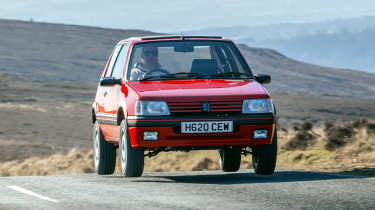
“It’s fun getting back into one of these again. It all came back – the tall, slightly wobbly gearlever and the resistant, slightly notchy feel; the slightly spluttery-sounding idle, and the little bit of low-speed shunt – we forget it was still early days for mass-produced fuel injection.”
‘“Never driven one before,” says senior staff writer Yousuf Ashraf. “Everything about it feels light and crisp and positive. You don’t think about the controls too much, you just get on with the job of thrashing it, and it seems to love that. You’re not going quickly but it feels like you are. Like the MR2 it’s quite soft, but you use the weight transfer to help the flow. It’s a lot of fun.”
‘The 205 has that terrier-like quality that infects all the best hatches and would see it snapping at the heels of supposedly sporting coupes and roadsters. Back in the ’80s this would have been an MGB or TR7 driver’s worst nightmare.’
Driving the Peugeot 205 GTI 1.6 – Richard Meaden, evo editor-at-large
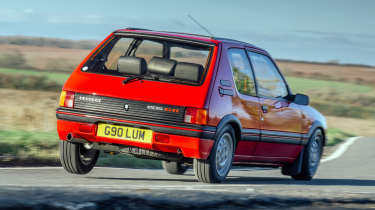
‘The art of hustling the GTI is maintaining momentum, so the last thing you want to do is jump on the brakes unless you absolutely have to. Pick your lines, snap clean upshifts, read the road, feel the car working and gauge its reactions.
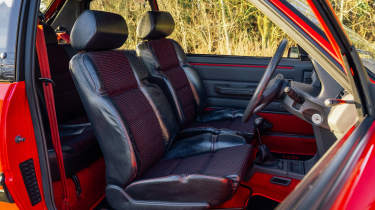
‘You sit a bit high, and as there’s little adjustability you have to get yourself approximately comfortable and then mould yourself around the car. The A-pillars are chopstick thin, which is great for visibility but betrays why these cars are so light. The shallow dash and thin door cards place you at the car’s extremities rather than centred safely within a passenger cell. It was acceptable in the ’80s.
‘Like all 1.6 GTIs, a dry run through the H-pattern gate suggests the shift will be a bit wonky, but there’s magic to be had from stirring that long lever around. It really is deliciously slick, with back and forth or cross-gate shifts as snappy as you like. Best of all it’s just as smooth when you’re going at a more relaxed pace.

It all adds up to a hot hatch that’s got an extra layer of sophistication and refinement. Not enough to mask its brilliance, and very different from the Golf GTI’s Teutonic solidity, but enough to position the 205 as more of a sophisticate.
‘Not that this came at the expense of performance. Even allowing for a slight and uncharacteristic hesitancy at the top-end, this GTI zips along nicely, the distinctive XU engine note providing a peppy soundtrack as we barrel along some of our favourite local roads.
‘It may not be fast, but it pays to remember this car has no driver aids, a liberal attitude towards lift-off oversteer, and the crash safety of a wet paper bag. This means you leave much greater margins. It’s more about fun and flow than reaching the absolute limit, so you focus on finding a different groove. It’s strangely freeing to be in a car which gives so generously from low speeds and can be driven quickly without anyone taking offence.’
Peugeot 205 GTI buying guide
Those who are familiar with most performance cars of the 1980s know that, for their simplicity, they are mechanically sturdy (generally speaking). They also know that almost the opposite is the case when it comes to their chassis and bodywork, though the 205 GTI, with its partial galvanisation, is at least somewhat harder-of-jaw.
Nonetheless, the boot floor, brake pipes, inner wings, footwells, doors, roof and under the seats warrant close inspection for tinworm. Look around all the window seals (and the sunroof if applicable) for leaks, too. Many years have passed and the rate of attrition for ratty, poorly maintained 205 GTIs has slowed to a crawl. The cars that remain tend to be well cared for – straight, rust-free, and dutifully and diligently repaired.
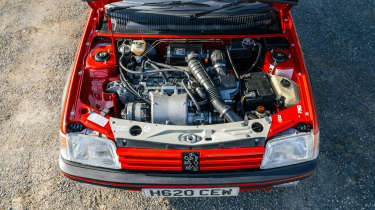
As we found in our tests, the GTI’s engines, with their early fuel injection, can come across as lumpy and choppy, especially by comparison to the almost imperceptible, sewing machine-like operation of some modern petrol engines. Most of the time, however, this is natural.
If it’s really choppy or smoky, some tinkering or a deeper dive into the engine may be required for valve stem seal replacement. Best sure to test drive your chosen example, get a good feel of the steering and gearshift and listen out for untoward clunks that could be indicative of component wear that needs attention.
Such is the 205 GTI's cult classic status that preparers and restorers and restomodders have long been in the game of perfecting the GTI. Tolman for instance will prepare immaculate cars with 193bhp 1.9-litre engines, among other choice upgrades. If originality is your desire, none do it better than AutoRARA, who prepared the simply stunning example featured in our test.
Peugeot 205 GTI values and specs
Values are a huge point of conversation around 205 GTIs. There’s a reason Tolman saw a business case in £125k restomods. Nonetheless, 205 GTIs are still mostly within reach. A passable 1.9, with higher miles and in need of a bit of TLC, will set you back in the region of £8k-9k, while an absolutely immaculate, low-miles car will get up over the £30k mark. The 1.6 ranges from £6k to £26k respectively.
What could you have instead of a 205 GTI? At the time in the 1980s it had the Renault 5 GT Turbo and Citroen AX GT to face off against. Very much in the image of the 205 too was the 106 Rallye and GTI of the 1990s and early 2000s. Lightweight, foursquare of stance and mobile of tail, it’s the spirit of the 205 faithfully transposed onto (slightly) more modern bones, and for less cash too.
The original Golf GTI as well as the Mk2 aren’t considered to be quite so up for a bit of rough and tumble as the old Pug but are still worthy, if pricey, alternatives. Just don’t go down the 206 GTI route, we beg of you…
Peugeot 205 GTI specs
| Peugeot 205 GTI 1.6 | Peugeot 205 GTI 1.9 | |
|---|---|---|
| Engine | In-line 4-cyl, 1580cc | In-line 4-cyl, 1905cc |
| Max power | 113bhp @ 6250rpm | 130bhp @ 6000rpm |
| Max torque | 99lb ft @ 4000rpm | 121lb ft @ 4750rpm |
| Weight | 850kg (135bhp/ton) | 910kg (145bhp/ton) |
| 0-62mph | 9.1sec | 7.6sec |
| Top speed | 121mph (claimed) | 125mph+ |
| Price new | £6245 (1984) | £9930 (1988) |
| Value now | £6k-£22k | £8k-£25k |