Skoda Superb review – an excellent excuse to avoid buying an SUV
The Superb continues to do what it always has: punch above its weight and offer compelling value for money

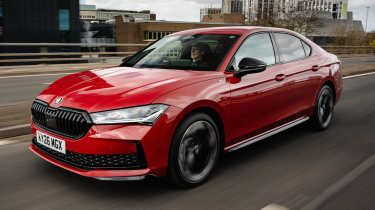
The evergreen Skoda Superb remains a pillar of familiarity in a market that bears little resemblance to the one it waded into on its 2001 debut. The repmobile space below the usual German exec suspects is virtually barren, with the Ford Mondeo, Vauxhall Insignia and Peugeot 508 now consigned to the history books. The Superb’s VW Group sibling, the Volkswagen Passat does hang on in the UK in estate form only but the big Skoda is still sticking around at a party that’s largely over.
For now the model that continues is traditionally handsome, with an upmarket yet inoffensive design and an attractive, well-made cabin that lend it great appeal - so too does a strong and varied range of powertrain options. As seems to be the case across the industry, the Superb’s pricing isn’t the bargain it once was, the starting rate having risen to over £36,000. That we don’t think this should put you off speaks to the quality of the product.
Engines, gearbox and performance
- 1.5-litre TSI plus a range of 2-litre petrols, diesels and PHEVs
- 261bhp EA888 the most ‘evo’ option
- 268bhp PHEV new for the range
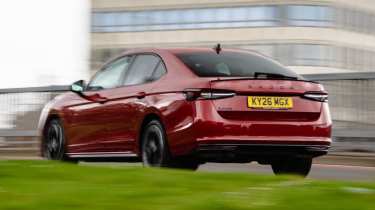
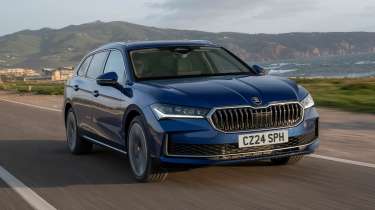
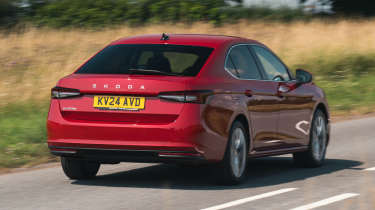
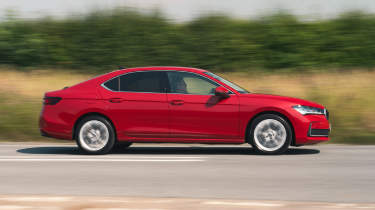
The B9 Skoda Superb arrived in 2023 based on the same MQB Evo platform as the Volkswagen Passat. Unlike the Passat, the Superb can be ordered as a saloon-shaped hatch, as well as an estate. Superb is an enduring nameplate in tumultuous times and the versatility of the engine lineup - the variety of choice - is similarly reassuring. Basically, there’s a Superb to suit all use cases.
More reviews
At the base of the range, there’s the mild hybrid 1.5-litre TSI four-cylinder with 148bhp. We’ve tried this engine in the Passat and it’s not the limiting factor you’d imagine, thanks to the car’s relatively low kerb weight. There’s also a 2-litre available in 148bhp and 190bhp forms, for the long motorway haulers, and a 2-litre petrol in 197bhp and 262bhp forms. The latter is the closest you’ll get to a Superb ‘vRS’, as this is effectively the Octavia vRS engine.
The plug-in hybrids are the most appealing to the broadest variety of modern buyers, whether personal or through business. They use the 1.5-litre engine in concert with an electric motor and a hefty 25.9kWh battery for 197bhp or 268bhp in the range-topping version.
The latter is the most powerful Superb you can buy, but still not as powerful as the previous B8-generation Superb with the 276bhp version of the EA888 four-cylinder turbocharged engine. Such a massive battery brings an impressive claimed electric driving range of 79 miles. The downside of course is that so equipped, the Superb is 400kg heavier than the 1.5 TSI model.
If you want performance and response, the basic 1.5 won’t blow you away, with a 0-62mph time of 9.3sec. Nor the basic diesel, which isn’t much quicker at 9.2sec. The PHEV, even though it’s more potent, takes 8.1sec, the extra weight sandbagging it, with even the 268bhp PHEV taking 7.1sec. The more potent diesel and the basic 2.0 TSI are both good for the sprint in 7.5sec while the most potent petrol manages a genuinely quick 5.7sec.
An obvious aid for the more powerful petrol and diesel motors is their standard-fit four-wheel-drive system. All Skoda Superbs utilise a seven-speed dual-clutch DSG transmission, the B9 dispensing with a manual option. This causes no great stress, given the DSG is a competent ‘box, if occasionally stuttery at low speeds. Only the most potent TSI will bother the 155mph limiter too, with the most powerful diesel managing 147mph and the rest of the range topping out under 140mph.

None in the Superb’s engine range will set your soul alight. Nonetheless, the 1.5 TSI is a perfectly pleasant engine to exercise. Just as well, given it needs stretching out to develop any meaningful pace. If you’re going for the diesel, it’s got to be the more potent one, so at least you get more performance and all-wheel drive. That said, the lesser car is only 30lb ft down on torque at 265lb ft, so low-down urgency isn’t lacking in either.
The extra electrified performance you get in the PHEVs isn’t particularly dramatic compared to a standard 1.5 thanks to the extra weight. All the same, the little extra urgency low-down is nice to have. It won’t surprise you to read that the most natural, full bodied-feeling engine option is the 262bhp 2-litre. Not the most soulful, but well rounded and above average in its musculature, and our choice from the range.
Ride and handling
- Drives with poise and decorum above its station…
- … even if it’s not a thoroughbred thriller
- You can’t have a PHEV without DCC, and that’s a good thing
The Skoda Superb is a comfortable and cossetting car by and large. Even in its sportiest configuration (the 262bhp engine) on its 19-inch wheels, with the Dynamic Chassis Control set to its punchiest, the Superb is never overly hyperactive or flustered. At pace the Superb isn’t exactly the last word in body control, or absolute composure but back in its comfort zone, stroking along keenly, whether on a swooping A-road or a motorway, it’s a car with refinement and ride above its station.

That goes for both suspension set-ups too. Obviously, the DCC that’s standard on Sportline trim and above broadens its window of capability, especially when it comes to control on tougher roads at higher speeds, but all Superbs are comfortable everyday cars.
What is somewhat telling is that you can’t actually spec the heavier plug-in hybrid in SE L or SE L Technology forms, or in other words, in the trims where DCC isn’t standard. Indeed, it’s the hybrid with its heavy battery that puts the DCC system to the test the most, and presents the biggest challenge to the Superb’s otherwise sturdy demeanour beyond simply driving it like an ape. The combustion-only cars are sweeter across a broader variety of routes.
There’s not much to be said for the steering. It does the job without offering striking feel or response, or indeed offending with any kind of untoward sponginess, elasticity or rumbles. It feels premium and is at its best when in its ‘normal’ setting, with the more dynamic Sport mode simply adding weight, rather than upping the positive sensations.
MPG and running costs
- The PHEV is a revelation, with outstanding electric range and strong efficiency
- However, it’s too keen to run in EV mode all the time
- All Superb engines are relatively efficient
You’d hope that there’s not really such a thing as a Skoda Superb that’s a gas guzzler, but get the most powerful TSI and plumb it for all its 262bhp and you’ll get through unleaded at a reasonable rate.
The issue comes when driving more sedately. In part due to the AWD system, the 40mpg you can get close to with this engine when it’s in Cupra Leons and Golf GTIs isn’t really possible in the Superb unless you’re hypermiling on a long run. Make faster progress and averages will be closer to 35mpg. The 1.5 TSI and the lesser 2-litre vary a lot in thirst depending on how they’re being driven, but even the 2.0 should return over 40mpg when you’re being sensible.
If you’re doing plenty of motorway miles, it’s the 2-litre diesel that’ll serve you best, returning between 45 and 55mpg. The more powerful version will be closer to 45mpg, again due to its AWD system. The lower power model, turning only the front wheels, is the one for the hypermilers.
The PHEVs are astonishing in their versatility, with their 79-mile claimed electric range. We saw around 60 miles from a charge in mixed driving, which still makes it effectively usable as an EV for most of the time. If your week’s journeys are short, you won’t be troubling the 1.5-litre TSI engine much.
What’s not so great is how it manages its electrical energy for longer journeys, still always prioritising electric power rather than conserving it more intelligently for the right moments. You don’t want to necessarily be chewing through battery charge at motorway speeds, knowing you’ve got an urban stretch at the end of your journey.
Find yourself in town without any kWhs to spare and the car will juggle the two powertrains to the point of irritation, the engine springing into life repeatedly as your electric range dances between 0 and 1 mile. Better to set the powertrain to sport when on long runs and keep the combustion engine in play. And don’t buy the PHEV if you can’t plug in at home, or at least at work.
Design interior and tech
- Good-looking inside and out
- Great ergonomics, good quality
- Spacious and practical
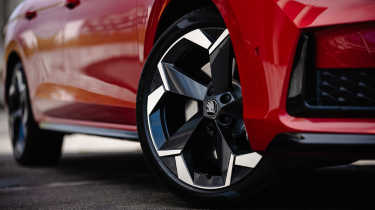
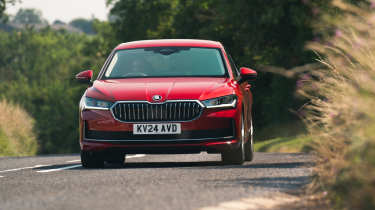
Design slogans tend to be on the wrong side of cringeworthy but ‘Modern Solid’ is an entirely accurate way of describing the Superb. It’s not as traditionally handsome as the B8 before it but it’s still a fine, regal-looking thing, with a premium presentation above its station. Something the Superb has always managed. All the same, the Passat probably looks a bit more svelte.
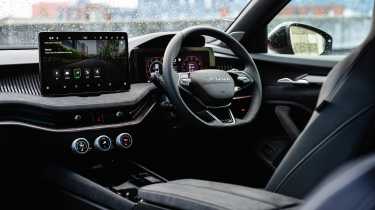
Inside is where things get really impressive, however. Frankly, VW itself Audi and even Porsche, could learn a thing or two. Parts of the Superb’s cabin are a stroke of brilliance, with tactile physical controls, impressive ergonomics and strong material quality. The steering wheel is missing its central spoke, but eschews any infuriating haptics for proper buttons, and even nice high-quality scroll wheels. Yes, the 13-inch touchscreen is familiar but the Superb doesn’t hide its climate controls within it. Rather, a trio of rotary ‘smart dials’, with screens inside, make adjusting the climate both intuitive and even enjoyable thanks to their tactility.
The seats are comfortable and the materials across the cabin are strong in terms of quality. That being said, the top-spec Laurin & Clement trim does cost a bit too much compared to other models without a commensurate bump in quality and appointment. The SE L we tested was pleasant enough in terms of its trim and kit levels, though the slightly more supportive seats add appeal to Sportline models.
What’s worth bearing in mind is how much boot space you need, as with the battery placed under the boot floor, the PHEV models give up 180 litres on the 690-litre non-hybrid estates. That said, 510 litres is still decent for a PHEV.
Price and rivals
The Skoda Superb range starts from £36,800 for a bottom-spec 1.5 TSI SE. The estate version is £38,135. The most expensive L&K 272PS iV Superb costs from £50,345 in hatch form and £51,390 for the 2.0 TSI estate. At the time of writing, the 272PS iV was not available in estate form. Our advice is to be sure which Superb best fits your use case.
Rivals? As we said above, the traditional repmobile is largely dead. Volkswagen’s Passat is a more expensive but well-equipped estate alternative, from £40,875. BMW’s 3-series offers superior driving dynamics, from £44,625, though that is for the 180bhp 320i. The Mercedes CLA, while nowhere near as practical, can be had for Superb money too, in both saloon and Shooting Brake form too.