The Toyota GR GT is Japan's answer to the Aston Martin Vantage
Toyota has revealed its highly anticipated flagship V8 super GT, and we’ve spoken to the team behind its creation in Japan

We’re certainly not short of hypercars in the 21st Century, but the introduction of a brand new supercar designed from the ground-up by the world’s largest car manufacturer is a rarity. Unheard of in fact. That’s what makes this moment particularly significant, with Toyota Gazoo Racing unveiling its all-new flagship GR GT. Revealed at an exclusive event held at the Fuji Speedway in Japan, I sat down with the engineering team responsible for the car to hear all its secrets (and its new V8).
Until recently, this car was little more than an exotic prototype with only the internet rumour mill suggesting what it was. An official, albeit camouflaged, outing at this year’s Goodwood Festival of Speed further stoked the rumour mill, but Toyota remained typically tight-lipped as to precisely what we were looking at. Now, all has been revealed.
> Toyota GR GT3 racer launched to battle Ferrari's track-only 296
As is immediately clear, this is not a car that follows the typical supercar formula. Developed by Gazoo racing (hence GR GT), it was developed as a ‘race car for the road’, and while this phrase is thrown around an awful lot these days, the GR GT takes this quite literally. An FIA GT3-spec variant has been launched alongside the road car, with both developed in tandem to optimise the development of the road as its racing sibling took shape.
Initially the suggestion was that the camouflaged prototypes were development mules for the spiritual successors to the Lexus LFA, but Lexus also revealed the all-electric ‘LFA concept’ within earshot. So that’s two new supercars confirmed from Toyota in a week...
Engine, power and top speed
As if a new supercar wasn’t exciting enough, this is one not with a battery and two electric motors, but a brand new V8 instead. Yes, Toyota really has developed a new V8-engine from the ground-up in 2025, using the architecture from its incoming 400bhp 2-litre G20E as its basis. While in simple terms this new V8 is effectively two of those units combined, this doesn’t result in it generating twice the output. Toyota’s quoting ‘more than’ 641bhp and 627lb ft of torque. For now.
All of this power doesn’t come from the internal combustion engine alone, for Toyota has developed an electric-hybrid element for the GR GT, although it’s not a plug-in. A battery is mounted high behind the seats (for weight distribution) and powers a single motor nestled within the powertrain for torque fill. There's also a new eight-speed wet clutch transmission developed specifically for this car.
What the hybrid assistance doesn’t do is provide any electric driving range, as per Porsche’s 911 Carrera GTS T-hybrid. With development headed by Akio Toyoda - yes, ex-CEO and chairman of Toyota - unsurprisingly the N24 racer insisted that the road car of his new race car be a pure driver’s car with power sent to the rear wheels only. This puts the GR GT in an increasingly rare class, and directly up against the likes of the visually more subtle, similarly powerful, rear-wheel drive Aston Martin Vantage.
Despite the hybrid assistance, the way in which this system is integrated makes it near-impossible to convert the GR GT to all-wheel drive in its current configuration, with packaging constraints to blame. The hybrid system is not capable of running the car in a full-electric mode either, not that many will be overly concerned about either of these factors.
Final performance figures are still under wraps for now and while the ethos of this car puts driver engagement over numbers, it’s still capable of at least 199mph according to Toyota. Power-to-weight stands at 372bhp/ton, marginally down on the 393bhp/ton Aston Martin Vantage.

Design and aerodynamics
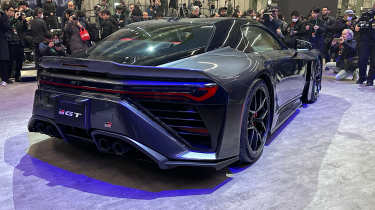
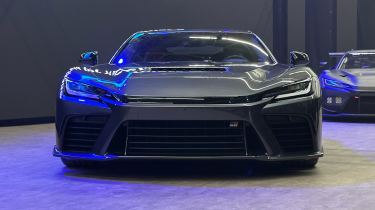
The GR GT’s bold design follows function over form, with its aerodynamics and cooling optimised and incorporated into its final design. The result is an exotic silhouette and the kind of long-nosed, bluff-windscreened, ultra cab-rearward super GT design I haven’t seen since the days of the Mercedes-Benz SLS and Dodge Viper. You could land a plane on the bonnet and I’m not sure you could get any closer to sitting on the rear axle unless you sat in the boot.
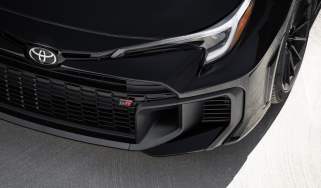
There are elements of Dodge Charger in its front end, but the relation to the rest of the GR lineup such as the Yaris and Corolla is very clear, with the surfacing and lighting units tying in with other members of the GR family. What is abundantly obvious is the lack of overt aero devices, active or otherwise. Toyota tested the GT with fixed wings and more complex aerodynamic solutions, but that a sleek setup with a ducktail spoiler worked best for the aero balance and targets they were looking to achieve.
This is not a small car. I might have suggested it compares to the AMG SLS, but the GR GT is a whole 18cm longer, 6cm wider and 6cm lower than the gull-winged icon, giving it a genuine sense of presence, almost muscle car like. Japan and the US are car’s key markets, but it will come to Europe and the UK, the latter might requiring breathing-in on some of our tighter roads.
Chassis and technical details
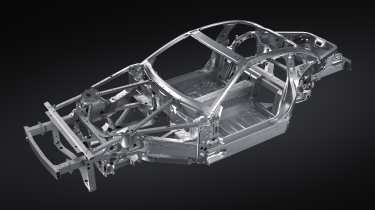
Developed alongside the GR GT3 and all-electric LFA concept, Toyota’s new supercar features its very first body frame constructed entirely from aluminium. While it does feature more exotic carbonfibre reinforced plastic components and bodywork for rigidity and weight savings, this basic aluminium architecture makes it a much more accessible car than the V10-powered LFA with its expensive carbonfibre monocoque; Toyota said cost to the customer and ease of manufacturing was a key consideration.
It’s rigid, then, but while there has been plenty of attention paid to keeping weight to a minimum, it’s not light. Even with power to the rear only and a hybrid system smaller than most, weight stands at 1750kg ‘or less’. Put it into context of models like the smaller and less-complex Mercedes SLS and it’s only 80kg heavier and a new Aston Martin Vantage that comes in at 1670kg.
Suspension is double wishbone front and rear, with 20-inch wheels (very similar in design to the BBS F1-R) wrapped in 265/35-front, 325/30-rear Michelin Pilot Cup 2 rubber developed specifically for this car. Behind those wheels are huge carbon ceramic brakes from Brembo. To extract the absolute most from its tyres, the GR GT features a derivative of the trick multi-stage stability control system honed in its endurance racers at the Nürburgring 24 Hours.
Toyota hasn't committed to a record Nürburgring lap just yet, but with development heavily centred around the circuit and Akio Toyoda having shown plenty of interest in the past, we wouldn't be surprised to see the marque try. At the launch event, Toyota said it was ‘in a position to not get passed by too many people’, with the possibility of a sub-7 minute lap in their heads.
Interior
The cabin design of the GR GT follows the same function over form approach as the exterior. Toyota says it has prioritised ergonomics, visibility and driving position, ensuring vital controls are within easy reach while ensuring everyday usability is possible. Even the digital dash has been designed with this in mind, making sure important information is clear to the driver, whether on the commute or a flying lap.
While the design language inside makes it very clear this is a Toyota, it’s much more exotic and purposeful than anything we’ve seen from the brand before. You sit low in sparsely padded Recaro bucket seats (similar in design to those last seen on the Supra A90 Final Edition), with the centre of gravity deliberately designed to sit in-line with the driver – a high, wide transmission tunnel also adds an element of theatre.

Toyota GR GT price and availability
The car we see here might be the GR GT in its final form on the surface, but Toyota says it’s still in active development. As a result, its market launch won’t come until around 2027, which is when we’ll find out exactly how much it will cost and what it will compete with. We do know that this won't be a limited-production car as the LFA was which suggests a much lower price point.
Given its power output, all-new powertrain and aluminium construction, a price of in the region of £200,000 seems likely. That would put it right in the firing line of alternatives like the £165,000 Aston Martin Vantage and the Mercedes-AMG GT.
Toyota GR GT specs
| Engine | 4-litre twin-turbocharged V8 & hybrid assist |
|---|---|
| Power | >641bhp |
| Torque | 627lb ft |
| 0-62mph | TBC |
| Top speed | >199mph |
| Weight | <1750kg |
| Power-to-weight | 372bhp/ton |
| Price | TBC |