VW Golf R v Cupra Leon 333 – the family feud with an unexpected winner
Volkswagen's Golf R has been the pick of the Mk8 line-up, but could it's Cupra Leon cousin be the better four-wheel drive, 300+bhp hot hatch? We find out.

Arms don’t go flying skyward in the evo office when volunteers are needed for a comparison between two Volkswagen Group MQB Evo-based machines. Especially on a slightly gloomy autumnal Wednesday morning. In the six years that the platform has been around, few cars that have MQB Evo at their heart have set ours aflutter. Doesn’t matter whether all or just the front wheels are driven either – both the Mk8 GTI and Golf R, to our great regret, leave us a little cold.
There are exceptions. Audi’s RS3 has levelled up in its latest (and soon to be discontinued) generation, its Torque Splitter differential combining with the five-cylinder engine’s 394bhp to unlock appreciable throttle adjustability. Quiet though its rise has been, Cupra has also elevated its hottest Leon as a driver’s choice, our last Fast Fleet long-termer surprising us with a genuine sense of playfulness and combative hot hatch personality.
You might have forgotten that you can still buy the Cupra Leon 333 estate at all, let alone that it’s the only one that’s all-wheel drive. It’s also the most powerful of the hottest Leons, with a Golf R-matching 328bhp and 310lb ft from its shared EA888 Evo 4 turbocharged 2-litre four. But does a driven rear axle dull the fun for which the hatch earned our affections? With the Torque Splitter diff, hopefully not. So, just how different can these mechanically nigh-identical cars feel?
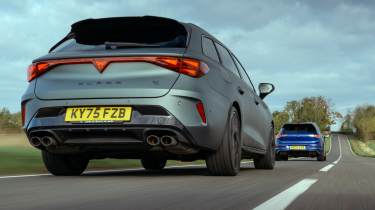
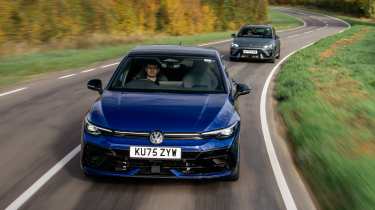
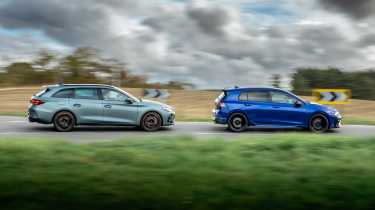
‘Eurgh,’ goes photographer Aston Parrott as we stroll out into the office car park to get underway; it’s fair to say the updated Cupra Leon’s styling remains somewhat divisive. I quite like the lights with their distinctive triple-accent DRLs, but blow hot and cold on its slashed-up maw – one that always calls Predator to mind. We disagree on the colour, too. Photographers never like matt paint but I quite like this Enceladus Grey, which comes up almost blue on a dull, dewy morning and highlights the subtle muscularity of the Cupra’s swage-lines.
The VW, meanwhile, is typical Golf R – Lapiz Blue with plenty of black trimmings and black wheels, this being a Black Edition. Complete with the optional (£3395!) Akrapovic exhaust system, it does look good, in a slightly juvenile way – squat on its 235-section tyres, its updated rear lights shining like 8-bit jewels, its quad exhaust tips cavernous and internally perforated.
More reviews
In-depth reviews
- Volkswagen Golf GTI review – still the definitive hot hatch?
- Volkswagen Golf Mk8.5 review – still the hatchback benchmark?
- Volkswagen Golf R (Mk8.5) review – a better hot hatch but not the best
- Used Volkswagen Golf GTI (Mk5, 2004 - 2009) review – one of the best VWs of the last 30 years
Reviews
You’re smiling before you’ve even got the door of the Cupra all the way open, as you catch a glimpse of the aggressively shaped, carbon-backed Cup bucket seats, which are included along with the Akebono brakes (375mm discs at the front) in top-end £53,470 VZ3 trim. The seats look brilliant and feel even better once you’re in them, at just the right height, with a good sense of support. What VW calls ‘comfort’ seats in distinctive ‘R’ fabric place you higher in the Golf and offer less support.
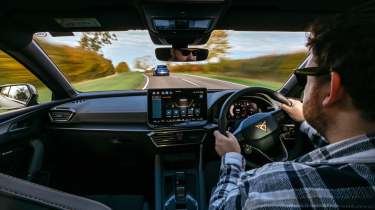
The Cupra scores other ergonomic wins, too, starting with its physical steering wheel buttons. Most important perhaps is the one with a circled car motif, a shortcut to switching off the nannying speed and lane warnings with just a couple of clicks. A button showing the Cupra logo lets you thumb through the drive modes, while another below the infotainment screen, just above the gear selector, lets you turn the traction control off.
The haptic controls on the Golf’s steering wheel aren’t as intuitive but had to be carried over from the pre-facelift car because relocating the ‘R’ button for the driving modes was prohibitively expensive. Unlike in the Cupra, the button for the assist systems is sited below the infotainment screen, but the biggest pain is turning the traction control off. There’s no physical button for this job here; instead seven swipes and clicks are required to find the off setting under the ‘Brakes’ dropdown in a diagram of the car on the touchscreen.
In the Cupra, it’s not until you want to adjust the damping via Dynamic Chassis Control that you need to interact with the touchscreen. You also note that the steering wheel is just the right thickness and its perforated grips have a high-quality feel. That said, the shift paddles are better on the Golf R, if not in materials then in size and action.
The Leon’s more extreme ‘Cupra’ and ‘Track’ driving modes make the damping a touch too aggressive for our tastes on poor surfaces. ‘Individual’ allows you to set the powertrain, steering and Torque Splitter to their most aggressive settings, but you’ll want to find the DCC’s sweet spot – around eight clicks along the 15-step slider – where the opposing needs of control and comfort are both satisfied. On most British B-roads, you’re rarely looking for more composure or cushioning in the Cupra.
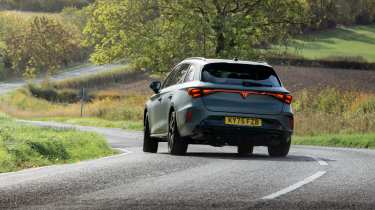
Instead you get stuck in, working the EA888 turbocharged four and snapping back and forth through the gears. Here, as in the Golf, the powertrain is effective if unremarkable in terms of emotional resonance. You’re more inclined to work the 2100-5500rpm torque band for its 310lb ft than chase the full 328bhp through the 5600-6500rpm peak powerband. It’s not an engine that relishes a race to the red line.
There’s certainly enough grunt to get the Torque Splitter working, though. First you haul the Leon down to an acceptable corner entry speed. The Akebono brakes are eager to bite but also easy to modulate, with good feel, and if you so desire you can use the extra mass of the estate body behind you to set up a neutral attitude. Tuck the nose in and you appreciate the steering’s off-centre positivity and the linearity to its weighting, even if there’s not an abundance of real feel. Then, as you apply power, you feel torque being sent to the outside-rear wheel to help you through the turn.
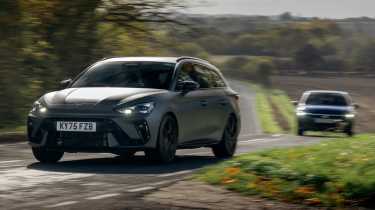
It’s not some gratuitous drift missile, not as eager to oversteer as the torquier Audi RS3, but it is unexpectedly agile. The tighter the turn, the more eager it is to tighten your line with a squeeze of throttle. The result is real confidence in the Cupra – to throw it at a road, use the extra tail-end mass to your advantage and develop a flow. It’s more sophisticated than its front-driven hatch sibling – not as pugnacious perhaps, but still fun.
As the late autumn sun burns off the morning cloud cover, the Golf makes its own case. How different can it be to drive? Noticeably. Press the start button and the Golf rouses with a predictably more anti-social, tinnier bark than the Cupra; it transmits more bass and general roar into the cabin at speed, too. So it’s louder – with this exhaust, at least – even if it isn’t any more musical. Slightly quicker too, according to the manufacturer claims, the Golf hitting 62mph from rest in 4.6sec, 0.2sec before the Leon.
The biggest difference is in the feel of the steering. There’s a rubber band-like elasticity and tension to the Golf’s rack, the immediacy off-centre fading as you load it up. More often in the VW, you’re making corrective adjustments to your steering inputs mid-corner to keep it on your chosen line. The back axle has Volkswagen’s R Performance torque-vectoring differential, which uses essentially the same hardware as the Torque Splitter, and it generally eliminates understeer unless you’re really ham-fisted, but the R doesn’t have the Leon’s on-a-dime eagerness to rotate. (Weirdly, it’s also noticeably less manoeuvrable than the 36cm longer Cupra at low speeds, with a 30cm wider turning circle.)
The damping isn’t a mirror image of the Cupra’s either, despite using the same adjustable DCC hardware. The tuning feels harder, with more low-frequency chatter. It’s well controlled for the most part, almost certainly tauter than the Cupra in its most aggressive settings, but it’s harder to find the damper setting where the Golf breathes with the road. It’s not as easy to relax with it, more often goading you to grab it by the scruff. Which is odd, as it’s not as playful (counterintuitively, the Leon on a more adhesive Bridgestone Potenza Sport compared to the Golf’s Potenza S005). Essentially, the VW is not as sophisticated in feel as the Cupra, happier to play the point-to-point missile.
Getting back in the Cupra reaffirms my earlier feeling that there’s an immediate rightness about it, while staff writer Sam Jenkins echoes my thoughts on the Golf: ‘The Cupra’s definitely keener,’ he comments. How different they feel is remarkable, really. The Cupra is simultaneously more dynamically polished yet also more eager and fun, though the driven rear axle does round off some of the hatch’s amusing rougher edges. The Volkswagen rides in a rowdier fashion yet isn’t as transparent in its responses – it eggs you on a bit more but then rewards a bit less.
The question of value is complicated. At £46,810, a basic R is a touch cheaper than a basic 328bhp Leon estate VZ1 at £47,570. But that difference is accounted for by the standard inclusion of DCC on the Leon, a £735 option in the Golf. With its Akrapovic exhaust, ‘Warmenau’ wheels, Harman Kardon sound system, carbon trim and other trinketry, our Golf R Black Edition test car came to a full-bodied £57,425 – nearly 60 grand for a Golf! Our VZ3-spec Leon meanwhile, with its optional matt paint and panoramic sunroof, was £56,520. For its seats alone I’d say it looks the better value proposition. It just happens, in spite of so much shared DNA, to be appreciably the better driver’s car too.
Specs
| Volkswagen Golf R | Cupra Leon Estate 333 4Drive | |
|---|---|---|
| Engine | In-line 4-cyl, 1984cc, turbocharged | In-line 4-cyl, 1984cc, turbocharged |
| Power | 328bhp @ 5600-6500rpm | 328bhp @ 5600-6500rpm |
| Torque | 310lb ft @ 2100-5500rpm | 310lb ft @ 2100-5500rpm |
| Weight | 1548kg (215bhp/ton) | 1576kg (211bhp/ton) |
| Tyres | Bridgestone Potenza S005 | Bridgestone Potenza Sport |
| 0-62mph | 4.6sec | 4.8sec |
| Top speed | 155mph | 155mph |
| Basic price | £47,050 | £53,470 |
| evo rating | 3.5 | 4 |