Aston Martin DB12 review – a flawed but seriously charming Ferrari Amalfi rival
Aston’s DB12 was a compelling but flawed grand tourer at launch – its recent S update has made it much more cohesive
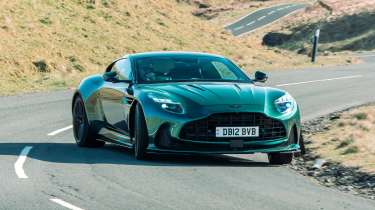
Aston Martin introduced the DB12 in 2023, as the beginning to a new era of GT cars and sports cars that are more potent, more capable and more focussed, not to mention finally with bang up-to-date cabins in terms of fit, finish, quality and user experience. It was a largely successful opening gambit, if not perfect. The DB12 is never quite able to settle down as a GT, but also lacks the tactility to make it a truly involving, engaging sports car.
Aston Martin redressed these concerns with a raft of upgrades for the DB12 S derivative it launched in 2026, turning what was the weak link in its range following the introduction of the Vantage and Vanquish, into perhaps its best current front-engined car.
Engine, gearbox and performance.
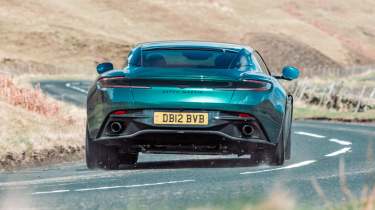
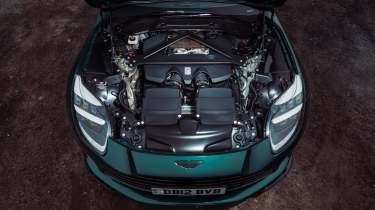
- Twin-turbo V8 poduces 671bhp and 590lb ft, or 690bhp in the S
- Eight-speed ZF transmission with a shortened final drive
- Supercar-quick, hitting 62mph in 3.6sec on the way to a 202mph top speed
An AMG-derived 4-litre twin-turbo V8 is the only engine option for the DB12 and it makes 671bhp (40bhp more than the V12-engined DB11 AMR) and 590lb ft . It manages as much thanks to modified camshafts, a lowered compression ratio (from 10.5:1 to 8.6:1) and larger turbos. Cooling was also increased to manage the 168bhp and 93lb ft boost over the DB11’s V8.
More reviews
While the final drive is shorter and the other seven ratios are carried over from the DB11’s eight-speed auto, the casing is new to reduce weight and manage gearbox cooling. A great deal of time has clearly been spent on shift management, with clear differentiations between the different modes in terms of shift speed and reaction times. It leaves you wanting to engage more with the powertrain, build a closer connection and get involved as you do in a dual-clutch Ferrari or Porsche. Aston claims 0-60mph in just 3.4sec and a top speed of 202mph.
The DB12 S adds another 19bhp on top for 690bhp, while torque remains the same. Software changes mean the DB12 S revs more freely up towards its redline but is less jumpy on initial throttle application.
When the hammer goes down on an open road all DB12s have a lot to give. The acceleration is a proper kidney punch, the urge sustained through the gears. Anyone who wants a V12 DB12 only wants it for the noise, but that’s as valid a reason as any, especially as the twin-turbo V8’s aural character isn’t strong.
There’s never any shortage of almost instant punch from the engine and, impressively, the rear tyres – with their huge 325 section – never have any trouble converting it all into forward motion. If the stability control system is managing anything other than the e-diff when the torque hits, you get no sense that any of the V8’s urge is being withheld. You ask, the car delivers.

There’s no doubting the muscle of the V8 but it’s a little light on aural character. Turbos mute the intake, GPFs mute the tailpipe noise, yet there is the opportunity to infill a bit more of the missing tone because the engine note is augmented through the Bowers and Wilkins sound system.
‘Soft hands on the open, flowing sections and quick but measured inputs in the tighter stuff produce a very satisfying, brisk flow. There’s plenty of low-down performance but the V8 enjoys high revs too, its light, flat-plane-like bark and strong response giving it the feel of an eager, naturally aspirated engine. There isn’t fantastic feedback through the wheel but you can be precise, the car changing direction crisply, front-end grip seemingly undefeatable.’ – John Barker, evo editor-at-large
Ride and handling
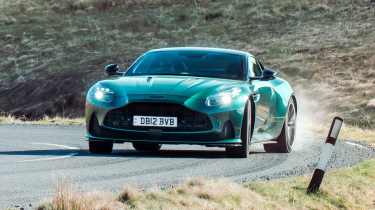
- Sharpest mid-range Aston GT yet…
- … however not the most feelsome, refined or pleasant-sounding
- DB12 S is the dynamic debug – the one to buy budget permitting
The underpinnings of the DB12 are fundamentally DB11 but Aston set themselves the objective of making the car sportier while retaining its GT credentials. During development there was some significant churn at Aston, which still harbours ambitions to be Britain’s Ferrari. This saw the departure of CEO Tobias Moers and the hiring of ex-Ferrari CEO Amedeo Felisa in his place, while Roberto Fedeli, who was head of development for LaFerrari and 458, came on board as Aston’s CTO (chief technical officer).
Meanwhile, heading the team tasked with shaping the DB12’s dynamics is Simon Newton, who enjoys the title ‘director of vehicle performance’. He arrived in the wake of the departure of chief engineer Matt Becker, and inherited a project that in some respects was quite mature but which needed some strong direction.
‘There was a great ambition to take the performance a long way north but at the same time preserve the car’s GT character,’ says Newton. ‘Some big ticket items were already decided but I wouldn’t say the character of the car was where it is today.’ One of those items was the tyre. After many years with Pirelli, at the behest of Moers, the DB12 is on Michelins, a bespoke version of their Pilot Sport 5S.
Newton says that while they were happy with the rear of the DB12 on the Michelin, and the front end capacity too, they worked hard to get the character of steering they wanted. That involved making the front end structure stiffer laterally than DB11, tying together the rear damper tops for the first time, deleting the steering column isolator (as on the DBS 770 Ultimate), and using the new, adaptive Bilstein dampers to help deliver linearity.
As well as exploiting a new tyre, the dynamics team also had to learn how to get the best from those Bilsteins. ‘It’s a very powerful system with quite a breadth of capacity,’ says Newton. It gave them the opportunity to make the distinction between GT, Sport and Sport+ modes much greater, and the difference wasn’t simply a tweak to the vertical control, says Newton. ‘We spent a lot of time on things like the cornering, controlling the turn-in response, so that everything is well matched in each mode, so that the car feels quite different in each mode.’

If you were looking to attribute one of the DB12’s hardware changes to the influence of Ferrari, it would be the e-diff. Ferrari has long used the electrically activated, locking diffs to help shape the dynamics of its cars but the DB12 is the first Aston to use one. A traditional, mechanical limited slip diff can do a great job but an e-diff can do the same job plus a whole lot more, with lock-up between zero and 100 per cent on or off the throttle, so it becomes an active part of the car’s dynamic performance, character and control.
The DB12 also has Bosch integrated vehicle control, which Newton describes as ‘an umbrella that looks down on the car and decides what levers to pull to deliver a certain dynamic behaviour’. Its core is an advanced accelerometer, a six-axis IMU (Inertial Measurement Unit), that builds a picture of what the car is doing and therefore knows when an intervention is required. ‘It can pre-empt, anticipate,’ says Newton, ‘so it can come in more modestly and smoothly, without locking the car down. DB12’s braking distances are significantly better because it doesn't have to go into slip to know it's going into slip. It also uses the e-diff as a mechanism, as a dynamic modifier.’
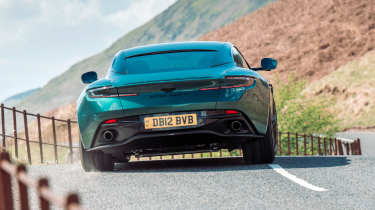
For the DB12 S, the diff was fettled to be quicker to respond with reduced tightness, while rear end roll stiffness was increased, artifice filtered out from the EPAS and the Bilstein DTX dampers tuned for linearity.
It’s a big car the DB12, a fairly heavy one too, and yet each time you lean on the grip a bit more the car responds, nailing the precise line. The surface is smooth and warm and the Aston jinks sweetly through a sequence of fast flick-flaks like a car half its size. On every straight the twin-turbo V8 delivers a solid thump of power.
The pace and grip are impressive but so too the steering fidelity, the flat poise, the remarkably neutral balance and the complete lack of slack which make the DB12 feel so exploitable and kind of effortless. It might be an evolution of the DB11 but dynamically it’s capable of going to another level.
The flipside is that the DB12 does not like lumpy surfaces, even in GT mode, which should be the go-to mode for general use. Patches of broken asphalt bring a sharp reaction, and the toughness of the ride is inescapable.
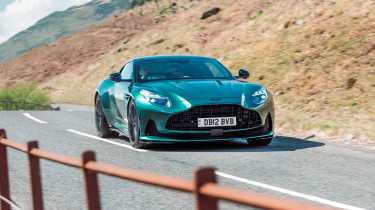
Conversely, The DB12’s steering is well weighted, precise and linear but it lacks feel, that tactility that connects you to the tread blocks and makes you feel properly immersed in the dynamics. It’s not crucial at low speed but detailed steering feel rewards and validates your input. The DB12’s lack makes it feel a little clinical.
With traction off and an early stab of throttle the torque is irresistible, unsticking the broad Michelins and kicking the rear wide quite abruptly, requiring a quick armful of opposite lock. DB12s are fitted with scalable traction control which is a revelation. It allows you to set the slip to a level from 0 to 10, so you can use the power to gently and subtly steer the rear, or allow greater slip angles up to a point, or wind it off entirely. For drivers who like to feel fully in control of a car’s balance, it makes the DB12 much more approachable and exploitable.
‘With the original DB12 the feeling was of a car confused, one that didn’t know, or perhaps understand, its remit. Too harsh and nervous as a GT, not precise or engaging enough as a super sports car. The S resolves all this, its ability to flow like the very best GTs and excite as a super-sports car addresses the frustrations of the original. An Aston Martin that can deliver the go to match its beguiling show.’ – Stuart Gallagher, evo editor-in-chief.
Design, interior and tech
- A glorious looking car inside and out
- Interior ergonomics improved but still not perfect
- Quality physical controls add to the premium ambiance
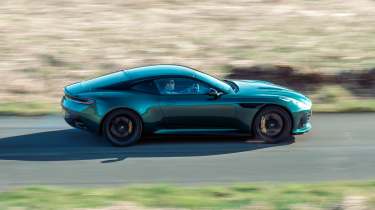
Some criticised the DB12 on reveal for looking like a light DB11 facelift. In person, on the contrary. It’s strikingly handsome, much more cohesive than DB11, thanks to the deeper front grille and that the painted lower edge and the strong sill balance the shape. It sits perfectly on its bigger diameter, 21in wheels.
The drop-top Volante version isn't quite as cohesive, though – the flowing roofline of the coupe makes way for a fabric top, which gives the illusion of a shorter cabin and longer rear deck. Space in the rear is tighter and the boot has shrunk, so you'll also need to pack a little more carefully for a weekend away.
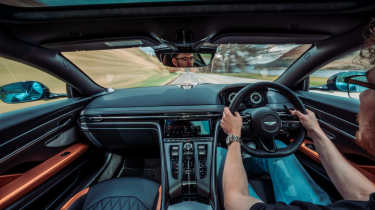
The exterior may have been carefully and effectively reworked but the interior is all new, a clean sheet, and all the better for it, with a bold line running across its width, a new instrument binnacle and a ramp-like centre console.
The HMI is custom-made, with fully digital instruments, a large centre screen and a pleasing number of hard keys arranged around a new, stubby auto gear selector. Few will mourn the demise of the individual PRND buttons. The starter button survives but as the centre of the mode switch; you twist its outer collar to cycle between GT, Sport and Sport Plus, and the new Individual and Wet modes.
evo Car of the Year 2023 result
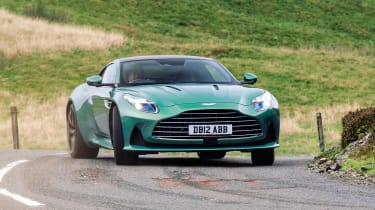
‘If evo had any sartorial sensibility it would place the DB12 first and dismiss the others for being overwrought design disasters. If presence is your thing, few cars come closer to owning the road in that respect than the DB12. It blends muscle and sophistication expertly, a brooding menace one moment, a svelte GT the next. You want to drive the DB12 purely so you can be part of it. Peter Tomalin reckoned it by far the best-looking car in this year’s line-up, adding ‘the interior is such an improvement from the DB11, you can scarcely believe it’s from the same manufacturer’.
‘When the push came, the DB12 was rarely found wanting. In terms of the ‘super’ element of its super-tourer claim, the 671bhp V8 takes care of that, although the engine – as it does in many AMG products running the same unit – feels and sounds its age, the fitment of particulate and noise filters muffling the delivery and the soundtrack.
‘It was in the ‘tourer’ side of things that the dynamics came up slightly short. ‘The rear suspension struggles to deploy the engine’s performance,’ was Adam Towler’s take. ‘This was something you’d feel on the DB11, and I don’t think they’ve eradicated it. The wheels feel too heavy, as though they can’t maintain contact with the ground.’ A hyperactive nature made it hard to settle into the car, while in the wet the traction software was given a dizzying workout. The general view was that it drives like a DB12 S or AMR model and would benefit from winding back the settings just a touch.’ – Stuart Gallagher, evo editor-in-chief.
Price and rivals
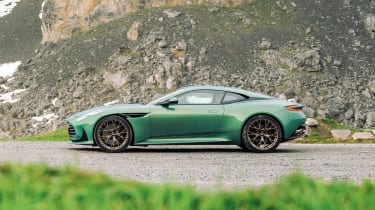
Aston has achieved its goal of elevating the performance of DB12 far above DB11. It’s a great looking car with an interior to match and delivers stunning performance; for such a big car it’s remarkably capable and composed at speed. However, in the process it’s lost some of its grand tourer qualities. The DB12 S is a step forward, however, simultaneously more engaging and more relaxed on a cross country cruise.
At £197,500, the DB12 trails slightly Ferrari’s Amalfi and Bentley’s Continental GT, though the much-improved 690bhp DB12 S is a £211,500 prospect. More expensive it may be, but it’s worth the extra outlay. There is also the V6-engined Maserati GranTurismo Trofeo to consider and Mercedes-AMG’s GT63.
The Bentley is a GT car first and foremost is and has a level of luxury beyond compare, although the DB12 runs it close. The Ferrari is the sharper sports car but is remarkably versatile as a GT. The Maserati’s V6 might seem less exotic but it feels explosively quick, with versatile but unobtrusive four-wheel drive.
The Mercedes-AMG GT 63 might share the same 4-litre hot-vee twin-turbocharged V8 as the Aston but the AMG 'only' has 577bhp and 590lb ft of torque. What it gives away in power to the Aston it makes up for with an armoury of chassis technology that makes a strong rival and value proposition in this competitor set.