BMW M3 (F80, 2014-2018) review – the worst M3 that became one of the best
The turbocharged F80 M3 took some time to find its feet, but later versions were hugely impressive performance cars
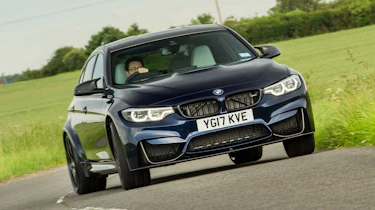
The BMW M3 has become a fundamental part of the performance car world since its introduction in 1988. Track days or a Nürburgring tourist lap wouldn’t be complete without at least one M3 of some generation slithering its way round the circuit. In the 32 years since the M3 lineage was founded, the car’s influence hasn’t waned much either. BMW’s creation remains a benchmark sports coupe, and saloon, that trades little of the base 3-series’ comfort and usability in delivering its exceptional driving dynamics.
When the ‘F80’ M3 was released in 2014 it brought with it a larger saloon-only bodystyle (the coupe and cabriolet now moved to the less evocative M4 moniker, designated F82 and F83), a turbocharged six-cylinder engine, and more comfort and convenience features than ever before.
We weren’t quite sold on the new car at first, and the M3 narrowly avoided a last-position finish at eCoty in 2014 on account of its untrustworthy, white-knuckle behaviour, exacerbated by the wet roads of that year’s test. But as BMW often does, it tweaked the M3 over the years, added more focused variants like the Competition and CS, and by the time it was replaced by the G80 M3, it was able to give its successor a hard time for involvement and thrills.
Engine, gearbox and performance
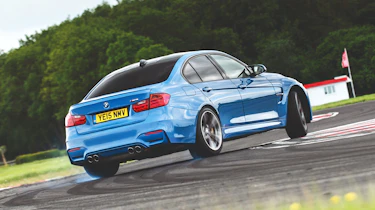
- Huge thrust from turbo straight six
- Manual gearbox standard, but 7-speed DCT was more popular
- Exhaust note can be unpleasant, but improved over time
More reviews
In-depth reviews
- BMW M3 (G80) review – still the best reason not to buy a Mercedes C63
- BMW M3 (E30, 1986-1990) review – the greatest M car of all?
Reviews
- New 2027 BMW M3 electric prototype review – the EV we've all been waiting for
- New BMW 3-series review – powerful M350 shows BMW can still be brilliant
- BMW M3 (E90 & E92, 2007 - 2013) review: £20k family car with an F1-inspired V8
- BMW M3 CSL (E46, 2003-2004) review – Munich's answer to the Porsche 911 GT3
- Used BMW M3 (E46, 2000 - 2006): an analogue sports coupe icon
One consolation for the loss of the E92 M3’s screaming naturally aspirated V8 engine was the sheer performance of its forced induction replacement. The F80’s 3-litre twin-turbocharged straight-six revs to a relatively high (for a modern turbo engine) 7600rpm, producing 425bhp at 5500-7300rpm and 406lb ft at 1800-5500rpm along the way. 0-62mph was quoted as 4.1 seconds, with top speed adhering to the usual German 155mph limit.
> BMW M3 (E90 & E92, 2007 - 2013) review: £20k family car with an F1-inspired V8
But rather than just being able to reach those elevated RPM figures, the engine gets more and more intense as the revs pile on. It makes for a great engine to wring out, with every additional RPM making the engine ever more exciting rather than losing momentum at the top of the rpm range.
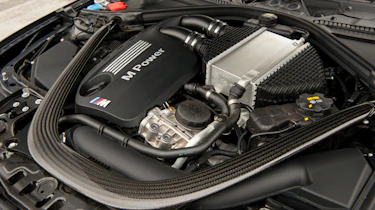
Combined with the slightly undeveloped feel of early cars this punchy power delivery and somewhat sudden shifts from the popular seven-speed dual clutch gearbox (a six-speed manual was standard) could be a recipe for sweaty palms, as particularly in wet weather. It was all too easy to find yourself sideways without the chassis informing you first, but when the Competition was launched, a more progressive throttle response made it easier to meter out the power, without taking away the excitement of all that performance.
Another downside was the tuneless, almost diesely blare emitted by early cars, though this too improved with time, and if you’re not keen on the way an M3 sounds, the aftermarket is usually only too happy to help.
Competition package cars expanded the M3’s output to 444bhp but torque remained at 406lb ft; the 0-62mph time dropped to four seconds flat, but top speed remained the same 155mph. CS versions got a further 10bhp but torque jumped to 443lb ft, albeit now developed from 4000rpm, implying a marginally peakier engine. It took another tenth off the 0-62mph sprint, but top speed was now 174mph.
Ride and handling
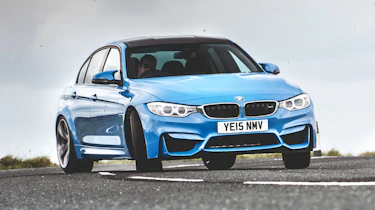
- Early cars were quite spiky and unpredictable at the limit
- Competition Package was a big improvement and worth seeking out
- Fantastic front-end grip and strong brakes
The performance and pace of the early versions of the F80 was never in doubt, but they weren’t particularly suited to the UK’s bumpy and undulating roads. Poor body control, particularly at the rear, made the car feel difficult to predict and trust, especially when the weather was anything other than bone dry.
> Used BMW M3 (E46, 2000 - 2006): an analogue sports coupe icon
Over the years, tweaks to the BMW’s chassis and drivetrain calibration helped, but it wasn’t until the M3 Competition version arrived that the F80 M3’s potential was finally realised. It felt more settled at low speed and more predictable at quicker speeds, while different engine calibration meant the power delivery was less spiky too, giving you better control over what happened at the rear wheels.
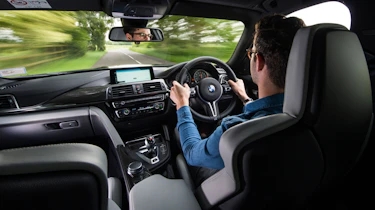
One aspect of the M3 that has never been in doubt is just how impressive the front axle is. There is truly fantastic grip on turn in, meaning you can carry huge speed into a corner without any understeer. The steering doesn’t transmit much usable information about what’s happening between the tyres and the road but, with such a dependable nose, you can be incredibly accurate when placing the car.

On track the M3’s mighty front end and masses of torque mean that it’s all about managing oversteer. Every prod of the throttle, even through some of the faster corners has the rear tyres spinning. But, thanks to a very transparent limited slip differential that locks early and remains consistent throughout a corner, it feels very natural to drive at the limit. The engine’s response means that once you’re accustomed to the M3’s balance, you can restrict the slides to small angles and refrain from losing too much speed to wheelspin.
The F80 generation of M3 was finally given a set of brakes up to the task of stopping a powerful saloon car too so, whether they’re the standard steel brakes or optional carbon ceramics, you can really lean on them.
BMW M3 (F80) updates
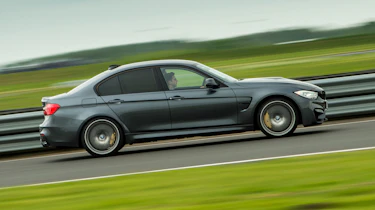
Following the M3’s 2014 launch, the first significant update came with 2016’s Competition Package. Unlike the relatively simple springs and wheel changes of its E90 Competition predecessor, 2016’s Competition was a more comprehensive upgrade to the standard car. Power increased by 19bhp but the chassis also underwent notable changes. Uprated springs, dampers, and anti-roll bars were included, while BMW tweaked the drive modes and the response of the traction control. Polished 20-inch alloy wheels wrapped in Michelin Pilot Super Sports and a set of lighter sports seats were also included, while Competition cars got the M sport exhaust from the regular car’s options list.
Next up was 2018’s M3 CS, a badge that skipped the E90 generation but was fondly remembered from the E46 M3 CS, the half-way house between a standard M3 and the racy CSL. For the F80, CS meant an even more potent version of the 3-litre turbocharged straight six with 454bhp and an increase in torque too. Weight-saving measures, including a CFRP bonnet and roof, a carbon front splitter and rear spoiler resulted in 10kg of savings, which still left it heavier than the earliest manual F80s on paper. You did get retuned suspension and staggered 19-inch front and 20-inch rear wheels, while the exhaust note was also specially tuned for the CS.
What’s the interior like and is the tech any good?
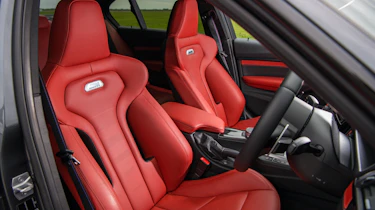
It’s a sign of how quickly cars have changed over the last decade or so that the cabin of the F80 M3 now looks and feels quite old-school. Yes, there is a screen, those had arrived by 2014, but it doesn’t dominate the cabin. There are physical dials in the instrument cluster, a full bank of controls for the audio and air conditioning systems, and the aforementioned screen is operated not with a prod or a voice command but with an iDrive knob between the seats. There’s even a six-speed manual gearlever in some models, while the DCT versions have a raised gear selector rather than a disappointing plastic nub.
Old-school, but not obsolete. The infotainment system is a doddle to find your way around and while not blessed with CarPlay and the like, it’s more than happy to pair up to a phone. The M3’s cabin also feels well put together and like almost all modern-era BMWs, the driving position is effectively faultless whatever your height or body shape, thanks to ample adjustment. In the right spec, such as when equipped with the M sport seats, or with the CS’s flashes of Alcantara trim, it feels special too.
The F80 3-Series platform is also large enough to allow adults to accommodate the rear seats, and the 480-litre boot is generous too, so it’s largely as practical as any 3-series.
BMW M3 MPG and running costs
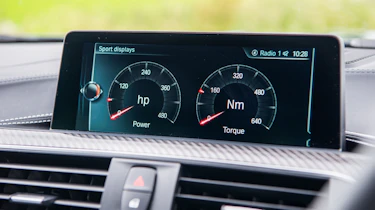
The M3 has never been a cheap car to run, and the new one is no different. BMW claims the M3 can achieve 34mpg, but in reality that will plummet to mid- to low-20s if you tap into the car’s true performance.
With such significant power and torque, the M3 is going to go through rear tyres relatively quickly. The 275/35 19 Michelin Pilot Super Sport tyres, that are standard fitment for the M3, cost around £240 each. The Competition Pack comes on bigger 20-inch wheels with larger versions of the same tyre; it runs 285/30 20 rear tyres, and as of 2026 these will cost you even more, at £315 a corner.
Front tyres for the M3 are touch cheaper, at about £220 for the 255/35 R19s of the regular car and £280 for the 265/30 R20s on the Competition pack, but won’t have to endure quite as much pain and probably won’t need changing as frequently as the rears.
evo Car of the Year 2014 result – Richard Meaden
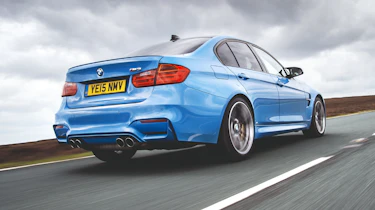
‘We had hoped for big things from the M3. Not an outright win perhaps, but a strong result surely should have been within its reach. And yet it’s perilously close to last place. What went wrong? Judged on looks alone the M3 should have walked it. The spec sheet is equally compelling, and though we knew the F80 was a very different kind of M-car, its potent engine, excellent (optional) dual-clutch transmission and – at last! – brakes worthy of a sporting car are fine ingredients. Shame, then, that when push comes to shove it all feels a bit half-baked.
‘We were all frustrated and at times spooked by the M3’s strange mix of blunt-instrument clumsiness and spiky on-limit handling. Rarely less than unsettled, when pushed to its limit each failing or unpleasant trait seemed to collide with the next, like some dynamic domino effect. In the dry this could be exciting, but the overriding sense was a ragged lack of control and precision. In the damp and the rain it was pretty dicey.
‘That the M3 is so lacking in finesse is hard to reconcile, because that polish and heightened ability should be something central to the M-car proposition. With such a grand stage on which to perform it should have excelled, but what we found was a car at odds with itself.’
BMW M3 (F80) prices and buying checkpoints
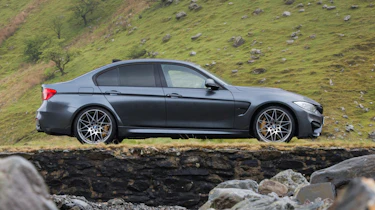
F80 M3 prices currently start at a shade over £20,000, a touch higher than the entry point for the equivalent M4 coupe or convertible. It’ll almost certainly be a DCT at that price, with the manual much rarer, and when they come up, more expensive – at the time of writing, the sole manual F80 M3 we found was listed at £29,000. You might need to hang around for the right car then, or expand your pool of potential candidates by including the M4 in your search if a manual is essential. Competitions generally start around the £30,000 mark and the CS is upwards of £40k.
One thing you’ll spot a lot is modifications. Being turbocharged turned the M3 into a bit of a Nissan GT-R-lite – people just can’t help playing around with the things, and dubious visual alterations are just as common as tweaked engines or suspension.
Standard cars are relatively hardy, without a “big one” bill to speak of like its predecessor’s rod bearing issues. A spinning crank hub looked to be the F80’s Achilles’ heel for a while, but it seemingly affected only a handful of cars.
If you want to avoid it to be on the safe side, post-2016 cars are the ones to go for. Exteriors and interiors hold up well but front ends and arches might be showing signs of the miles with stone chips, lighter leather colours inside can look a bit grubby if they’ve not been looked after, and the big 19 and 20-inch wheels are susceptible to kerb damage.
Specs
| BMW M3 | BMW M3 Competition | BMW M3 CS | |
|---|---|---|---|
| Engine | In-line 6-cyl, 2979cc, twin- turbo | In-line 6-cyl, 2979cc, twin- turbo | In-line 6-cyl, 2979cc, twin- turbo |
| Power | 425bhp @ 5500rpm | 444bhp @ 7000rpm | 454bhp @ 6250rpm |
| Torque | 406lb ft @ 1850-5500rpm | 406lb ft @ 1850-5500rpm | 443lb ft @ 4000-5380rpm |
| Weight | 1560kg (DCT, 276bhp/ton) | 1560kg (DCT, 289bhp/ton) | 1585kg (291bhp/ton) |
| 0-62mph | 4.3sec (claimed manual) | 4.0sec (claimed, DCT) | 3.9sec (claimed) |
| Top speed | 155mph | 155mph | 174mph |
| Price new | £56,190 (2014) | £59,595 (2017) | £86,425 |
| Value now | From £20,000 | From £30,000 | From £40,000 |