Ford Focus (Mk1, 1998-2004) review – a gamechanger that embarrassed the VW Golf
The original Focus marked the moment a humble Ford set a new benchmark for hatchback dynamics
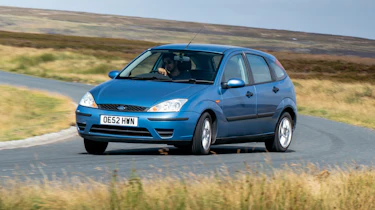
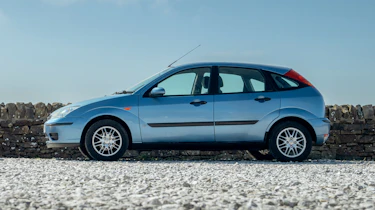
It’s hard to recall today, but the Mk1 Focus was a real risk for Ford. It marked a paradigm shift for the company in every metric, from design to engineering to the customers it was targeting. All this came out of necessity. Ford needed change, and the Focus was a total reset.
The Mk1 Focus was in some ways an even bolder move for Ford than taking on Ferrari with the first-generation GT supercar in 2005. The Focus was a gamble on the company’s biggest cash generator in Europe, and supercars are comparatively small fish. But it was a gamble that paid off and then some, putting Ford back at the top of the sales charts. Alongside the Mondeo, Mk4 Fiesta, Ka and Puma, it cemented Ford’s status as a maker of cars you’d actually want to own and drive, not just purchase out of necessity.
Ford Focus Mk1 – history
There have always been unassuming, everyday cars that are nice to drive. Italian and French companies used to be especially good at this, but there was always a sense that the spring in the step of a Fiat Brava or Peugeot 306 was a happy accident because its creators liked driving. This wasn’t the sort of thing Ford did. Ford was data-driven, furiously analysing and researching and then relentlessly paring costs. Hence the apocryphal story that a standard Ford job interview question was: ‘What do we make here?’ Successful candidates were the ones who replied ‘money’.
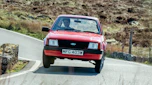
Of course, Ford engineers knew that rival cars were more fun to drive. When they were developing the Mk3 Fiesta they studied the Peugeot 205 to discover its secrets, even filming one with slo‑mo cameras to dissect the nuances of its delightful handling. But then carefully researched practicalities like cheap servicing and light steering got in the way and the ’89 Fiesta arrived as a woolly sluggard, beaten only for dreariness by the all-new Escort of the following year.
More reviews
Yet these grey mush machines did us a favour because they attracted such lukewarm response that Ford of Europe, under newly appointed chief engineer Richard Parry-Jones, decided it could do better. Making cars that were nice to drive became an official corporate position, based on Parry-Jones’s belief that even less-enthusiastic customers felt more confident and therefore happier in a car that was crisp and responsive. This led to the Mondeo of 1993, then the Ka, the Puma and finally, in the year evo was born, the pinnacle of Ford’s let’s-not-be-crap policy: the Mk1 Focus.
A radical (for the time) design philosophy was central to the project, with a mix of edgy angles and curves grafted onto a traditional hatchback body. The Focus looked like a concept car when it first appeared on show stands in 1998 – though you could argue that time has been kinder to the more conservative and classy Mk4 Golf.
But the big revolution came under that skin, where Parry-Jones and his team sweated over every detail to build something genuinely enjoyable to drive – something Volkswagen hadn’t achieved with its recent Golfs, even in GTI spec, and Ford itself had struggled with on the Mk5 Escort. It wasn’t a quick fix. Parry-Jones and his team engineered each element, from the steering to the damping to the gearshift, to be a cut above the then-current standards for ordinary cars, and doing so without breaking the budget required inventive solutions. One of these was the ‘Control Blade’ rear suspension – a cost-effective and space-saving multi-link solution that gave better ride and handling than a torsion beam.
Rumour was that Lotus had some early input into the chassis and you could believe from its manners that the Focus had spent a little time in Norfolk. Equally impressive was the sense that all the controls had been carefully tuned to demand an equal effort, giving the car that sense of polished integrity you usually got only from a Porsche or a BMW. But the Focus wasn’t a Porsche or a BMW, or even a Fiat or a Peugeot. It was a Ford. And at the time it was a revelation.
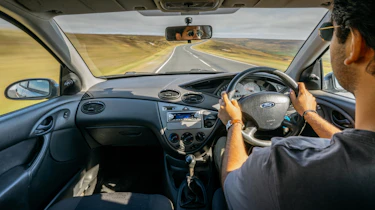
Driving the Mk1 Ford Focus – Yousuf Ashraf
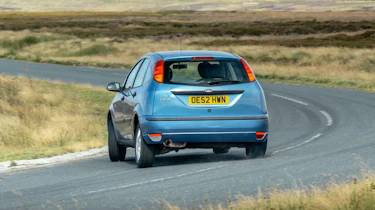
I’ve never driven a Mk1 Focus before and I’d heard they were good, but I wasn’t expecting quite such brilliance. From the moment you get moving it feels so poised, precise and communicative, to the extent that it actually feels better resolved than some of the supercars in our test. Then I look down and find that this example (kindly lent by the Great British Car Journey museum) has covered 90,000 miles. Yet it feels tight and completely rattle-free – even if the cabin, with its wacky dashboard design and cheap plastics, looks and feels low-rent compared to a contemporary Golf’s.
Dynamically, the sense of cohesion is what strikes you. The steering is superb, sharp and perfectly weighted. Likewise the damping, which connects you to the surface but finds a great flow at speed. You can carry impressive pace with no effort, revelling in the keen response and feedback from the front end, even getting the rear to pivot around gently with more commitment and a well-timed lift. It genuinely handles better than many hot hatches.
The powertrain is solid too, if not as stand-out brilliant. The 99bhp 1.6-litre petrol is smooth but a bit light on torque, and the five-speed ’box is precise and easy, if a little rubbery in feel. It would’ve been a crime not to give the Focus the extra power its chassis could handle, and Ford duly obliged by launching the Focus ST170 in 2002. Forged pistons, a new head and other engine mods raised power to 171bhp, but Ford saved its best for the Focus RS, which launched in the same year with 212bhp and comprehensive chassis upgrades including a Quaife limited-slip diff.
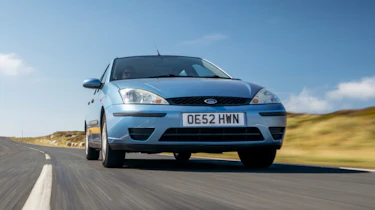
But the basic Focus proved that you don’t need something exotic to enjoy yourself in a car. It brought genuine brilliance to the masses, changed Ford’s trajectory for years to come, and forced its rivals to up their game to the benefit of the entire industry. In its own way, it has as much star quality as any supercar of the time.
The original Focus is a sure-fire future classic that's still in its rock-bottom value phase, with early examples out there from £600. Never let it be said that the days of great cheap cars are totally gone. Given what a talented thing it is and given their propensity to oxidise, they'll only get rarer, more desirable and more valuable.
Specs
| Engine | four-cylinder, 1596cc |
|---|---|
| Power 99bhp | 99bhp |
| Torque 105lb ft | 105lb ft |
| Weight | 1077kg (93bhp/ton) |
| 0-62mph | 10.6sec |
| Top speed | 115mph |
| Price new (1998) | £12,315 |
| Value today | from £600 |