He grew up looking at Trabants and now he designs Lamborghinis
Mitja Borket grew up on the east side of the Berlin Wall, but that didn't stop his remarkable journey to become Lamborghini's head of design

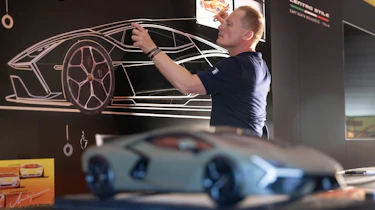
The most exceptional jobs in this industry often come with exceptional journeys to get there, and that of Mitja Borkert, Lamborghini Centro Stile’s head of design, is no exception. Today he leads a top-tier team of 25 designers who are literally shaping the poster darlings of tomorrow – surely there is no more pivotal role in the world of car design?
But Sant’Agata Bolognese in 2026 is a long way and a few decades on from Mitja’s humble East German origins. On the wrong side of the Berlin Wall in the 1970s and ’80s, a BMW 5-series was considered frivolous and excessive; just possessing imagery of a Countach would have been grounds for state reprimand. It was a different world, as Mitja explains.
‘We never saw fancy cars. In the Western world you had the Countach and the Porsche Turbo and the Golf. In East Germany there was only Trabant, Wartburg and Lada.’
However, the industrial and agricultural town of Herzberg was close enough to the border that objects built for speed and that conjure awe were within view – they just had a militaristic flavour.
‘We had a Russian air base near us, so I remember as a child, every day a couple of MiGs would fly over. The sound when an aeroplane hits supersonic, for me it was present every day. I miss it a little bit now.’
Like many East Germans who dreamed of forbidden fruit, Mitja’s love affair with motorised transport was nurtured with contraband: ‘I remember, I don’t know why or how, but we watched a car race with red and white F1 cars in Monte Carlo in the mid-’80s, around Niki Lauda’s time. Then in school I made and painted an F1 car in red and white. It was a problem for my dad, who was a director in the school, because “How can Mitja know what this is?” It was, of course, forbidden.
‘My brother also brought me Hungarian car magazines, Autó-Motor it was called. I was already sketching and I would cut out cars and glue them into my own car catalogues. My centrefold posters were never with a Lamborghini or a Ferrari, they were not present in these magazines. Sometimes a Renault 21 or Renault 19. I put them in my room; they were precious.
‘A friend also wanted to be a car designer. We were inspired by the [Mark] Stehrenberger sketches in [German magazines] Auto Bild and Auto Motor und Sport. We would wonder how he drew these. We were sketching, we were recording whatever pieces of television or reading whatever articles we could find about design.’
Mitja also developed a love of motorcycles early on in life, from riding his own Samson in the deep furrows left by the tracks of Soviet tanks, to spying Western superbikes when on his holidays: ‘My brother took me to Hungary to the Balaton lake, to have a holiday. I remember the Kawasakis and the Suzukis – the sound of them. It fed my love of sports bikes today.
To some degree, Mitja’s place in automotive design history is fortuitous. While his story began in the oppressive German Democratic Republic, the geopolitical seismic shift that was the GDR’s dissolution and the collapse of the Berlin Wall came almost at the perfect time to pursue his dream, though not quite soon enough for him to avoid a stint doing military service.
‘At 15 in tenth grade we needed to go in for careers advice. There was a guy from the Stasi, the secret service, asking, “Mitja, what do you want to do?’ And I said I would like to do something with sketching – I want to do something where I can draw. But car design was, of course, not a job in East Germany. I was applying for high school everywhere and not getting accepted and wondering, what do I do? Then in the summer of ’89 the wall came down. My dad said, “Mitja, now do the high school,” because they opened things up.
‘A few years later my friend applied for a university place in the Hochschule Pforzheim School of Design but was denied. At the time I was doing my military service, and I thought I’d try as well. They wanted to see car sketches as well as my bigger artistic vision – they didn’t want you to be narrow-minded. They invited me for the test and I got in.’
From East Berlin to Porsche
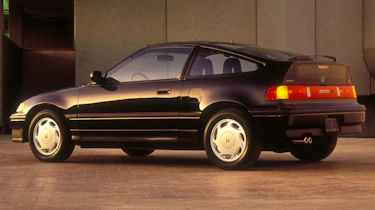
With savings from his military service, Mitja bought himself a Honda CRX, which he would use each week to commute to school – 700km away from home, near Stuttgart.
‘I spent all the money that I made in the military service to buy a Honda CRX with the 150hp VTEC. For me as a young man it was one of the coolest cars. I was a big Honda fan in this period. This was my commuter from East Germany to West Germany. I did 200,000km with my Honda. At the time the Autobahn was being renewed so it always took eight hours. I spent the week studying at Pforzheim then I’d go home on the weekends and go to the discotheque. It was a good period for sure.’
Studying Transport Design so close to Stuttgart meant rubbing shoulders with Porsche designers and studying under Stefan Stark, who worked on the 1993 Boxster Concept. He would recommend Mitja for an internship at Porsche in 1997 under then design chief Harm Lagaay, of ‘fried egg’ headlight infamy, and this would later lead to a job offer.
‘Harm Lagaay called me into his office one morning in February 1999 and said, “Mitja, I’d like to offer you a job at Porsche.’ My friend was the favourite but we had a friendly competition; I never gave up and Harm Lagaay noticed. He said, “I’ve seen Mitja, he’s improving, he’s learning, you can see he’s going in this direction.” I tell you honestly, as a young student you think you’re the best, but really you’re not ready at all.’
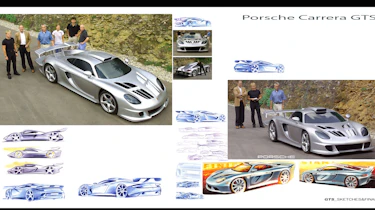
So what did Mitja start out on? Cayenne headlight washer? Boxster tyre-valve cap? Not at all: ‘My first job was to do some sketches for a super-sports car that was not yet called Carrera GT. I did the sketches, he [Lagaay] saw my sketches and came to me and said, “Mitja, I’d like to send you to California.”’
How much life can change in just ten years…
‘It was my first big trip to the US – they nearly didn’t let me in because I was travelling on business and not for a holiday and I didn’t know it was a problem. They said, “You must be very special if an American can’t do your job!” I was there for five or six weeks only, but we did Carrera GT sketches and tapes [a pre-CAD method of defining design details on 3D models]. The kudos goes to Grant Larson – he was the magician. He had exactly the feeling of how a Porsche needed to be designed, but I was happy because some of my lines had an influence.’
Porsche Macan to Mission E
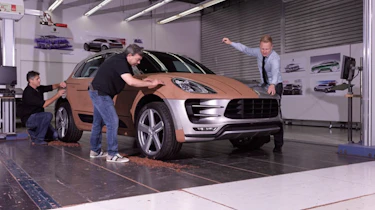
When Michael Maurer took the helm of Porsche design in 2004, his collaborative approach allowed Mitja to flourish. After contributing to the 987-generation Cayman and Boxster facelifts with Hakan Saraçoğlu, Mitja secured a major milestone by penning the initial proposal for the second-generation Cayenne – a vision that became the model’s stylistic foundation.
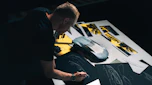
With confidence and experience growing, Mitja felt ready to really ‘do’ his own car: ‘With the Macan I said, “Michael, please let me do all of this project, because I want to learn everything.” I tried to take a holistic approach, from the engine-bay design of the basic model to the wheels for the Turbo model.’
Then came a flurry of exciting projects. ‘We went to an outside design centre because the original design centre was getting too small. With energy and enthusiasm, we made an atmosphere where we were pumping out projects. We did the Macan, then the Panamera Sport Turismo concept, the 917 and 904 Living Legends concepts, the 991 Safari and the GT3 Speedster. There was a mushroom of ideas – an incredibly cool time with so much freedom. I could grow as a designer, as a leader.’
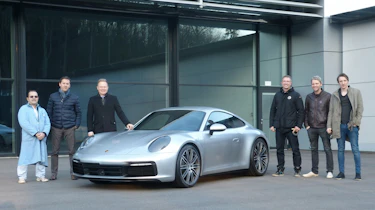
Elevated to head of exterior design, Mitja went on to pen the Porsche Mission E concept and then oversaw the first proposals for the 992-generation 911. But in 2015, his future came knocking.
‘We did the presentation to [Volkswagen Group CEO] Martin Winterkorn of the 992 models in 2015. Then in September, Walter [de Silva, head of Volkswagen Group design] grabbed me by the arm. He said, “Mitja, I want you for Lamborghini.” I did my interview in October and I started in April 2016.’
It will soon be ten years since Mitja started in his role as the head of design at Lamborghini Centro Stile, before becoming design director of Automobili Lamborghini in November 2023. His style, charisma, the way he carries himself, all make so much sense when you consider his origins. This is someone who knows first-hand what a privilege it is to be able to express oneself, and arguably no car is more a piece of four-wheeled self-expression than a Lamborghini.
Designing a Car of the Year winner
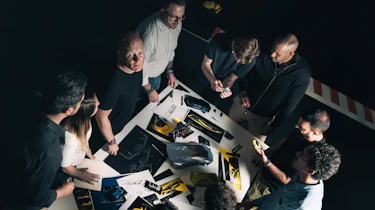
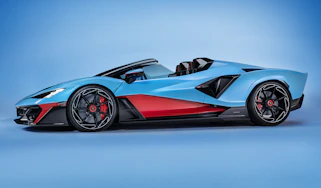
While he and his team have guided the Huracán and Aventador into their twilight years, it’s the eCoty-winning Revuelto and the new Temerario that are true ‘Mitja’ Lamborghinis. But what’s next? Is there a place for sketching, sculpting and modelling in an increasingly digital world? Absolutely.
‘I am insisting that new designers work with old methods of design, even though AI is the latest tool. When I came to Lamborghini, the team was fully digital, with very few models. I always want to be proud of a real full-size model – that’s your result. You touch it, you criticise it. The taping, the sketching will never die. I see design in this romantic way and as long as I’m in charge I don’t want to lose this.’
And what of that thorny issue of artificial intelligence? Contrary to fearing it as a threat to Centro Stile, Mitja is actually excited by AI, seeing it as the next in a long line of innovative design tools: ‘AI is a fantastic tool that we need to understand. It will never substitute any creative person, but it’s the next step of having fun with design. You still need to say, “This is what I would like to see.” Without the spark, AI doesn’t help. Someone with good taste has to be in the position to master it and say yes to a design. It cannot create a strategy. It cannot create vision.
‘You need to master AI. I would not be scared of it; if you don’t deal with it, then you will lose the game. Design is storytelling and AI can help tell the story. I am already curious about where we will be with it in the next year. This is the next step in the process of design. Those who are not mastering it will be left behind.’