Porsche Mission S – new Ferrari-rivalling supercar and Porsche’s plan to save itself
Porsche’s plan to save itself will see the Stuttgart brand push upward with a new supercar, more customisability and one-off special projects
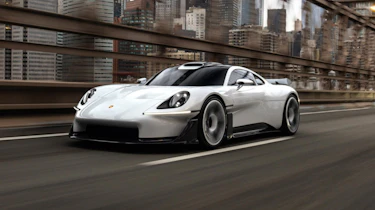
What you’re looking at here is nothing less than the future of Porsche. The Mission S is a concept supercar that the sports car maker vows to make a production reality. It previews the new design language that will shape every future Porsche and spearheads ‘Sportwagenschmiede 35’, new CEO Michael Leiters’ master plan to return the company to profitability. Alongside the new supercar will come a ramp-up in customisability to maximise the profitability of its high-end and GT road car products, as well as plans to lean into one-off customer cars and restorations.
Porsche needs to rediscover its mojo, both financially and with its powertrain strategy. After years posting the industry’s best margins, the company’s operating profit plunged by 98.5 per cent in 2025 due to a combination of factors: tariffs in the US, which remains Porsche’s biggest market, a slump in Chinese demand, and penalty payments to suppliers for not meeting EV volumes.
Four years ago, high on initial booming demand for the electric Taycan, Leiters’ predecessor, Oliver Blume vowed 80 per cent of Porsche sales would be EV by 2030. The company made a big – and costly – bet to replace the Macan SUV with a zero-emissions successor, just like the 718 Boxster and Cayman replacements due next year. It’s one of the issues that forced Blume to hand day-to-day control to Leiters and focus on running Volkswagen Group.
Porsche Mission S and the supercar it previews
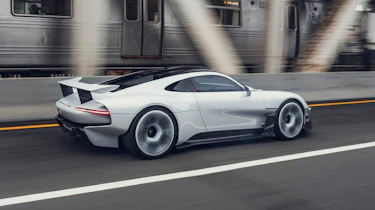
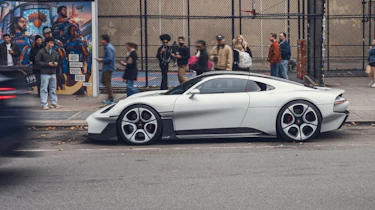
Rather than a successor to the Carrera GT and 918 Spyder, the car that appears in the image of the Porsche Mission S will be a series-production model to take the fight to Ferrari, McLaren and Lamborghini.
As Leiters explained: ‘We are developing a super-sports car platform, and we intend to use it as the basis for a new mid-engined car that will sit clearly above the 911. The Mission S is an idea of what such a car might look like, a vision of how Porsche can continue to evolve while remaining unmistakably Porsche.’
The new boss, with a CV that includes running McLaren Automotive, being Ferrari’s CTO, and engineering the first Cayenne hybrid, predicts combustion and hybrid cars will still account for two-thirds of sales at the end of the decade. And while Porsche did show the Mission X electric hypercar concept in 2023, the Mission S will be cut from a very different cloth.
‘There won’t be a battery electric vehicle on the super-sports car platform, because there is no demand in the segment for a BEV,’ said Leiters. ‘We have the flexibility in that platform to do pure ICE, hybrid and also plug-in hybrid. With Mission S we will listen to the customer.’
evo grabbed a word with R&D chief Michael Steiner, who mused: ‘In principle it could be a very pure, lightweight [combustion] sports car or combine performance hybridisation to take advantage of chassis systems.’ The 911 Turbo S could show the way, with its electric turbochargers to eliminate lag, and its active anti-roll system, both powered by the 400-volt T‑Hybrid system. A motor in the transmission shovels more power and torque into the driveline, too.
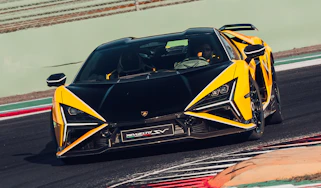
Clarification on the supercar’s positioning in the food chain is still to come. We know it won’t be a limited-run hypercar in the lineage of the 918 and Carrera GT but whether it’ll be a £250,000-£350,000 senior supercar akin to McLaren’s 750S, Lamborghini’s Temerario and Ferrari’s 296, or a £400,000-£800,000 junior hypercar in the ranks of the Aston Martin Valhalla, Ferrari 849 Testarossa and Lamborghini Revuelto, is to be determined.
Porsche Mission S – design and interior
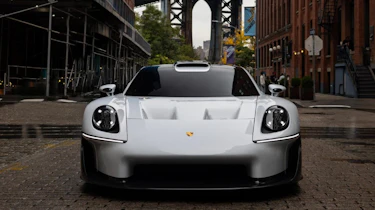
The Mission S’s new design direction takes cues from the 911 in the glasshouse and rounded surfacing, with hints of 911 GT1 in the mid-engined proportions and central roof intake. On the rear deck you’ll find an exposed horizontal cooling fan that calls back to the historic 917 race car, while the wheels are said to be inspired by the 928’s teledial rims. Porsche tends to faithfully reproduce its concepts for production – the Taycan and 918 Spyder are examples of this – so expect most of the design to translate to reality.
‘I don’t like hard lines on a Porsche, I like soft shapes. With very precise, architectural graphics that give an amazing contrast, that [create] tension,’ said new Porsche design director and former McLaren chief design officer Tobias Sühlmann. He also hints that the concept calls time on the widely copied Porsche rear light bar, opting instead for super-slim units at the extremities. They’re crowned by a retractable rear wing, as per the 918 Spyder and Carrera GT hypercars.
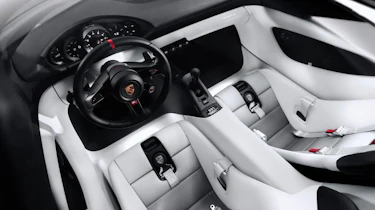
A focus on purity and simplicity inside is also part of Porsche’s new direction – adjectives you wouldn’t necessarily apply to the Taycan and Cayenne Electric, with their heavily digitised cabins. By contrast, the Mission S is pared-back, with an interior inspired by those of the 550 Spyder and 356, with a simple dash layout featuring physical switches and part-physical, part-digital instruments with a central analogue rev needle.
To reduce distractions, Porsche has intentionally omitted a permanent central infotainment screen (there’s a retractable holder for your smartphone instead) or passenger display – ironic when it pioneered the latter with the Taycan, but it makes for a very clean, almost Lotus Elise-like driving environment.
Beyond the supercar: Porsche’s plan to save itself
In addition to the new supercar, Porsche wants to recalibrate its line-up with more models in other lucrative segments, including a three-row SUV above the Cayenne, aimed squarely at its biggest market, North America. Also on the horizon is the electric 718 Boxster replacement, which will go on sale at a considerably higher price than the previous Boxster to pay for its bespoke architecture and drivetrain.
Porsche will also unleash myriad new ways for customers of its 10,000 most expensive cars to spend much more money. Today those buyers lavish an average of €270,000 on a new Porsche, which the company hopes to raise to €330,000 with a greater array of individualisation options, including customer-commissioned ‘few offs’. That’s the playbook from a brand Leiters’ presentation identified that has an average selling price of €440,000 – Ferrari.
The recently unveiled Flachbau RS is a perfect demonstration of Porsche’s ‘Sonderwunsch’ (special wish) offer: a customer’s 2018 GT2 RS was given an interior and exterior overhaul, re-engineered with new aerodynamics, a 31kg weight reduction and tested on the Nordschleife. Porsche says 15 more one-off projects are in the works, with customers paying between €1.62m and €13.47m for the privilege. Weissach is also scaling up its capability to recommission existing cars, with new styling inside and out; 11 Carrera GTs have been refitted, with another 37 working their way through this factory ‘restomod’ process.