Mercedes-AMG GT R (2016-2022) review – the Porsche 911 GT3 rival now costs under £100k
Mercedes-AMG created something very special in the AMG GT R – an AMG hot rod with 911 GT3-like dexterity and precision
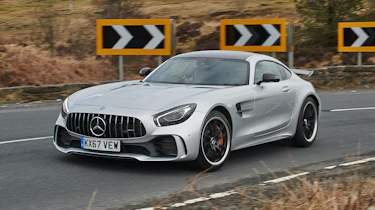
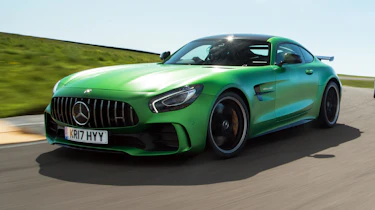
As Mercedes-AMG’s first serious stab at a rival to Porsche’s ultra-successful 911 GT3, the AMG GT R is a great success. It’s hugely desirable and genuinely credible, with star quality (no pun intended) and its own distinct character. As a road car the GT R delivers a distinctive and dynamic driving experience: one that’s unique among front-engined, rear-drive supercars.
On track, it’s a car that’s to be enjoyed rather than feared. With Race mode selected and the ESP system active in its most relaxed setting, you can work the GT R’s throttle hard with confidence. It’s bullet-fast out of the corners and down the straights, aided by a DCT transmission that delivers clean upshifts and snappy downshifts, complete with a fusillade of bangs and crackles through the exhaust. It’s still one of AMG’s most talented and complete super sports cars. We’ve established as much with extensive road and track testing against rivals.
Engine, gearbox and performance
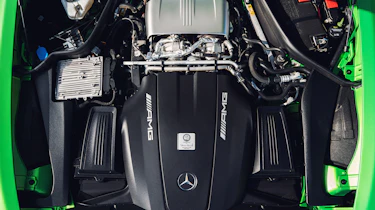
- The twin-turbo V8 is brutally performant, with old-school AMG character on the road
- Though it doesn’t feel entirely distinct from other versions of this engine in ‘lesser’ cars
- Gearbox solid for the most part, save for occasional downshift hesitation
Like all GTs of this generation, the heart of the GT R is AMG’s stonking M178 twin-turbo 4-litre V8. This engine might feel familiar thanks to its use across a whole generation of AMG models from C-classes to G-classes, but for the GT it was a specific iteration designed for AMG’s supercar and motorsport programs. There were a whole range of small detail changes, but the most obvious difference was its dry-sump layout, a feature that allowed AMG to mount it much lower in the chassis than other AMG models.

Given its placement at the upper end of the AMG range (later usurped by the AMG GT Pro and GT Black Series), the R increased its peak power compared to the standard AMG GT and GT S to 577bhp, together with 516lb ft of torque from just 1900rpm right through to 5500rpm.
More reviews
Group tests
- £200,000 supercar shoot-out: AMG v Aston Martin v Maserati v McLaren
- Porsche 911 GT3 RS (991.2) v Mercedes-AMG GT R Pro – battle of the road-racers
In-depth reviews
Reviews
- Mercedes-AMG GT2 review – a track weapon that’s almost too easy
- Mercedes-AMG GT63 4-door S E Performance (2023 - 2026) review – family saloon with Ferrari 296 power
- Mercedes-AMG GT 43 2025 review – £100k four-cylinder lacks Affalterbach soul
- Mercedes-AMG GT 63 S E Performance 2025 review – is AMG’s £190k hybrid hot rod its best GT?
- Mercedes-AMG GT63 Pro 2025 review – a four-seat Porsche 911 GT3 rival?
To achieve this, the turbo internals had been modified, engine mapping revised and boost pressure increased from 1.2bar to 1.35. AMG’s engineers have also altered the compression ratio, refined the exhaust port design, changed the way the boost pressure builds and fitted a new dual-mass flywheel that’s 0.7kg lighter than that fitted to the GT S – all with the aim of sharpening throttle response.
The transmission was the familiar seven-speed dual-clutch paddle shift gearbox fitted to the rest of the previous-generation GT range, albeit with a taller first gear, shorter sixth gear and a lowered final-drive ratio for increased in-gear urgency. Top speed is 199mph and 0-62mph takes just 3.6sec.
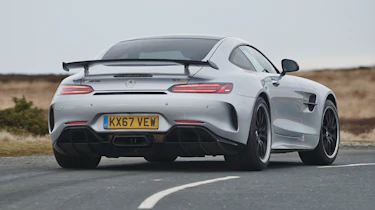
No one could ever doubt what a brilliant engine this is, but when essentially the same motor – complete with savage bent-eight soundtrack – can be enjoyed in a ‘small’ saloon at half the price, would it offer enough extra ‘something’ to really captivate the soul? In a word, yes. And then some.
From the moment it rips into life, to its shuddering idle akin to a cross-channel ferry about to leave port, the V8 is a constant presence, breathing hard through its twin induction tubes and blasting out hot gases through its triple tailpipes, spitting and crackling on the overrun.
Throttle response is so sharp it seems impossible that this car is turbocharged at all, a feeling compounded by the rich soundtrack that has the demonic blare of a late-1960s Trans Am racer. There’s something about the routing and design of the part-titanium exhaust that makes it sound as though there’s a fat, unsilenced side-exit pipe emerging from under the driver’s door.
Nevertheless, while there’s exhilaration in all this for the GT R driver, so much of the sensation is of a cramping self-restraint, for it would be ludicrously easy, so criminally indulgent, to point that long nose at the horizon and hold the rightmost pedal to the carpet.
Ride and handling
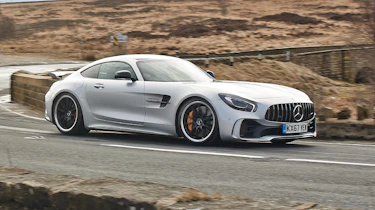
- Hardcore suspension set-up feels pretty serious in the GT R on the road at first
- Nine-stage traction control gives you enormous room to breathe and grow your ability
- But really challenging surfaces make the car skip and dent your confidence
Beyond the powertrain, the GT R was really about detailed engineering, with painstaking attention paid to the chassis, aerodynamics, weight reduction and structural rigidity.

Hidden beneath the skin are many trick components made from exotic lightweight materials. Carbonfibre is used for the prop shaft and torque tube, with magnesium used for part of the front structure. The battery is lithium-ion. The most obvious changes compared to the ‘narrow-body’ GTs are those made to the bodywork. Using a mixture of aluminium and carbonfibre, the front and rear wings have been stretched by 46mm and 57mm respectively to cover the GT R’s wider track.
The nose was the first AMG to gain the now trademark Panamericana grille, while the rear end wears an adjustable, full-width wing. In addition, active aerodynamics control a section of the underbody beneath the engine bay that automatically lowers 40mm (at 50mph in Race mode and 75mph in Comfort, Sport and Sport+), to create a venturi effect that reduces front-axle lift by some 40kg at 155mph as well as feeding the large double diffuser at the rear. In total, the R’s aero package generates 155kg more downforce at maximum speed than the regular AMG GT.
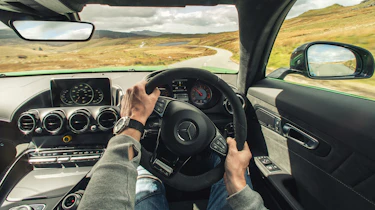
The suspension features adaptive coil-over dampers, which can be run in Comfort, Sport and Sport+ settings. Uniball spherical bearings are used to locate the lower rear wishbones for more precise control. There’s also a thicker tubular rear anti-roll bar. Up to a speed of 60mph the rear wheels are turned in the opposite direction to the front wheels, increasing agility by effectively shortening the car’s wheelbase. Above 60mph the rear wheels turn in the same direction as the fronts to increase stability.
Also new to the R was a nine-way traction-control system, which is controlled via a yellow rotary switch on the dashboard. It looks incongruous until you appreciate it’s very similar to that found in the GT3 race car. This system is accessed once you disable the regular three-stage ESP.
This car being an AMG model, you can work your way through the usual suite of driving modes to tailor engine response, damping and transmission characteristics via Comfort, Sport, Race, Race+ and Individual modes. And, of course, there’s a switchable exhaust mode to bring the thunder on-demand via the R’s striking triple-exit system, which features a large central tailpipe flanked by a pair of smaller outlets.
Other highlights include the lightweight forged aluminium wheels and ceramic composite braking system. Featuring 402mm front and 360mm rear discs, the braking system offers longer service life, greater resistance to fade and a significant 15kg saving in unsprung weight.
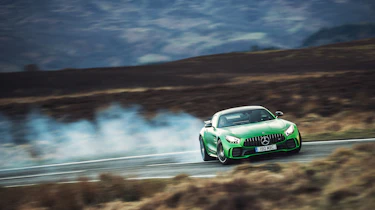
As AMG’s take on a 911 GT3, you’d expect the R to look the part, but crucially it feels it, too. The manually-adjustable seats grip you tight and place you low in the car, but you still get a great view down the sharply sculpted bonnet. Like with all AMGs, the engine starts with a boom, pulses at idle and roars with every prod of the throttle. It’s a loud and extroverted machine.

Out on the road the GT R feels hardcore. That’s as you’d hope, but it’s a very firm car, even in Comfort mode. On the plus side that means it’s sharp as a flick knife, cutting a clean line through the corners and revelling in rapid direction changes, yet thanks to the rear-steer it always feels more controlled. There’s greater feel and connection, too, so tapping into this dynamism and agility doesn’t feel like a leap of faith. It’s fun and blisteringly fast, but doesn’t rely on pure speed to deliver a memorable driving experience.
The car copes well with compressions, but has a tendency to skip across sharp bumps and crests, especially when you’re accelerating hard. Hit the wrong combination of road imperfections and it feels a bit like a skimming stone. Not crashing from bump to bump, but just struggling for rear wheel travel. You feel it and hear it in the slight rise and fall in the engine note as the rear tyres momentarily fight for traction.
On the smoothest sections of tarmac the Sport setting is good and delivers really tight body control, but on the whole Comfort is plenty stiff enough. On tighter, more marginal roads it can all be a bit much due to not only the stiff setup, but also the GT R’s physical size. It’s just too wide to really shine on the sort of roads that a GT3 shines on.
Anglesey track test – Richard Meaden
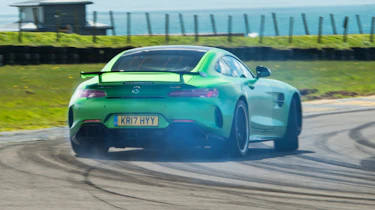
The GT R is a bruiser in the finest AMG tradition, but blessed with fleet feet and tailored around a package that’s a bit more compact and a lot more focused and tied-down than the less-than-fit-for-purpose Black Series models, which simply don’t feel cut out for track use.
The exception to this rule was the fearsome SLS Black Series – an all-time high point in AMG’s track-biased road car history – but still I’d say the GT R is the best road car AMG has ever made with track use in mind. This said, it still has some issues familiar from other AMGs. The gearbox is much better, but there are times where this seven-speed dual-clutch unit delays before giving you a downshift, and traction is still at a premium when you’re chasing the absolute limit.
Likewise, the brake pedal is occasionally inconsistent in feel and response, going a bit long but then coming back at your foot. You never feel like you’re running out of brakes – indeed you can work the GT R’s very hard and deep into corners – but there’s something about the pedal feel that lets the side down a little.
Chassis-wise, there’s a lot to celebrate. It certainly turns in really well, though there’s a slight lack of feel when doing so into the quick corners so you’re mindful of unwittingly asking too much from the rear by rotating the front end too aggressively. This is often the case with grippy, stiffly suspended cars, so it’s a statement rather than a major criticism, but it informs the way you drive the GT R on a fast lap.
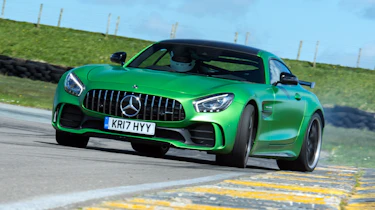
It’s in this split-second phase between initiating turn-in and collecting the throttle that the GT R will begin to oversteer. Fortunately the multi-stage stability control works extremely well, so you have the confidence to continue squeezing the throttle so that you can then use the electronics to maintain a slight oversteer stance and meter out as much power and torque as the tyres will take. Not losing time from being sideways, but not losing time from being held back by the electronics either, it’s truly impressive and very enjoyable.
You can trust and commit in the GT R, then, even through the high-speed, ballsy corners. The gearing feels a little short – you’re a gear up on the other cars in some corners – and this takes a little adjusting to as you expect AMGs to be big thumpers with a long stride, but once you’ve accepted this it’s never an issue.
The GT R is an inherently excellent track car. Always under you, always encouraging you to push harder, there’s never any question that it wants to be stretched.
It’s also willing to be driven for fun, rather than simply in the pursuit of a lap time. Given it’s not a racing car this is important, for although we’re benchmarking its outright pace, it’s ability to entertain that counts, or should count, more than bragging rights.
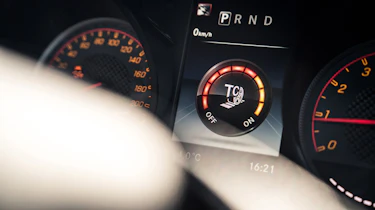
In the GT R you have a car that can remain tidy and lean on its high-fidelity electronics to transmit as much of its huge outputs to the track surface as its tyres will allow. Or, you can disable the electronics and drive it like a drift car.
Of course, the irony is that both these extremes aren’t especially appropriate in a trackday environment, but the fact there’s some middle ground to inhabit and enjoy suggests it is a car you can use to educate yourself with the finer points of discipline and commitment, or you can forget all that and simply grab it by the scruff of the neck and enjoy. Either way, you won’t find a more exciting, capable or competent driver’s car wearing the three-pointed star.
In terms of track pace, it consistently carries a little more speed – or at least stays with the best of them – through the slower corners. And thanks to the excellent traction control it makes effective use of what power it has.
Price and rivals
By the closing of production in 2022, the GT R’s price was listed at £158,285, getting closer to £180,000 when you add worthwhile options such as the composite brakes, forged wheels and lairy paint.
There are now AMG GT Rs on the used market for less than you’d pay for a new 911 Carrera, some even dipping below the £100,000 mark. That’s great value given this car’s ability and broad range of talents.
Its most obvious rival at launch was the Porsche 991 GT3, a car that was continually refined over its subsequent generations to be a constant benchmark that was always just out of reach from AMG. The later 992 took things even more seriously, and added a new level of performance and capability that did start to show the AMG up. The £100,000 region the AMG is now in will also buy numerous Audi R8 models, and gets you access to used McLaren 570 models too.
Yet AMG’s flagship is every bit as desirable as any of them, punches as hard and delivers abundant thrills in its own distinct way. It proved that AMG had found its groove, a super sports car that wasn’t dominated by its engine – brilliant though it is – but rather the way it syncs with the chassis and systems.
Specs
| Engine | V8, 3982cc, twin-turbo |
|---|---|
| Power | 577bhp @ 6250rpm |
| Torque | 516lb ft @ 1900-5500rpm |
| Weight | 1555kg (377bhp/ton) |
| 0-62mph | 3.6sec |
| Top speed | 198mph |
| Price new | £144,460 |
| Value Now | From £90,000 |