Gunther Werks Turbo review – part Porsche 911 Turbo, part hypercar
Gunther Werks has built a Porsche 911 Turbo with hypercar performance. Can it be worth £1.25million?

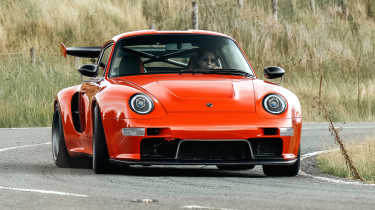
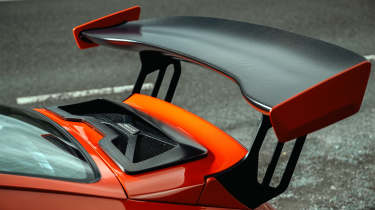
A complex metallic chunter vibrates through the ground as the car backs out of its trailer. When the rear wing appears before the bodywork, you know you’re dealing with something serious. The matt carbon, surfboard-sized main plane emerges into view, followed by the pearlescent orange end-plates, and eventually the unmistakable tapered tail of a 911. Except this is a 911 like no other.
The hips swell to a cartoonish width and wrap around Continental tyres that look as wide as they are tall. Then the car shrinks to the normal width of a 993 around the doors, before bulging out again at the front wings. When the whole car finally rolls into view, it looks like a de-stickered ’90s GT racer. Way over the top and about as wild and aggressive as road cars get. As we’ll find out, it drives like that too.

Gunther Werks has been around for nearly a decade, rebuilding air-cooled 911s as bespoke carbon-bodied creations at its base in Huntingdon Beach, California. Re-engineered from bare 993 chassis, they’re designed to offer the ultimate analogue 911 driving experience thanks to modernised, bespoke mechanicals, from suspension hardware to powertrain. As you can see, the aesthetic makeover is quite dramatic too, with extensively reworked bodywork (every panel is new) and a custom interior.
More reviews
If all that sounds similar to a certain other 911 restomod business on the west coast, the first thing to note is that the Gunther Werks doesn’t look or feel like ‘another Singer’. There are parallels, of course, but if Singer is Pagani, this is more Koenigsegg. Less of a moving art piece, more brutal and outrageous. It’s also more of a clash between modern and classic, you could argue. It looks spectacular, but elements like the bare carbon wing and centre-lock wheels don’t really blend with the classic 911 shape. Likewise the interior, which is a little on the glitzy side with gold detailing, naked carbon door panels and body-coloured footwells. It’s undeniably special and well-finished though, and there is of course scope to spec almost any trim or materials of your choosing.
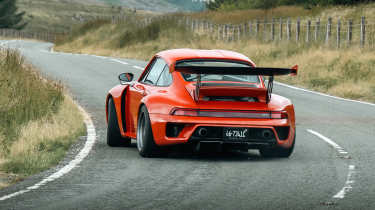
This is the Gunther Werks Turbo, of which just 75 will be built, costing from £1.25million apiece. You can pick out the Turbo over other Gunther Werks 911s by its even more aggressive bodywork with extra cooling inlets – and, if you look closely, the twin turbochargers glinting at you through the lower vents in the rear bumper. The stats are absurd: 840bhp and 660lb ft of torque from a 4-litre flat-six built by motorsport specialist Rothsport Racing, a kerb weight of 1265kg and a power-to-weight ratio of 675bhp/ton, which is higher than an Aston Martin Valhalla’s. Oh, and it’s rear-drive only…
Managing all that requires an extensive reworking of the 993’s chassis, aero and suspension. There’s a front strut bar and a wider, race-spec front track, bespoke suspension arms and uprights, upgraded bushings, new anti-roll bars and revised geometry. All this works with a JRZ active damper system tuned specifically for the Turbo, and a much wider wheel and tyre package. The 18-inch forged magnesium wheels are fitted with Continental ExtremeContact rubber, measuring an enormous 295-width at the front and 335 at the rear. As well as the rear wing (which can be swapped for a lower-level spoiler), the Turbo also gets a vented front bonnet to accelerate air over the top of the car, a double-bubble roof to direct flow towards the engine, and a rear-end treatment that shortens the path for airflow to reach the twin turbos.
First, the biggest test of all. How good is an 840bhp classic 911 Turbo at going slowly, and nipping through Welsh towns at the foothills of Snowdonia? The intimidation factor is very real to begin with, but, once inside, the Turbo’s fundamentals are familiar 993, from the thin pillars and expansive glasshouse to the floor-hinged pedals, and even down to the slightly offset driving position that skews you towards the middle of the car. Twist the key and the low-frequency timbre of the engine pulses through the shell, accompanied by the churning of the transmission. The gearbox is a six-speed Getrag unit with custom ratios and a bespoke shift mechanism, with a short, heavy action. With so much torque, it needs just a tickle of throttle to get moving, but the heavily sprung clutch means you need a precise left foot to pull away smoothly.
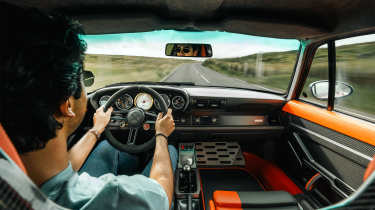
That’s about the only tricky part of driving the Turbo at normal speeds. It’s perfectly happy creeping around in first or second, the engine surprisingly tractable and smooth at low revs. You’re conscious of the enormous width at the back, the rear Continentals sometimes thumping over cat’s eyes, but you can place it easily, aided by the clear view out and beautifully precise steering. It’s heavy at parking speeds but superb once underway, accurate and perfectly weighted. Feeling raw and racy but not out-of-sorts on the road is a tricky balance to pull off, but the Turbo does it.
The temptation to nail it and feel the full force of the turbos is ever present, and when the first bit of wide, straight road presents itself, the Turbo is rabid. The lack of mass helps it shunt forward from low revs, then at 4000rpm and beyond it explodes forward with immense force. There’s a gritty flat-six howl and hissing from the turbos as the revs pile on, the needle whipping around the central tacho faster than you can move your hand to change gear. After the first pull through first and second gear, photographer Aston Parrott is wailing from the passenger seat, in shock at how rampantly the Turbo accrues speed. Then we realise we’re not even in the most powerful mode…
A button on the wheel allows you to cycle through Comfort, Sport and Track engine maps, corresponding to 513bhp, 650bhp and 840bhp. Switching up from Sport to Track is a dramatic change. The upward kick in the power curve at 4000rpm is even steeper and the Turbo goes into warp drive, feeling hypercar-quick at full throttle. You need to scan the road far ahead to anticipate curves or bumps that will graze the underbody at such speed – it’s a wild ride, and there are very few places you can give it everything for more than a fleeting moment.
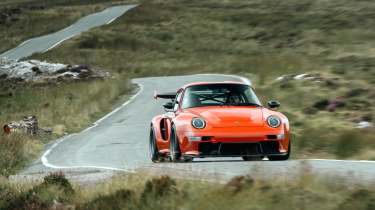
The higher power modes give the chassis more of a workout. The active dampers control roll, pitch and heave 100 times per second, with three switchable presets available via a rotary dial on the dash. In the softest mode the ride is tough and connects you clearly to the surface, but it’s still usable. At speed you’ll want a little more support, the rear squatting under power and the front going light in typical 911 fashion. Sport tightens things up and is the pick for most surfaces, with Track offering uncompromising control at the expense of being far too busy and stiff when the roads aren’t smooth.
Running to the 7800rpm rev limit in Track mode is fun for its sheer intensity, but after a while you end up calming things down to more manageable speeds, at which point there’s still plenty to enjoy about the Turbo. For one, you can short-shift and enjoy the sensation of it being turbocharged, boost building and tailing off according to throttle and revs. You can also enjoy the hefty gearshift and how snappily the engine responds to the lightly weighted throttle pedal, with very little inertia when dipping the clutch and blipping for a downshift.
There’s a satisfying, motorsport edge to the car, and a physicality that rewards you for putting the effort in. The same applies to the Brembo GTR brakes – the pedal is firm and needs a hard push to get anywhere near the ABS. This makes modulation more precise at the limit, but on the road I’d prefer more easily accessible stopping power.
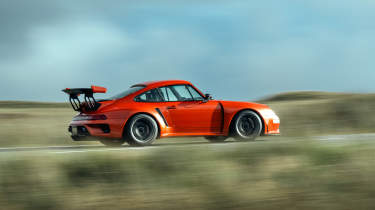
It’s true that this physicality and focus takes some of the delicacy out of the classic 911 experience, the Turbo feeling locked-in and laser-guided, less expressive in its handling. The enormous amount of rubber on the ground plays a part in that, generating massive grip and stability but not allowing you to freely play with the balance of the car. For the most part that’s a good thing, because it means you can lean on the Turbo and deploy its massive performance with confidence, diving hard into corners, feeling the load build through the steering and slingshotting out the other side thanks to immense traction. It jostles and tramlines over bumpy sections, but on a smooth, flowing road it carries speed effortlessly, with a wonderful sense of it tucking into corners and pivoting around its centre.
The scare-factor is there if you go looking for it, though, because there’s a very small window to work with when overcoming the Turbo’s huge grip. Which end of the car breaks away first, and how, is entirely dependent on your technique and how you use the boost. Catch it at low revs on the exit of a corner and it’s the front that scrubs wide, without enough power to bring the rear into play. Stay committed to the throttle, however, and that understeer can turn into a sharp snap of oversteer when the twin turbochargers fire, which needs very quick hands to catch.
The best approach is to set the car up early in the corner, doing most of your turning while off the throttle or on the brakes, allowing you to exit with a straighter wheel. This means when the power does come, it’s a more subtle squirm at the rear that doesn’t need much corrective lock. Consistently driving in this window is tricky, which makes it satisfying when you get it right, but a little frustrating that you can’t reach those peaks for corner after corner.
That’s not to say the Turbo isn’t hugely involving and exciting below the limit. It’s a visceral and raw car to drive, the feedback, sounds and sheer speed keeping you fully engaged at all times. It bottles up the character and primal excitement of a turbocharged 911 and delivers it with maximum intensity – perhaps without the nuance of the very best restomods, but with enough depth and capability to support its outrageous performance.