Porsche Macan GTS Electric 2026 review – the sweet spot in the range, but it’ll cost you
The GTS is the best electric Porsche Macan yet, with a detuned Turbo powertrain and standard-fit chassis upgrades. The price? A rather punchy £89,000…

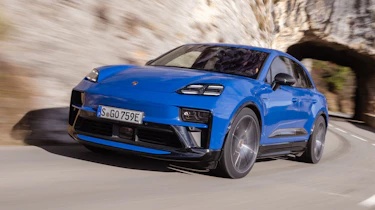
We were deeply impressed by the electric Porsche Macan when we first drove it in 2024. As Porsche’s first step into the mainstream EV market it had pretty much all bases covered: a new 800-volt Premium Platform Electric architecture shared with Audi meant it was bang up to date in terms of range (not far off 400 miles) and charging speeds (up to 270kW), but most importantly, it felt like a Porsche – precise, nuanced and a world away from the technically related Audi Q6 e-tron in terms of its dynamics. Quick too – a bit of a monster in fact, as a 630bhp Turbo. At the time we described it as ‘one of the most rounded and capable EVs of its type’.
However, that impression unravelled slightly when we drove a wider range of models. As it turns out the electric Macan is very sensitive to spec: as well as being offered with rear or four wheel drive and numerous power levels, you can specify it with coil springs or air suspension, with or without PASM adaptive dampers, rear-wheel steering and a torque vectoring rear axle. Without all the fancy hardware, it feels like quite a different car. Still competent but less sophisticated, busier and a bit scrappy at times on a bumpy road, lacking finesse.
That’s where the new GTS comes in. In theory it should be the Macan at its best – Porsche calls it the most dynamic and ‘emotional’ model in the range, packing cherry-picked chassis options while being cheaper than the Turbo (still a very punchy £89,000, compared to £97,500) and not having the headline 600bhp+ power figure of the flagship – which, let’s face it, no one really needs.
More reviews
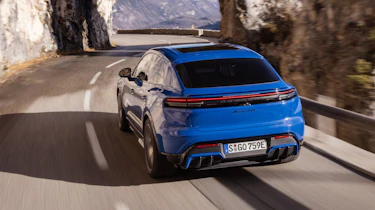
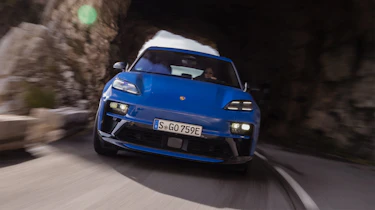
We’re used to Porsche GTS models standing apart from the rest of the range and being meaningfully sharper and more driver focused – some, like the 911 GTS and now-dead 718 GTS even have bespoke engines to support this character shift. For the Macan GTS, however, the chassis changes are quite mild, consisting of 10mm lower air suspension, retuned roll bars and adaptive dampers, while engineers say there's no special sauce in the steering or geometry. The dual electric motor setup, meanwhile, is carried over from the Turbo with the same PTV Plus torque vectoring rear diff, and software capping power to 563bhp. Yes, there are design tweaks and Race-Tex suede trim inside, but you might expect more comprehensive changes for a GTS – particularly since most of the standard-fit chassis options can be specified on the lesser 4S at extra cost.
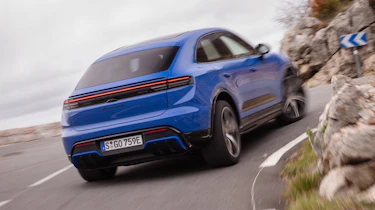
These concerns melt away quite quickly when you drive it, however. It may not be a significant mechanical evolution, but the GTS is very sweet to drive. Intuitive and precise from the first turn of the wheel, and really satisfying to flow from point to point – surprisingly so for a 2395kg lump of electric SUV. On the move it feels like it sheds two or three hundred kilos from that figure.
Having more grunt than a BMW M3 helps with that, of course, so too the rapid response of the motors. In normal driving they develop a combined 509bhp, but on overboost with launch control enabled that rises to 563bhp, with torque peaking at a stonking 704lb ft. 0-62mph is ticked off in 3.8sec but in reality the GTS feels a good bit quicker than that. It kicks up the road with enormous force, the combination of instant response and strong traction giving you immediate access to the performance – even on a damp surface, where Porsche’s ePTM traction management system precisely metres out the torque from low speed, with only a little scrabbling from the wheels.
The motors are powered by the same 95kWh (usable) battery pack found in other Macans, mounted within the floor and delivering 362 miles of range. That’s 14 miles fewer than the 509bhp 4S, and four miles less than the more powerful Turbo, strangely. The GTS comes with 21-inch wheels as standard rather than the Turbo’s 20s, which must be a contributing factor. Topping up the battery from 10-80 per cent takes 21 minutes thanks to 270kW charging capability.
The GTS’s rear motor is a bigger unit from the Turbo (all Macans share the same front motor) and mounted behind the rear-wheels, 911-style. Before you get excited that doesn’t mean you drive the Macan like a rear-engined car, hustling it using weight transfer and working the masses at both ends. The weight balance is a relatively even 48:50 front-to-rear split, and at road speeds the handling is prescriptive rather than truly playful. Instead it’s about carving precise lines, leaning into the control and tied-down feel of the air suspension and, when necessary, making sure you shed enough speed for tighter corners. With so much power moving so much mass, the GTS builds momentum very quickly.
Thankfully, the brakes are up to the job. In normal driving most of the retardation is handled by regen, with the friction brakes blending in when pushing deeper into the pedal. The feel is intuitive, much more so than in a Taycan, strangely, which has a lighter initial travel that’s trickier to modulate.
There are three drive modes to choose from – Normal, Sport and Sport Plus, as well as a track setting that increases battery cooling to reduce performance drop-off at sustained high speeds (included in the GTS’s standard-fit Sport Chrono pack.) Cycling through the modes ramps up the powertrain response and stiffens the adaptive dampers, with Sport Plus activating a GTS-specific synthesised engine noise. At ‘idle’ it’s a bassy, almost V8-like rumble, and on the move it’s a useful reference point for your speed, throttle position and rate of deceleration, changing in pitch and tone according to your driving.
After Sport Plus (or Sport, which uses a driving sound shared with other Macans) the silence of Normal is quite stark, so too the overall character shift. With a much calmer throttle and softer damping it’s as if all the energy has been sapped from the driving experience, but it makes the GTS impressively refined and easy to drive smoothly at normal speeds. The duality is impressive, particularly given that EVs so often feel one dimensional in terms of character.
In Normal mode the GTS is still controlled – it doesn’t waft along with the body moving freely on its springs – but the balance between comfort and connection is nicely judged. Sport is the mode of choice on a winding, technical road, providing better control of the mass over undulations, with Sport Plus being a step too far on most surfaces, too busy and reactive. Delve into the drive mode menu and you can mix and match damper and powertrain settings, however, giving you the sharper throttle of Sport Plus with the happy medium of Sport damping.
Configured this way, the GTS is not only immensely fast across the ground but sharp, consistent and keen. There’s definite Porsche DNA in its steering, which is crisp and linear – even on the Continental winter tyres fitted to our test car. In tighter sections the optional rear-wheel steering – which should, at this price, be standard – pivots the car into corners and aids agility without feeling unnatural. You are conscious of the considerable mass beneath you, but not in the sense that the Macan doesn’t feel keyed in and controlled.
Charge into a corner with too much speed and there’s a reluctance for the front to bite and the weight to change direction, but you aren’t often encouraged to reach and explore these limits. Unlike, say, a Hyundai Ioniq 5 N, Macan isn’t that kind of car. While it does feel rear biased and can be playful as it squirms out of hairpins under power, it’s more about precision and competence than fun.
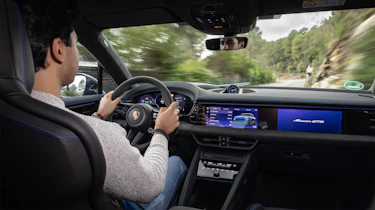
Enjoyable and polished it certainly is, though – more so than any Macan in standard spec. And as well as the included chassis options, it gets extra equipment over the 4S to justify its £12k higher list price, including LED Matrix headlights, 18-way adaptive sports seats, a heated steering wheel and a Bose sound system. As with other Macans the cabin is clean and functional rather than sumptuously designed – there’s a bit too much plain black plastic for our liking – but build quality is good, and the knurled climate control switches on the centre console are a tactile delight. The central infotainment display is fast and intuitive too, although the optional passenger display (which has a directional filter to make it invisible for the driver) seems like overkill. Looking down to watch a movie on the dashboard is the perfect recipe for car sickness.
Price and rivals
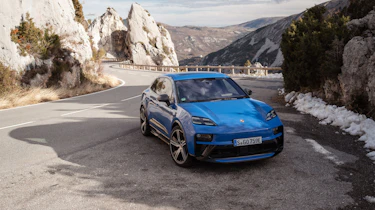
The GTS does feel like the sweet spot for the electric Macan range, but it comes at a price: a very punchy £89,000. That puts it around the same level as the Polestar 3 Performance, which has a similar range figure, a quicker 350kW peak charging speed and over 100bhp more. Numbers are only part of the story, however, and the Macan’s real strength is in its dynamic ability and bandwidth.
If you’re after an engaging EV, however, the answer is still Hyundai’s Ioniq 5 N. It’s not as plush or premium as the Porsche but its sense of fun and involvement are unmatched by any mainstream EV, thanks in part to its ability to simulate an internal combustion engine and gearbox. It’s also substantially more affordable than the Porsche at £65,800. You could also consider Alpine’s A390 GTS for £69,390, but while it has a torque vectoring rear axle and slick dynamics, it’s not as thrilling or engaging to drive as the 5 N. It may, however, be a closer match to the Porsche in that regard.
In terms of combustion-engined rivals, the GTS has BMW’s X3 M50 (£75,440), Audi’s SQ5 (£72,825) and Mercedes-AMG’s GLC 53 to contend with – plus the petrol-engined Macan GTS, which remains on sale alongside the EV for £75,000.
Other alternatives from within Porsche’s stable are the electric Macan 4S and Turbo, positioned either side of the GTS. The flagship does offer more performance but costs nearly £100k, and the GTS is already more than quick enough and just as competent dynamically. The 4S gets within a two or three grand of the GTS’s list price with the same core chassis and equipment options ticked, but does without the GTS’s more powerful rear motor, suspension setup tweaks and design upgrades.