Porsche Taycan Cross Turismo review – as appealing as jacked-up estates get
A convincing play at being the ultimate everyday driver of the future. It’s heavy and doesn’t have enough range, but there’s lots here to like

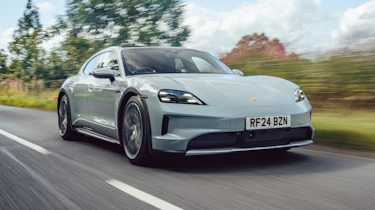
You could be forgiven for thinking that the Porsche Taycan Cross Turismo is evo’s worst nightmare. Not only is it a 2.3-ton electric vehicle, but it’s also a rather unusual form of crossover, and let’s be honest, that particular genre has yielded some of the most pointlessly compromised and thoroughly vacuous vehicles ever to pass down a production line. The Vauxhall Adam Rocks. The BMW X6. It’s a rogues’ gallery, make no mistake. The Taycan Cross Turismo is an entirely different proposition, however.
Motors and performance
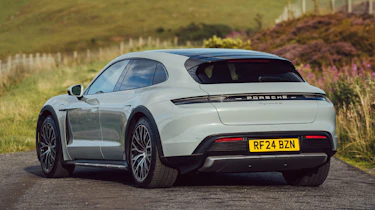
- Available in 4S, Turbo and Turbo S guises
- All Cross Turismos are AWD
- Turbo S can hit 62mph in 2.5sec and produce 938bhp in boost mode
You may have seen footage of it flamboyantly blasting along gravel tracks like a doomed prototype enduring destruction testing, but while it will indeed do that (at potential cost to the underside of the car if you’re brutal about it), this isn’t some jacked-up Taycan with phoney off-road pretensions. It may have plastic wheelarches and, yes, its default suspension setting is 20mm higher than a Taycan saloon’s (or 30mm with the off-road package that makes the default level ‘High’ and includes the extra sill cladding and winglets shown on this car), but it can also be lowered to somewhere between Low and Medium on a saloon. Got all that? Good.
Crucially, thanks to the fundamental packaging of electric vehicles of this kind, when you’re standing beside the Cross Turismo it feels every bit as low and lean as the Taycan saloon. The result is a car with massive presence – one that turns heads more than its maker’s sports cars. It is unmistakably a hyper-estate.
More reviews
In-depth reviews
Reviews
- Porsche Taycan Turbo GT Manthey review – by far the most capable Taycan, but at what cost?
- Porsche Taycan E-Shift review – Hyundai-style fake gears here to up engagement in Porsche's electric saloon
- Porsche Taycan GTS Sport Turismo review – why this is the only everyday electric performance car you need
- Porsche Taycan RWD 2025 review – a good car at a good price, but mind that depreciation
- Porsche Taycan Turbo GT Weissach Package review: two seats, 1020bhp and £186,300
The range has been slimmed down for this facelift, with the Cross Turismo now only available in 4S (510bhp), Turbo (697bhp) and Turbo S (764bhp) guises. Those figures rise in boost mode when using launch control, to 589bhp, 871bhp and 938bhp respectively, informing the frankly astonishing respective possible acceleration figures of 3.8sec, 2.8sec and 2.5sec to 62mph.
Ride and handling
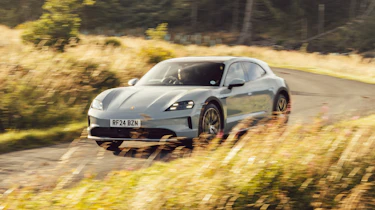
- PTV differential and rear-steering standard on Turbo models
- Active ride optional on all, including the £164k Turbo S
- Refinement and capability strong, raw enjoyability not so much
All Taycans now come as standard on air suspension, with Porsche’s hydraulically cross-linked Active Ride system a £6476 option. The new E-Shift system with its fake gears and paddle shifters that adds at least £3000 to the price once the essential Sport Chrono and higher-spec surround sound are added. Optional on 4S but standard on the Turbo and Turbo S is Porsche’s Torque Vectoring Plus rear differential, for £1157. Likewise standard on Turbo and Turbo S is the rear-steering system, that’s £1592 on the 4S.
Where the Porsche Taycan has always shined is how it holds itself on the road, and the 4S Cross Turismo I tested is equal to its regular ride-height cousins. Whisper quiet and silky smooth the lightness to the Taycan’s controls may be at odds with Porsche’s more thoroughbred sports cars but they match the nature of the car adding a level of refinement none of the brand’s combustion engined cars have ever achieved.
Its instant, linear responses provide the refinement expected of an electric car, with a seamless flow of energy, tight body control but a supple ride and responses from its steering and powertrain precise and controlled and with an almost mechanical level of tactility.
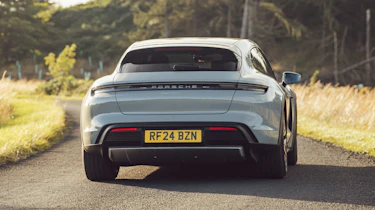
Up the pace and the adaptive chassis earns its keep but can be caught out by bigger camber changes in the road and mis-corner lumps and bumps. It also lacks that last 15 percent of detail when you push further to its limits, that feedback and detail fading away when you need it most.
Restraint is required when enjoying the car’s dynamic ability. Make no mistake, it has plenty; given its size and weight it can hustle along with a rabid intensity that verges on the alarming, aided by unshakeable four-wheel-drive traction and freakish agility, boosted here by optional rear-wheel steering.
It’s only when you enter a classic 90-degree B-road corner a little hot that the realisation of how much mass is rocketing along suddenly hits you – how big a hole in the scenery you’d punch if things really got out of hand. And because of its size and weight, and the rather two dimensional act of driving an electric vehicle – just two pedals, no engine sound, although there is a synthesised soundtrack – the Cross Turismo really needs the right roads if you’re actually to gain any of the ‘Thrill of Driving’ from it.
On the lanes of the Home Counties driving it hard can all feel a bit reckless, and not that enjoyable. This is an estate car, with a raised ride height and not a Porsche to get your adrenal glands working overdrive. They still make 911s for that.
Interior and tech
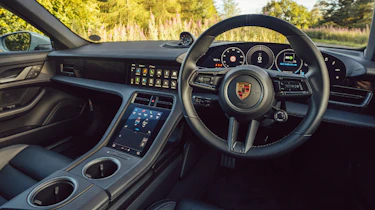
- Still a high quality and refined place to be
- Practicality is reasonable, if not amazing
- Tech and UI have been updated to keep the Taycan reasonably contemporary
The car feels very comfy-cosy indeed from behind the wheel in its stylish cabin, a glance over the shoulder revealing that this particular car has the ‘4+1’ seating option, which, yes, you do have to pay extra for. Obviously. Despite this being such a large car the rear accomodation is still centred around comfort for two, with the middle pew a more occasional perch. And while the idea of the estate body promises a lot more space, the luggage capacity only rises by 39 litres with the rear seats in place, although there’s a useful 1170 litres in total with them folded.
More than six years on from its launch the interior still works simply, and is simply brilliant as a result. The digital instrument display is integrated far more cohesively than it is in a 911, the centre console and its screen the result of someone taking the time to design them as an integrated piece of product design rather than think of it as an afterthought.
Refinement remains at the top of its sector regardless of some of the new incumbents, although the Lotus Emeya can match and surpass the Porsche for feeling a little more special if specced correctly.
Range and efficiency
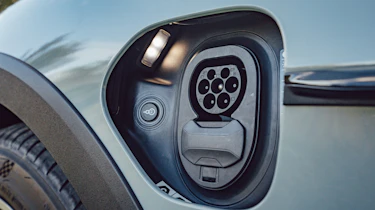
- c370 miles of claimed range
- Closer to 250 miles in the real world
- Charging speeds greatly increased and improved
Stated range is one thing and indeed, very impressive if taken as read, right around 370-380 miles overall for all Cross Turismos. Like many big electric cars the Porsche Taycan 4S Cross Turismo is at its best when treated as a GT car, although this does highlight a technical issue: range. Stated range is one thing and indeed, very impressive if taken as read, right around 370-380 miles overall for all Cross Turismos but we saw closer to 240 in the real world, even with its increased 97kWh (usable) battery capacity. That limits its impressive capability in daily use.
That’s not helped by a charging network that’s still not quite up to the standards parts of Western Europe set, either in terms of speed or the amount of chargers in the infrastructure. The Taycan’s stated charging speed of 320kW is impressive. More-so that it can deliver on that claim, ramping up and accepting charge quickly when plugged in to a quick enough charger. If you’ve the ability to charge your car at home, that’ll help enormously and increase the appeal even further of what is a deeply impressive crossover alternative.
Prices and rivals
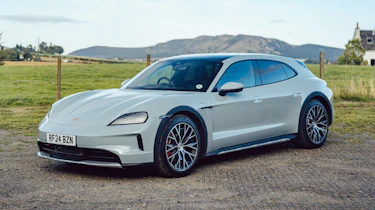
The Taycan Cross Turismo channels many Porsche attributes, and a reassuringly expensive list price is one of them. All Cross Turismo’s come as standard with a dual-motor setup, the basic 4S costing from £99,465. The Turbo starts much higher, at £138,265, and the flagship Turbo S rocks in at a dizzying £165,265.
Five years on from its introduction, no one else is doing a jacked-up estate crossover-style EV. Perhaps because the Cross Turismo is a niche version of a car that’s the opposite of the sales darling it once briefly was. Electric SUVs are, however, still ten a penny. From Porsche itself, you could have the Macan EV or Cayenne EV. From BMW, the range hero iX3 or aging iX.
If you don’t want the jacked-up experience, there are a couple of alternative estates. Porsche still sells the Taycan Sport Turismo and Audi has entered the fray with the S6 e-tron, available in Avant form. If a saloon will do just fine, Lotus’s Emeya, Polestar’s 5 and Audi’s e-tron GT remain, with Mercedes-AMG’s GT 4-doorhttps://www.evo.co.uk/mercedes/amg-gt/207847/the-new-mercedes-amg-gt-4-door-is-a-1153bhp-answer-to-the-porsche-taycan and Jaguar’s Type 01 on the way.