BMW i8 (2014-2020) review – futuristic hybrid sports car now looks a bargain
The BMW i8 was a very different sort of 911 rival, not least because it used a hybrid system with a Mini engine mounted in the middle and a carbon tub
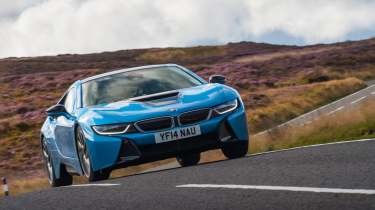
While the i8, BMW’s vision of the future of the sports car, didn’t resonate with buyers at the time of its release in 2014 (or throughout its six-year term of service) it’s become the very definition of a car that was ahead of its time. There are more sports and supercars on the market now that do incorporate some form of hybridisation than don’t. Even apart from its prescience, the i8 is an interesting machine, featuring an advanced carbon construction, dramatic styling and a genuinely appealing if atypical driving experience.
We’ve always been fond of the i8 at evo, even seeing fit to include an example in evo Car of the year 2014, where it finished sixth – ahead of BMW’s own F80-generation M3 in ninth. While we’d ultimately choose a Porsche 911 for a twisty road or racetrack, the i8’s ability to provide a different, more cerebral king of thrill, while delivering fine fuel economy and excellent long-distance comfort made it a genuine pleasure.
There were signs BMW was thinking about a new sports car as early as 2009. As is often the case, the German brand previewed its early ideas with a concept, 2009’s Vision EfficientDynamics. The concept was more M1 than 1M in its form factor. By the time of the i8 production car’s launch in 2013, the full glass doors had gone, though the McLaren-style butterfly opening mechanism and, in fact, most of that supercar style was retained.
Engine, gearbox and performance
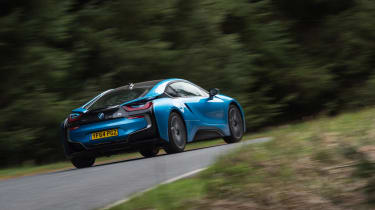
- The three-cylinder’s thrum is backed up by instant electric surge from the hybrid system
- It’s a strong powertrain, if a little synthetic in feel when pressing on
- Official driving range is 22 miles on the early models, 34 miles on 2018+
More reviews
Under the skin though, the i8 is very different sort of exotic. The drivetrain paired a mid-mounted, Mini-derived 1.5-litre three-cylinder turbo (making 228bhp) with a front-mounted electric motor (129bhp). Performance was close to Porsche’s 911 Carrera of the time, with a 0-62mph sprint of 4.4 sec, aided by all-wheel drive traction thanks to a front electric motor. While a 155mph top speed won’t set any records the i8 still offered that important grand-tourer quality of having something in reserve even if big numbers are already showing on the speedometer.
> BMW i8 – the car world's greatest misses
Driving it remains a unique experience. You can creep around in EV mode for a decent distance (a good 30-ish miles in later models, thanks to a 11.6kWh battery pack rather than the original 7.1kWh) and at respectable speeds, though the sensation of the front wheels pulling you around is an interesting one in a supercar-style BMW. The electric assistance does make for plentiful punch when you ask for it though, and the three-cylinder engine makes an interesting noise, augmented through the cabin speakers.
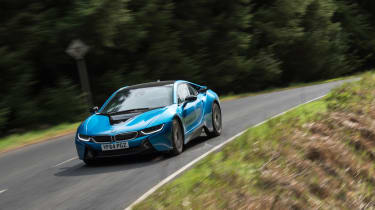
The complicated drivetrain demanded an equally ingenious transmission. Essentially, power from the petrol engine is transferred to the rear-wheels using a six-speed auto and the front handles the electric motor using a two-stage automatic box. The driver controls the six-speed either by leaving it in auto mode or via the shift paddles on the steering wheel.
What’s most impressive with the performance of the i8 is how the two systems work together to create a very clever four-wheel drive setup. They both fill in for each other, with the electric motor providing power at the lower end of the rev range and the turbo three-cylinder unit filling in at the top.
Two of the i8’s most glaring faults also chipped away at its GT-like qualities. One, luggage space was poor, though in the fixed-roof model the rear seats were adequate for extra storage. And two, with two power sources and a bank of batteries crammed into a mid-engined car, the supermini-sized 42-litre fuel tank means reasonably regular stops at motorway speeds – around 300 miles, give or take. The i8 got a power boost that coincided with the Roadster’s introduction in 2018, for a combined 369bhp. Sadly, it wasn’t around for long before the i8’s discontinuation in 2020.
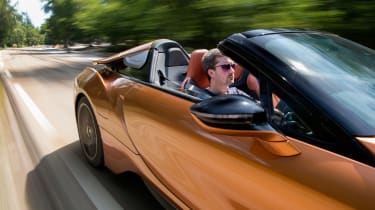
‘This hybrid really hustles out of tight corners, the front motor compensating for any hesitation that might be present in the turbocharged triple’s responses. It’s like someone has released the rope on a trebuchet as you squeeze the throttle and feel an instant, proportional urge in your intended direction.
‘Better still is the noise. The three-cylinder has a characteristic tone, and its clear, electronically enhanced sounds actually feel appropriate. The i8 is such a technological car there’s none of the incongruity you get with piped-in noise in a simplistic hot hatch or traditional sports car. The real thrill comes from surging into and out of every corner accompanied by the wooooooeeeeeee of the electric motor harvesting and delivering its power… like sitting on board an R18 e-tron or Porsche 919 as it brakes deep into each chicane on the Mulsanne and brawls out of the other side.’ – Antony Ingram, evo 258
Ride and handling
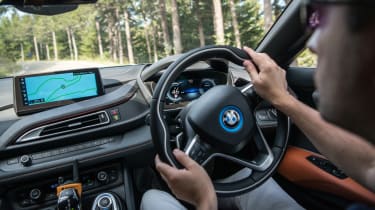
- Unique powertrain makes for a clever and willing four-wheel-drive system
- Skinny eco tyres means it lacks the focus, bite and feel of a proper sports car
- But drive it with a more considered approach and it is rewarding
Like the upright i3 electric city car, the i8 used a carbonfibre (CFRP) central tub, to which subframes were attached at either end carrying the engine and motor. This kept the car relatively light despite the need to stow heavy batteries and a pair of powertrains – BMW quoted a kerbweight of just 1535kg, so well within the Porsche 911 ballpark.
In everyday driving, the i8 is refined, it rides comfortably for a car of such performance and there are no histrionics from the complex drivetrain around town. When in electric-only mode it has enough straight-line performance to dismiss most traffic away from the lights, all without making anything more than a distant hum. Nevertheless the i8 always fell a little way short of more conventional rivals for outright thrills – but it is better to drive than we imagined it would be.
One of its dynamic weaknesses is the brake pedal feel, which was hampered by the same sort of inconsistency when marrying the efforts of friction and regenerative braking, some manufacturers still struggle with today. The steering too can come across as remote and lifeless and the ultimate lack of grip across the front axle thanks to the tiny 195-section front tyres initially frustrates.
Compared to some fat-tyred M-cars though, there’s a novel glassiness to the i8’s gait. The slim rubber does make for understeer in some conditions, but tune in to the way the i8 does things, accelerating and decelerating smoothly and guiding rather than hustling the car and it can satisfy in its own unique way.
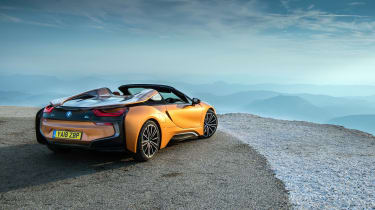
BMW introduced the i8 Roadster in 2018, which was very literally a coupe with its roof cut off – BMW’s engineers realised the carbon tub’s structural stiffness was more than up to the task, though they still installed extra bracing anyway, leading to a 60kg bump in kerbweight.
evo Car of the Year 2014 - Henry Catchpole
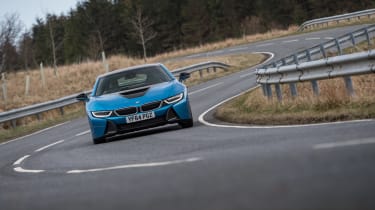
‘Everything is very serene for the first few miles as I just enjoy the various sensations. Even when the little 1.5-litre turbocharged three-cylinder kicks in, the refinement of the whole car is so good that it still has an air of calm about it. The steering is very light and lacks any real feel, but it’s also clean and precise and the overall effect is one of ease as you guide the car through corners.
‘The supreme ride only enhances the grace of the whole thing. Up the pace and you find that you mustn’t push the front tyres too hard otherwise their relatively narrow contact patch will wash into understeer. In fact it seems that the less lock you can apply, the better. It encourages you to be very economical with your inputs and carry speed, occasionally adjusting a line mid-corner very subtly with the throttle, but mostly making use of the instant torque delivery on the exits.
‘In terms of pace it feels on a par with the Cayman [981 GTS] across the ground and there are plenty of times when you really do forget the whole hybrid angle and just enjoy the i8 as a fantastically accomplished 357bhp sports car. Yes, if you look at the dials then you can get quite fixated by what’s going on, but the technology is so well executed that if you’ve got a good bit of road or another car to chase in front of you then you can simply enjoy driving and the innovative engineering melts into the background.’
Interior and tech
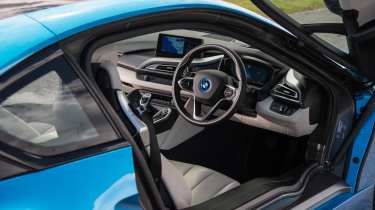
- Old BMW iDrive system was good, but takes away the i8’s uniqueness
- Materials, quality and practicality not great
- The theatre of the tub and doors is great
Dihedral doors kick off the i8's interior experience, with high sills from the carbon fibre reinforced plastic tub making ingress and egress a little difficult. A large transmission tunnel separates driver and passenger, but strangely despite its size, there is very little cubby or storage space. Rear seats are usable although only for younger passengers.
The rest of the interior, although eco-friendly, doesn't feel anywhere near as special as the car looks from the outside. The materials used aren't as premium to the touch as the less environmentally sound stuff you would find in other top-spec German cars.
The iDrive system and driver’s display didn’t look or feel particularly special when new certainly looks and feels their age now. All the same, being related to other BMWs of the era, they work reasonably well.
MPG and running costs
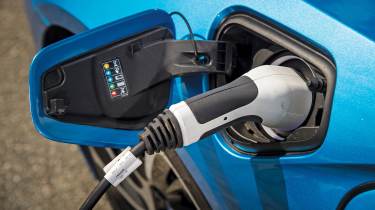
- The official 100+mpg figure was a fantasy
- But 35-40mpg and more is possible with diligent charging
- Brakes and tyres are modest and therefore cheap
As you’d expect, the i8 was an emissions focused car. It’s possible to run it completely on electricity for 22 miles at speeds up to 75mph, or alternatively, use the combination of the two power sources while the car is set to EcoPro mode to achieve a 330-mile total range. Fuel consumption is a claimed 134mpg, but don’t expect to see that in real world usage – somewhere between 35 and 40mpg in normal use is much more realistic and still impressive for a sports car.
The bottom line is, the i8 is going to be more efficient in day-to-day use than virtually every other conventionally powered sports car. The i8 makes most sense, economically and practically, when the owner can regularly charge it – perhaps at home and at work.
The i8 will look after you in terms of regular consumables. The engine, while more difficult to access for servicing, comes from a Mini, so shouldn’t break the bank in terms of parts. Likewise the relatively modest brakes and skinny tyres will attack the wallet with a far lighter touch than most ‘proper’ sports and supercars.
12,500 miles in a BMW i8 – Stuart Gallagher
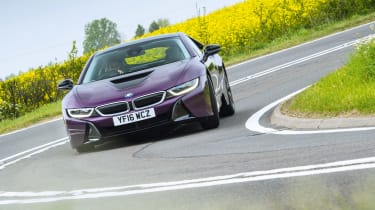
'The car that doesn’t win the group test or float our boat on that first drive but is one you sense that, over time, could be the best alternative choice. That is where BMW’s i8 comes in and why its carbonfibre tub and aluminium and plastic body were allocated a space in the evo car park for eight months. The i8 had impressed us in 2014 when it was new, but further exposure to it left us enthralled and nonplussed in equal measure. It looked cool to some, drove okay for others, and most of us admired its tech. But whenever we had an i8 around for a few days to test there was never a fistfight to win the key for the night. Perhaps a longer stint with one could help our view become more concrete.

‘The i8 doesn’t need special paint to turn heads; three years on from its launch it is still a car that draws attention like few others. Tesla aside, there are few, if any, that break the modern-day car-design code as much as this one. The dihedral doors wowed young and old, but they did make egress and ingress a challenge and contributed to the reason Mrs Gallagher despised the i8 so; little legs and a high, wide sill do not make for an elegant entry or exit. And for a 2+2 coupe the luggage space is next to hopeless; a Lotus Elise has more.
‘It was, however, the car’s powertrain and how the i8 drove that both got under my skin and was the main topic of conversation with strangers. With a 13-amp three-pin socket in the evo car park and a 7kW Pod Point charger installed at home making use of the i8’s battery technology wasn’t an issue. It took the best part of a working day to fully charge the batteries from empty at the office, but no more than two hours at home. Both resulted in up to 20 miles of electric range.
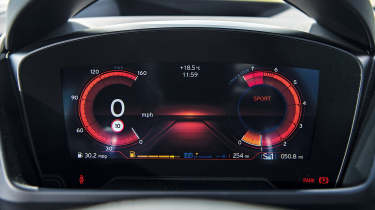
‘I always got a smug, satisfactory glow leaving the house with a full charge and silently driving through my town. Travelling emissions free (okay, tailpipe-emissions free) focused your mind on how internal combustion engines are so inefficient for driving in town or residential areas. I could complete all those short runs that fill every spare minute of a normal weekend (around 60 miles in my case) on nothing but battery power. That’s a big appeal in my book and yes, my driving style adapted to make the most of the regen capabilities to boost the range. Again, why not? It’s how the car was designed to work.
‘In terms of economy, not exactly an evo hot topic but relevant here, over the 12,500 miles on test it returned 39.9mpg and cost in the region of £3 to charge overnight at home on a cheap energy tariff. Other expenditure extended to a set of rear tyres courtesy of Mr R Meaden Esq and an evo track evening, and a windscreen, which wasn’t covered on our insurance and cost £1500.
‘So, is the i8 an evo car? For the majority, probably not. Its focus isn’t on pure performance, and the 228bhp three-cylinder, 1.5-litre petrol engine is the weakest link, partly due to it lacking character and partly because it needs the assistance of a fully charged battery and the 129bhp electric motor to give its best performance.
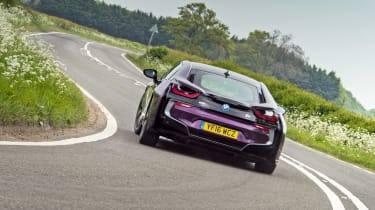
‘The i8’s steering also lacked feel and the low-speed ride felt rough on surfaces other cars from its class would float over. But tighten the powertrain with Sport mode and fire the i8 down an interesting road and it could earn its keep. The eco-friendly Bridgestones broke away earlier than you were expecting and the front would push wide way before the rear would break away, resulting in a lack of the fluidity you’d expect from a mid-engined car. But play to its strengths and it was rare to be frustrated by the i8.
‘Ultimately, there are two ways people will look at the i8. There will be those who see a sports coupe wannabe that doesn’t deliver that last 15 per cent of the thrills expected from a model costing this much from BMW. Others will see it as a fine achievement for a first attempt at a plug-in performance car. This is where I stand on the i8. It’s not perfect. But as a car, and ultimately a piece of automotive engineering, it’s hard not to come away from the i8 without being hugely impressed by its capabilities. I can’t wait to try version 2.0.’
Rivals, values and buying guide
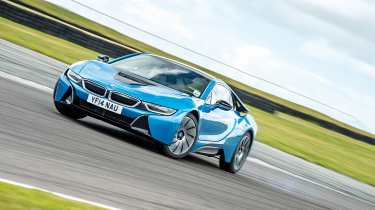
Slotting the BMW i8 into a performance car segment and defining its rivals was difficult throughout its life. At the time, the much-loved Porsche 911 (991) Carrera 4 GTS was a good fit, also just eclipsing six figures in price and offering 430bhp, albeit from a naturally aspirated flat six – it was a very exciting thing. Dynamically, it was better in the traditional sense, but no amount of bright Guards Red paint turns heads like an i8 and no rival, including the Porsche, can offer the adjustability of the i8 at such low limits and speeds.
A fellow hybrid supercar, and technological tour de force, the all-wheel drive NSX, was £30k more expensive at the time and flaunted the same exotic panache as the i8. Its performance, however, elevated the Honda into a higher plane of supercardom.
Questions about the reliability and longevity of electrified vehicles might be a hot topic but they’re nothing new. They’ve hung over the prospect of second-hand BMW i8 ownership since its introduction like a belligerent storm cloud.
Generally speaking though, the i8 has proven to be relatively reliable with only niggling ancillary issues like air conditioner compressors causing some owners grief. The struts on the butterfly doors can lose their strength and become audibly grumbly, the door locks can be problematic and windscreens have been known to crack. Check the dash for coolant lights too, and that the fuel filler flap works.
When it comes to the battery, a car that’s been looked after – cycled sympathetically and not been left to sit without being plugged in – ought to be fine. You can have the mileage and condition of the battery checked regardless, as well as the car’s error history overall. It’s also worth checking the car A ) still has its charging cable and B ) that it’s still functional. As ever, good service and MOT history will be indicators as to what kind of life the car you’re looking at has led. Be sure all recalls have been addressed, too.
Worth noting: having work done through BMW dealers directly is expensive and expertise can be thin on the ground for what is a strange car that’s beginning to advance in years. Our advice? Find a specialist who knows the cars, that you’d be happy to use should you take the plunge.
There’s no escaping the fact that the i8 is a strange car, from its carbon construction to its powertrain. So parts and knowledge won’t be in abundance like they are for 911s and other more conventional contemporaries of the i8. The i8 Roadster, having come out four years later than the Coupe, is rarer and as such, commands a premium more often than not.
Early coupes start from £20,000-£25,000 (with serious miles), rising to over £40,000 for those with the lowest miles and from later years. Arguably, an i8 that’s not been exercised, with a battery that’s not been used within reason, could be a more concerning prospect.
The Roadster arriving late in the i8’s life, in 2018, means it’s a more expensive car and rarer, with prices ranging from £45,000 to £70,000. All BMW i8 prices have fallen over the last couple of years by between £5000 and £10,000. By most accounts, if you get a good one, it’s a sweetheart of a car and more relevant today than when it was new.
Specs
| i8 (2014) | i8 Roadster (2018) | |
|---|---|---|
| Engine | 1499cc turbo, electric motor | 1499cc turbo, electric motor |
| Power (bhp) | 357 | 369 |
| Torque (lb ft) | 236 engine, 184 motor | 236 engine, 184 motor |
| Weight | 1535kg | 1595kg |
| Power-to-weight | 244bhp/ton | 235bhp/ton |
| 0-62mph | 4.4sec | 4.6sec |
| Top speed | 155mph | 155mph |
| Price | £99,895 (2013) | £127,105 (2020) |