Peugeot 508 (2018-2024) review – France’s sharp-suited BMW 3-series rival
The 508 isn’t standout in any area, but it’s one of Peugeot’s better efforts at an executive saloon – and more stylish than most
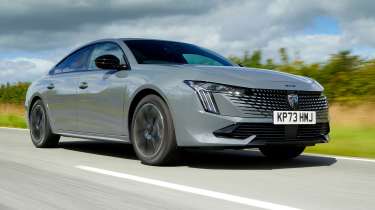
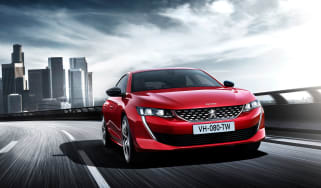
While the shark-nosed rear-drive 505s and high-revving 405 Mi16s are fondly remembered, large Peugeots have had a rocky history – and most recent examples have hardly been inspiring. Things took a positive turn with the second-gen 508, however. An executive saloon that launched in 2018 to rival the BMW 3-series, not only was it available as a high-performance PSE (Peugeot Sport Engineered) model, as a package it was quietly competent and more stylish than most rival saloons.
The 508 went off sale in the UK in 2024, and it aged well across its tenure, partly thanks to a facelift in 2023. The update made the design a little fussier but the 508 remained a relatively advanced saloon, coming with hybrid powertrains and using the same lightweight platform as the agile 308 hatchback.
It drives well too, while not quite coming close to dynamic benchmarks in the class such as the Alfa Romeo Giulia and BMW 3-series, though it fights back on comfort. Even in PSE form it wasn’t exactly a thriller, but on the whole it’s the closest Peugeot has come to building a genuinely premium, desirable saloon in years.
Engine, gearbox and technical highlights
- Platform shared with the 308 hatchback
- Range of powertrains available, from a 1.2 petrol to a 355bhp PHEV
- Flagship PSE has sports car-rivalling pace
More reviews
The 508 was offered with a range of three and four-cylinder powertrains. None are too mean for the job of motivating the Pug, but some are stronger than others, and the strongest of all is the 1.6-litre plug-in hybrid found in the Peugeot Sport Engineered model.
Pairing a 197bhp turbocharged four-cylinder with two electric motors, the range-topper sends a strong 355bhp and 386lb ft of torque to all four wheels. This engine is also found in the middling 225 plug-in hybrid, where peak power is quoted as 222bhp at 5500rpm with peak torque of 221lb ft.
Diesel power and a manual gearbox were offered earlier in the 508’s life, but later examples came with a non-hybrid 1.2-litre three-cylinder petrol as a starting point. Paired with an eight-speed automatic as standard, the 1.2 produces a modest 129bhp and 170lb ft of torque, almost a third of the output of the range-topper. That’s not the whole story, however, as its 1455kg weight figure makes it a whole 432kg lighter than the PSE…
The 1.2-litre petrol manages 0-62mph in 10sec, with a slight penalty for the estate, and goes on to a 132mph top speed. The 225 plug-in hybrid achieves the same sprint in 7.9sec with top speed of 149mph. The 508 PSE, meanwhile, has a sports car-troubling 5.2sec 0-62mph time and 155mph top speed.
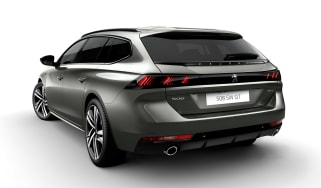
Chassis wise, front suspension is via struts with a multi-link rear axle, and GT trim cars got adaptive damping that was otherwise optional in lesser models. Fastback and estate (SW) versions were available, with estates being slightly heavier than their fastback counterparts.
Driver’s note
‘It takes a few miles to get used to the PSE’s tiny, low-set steering wheel. It gives the car a sense of alertness, but rivals with more conventional ergonomics are easier to get along with. At low speed in Hybrid mode you can tickle the throttle to drive predominantly on electric power, and the PSE is as quiet and easy to operate as a standard 508.’ – Yousuf Ashraf, evo Senior Staff Writer
Performance, ride and handling
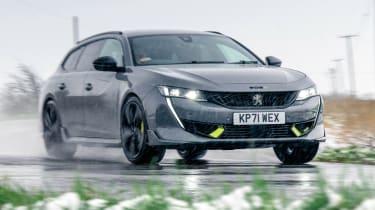
- Fluid and comfortable rather than exciting
- 1.6 hybrid has a decent turn of pace, PSE is genuinely quick
- PSE lacks the satisfying soundtrack and balance of an M340i
At best, the 508 feels adequately quick in non-PSE 1.6-litre guise. Acceleration is brisk but there’s no real kick in the back, and with the auto ’box slurring changes, the process of gathering speed is far from exciting. The PSE is much peppier and genuinely quick, but the complex hybrid powertrain doesn’t have the linearity or rich soundtrack of the B58 straight-six you’ll find in a BMW M340i.
Switching to Sport mode noticeably enhances the throttle response, with the e-motors working harder to support the engine at low revs. To take full control of the gearbox you actually need to notch the switch on the centre console forward from Sport to choose Manual – in Sport it’ll eventually revert back to auto if you leave the paddles alone for a certain length of time.
There’s not much joy to be had using the paddles, though. Gearchanges aren’t as snappy as we’d like and the paddles themselves feel cheaper than the interior’s other touch-points, which is a shame. Most of the time you’re likely to leave the car in auto, occasionally pulling a paddle to dial up some more revs. The auto ’box behaves smoothly most of the time, but can hunt around a bit when left to its own devices.
Being based on the same EMP2 platform as the 308, there is some 308-style agility from the 508, albeit not quite to the same extent. While a minimum kerb weight of 1455kg makes it not far from the lightest in its class, the range-topping 508 PSE weighs in at 1892kg. Regardless, there’s a sense of integrity to its structure and a well-cushioned ride, even in entry-level form.
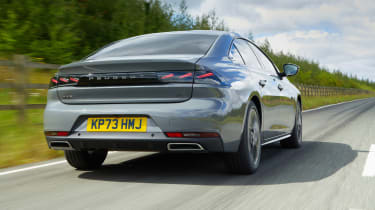
The 508 feels effortless to guide down a road in all its forms. There’s not much roll, and grip levels are strong too, which is useful as the small steering wheel responds quite quickly, and at first you may end up taking a tighter line through some corners than intended.
The small wheel is both a blessing and a curse. In smaller Peugeots like the 208 it’s an essential part of the car’s character, encouraging you to turn in aggressively and ensuring you can make instantaneous corrections as you hustle down a road. But in a larger saloon it can feel at odds with the car, making it feel less natural than a bigger rim would. It’s not nervous, but it does take some getting used to.
Overall the PSE boasts impressive dynamic ability, with a tendency to flow and carry speed without much fuss, putting the imperfections of Britain's roads to one side. Hustle it along and it doesn’t reward like an M340i – the four-wheel-drive system is nowhere near as playful and the stability control keeps a leash on things – but it is satisfying to drive at pace.
In the ordinary 508, the small steering wheel feels more at odds with the laid-back nature of the car. The chassis sometimes feels like it’s slightly lagging behind those speedy inputs, rather than immediately following as it would in a 208. The relative lack of leverage of a small wheel means Peugeot has also whacked up the power assistance, which masks any semblance of feel – everything feels a bit remote.
The front wheels do seem more than capable of taking everything you throw at them though, not just in terms of strong lateral traction, but also resistance to torque steer. Even accelerating hard out of tighter corners the 508 seems to follow your line faithfully.
Driver’s note
‘In Sport there’s more eagerness, more tension to the driving experience without sacrificing the PSE’s sense of flow, although the steering takes on a heavily damped, weightier feel that we’d prefer to do without. The rack is otherwise accurate and well judged for speed, giving you confidence to up the pace and pick clean, precise lines.’ – Yousuf Ashraf, evo Senior Staff Writer
MPG and running costs
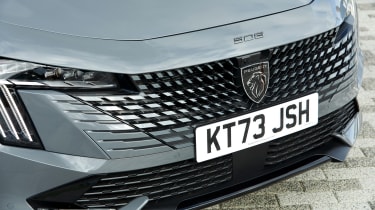
No 508 has a particularly voracious appetite for fuel given the size of the car. At its most frugal, the ordinary plug-in hybrid 225 model is said to achieve between 193 and 274mpg, with the pure-combustion 1.2-litre PureTech quoted at between 42.7 and 50mpg. In reality, expect to see somewhere around the 40mpg mark in normal driving from the latter.
Should you keep its battery charged, the most potent Peugeot Sport Engineered model is said to achieve up to 156.9mpg, but 30mpg isn't uncommon on a normal drive with the battery at a low state of charge. Having 34 miles of all-electric running is a useful feature though, and can make short commutes very cost effective.
Long-term maintenance costs are still difficult to determine, but it’s worth bearing in mind the potential expense of new tyres – a set of replacement 235/45 R19 Goodyear Eagle F1 Asymmetric 6s for the 508 GT will set you back around £700, including fitting.
Interior and tech
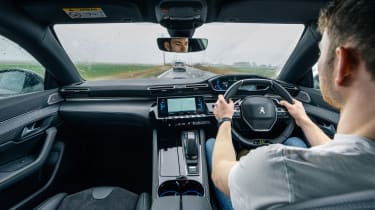
The 508’s interior will be a shock to the system, at least if you’re unfamiliar with Peugeot’s previous interior design trends. Climb in – through doors with frameless windows – and you’re faced with a small, almost hexagonal steering wheel, a large digital instrument display, a raised centre console, and plenty of eye-catching details.
Some will instantly hate it. Like other Peugeots using the firm’s 'i-Cockpit' layout – basically, a small, low-mounted steering wheel and high-set instruments – it can be tricky to find a driving position that’s both comfortable and gives a full view of the instruments, depending on your body shape.
Others will be fine, and it’s fair to say that with time to adapt it’s easy to settle into a suitable position. The trick is usually as simple as positioning the wheel slightly lower than you normally might, aware that its smaller size means it won’t foul the tops of your legs as a regular-sized wheel might.
Other than that, there’s a lot to like. The seats are comfortable, the cabin is hushed, and Peugeot’s implementation of physical hot-keys for the central display means choosing between menus is simpler than it used to be – and the bank of keys acts as a shelf to steady your hand when using the screen, too. The digital instruments have various layouts, only a few of which are truly useful, but you do get satnav information and other key data presented ahead of you in a clear format.
Above all, it’s just an imaginatively designed environment, and one that feels considerably more special than most others in the class. Build quality is better than in previous Peugeots, too.
Tech-wise, there’s the TFT display, as well as typically-found features such as adaptive cruise control, lane-keep assist (best switched off, in our experience), speed limit recognition and high-beam assist. More impressively, the 508 was the first car in its segment with night vision, and it genuinely works – on one night-time drive, it alerted us to a pedestrian unwisely walking down the side of the road rather than on the pavement, which we otherwise wouldn’t have spotted as early.
Prices, specs and rivals
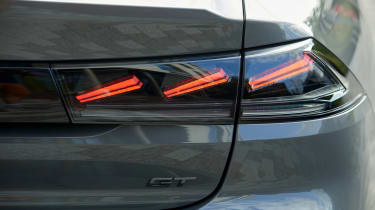
At the end of its life, the 508 range spanned from the £34,170 Fastback in Allure trim, to the GT and through to the range-topping Peugeot Sport Engineered at £53,975. Estate models commanded just over £1000 more than the equivalent saloons. Today, early diesel models with less than 50k miles on the clock cost from around £10k, with PSEs priced from £17k.
Standard equipment of later models is comprehensive regardless of trim – even entry-level models get autonomous emergency braking and lane-keep assist, as well as climate control, rear parking sensors, navigation, smartphone compatibility (including CarPlay and Android Auto), auto headlights, and 17-inch alloy wheels.
The next step up is the GT trim, which includes the likes of the Drive Assist Pack Plus for adaptive cruise control and heated seats, with more optional kit available to specify. There's also a choice of interior trim finishes, with design noticeably sportier than the entry-level Allure. A set of 18-inch wheels were standard, with 19-inch wheels available at a cost.
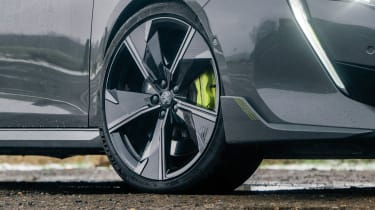
The PSE features most kit as standard, and comes with a 1.6-litre four-cylinder plug-in hybrid powertrain. Aggressive aero elements, green accents and standard 20-inch 'Exxar' diamond-cut wheels all came as standard to set it apart from more ordinary models in the range.
Peugeot aimed upmarket with the 508, so as well as rivalling Mondeos and Insignias, it also competed with the Audi A4, BMW 3-series and Mercedes C-class, as well as the Jaguar XE and Alfa Romeo Giulia.
We’re huge fans of the Giulia in particular at evo – its driving dynamics are among the best in the class. You can’t go too far wrong with any of the premium models in this class, but Peugeot has to be commended as the 508 really doesn’t feel too far from those premium benchmarks.