Mercedes-Benz E-class review – how to beat BMW’s 5-series on luxury if not fun
The E-class’s wide range of powertrains isn’t the only way it beats its rivals for versatility
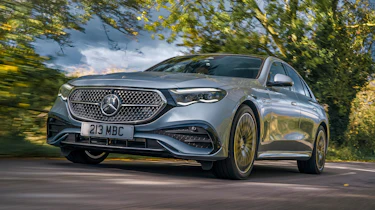
You have to feel for Mercedes. It spent a sizable country’s GDP developing its EQE electric saloon, only for that car to find neither critical acclaim nor commercial success. The latest E-class on the other hand, has proven to be the dependable, competent, agreeable saloon it always has been.
The W214 generation arrived in 2023 featuring the latest cabin tech and a generously varied powertrain lineup to suit most needs, but being able to choose between everything from old-fashioned diesels to mega-battery plug-in hybrids is only one factor that contributes to the E-class’s commendable versatility.
Engine, gearbox and performance
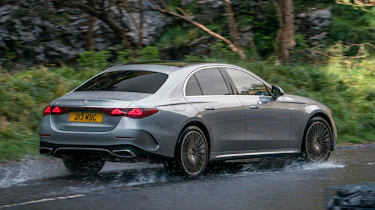
- Broad range of petrol, diesel and hybrid options
- Rear-drive and 4Matic AWD available, though all use 9G-Tronic automatic transmission
- Four-cylinder engines a touch rough, six-cylinders potent and smooth
The E-class range spans from the base E200 featuring a mild-hybrid four-cylinder petrol engine good for less than 230bhp, to the full-fat (but not quite E63-replacing) E53 AMG, with close to 600bhp thanks to its electrically augmented twin-turbo straight-six, with all E-classes using Mercedes’ nine-speed automatic transmission. In the middle, a range of four-cylinder and six-cylinder plug-in hybrids, mild hybrids and even good old-fashioned diesels. And yes, one of the latter is very good.
At the heart of the E-class range is the E300e plug-in hybrid, which pairs a 2-litre, turbocharged four-cylinder petrol engine with an electric motor and 25kWh battery (the same used on the E300de and the E53) good for 70 miles of electric range, adding onto the 350 miles you’ll get on petrol power. The E300de and E53 are claimed to be good for 67 and 60 miles respectively.
More reviews
In-depth reviews
- Mercedes-Benz E-class review – how to beat BMW’s 5-series on luxury if not fun
- Mercedes-AMG E53 review - sub-BMW M5 performance but still a strong alternative
Long term tests
Reviews
- Used Mercedes-AMG E63 (W213, 2017 - 2023) review – a V8 supersaloon for hot hatch money
- Mercedes-Benz E55 AMG (W211, 2003 - 2006): review, specs and buying guide
- Mercedes-AMG E53 2021 review – brimming with tech, but missing the charisma of an M550i
- Mercedes E-class 2020 review – new E450 a smooth operator
- Mercedes-Benz E-class review – executive tour-de-force still one to be reckoned with
Some say that hauling two powertrains around with you in a PHEV is a self-defeating prospect, and while this might have been true when the original PHEVs arrived over a decade ago and were, quite frankly, an embarrassment, the current crop are exactly what many need today: zero emission driving in urban environments and not a whiff of charge anxiety when further afield.
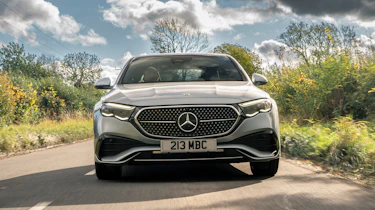
Even when the battery is running low there’s always some charge left to start every journey in silence, and the switch to the 207bhp petrol engine is seamless. Although not serene, as it’s not the quietest of engines. The E300e sounds coarse at times and isn’t the smoothest across its power and torque bands (406lb ft combined by the way). In fact, both the petrol and the diesel four-pots have a roughness to them when plumbed for their performance.
But despite hauling 2210kg around (400kg more than the E200 that shares the same internal combustion engine) it doesn’t feel breathless or lethargic. At no time did the electric drive feel a hindrance, its instant torque more manageable and less all or nothing compared to a pure EV, which makes it so much calmer and less frantic. For the driving it’s designed to do there’s little to complain about how the E300e deploys its energy.
At the other end of the E-class spectrum is the E450d, all but topping the lineup apart from the AMG E53. Its big straight-six diesel engine displaces three litres, features two electrified turbochargers and has the mildest of mild-hybrid assistance.
Mercedes’ spec sheet claims ‘367hp + 23hp’ under the heading ‘power’ but reality is 362bhp from 4000rpm and, more importantly, a 553lb ft serving of torque arriving from 1350rpm through to 2800rpm. It's an engine that’s also available in a few other Mercedes models, including the S-class and G-class. Like the G, the E450d’s power and torque is distributed to all four wheels via Mercedes’ nine-speed automatic transmission and 4Matic four-wheel drive.
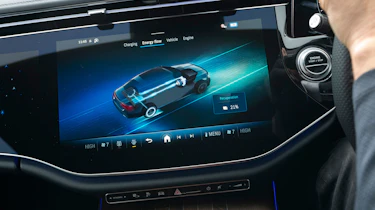
The engine’s numbers only give an indication of how this car actually feels. If you're familiar with Audi's brace of slightly breathless 2-litre engines in the new A6 and the lack of a strong diesel in BMW’s 5-series, the E450’s big capacity old-school potency and delivery are at once familiar and surprising, not to mention welcome.
Except it’s not that old-school. Yes, you get the industrial multi-cylinder rumble as the engine’s revs rise but the surge comes near-instantly, the full torque load available just 400rpm above the engine’s idle speed. Then as the revs rise, the automatic 'box is responsive and savvy enough to serve you the next gears at the right revs to stay on the torque bow wave.
The engine is more responsive than you'd expect thanks to the 48-volt mild hybrid element and eBooster compressor in the turbos, which vastly improve throttle and engine response. But there’s still a semblance of an almost nostalgic swell to the performance, as opposed to the uncomfortable instant jolt of an EV.
The E450d’s 4Matic is rear-biased and when asked to deal with everything the engine delivers you sense the rear squat a little before the torque heads to the front axle. Five seconds to 62mph doesn’t sound life changing in today’s world of rapid electric cars but what you need to know is this: in the real world, the E450d is rarely short of breath, those of a certain age will quickly feel familiar with the big-chested turbo-diesel feel of old.
Ride and handling
- Exceptional refinement and ride, especially on the air springs
- Not totally at the expense of body control or composure, but it’s no thriller
- Steering a little light and braking is a touch inconsistent in the PHEVs
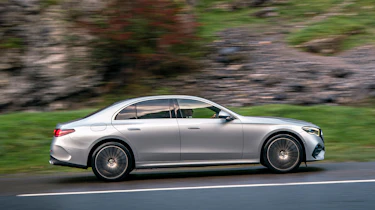
The E-class arrived first only with steel springs and adaptive dampers, though air suspension and rear-wheel steering arrived later for higher-end models. The more traditional set-up doesn’t impact the E-class’s composure, its ride is calm and measured in its delivery, with no unexpected movements through the cabin.
There’s strong body control too and the whole car feels engineered and set-up to be the relaxed exec it needs to be, although this does mean the steering is overly light, which doesn’t make for a particularly precise front end. Not a deal breaker, as the E-class has never been a car to hustle.
Larger road surface imperfections are harder to contain and throw-up the shortcomings of not having a set of air-filled bags to suspend the car on. And depending on the road’s surface - older concrete types - there’s more tyre noise than you might be expecting. What’s not perfectly resolved in PHEV E-classes is brake feel. The handover between friction and regenerative elements is not perfectly resolved, with that runaway feeling as you come to a stop not ideal.
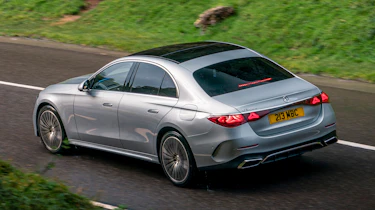
The E450d we tested was a different animal on its self-levelling air springs and adaptive dampers. While it is unashamed in its lack of real dynamic focus, in exchange you get almost S-class levels of composure and ride quality.

The suspension’s ‘Sport’ setting is almost essential if you want the E450d at its most well-rounded, with a degree of control while retaining compliance. It's not perfectly controlled and there remains noticeable roll if you pitch it in too quickly with too much enthusiasm, but it’s neutral and surefooted.
It’s decently agile and the steering is well weighted and ratioed too – still a bit light, but with little cause to second guess your inputs. It’s far from the ultimate fast saloon or estate, but it is possessed of a sense of polish and being buttoned up and together. Its happy place is gorging on motorway miles, sipping on fuel and plying its driver with a hot stone massage.
MPG and running costs
- Largest E450d an effortless long-distance fuel sipper
- PHEV options are better suited to mixed driving
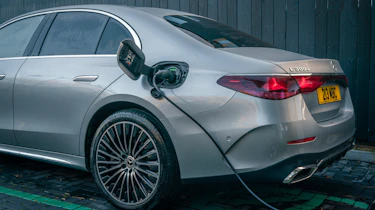
- Real-world 50-mile minimum range works well for commuters that can plug in
In the single-digit temperatures of mid-December we achieved 60 miles of electric driving on every road type at the same speeds we would cover them in an ICE powered E-class before the four-pot ignited. Meanwhile over the course of 600 miles, across a blend of roads from congested and free-flowing motorways, to A roads and tight B roads, the E450d also delivered solid efficiency, with 45-60mpg the range we saw.
The elephant in the room is that on paper, a lot of what a big diesel offers, so too can a plug-in hybrid. The E300e is a bit more versatile in terms of being better-suited to short journeys and urban driving, as well as managing the more sprawling journeys. Even more so the E300de hybrid, which almost combines the best of both worlds, lacking a little bit the barrel chest of the E450’s six-cylinder.
But that does sort of speak to the reason why the E450d is the last of its kind. Its speciality of spitting out hundreds of miles without having to stop is one that was invaluable during the peak era for such cars. While many do still take regular long schleps, it’s more of a niche talent than the norm it once was. What it offers is nice to have if you tow, or prefer travelling long distances to your own timetable rather than being dictated to by short-haul air travel.
Interior and tech
- Quality is better than creaky Merc cabins bygone
- Lots of touch and haptic controls
- Screen is intuitive, wheel’s touch controls not so much
Today’s E-class is as much a miniature S-class as it is a larger C-class, with sumptuous leather and textured wood trim delivering an interior space you don’t want to get out of.
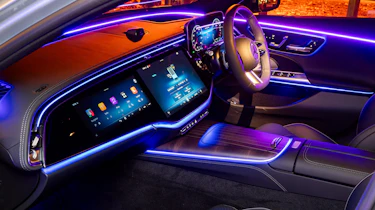
The cabin is a considerable step on from what came before from Mercedes, however, in terms of fit and finish (it’s one of the first Mercedes we’ve driven in a long time without any squeaks or rattles), but some of the plastics feel harsh and brittle with surprisingly sharp edges, although this down to the rest of the interior being to such a high standard that these imperfections stand out. Though many will love it, we did find the full ambient lighting suite to be a bit 'Vegas'. Happily, you have a broad choice of colours and its brightness can be turned down.
There’s an intuitive nature to the controls, too. Granted, there are two sizable screens, with the passenger also getting their own, but the smaller ‘superscreen’ setup highlights the absurdity of the hyperscreens Mercedes fits in other models. A simple button marked with an outline of the car takes you directly to the lane keep assist off button, and the rest of the controls are logical to use. Mercedes’ wheel mounted haptic controls can be annoying though, with unwanted volume changes aplenty, while the voice controls are oversensitive too.
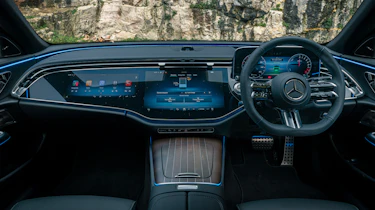
The tech overload is a bit much, with everything from interior lights that can pulse to the conversation between passengers or the sound coming from the entertainment system. There’s also a ‘4D’ surround sound system that includes speakers in the seats that bring up a nauseous sensation. But ignore these, dial them down or switch them off completely and the E-class is one of those cars that simply gets on with doing everything to a higher than expected standard it was designed for.
Even in the back, there’s an S-class like experience in terms of refinement in E-classes with air suspension – all you miss from the big brother is the reclining seat and limo legroom. The back of an E-class, especially the estate in terms of headroom, is a perfectly pleasant place to spend a good few hours, even as an adult. The boot is strong too, with plenty of room for suitcases. There is a point against PHEV models though: the battery eats some of that space, so buy according to your needs.
Price and rivals
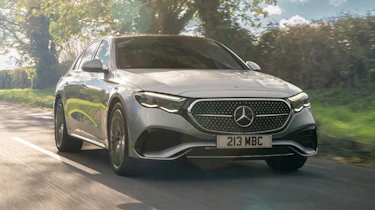
The E-class is as it ever was a foil for BMW’s 5-series saloon, as well as Audi’s A6. The BMW is the sharper drive and the Audi is sharper in terms of design. But the Mercedes might just be the best-engineered, with the broadest range of talents and certainly, the broadest range of powertrain options. Its PHEV options go further on electricity and there are far more diesel options than in rivals.
The only catch is generally, an E-class starts from a higher price point than a 5-series or Audi A6. While Merc pricing opens at £57,170 for the slightly weedy E200, BMW’s 520i starts from £53,110 and Audi’s A6 starts from £52,110. The E220d starts from £58,815 (the A6 TDI starts from £56,350) while the cheapest version of the E300e starts from £65,725. BMW’s 530e starts from £59,660 by comparison, while Audi’s A6 e-hybrid starts from £62,540.
Only Mercedes offers a diesel hybrid, the E300de starting from £67,725. The flagship E450d is our choice, unashamedly, though that’s with the proviso that it’s not the E-class best-suited to short or urban journeys. It’s expensive too, starting from £81,645. It’s this or the E53 that you’d choose from, depending on your needs, as an alternative to BMW’s 550e, that starts from £76,830. The former is closer on price but the E53 is the E-class with the hybrid potency to match what is probably the best 5-series, albeit for no less than £92,145.
The E-class boasts versatility to be thankful for, whether you’re doing minimal miles across an urban sprawl, or punting up and down the M6 twice a week, or regularly towing a big trailer, or need a tourer for pan-European jaunts, there’s an E-class for you and one that bests its rivals for the job.
Frequently Asked Questions
The Mercedes-Benz E-class is worth considering if you’re in the market for an E-segment executive car. It offers a greater sense of luxury and refinement than BMW’s 5-series but is not as dynamic to drive.