Peugeot 208 review – a fine alternative to the Ford Fiesta
Today's Peugeot supermini is a very different beast to those that came before; it’s clever, stylish and hides a sweet chassis that’s clawing to get out
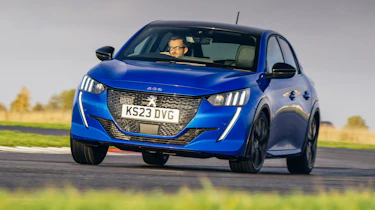
The modern supermini is a very different car to the ones that existed 20 years ago. The Peugeot 206, for instance, had a steering column that would rub between your feet as they sat on the pedals, which were hilariously off-set to one side – polish was certainly off the agenda. But step into the 208, some three generations the 206’s senior, and things are very different.
The 208 is built on a fresh platform built by PSA that is also found under the Corsa, and one destined to spread right across the wide reaches of its own brands, and those within its new FCA partnership. It’s bigger, more refined, more technologically advanced, and available with a fully electric powertrain, but it’s the petrol model that is still likely to find more homes in the UK.
> Peugeot 208 Fast Fleet test – living with the French Ford Fiesta
Engine, gearbox and technical highlights
We’ve got to grips with the range-topping petrol 208 GT, powered by a 1.2-litre turbocharged three-cylinder engine with 98bhp. By all accounts, it's not particularly special on paper, but it fights back as an energetic unit that pulls surprisingly hard for something with so little on-paper shove. For that, we can thank the turbo’s willingness to spin up promptly due to its compactness, making for a powertrain that feels far more punchy than its 96bhp and 151lb ft of torque would suggest.
More reviews
Group tests
- Peugeot 208 GTi by Peugeot Sport vs Renaultsport Clio 200 Cup
- BBR Mazda MX-5 Turbo vs PUG1OFF Peugeot 205 GTI 195 review
Long term tests
Reviews
- Peugeot 208 review – a fine alternative to the Ford Fiesta
- Peugeot 208 GTi and GTi by Peugeot Sport review - a return to 205 GTi form?
- Peugeot 208 review - a supermini for keen drivers?
- Peugeot 208 GTi 30th Anniversary review - specifications, price and 0-60 time
- Peugeot 208 THP 156 review - specifications, price and 0-60 time
When paired with the eight-speed torque-converter automatic transmission fitted here, its 0-62mph time is a class competitive 10.8sec, 0.9sec slower than when fitted with the standard six-speed manual. The torque-converter’s slight power sappage isn’t quite offset by the manual’s longer gearing, and despite the longer final drive is also a few MPG less efficient. The 208’s top speed is 117mph.
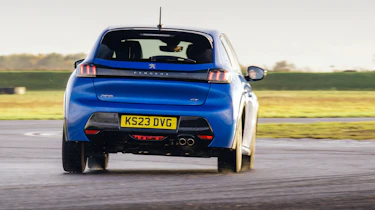
Performance, ride and handling
Accept its modest grip limits and the 208 noses around with small flicks of the tiny steering wheel, and probably feels the second most ‘on its tiptoes’ here, after the even lighter Swift. ‘The steering is quite fast and flighty, which gives it an imbued sense of sportiness,’ says James, though he notes ‘it’s more of a placebo effect.’ I find its agility quite enjoyable on the road, which is also where the 129bhp powertrain works best, with punchy responses at low to medium revs and relatively quick changes from this car’s six-speed automatic (and cheap-feeling paddleshifters), with a ride that strikes a good balance between fluidity and body control.
It’s predictably less strong on track, where you quickly discover that the engine basically gives up somewhere after the mid-range. I’d love to tell you how much of the engine’s bandwidth is actually useable, but as with the 308 there’s no tachometer in the fancy floating digital instruments.
The gearshift also gives up any hint of snappiness at maximum revs, with drawn-out, slurred changes like a 30-year-old slushbox. The manual alternative would be better in theory, though past experience suggests the 1.2-litre turbo engine also suffers from yawning rev hang, so fast shifts just aren’t in its repertoire. Don’t get your hopes up for Sport mode either: it’s about as effective as putting a racing stripe on a patisserie.
The 205-section Michelin Primacy 4 tyres also feel somewhat overworked on track, though the chassis is still the 208’s strongest suit. It steers sweetly, not unlike those old 208 GTis with their similarly button-like steering wheels, and there’s good balance hiding behind disappointingly aggressive and very much permanent stability and traction control systems. You can turn them off, but they switch right back on at 30mph, as per the 308 GT.
From a technical perspective, PSA’s new CMP modular platform that this new 208 is built on doesn’t have any real technical highlights, but the fact this new 208 is both bigger, more refined and loaded with kit, yet lighter than its dainty predecessor is highlight enough. Weighing in at just 1090kg for our GT automatic, it’s an impressive feat considering how refined and substantial the 208 feels.
Interior and tech
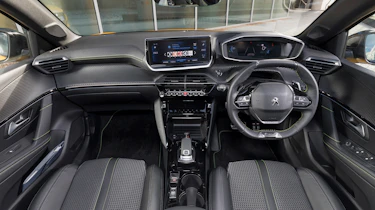
The interior also proves to be a big step forward in the supermini conversation, with a complex and ornate interior that’s interesting, well constructed, and even a little glamorous. A highlight is the 3D-effect i-Cockpit set-up, which takes Peugeot’s controversial small steering wheel, high-mounted dials combination one step further by squaring off the steering wheel into a sort of octagonal shape, while the now completely digital dial set is three-dimensional, thanks to some trick reflection-based projection similar to what you’ll find on a head-up display.
Lots of big-car tech has made its way into the 208, with a panoramic sunroof, massaging leather seats, adaptive LED headlights, active cruise control and a 10.1-inch high-set infotainment system all able to be specified.
At cruising speeds, town speeds, and on the motorway, the 208 is a very accomplished supermini though. Refinement is impressive (although the three-cylinder does struggle to contain vibrations at idle oddly), and all the controls feel more finely calibrated than in many a supermini rival.
It gets the basics right then, but just needs finishing off. ‘They should do a hot hatch version,’ says John, ‘with a rev counter and another 50bhp.’ Pity it’ll never happen.
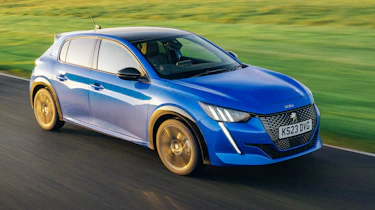
Prices, specs and rivals
Prices for the 208 start at a respectable £20,495, lower than its original price, with our GT 100PS auto coming in at £29,100. The range-topping e-208 is priced at £28,650 in Allure trim specification, making it model-for-model a premium of around £5000 over the combustion-powered alternative.
To balance the GT’s high price point, it’s loaded with standard features such as 17-inch alloys, ambient lighting, automated parking assistance, climate control, satnav, those funky LED lights, front and rear sensors, and a rear camera.
Rivals in the supermini class are extensive, the equally fresh Renault Clio being its most obvious rival. The entry-level E-Tech hybrid now costs from £18,995, and while direct rivals, the Volkswagen Polo, Vauxhall Corsa, Skoda Fabia, SEAT Ibiza and its kind are all extremely dull, if competent and competitively priced. The Ford Fiesta was an excellent, dynamic offering, but has now been axed.
Despite its mainstream origins the 208, more than most in the class, has found a way of making a supermini feel, well, super. With the Ford Fiesta no longer an option, the 208 is a worthy contender for the top spot in the class.
Living with the Peugeot 208
Given Peugeot Sport’s withdrawal from the hot hatch genre (all-electric 208 GTi aside), you could be forgiven for thinking the new 208 GT isn’t particularly evo-relevant. The version you see here comes with a mild-hybrid 1.2-litre three-cylinder engine that produces 134bhp – or just 14bhp more than the 106 GTi that launched 27 years ago.
However, being turbocharged it does have a whole lot more torque – 170lb ft to be precise, 67lb ft up on the ’90s classic – and while it may not wear Peugeot Sport or GTi badges, its compact size, relatively light kerb weight (1228kg) and nippy 0-62mph time (8.1sec) should automatically qualify it for consideration if you’re in the market for a supermini.
It’s a segment that’s been hit hard in recent years, making the 208 one of the last of its kind. The dynamically excellent Ford Fiesta is now off sale in all its guises, Volkswagen’s Up has gone too, and while the VW Polo and SEAT Ibiza are still around, they’re not exactly exciting. The 208 GT, by contrast, combines its small size and welcome economy with a good dose of French design flair and the promise of performance to match the looks.
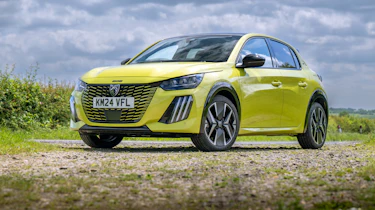
And it really is an eye-catcher, especially in our car’s luminescent Agueda Yello. It gets a surprising amount of attention out on the road, with its striking ‘claw’ daytime running lights, bold contrasting arch extensions and stout proportions ensuring it looks like nothing else in its class. The theme continues inside, with Peugeot’s small steering wheel a given, plus quirky digital dashboard graphics, protruding central control knobs and a sculpted, double-deck dashboard.
Options on our car are limited to a ‘Drive Assist Pack Plus’ (adaptive cruise control and lane assist, for £300) and Alcantara seats with green stitching (£500), taking the total up to £29,160 from £28,360 basic for the 134bhp hybrid GT (there’s also a 99bhp GT for £1200 less).
The fitment of self-charging, mild-hybrid tech has made the 208 more economical than ever before. In fact, so far it’s been supremely economical at all times. Even on a spirited drive and long, high-speed motorway stints it will regularly achieve a near-50mpg trip average. Given its small 1.2-litre three-cylinder engine under the bonnet, that’s rather impressive.
A manual would always be our transmission of choice in a supermini, but beyond the entry-level, 98bhp pure-combustion offering, a six-speed automatic (replacing the previous eight-speed unit) is all that’s available. While the added involvement of three pedals would be nice to have, response is good in normal driving, with the transmission calibration considerably more refined than some for everyday use.
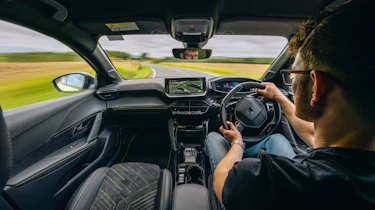
What’s most impressive, though, is the chassis, with its quick steering direct and confidence-inspiring, though not particularly feelsome. The 208’s performance envelope isn’t as expansive as those of its ancestors, but its chassis feels perfectly at home on a British B-road, allowing you to carry satisfying pace even on more challenging tarmac.
Slightly less satisfying are the interior ergonomics, the positioning of that small steering wheel and the instruments beyond once again making this a Peugeot in which drivers of a certain height can’t comfortably read vital information, necessitating a contortion of the neck to catch a glimpse of what you’re looking for.
We’ve also experienced some slightly unnerving whirring noises coming from within the engine bay. Whether these are characteristic of the hybrid powertrain or a quirk of our particular car is something we’ll investigate, but as everything appears to be functioning as it should, we’re leaning towards the former for now.
The 208 GT may be one of the less performance-focused members of the evo Fast Fleet, then, but with great fuel economy, sharp looks and pleasant handling, there’s a lot to like here. It might prove more popular than you’d first think… – Sam Jenkins, evo issue 324
Peugeot 208 GT specs
| Engine | In-line 3-cyl, 1199cc, turbocharged |
| Power | 129bhp @ 5500rpm |
| Torque | 170lb ft @ 1750rpm |
| Weight | 1158kg (1180kg as tested) |
| Power-to-weight | 113bhp/ton |
| 0-62mph | 8.7sec |
| Top speed | 129mph |