Porsche 718 Cayman GT4 RS (2022-2024) review – was the Porsche of our dreams too extreme?
The most extreme Porsche Cayman should have been the answer to all of our prayers, but did Porsche take it too far?
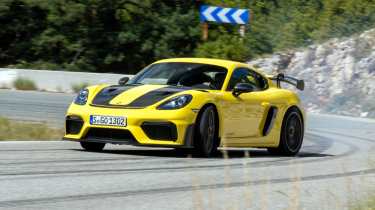
With the 981 Cayman GT4 of 2015, Porsche put its conservatism and innate protectiveness of the 911 to one side and made a Cayman with a 911 engine. It was fabulous – so much so that it won evo Car of the Year 2015 against formidable and much faster opposition.
But still there was a question mark: what about a GT department Cayman that really went all out, with a full Porsche motorsport engine? That car arrived in 2021 – the Porsche Cayman GT4 RS. In theory the recipe for the perfect Porsche. In practice, in the real world, off a race track and on our difficult roads? It could have been a step too far.
Engine, gearbox and performance
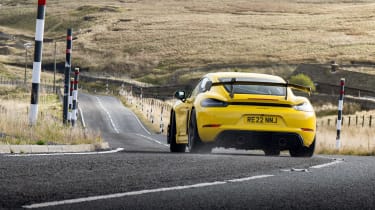
- A GT3 engine in a Cayman finally
- Louder inside than a GT3 thanks to the wild induction system
- The catch: It was PDK-only, though shortened gears keep it visceral and responsive
What we couldn’t have known, back in the months following the Cayman GT4’s eCoty win, was that Porsche had indeed squeezed a GT3 motor into the middle of a Cayman, as a rather nice birthday present for the then head of R&D, Wolfgang Hatz. To do it, sections of the 981’s body-in-white had to be butchered because the ‘MDG’ engine’s oil tank for the dry sump set-up fouled the bodywork.

Fine to do in a prototype, but a complete no-no for a production car. Still, the GT crew knew exactly what they had to do, not just in technical terms but also on a corporate level. So the car was demo’d to senior company people, who, like GT boss Andreas Preuninger and his team, quickly fell in love with driving the car. With the advent of the 718 model line and a new 911 GT3, the opportunity was there to redesign the engine’s oil tank so that it would fit both cars.
More reviews
There were a few other changes made for the GT4 RS powertrain-wise too. It uses the latest GT3’s 4-litre engine for 493bhp and 332lb ft of torque with drive taken through a seven-speed PDK gearbox, the only transmission available. Most intriguingly, and responding in part to criticism, the gear-set and final drive from the 991.2 GT3 RS has been adopted, along with a number of bespoke parts, to significantly lower the gearing compared with the GT4. Seventh gear is no longer overdrive but the ratio in which the car hits its 196mph top speed.
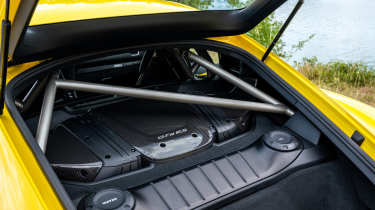
The engine is 10bhp and 15lb ft down on the GT3 because the exhaust system has a longer, more convoluted path out of the back of the Cayman compared with the rear-engined 911. The other difference is the intake set-up, which in the GT4 RS feeds the engine from both sides of the car, air rushing in through intakes that hitherto on the 718 were the rear side-glass.
As we know, it’s a blue-blooded beast of a motor: one that revs to 9000rpm, that exudes naturally aspirated purity and sabre-sharp throttle response, and that also powers the 992 GT3 Cup and 718 GT4 RS Clubsport racing cars in pretty much exactly the same form.
The flat-six fires with an aggressive wummph! and from that precise moment it’s hard not to fall completely in love with the GT4 RS. A trifle premature, perhaps? Not really. I imagine you’d be the same with one of Porsche’s naturally aspirated finest sitting mere inches from your ear canals – those six individual throttle bodies hungrily gasping for air; all those lightweight, race-honed components moving in perfect unison; the solid lifters; the 9000rpm rev limit.
The driving impressions flow like a torrent from the off. As I had already guessed, the engine dominates the car and in an entirely good way. But it’s more than just the engine alone: it’s what the transmission brings to the experience. The RS will hit the rev limiter in second gear at around 70mph compared to 85mph in a manual GT4, and don’t forget the RS has a whole extra 1000rpm of revs to pack into that gear.
In third, it’s 100mph plays 115mph. This is much more profound than it looks on paper: it’s a complete sea change in not just the level of performance but how much of that glorious engine you can actually enjoy – with some semblance of responsibility – on the public road. The RS really hits its stride with 4000rpm on the dial, so just imagine the fun you can have while still not travelling at warp speed.

The motor gets all snargly in the mid-range, then opens up like the brass section of an orchestra before settling on a single, high-frequency tone over the final 1000rpm that’s so intense, and so loud in the cabin, it’s verging on painful. I’d argue that even better are all the bits in between those extremes.
Sure, it’s rabidly quick – 0-62mph takes just 3.4 seconds – but it’s the way every last millimetre of throttle movement elicits a subtly different response from the engine. A different rate of acceleration, yes, but also a different sound, from the furious gasping for air as you lead in, to the gradual opening up of tone as those six throttle bodies widen like the mute being gradually removed from the mouth of a trumpet. You really can play tunes on this engine.
Its infinitely variable tone, timbre and resonance, organic and authentic, makes a mockery of the sort of flat, often-augmented or entirely fake noise we’ve come to expect from modern turbocharged supercars – and of course EV hypercars – and mean that the RS’s actual numbers are somehow irrelevant. It’s fast, sure, but there’s a lot more to it than that. Be in no doubt, it’s right up there with other four-wheeled orchestras such as BMW’s E46 M3 CSL and Ferrari’s 458 Speciale.
Do I miss the manual gearbox? Well, while I’ll always naturally default to the idea of a manual, the downshifts in this PDK have to be experienced to be believed. They come not so much with a blip, rather a spit or crack, and it seems inconceivable that the crankshaft can spin up and down that quickly. It becomes an integral part of the driving experience, and while I’m sure a manual would bring other qualities into play, I never find myself pining for an extra pedal.
It’s reasonably subdued at a cruise but any incline or any need to increase speed immediately brings that engine note flooding into the cabin. Despite the sensational, tuneful noises, you eventually end up wishing for a less full-on soundtrack on a long drive, partly thanks to the short gearing that gives the RS an 'always-on' feel. Bizarrely, it reminds me of driving 1980s French hot hatches in this regard; the RS is never sleeping, it’s always ready to go, unapologetically, unambiguously.
Driver’s note
‘Trickling along at first, the RS shuffles and thumps on frigid Cup 2s. The suspension is stone-cold and unyielding and the whole car feels like it’s got out of the wrong side of bed. I like it. For me this awkward, jarring phase is all part of a truly hardcore road-racer. It should feel grumpy as vital fluids warm through, and sensing all the rough edges being chipped away as the temperature gauges start to flicker to life is the best sort of initiation.’ – Jethro Bovingdon
Ride and handling
- Missing compliance hampered it on evo Car of the Year
- But later cars appear to have been ‘fixed’
- Extraordinarily sharp and responsive, a typical road racer
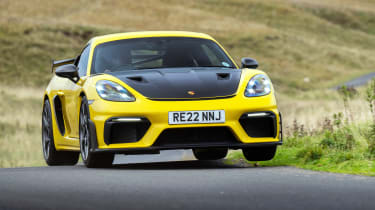
The chassis is a development of that already found in the fabulous 718 Cayman GT4 – our eCoty winner of 2019, don’t forget. It’s ball-jointed throughout, with its own specific spring and damper tuning, and combines torque vectoring (PTV) with a mechanical limited-slip differential on the rear axle. As with all GT cars, the set-up is highly adjustable.
The front brakes have grown by 10mm (to 390mm; 380mm at the rear), with carbon-ceramic discs (410mm front) available at extra cost. A Clubsport Pack – half cage, driver harnesses, extinguisher, etc – is a no-cost option. The expensive Weissach Pack is largely cosmetic (exposed carbonfibre for the bonnet, etc) but it does ‘allow’ customers the option of purchasing magnesium rims at £10,521 a set. The standard rims are shod with 245/35x20 (front) and 295/30x20 (rear) Michelin Pilot Sport Cup 2s (2 Rs are a further dealer option).
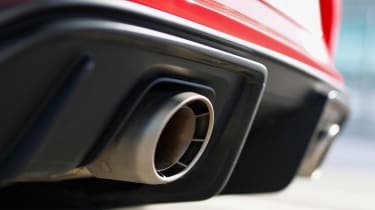
Weight-saving measures include front wings and bonnet made from carbonfibre, thinner glass for the rear window, plus less sound-deadening material and thinner carpets. The bottom line is that the RS is 35kg lighter than a PDK-equipped GT4, Porsche estimating that the weight saving is in the order of 60kg but negated in part by some of the beefier componentry. Aerodynamically, the front splitter is adjustable through four stages, and the swan-neck rear wing through three angles. With further tweaks underneath the car, Porsche claims up to 25 per cent more downforce compared with the GT4.
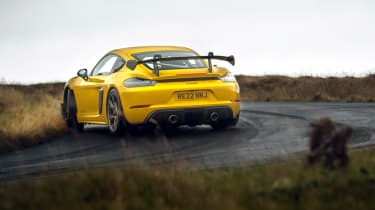
The ultimate Cayman is still slower around the Ring than a 992 GT3, essentially for three reasons: one, the width of the tyres’ contact patches is limited by the body of the 718 in spite of the front wings; two, the aero; and three, the 718 uses a mechanical limited-slip differential rather than the GT3’s electronically controlled diff because there isn’t room for the power pack the fancy unit requires.
But there’s also a more prosaic reason. While pitched as a ‘proper’ RS model like its 911-based bigger brother that’s due later this year, Preuninger argues that this particular RS moniker also stands for ‘Racing Fun’ (the German for fun is Spaß). A few seconds of pace on track has been sacrificed to make it a road car that entertains more of the time, on more roads. So it is claimed…
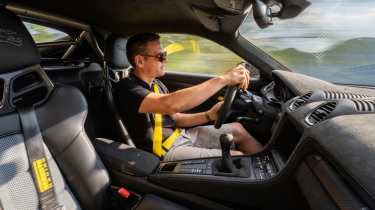
Out on the road, Porsche’s mastery of its PASM damping means that while it feels taut and stable, it’s rarely crashy or uncomfortable on smooth surfaces. What is immediately obvious is the sheer precision of this car: the steering really is quite beautiful, telling you absolutely everything you need to know but filtering out what you don’t. It’s a slightly more prescriptive approach than a McLaren with its hydraulically assisted rack, but no less enjoyable. Adjustments at the wheel can be little more than thought processes channelled into deft nudges on the suede-effect rim.
The outright level of grip is predictably very high, but it’s the balance of the car that really breeds confidence. As with all 718s, you can sense the engine is tucked up to the bulkhead right behind you, and mounted low, because the car has that pure mid-engined feel where it moves of-a-piece without any obvious inertia or weight to manage. Actually loosening the tyres’ grip in the dry takes some provocation, not because the engine is short on grunt, but because the RS wants to find drive.
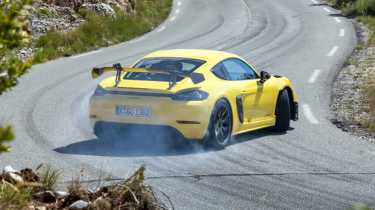
Obviously, it’s not like a BMW M4, where oversteer can be had with a mere flex of the right foot: in the RS it helps if you’re working up nearer the limits of grip already, or if you’ve given it some aggressive inputs to get it up on its toes. Then it really does want to move around, but it’s controllable all the same as long as you’re accurate with the inputs you make – and that’s made all the easier thanks to the sharpness of the throttle control. Brake feel is exemplary, and the sheer stopping power of the brakes is something that almost hurts when you really lean on them.
It's fair to say that after our fairytale first drive, evo has had a troubled, slightly confusing relationship with the GT4 RS. When we first drove it in the UK at eCoty 2022, our adoration of the RS was – quite literally – shattered by its ruthless, uncompromising and downright jarring feel over lumpen, craggy B-roads. A fifth place finish doesn't sound terrible, but given the enormous weight of expectation behind the Cayman, it was deeply disappointing.
We've since driven a later-build GT4 RS and the magic we felt when we first drove it appears to have returned. The ferocity and precision of the engine, gearbox and chassis melded with a firm but compliant ride quality that made pretty much any road – and not just newly-surfaced ones – a joy. Porsche hasn't officially confirmed whether the later car had a different suspension setup to the example we drove previously, but it certainly felt measured and fluid in a way that doesn't square with our impressions from eCoty, the conclusion of which you can read below. Put simply, it felt like the car we thought – and hoped – the GT4 RS would be. As for the noise? It'll still have your ears ringing to the sound of that flat-six after a long drive, whether you like it or not.
evo leaderboard track test
We brought the Porsche Cayman GT4 RS to Anglesey to put it to the test against the evo leaderboard stopwatch. Wearing Michelin Pilot Sport Cup 2 tyres, it posted an extraordinary 1:12.4 around the coastal circuit. That matches the Porsche 918 Spyder on Pirelli P Zero Corsas and falls only 0.3sec short of a 991.2 GT3 RS, also on Cup 2 tyres.
evo Car of the Year 2022 verdict – Peter Tomalin
Had there been a track element to this year’s eCoty, and had the road element been run on smooth German tarmac, the 4RS may well have finished higher. ‘On the right roads it’s a 99 per cent car,’ said Meaden. ‘Thrilling, brilliantly responsive, laser-guided and completely nuts. I loved its calm steering, and the pure, clean throttle response.’
However, on the wrong roads – that’s to say 75 per cent of the great driving roads you’re likely to encounter in the UK – it proved flawed at best, and sometimes truly miserable. The noise levels are a major issue if you wanted to drive a long distance – say from the UK to Spa or the Nürburgring – but the stiffness of the damping impacts the experience whenever you drive.
Vivian, still scarred by his five-hour motorway drive, said: ‘I did find a road smooth and twisty enough on which to exercise its best game: the extraordinary 5000 to 9000rpm rush and fury, blink-fast gearshifts and a chassis of sublime acuity and tenacity. But for most of the time its narrow focus and intensity are too much, severely limiting the amount of enjoyment it can give. A track toy, nothing more.’
Meaden said he’d still love to have one in his garage ‘more than any of the other cars here, but it’d have to be a second or probably third car, and I’d only use it when everything was in its favour.’ As Gallagher observed: ‘We’ve had some extreme road cars on eCoty in recent years, but this is up with the very wildest.’
Values and buying guide
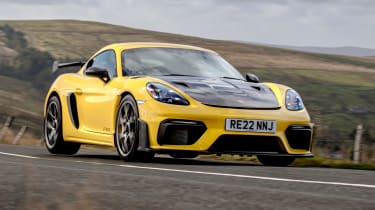
The Cayman GT4 RS was subject to plenty of price speculation on its release in 2022, with some of the first cars to reach the used market priced as high as £250,000. That bubble quickly deflated and now, four years on, prices have settled in the £120,000-£150,000 range. Prices will be higher for cars with desirable options, or rare colour specifications inside and out. For context, the list price of the GT4 RS on release was £108,000 but increased to over £120,000 before it was discontinued.
One key option that raised the list price by over £12,000 was the Weissach Pack, which itself then made the £10,000 magnesium wheels available to buy. Michelin Pilot Sport Cup 2 tyres were standard, with Cup 2 Rs an option. PCCB carbon ceramic brakes were also an option.
Porsche Cayman GT4 RSs are extraordinarily capable track cars and happily, many do see the kind of hard use they were designed for. This means diligent service history is essential.
Specs
| Engine | Flat-six, 3996cc |
|---|---|
| Power | 493bhp @ 8400rpm |
| Torque | 332lb ft @ 6750rpm |
| Weight | 1415kg (1460kg as tested) (354bhp/ton) |
| 0-62mph | 3.4sec |
| Top speed | 196mph |
| Price new | £108,370 |
| Value now | £120,000+ |